Memorie.al / She was sitting on her father’s lap, they were learning French, when they heard the door bang. They weren’t expecting anyone. It was an evening like any other, except with a warning. A day earlier, Zyhdi Herri had met Enver Hoxha. Enthusiastic as he was about it, he gave the news to his mother as soon as he entered the house. “He read all my writings, he told me he liked them very much,” he said. “Take care of yourself, my son!” his mother had replied – she, with the experience of years and none of the idealisms of youth, had heard a thing or two. “If he praises you, he’ll have your head.” Zyhdi didn’t listen! And what could possibly happen to him?! He did his job… and he had a close friend where he worked, at the newspaper “Bashkimi”, a friend he trusted. Everyone appreciated his writings and now, even he himself, “the greatest of the great”. Nothing to worry about – until the door knocked at an unusual hour…!
Who was it?
Midnight had passed and my sister and I were certainly asleep, but my mother told me later that they had been surprised. We lived in a large house, in separate entrances, together with my uncles, and when my mother opened the door, they all came out.
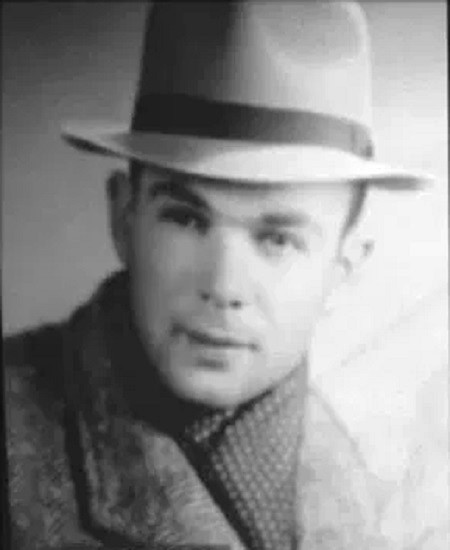
There were several men who first turned the house upside down and then took my father away. Mother said that he had said he would be back soon, nothing to worry about, because he hadn’t done anything, it was surely some misunderstanding.
What had happened that day?
They had thrown a grenade at the Soviet Embassy and more than 100 people had been arrested that night in Tirana. Nothing big, no one hurt, but Enver, to show Stalin his devotion, made it big.
Why your father?
Because my grandmother’s words came true. She had warned my father when he told her that he had met Enver Hoxha and that Enver had praised his writings. He worked at the newspaper “Bashkimi” as a journalist, at a time when the editor-in-chief was Thanas Nano. My father had known Enver since he was a student at the Liceum in Korçë – Enver had been his teacher. After the Liceum, since his father was in Siena, Italy, he went there for his higher studies.
He graduated in law, but decided to return to his homeland. My grandfather had told him it was a wrong idea, that it was uncertain how things would turn out here, but he didn’t listen to anyone – he came back. He was immediately appointed a journalist as soon as he returned. The communists had just come to power; it must have been ’45–’46. In ’47 he got married and then I was born.
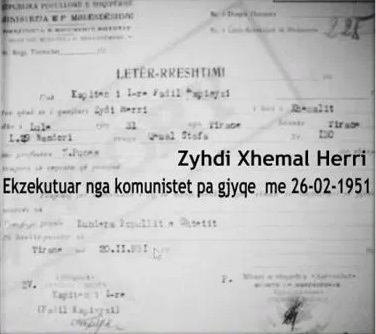
So when he was arrested, in 1951, I was only three and a half years old. He had taken off his wristwatch, kissed us and left.
What happened afterwards? Did he return?
No, never. Mother and my uncle looked for him everywhere in the following days, in all the prisons and interrogation offices, but they didn’t find him. Eventually we learned that they had taken him to the old prison, to “Mine Peza”.
In the adjacent cell he had met a man who would be released a few days later. He had asked him to bring us a letter. That was not possible, because no one would let you hold a letter, so the gentleman had read it and then eaten it. When he got out, he came to meet my mother and told her what had been written.
What had he written?
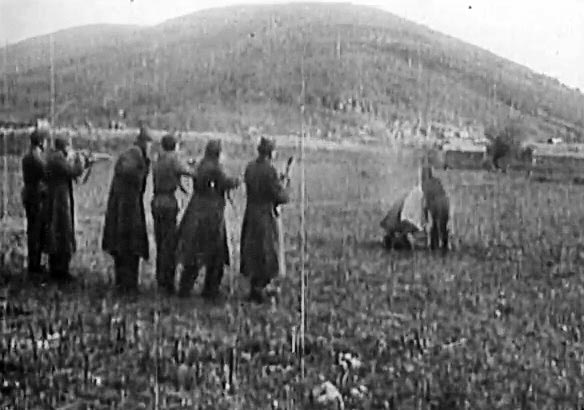
That my mother should remarry because she was very young, and that the two of us, me and my sister, should be raised by our uncles. Not even five days after the letter, the next news came: that he and 21 others had been executed by firing squad.
No one ever saw him again. Did you ever find out why he was chosen?
It worked the same way for all of Enver’s targets – those he thought would become somebody and would have influence in society. As soon as he smelled danger, he eliminated them. Many years later we found out that he had asked Thanas Nano if there was anyone from the editorial office to “remove”. He gave him my father’s name and that of Petro Konomi. The latter suffered the same fate.
What happened to you?
At first they assigned us to the Tepelena camp, but a cousin of my mother intervened with Kadri Hazbiu and they sent us to Vlorë, to the city. They put us on a truck, with 5 young brides, 15 children and an old woman. Also with us was the wife of Petro Konomi, pregnant and with another child aged 3.
One night they left us in the basement of the Internal Affairs Department, and the next day they terrorised us on the truck, driving us around Tirana in circles to cause fear not only in us but also in the people watching us. My uncle followed behind on a bicycle, crying. They took us to a coal warehouse that had neither windows nor anything – only a felt door, which they locked.
The women complained that the children would suffocate, but no one listened. So they opened a small gap with their fingernails, just enough to let in a little light and air. They left us there one night and then distributed us among some barracks.
You lived in Vlorë afterwards, all that time?
My mother and my sister did. My mother worked in construction; I remember that because she had nowhere to leave us, she would dig a hole at the work site and leave my sister and me there to play until she finished. My uncles kept visiting us, and after eight-year school, one of them adopted me. I came to Tirana and did my high school here, at “Sami Frashëri”.
Was that easy?
No, not at all. With many difficulties he managed to take me. They themselves were penalised – one was imprisoned twice, the other ended up as a labourer.
The remains of the group of 22 executed persons – that is why they were found after the ’90s…?
Yes, they were found. The villagers had also found a ring with two names and a date. They asked who it might belong to, and when I saw my father’s and mother’s name, I put it on my finger and have never taken it off. Sometimes people ask to see it and ask for it, but it does not leave my finger. At the same time we found out that exactly there, a little beyond the Beshir Bridge, they had opened a pit, which was guarded by police.
People were tied to each other with barbed wire and, just like that, they had thrown them into the pit to shoot them from above. Then they had left them like that and had the villagers cover them. A tractor driver, a very short time later, had caught a dress, and because he had stumbled upon the event, they made him disappear too. The villagers, among other things, tell of the scream of a woman. She was the only woman among 21 men – Sabiha Kasimati.
At the same time and for the same reason, another woman was also executed, Elisabeta Bast, a German…?
Actually, Elisabeta’s group was the one that had actually thrown the grenade at the Embassy. There were three people; they too were caught very quickly and shot.
Do you remember your father?
A little. I was very young, but I remember him a little. He loved foreign languages and would constantly take me on his lap to teach me French. I had started to learn a few words, but only that…! / Memorie.al