

By Visar Zhiti
Part thirteen
Memory Plates and Sacks…!
Continued from the previous issue
SOCIALIST REALISM
Memorie.al – Brought from outside, from the center of the communist empire, the new and only, supreme method was imposed on all arts and literature, placing itself in the service of the ideology and politics of the communist dictatorship, led in Albania by the teachings of the Party and Comrade Enver.
The method of Socialist Realism was indeed made compulsory throughout the communist empire, but not applicable equally in all countries, conditioned also by specific anthropologies and culturologies, by traditional education, by how harsh the dictatorship of each country was and the counter-pressure, but also by the last factor, which is the first but forgotten: the tastes of a people, how much it can stomach…!
Socialist realism is not the same as socialist reality, but what it is, is also helped by the ‘Encyclopedic Dictionary’, Tirana 1985, the only one the regime managed to publish:
“Socialist realism, the creative method of literary fiction and the arts, which was formed after the victory of the people’s revolution in Albania. S.R. selects, interprets and evaluates the facts and phenomena of life from the position of scientific realism…! Literature and the arts grew in struggle with the attempts of various enemies to hinder their progress… attempts that were crushed…”, etc., etc.
It seems as if you are reading the History of the Communist Party up to its Penal Code. A language of violence and meaningless enthusiasm for literature.
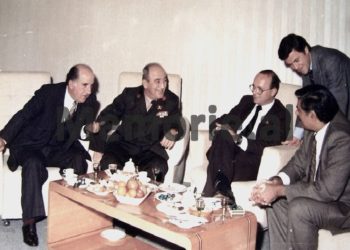
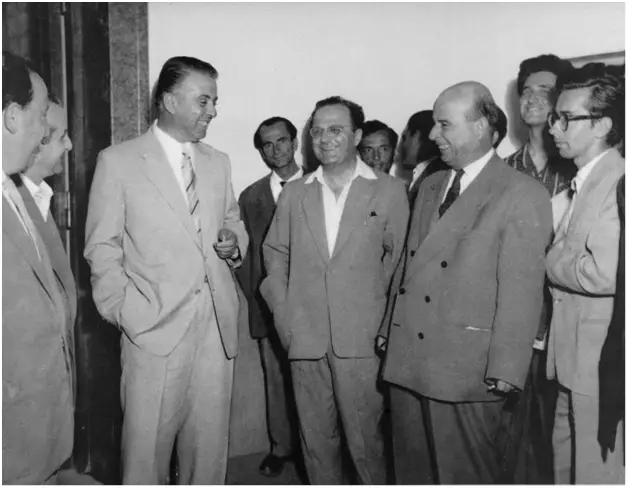
It could not be a coincidence that when the League of Albanian Writers and Artists was created, with members of its leadership together with Serbian generals – as photographs of that time prove – just as the Communist Party at its founding had Serbian leaders.
Why, a little later, would a part of that leadership be annihilated? Weren’t the generals needed anymore? Moreover, even the headquarters of the League had been the officers’ house, and it was transferred to the writers, officers of the Party’s word.
Typical socialist realism is found in the publications of Enver Hoxha, which they called works, in his memoirs – prolix and mediocre, full of distortions of historical and current truths, even inhuman for the hatred they sought to convey among Albanians and of Albanians towards the world – which were read to us compulsorily and in prisons as a continuation of physical torture into mental torture.
Literature had to follow that example.
And little Albania had to apply the new method just like in the great Soviet Union. Socialist in content and national in form. And the new man. All three difficult, not to say impossible, because there was no socialism, but dictatorship, and the national form had not crystallized – after all, it was also punishable – while the new man, where to find him, where to catch him, he didn’t exist…!
Our own Gorky was needed, and his novel “Mother” – the Albanian one. The first chairman of writers and artists had to be installed officially, and the first novel of socialist realism had to appear. Which would it be?
After several rejections and removals – after the leading partisan Sejfulla Malëshova, a professor of Marxism in Moscow, poet, translator, who was condemned; and after the other partisan Shefqet Musaraj, who used his pen as needed, like a rifle, who was told to step aside for health reasons – they arrived at Dhimitër Shuteriqi, chairman of the League of Writers and Artists of Albania.
He had left behind his all-French poetic experiments, very weak ones, which he thought he had made in his youth after studying in France, but like all partisans, he was not supposed to leave behind the rifle and grenades even in art. By now he was a politically engaged writer, hastening to produce – precisely in 1952 – the first novel of socialist realism, “The Liberators”; this honor fell to him. But he never wrote the second volume, because he couldn’t!
The renowned writer of the 1930s, Sterjo Spasse, would insist that his novel “They Were Not Alone” had been written earlier, while the embittered partisan Kasëm Trebeshina would explain nervously that the machinations of the Party leadership, the intrigues, prevented him, in order that Shuteriqi’s two-volume novel would inevitably see the light.
In fact, a year earlier, the novel of another partisan, “In the Wolf’s Mouth” by Kin Dushi, about the horrors he endured in the Nazi concentration camps in Prishtina, had been published.
With the partisans going over there to Kosovo, under the command of Shefqet Peçi, with the commissar Ramiz Alia, the local nationalists were persuaded to surrender their weapons. But when they saw that the compatriot forces were leaving and leaving them in the hands of the foreigner, they would step in front of the trucks shouting: “How you break your promise, we trusted you as brothers, don’t, you men, don’t leave us as hostages to the Serbs…!”
Let us return to literature. The novel of the new Albania could not possibly begin with the writer Kin Dushi, who would soon end up in prison.
Fatmir Gjata would publish his stories, dotted with blood, from the war as a partisan. And yet another partisan, Shefqet Musaraj, was writing his books about before and after dawn, with the somewhat journalistic style of “Zëri i popullit” (The People’s Voice).
And writers and new talents were being selected to be sent to the Soviet Union and other socialist countries for studies.
Profile of Drago Siliqi (1930–1963)
He would be one of those who would bring new critical thought, with the passion and courage of a poet.
He came down from the mountain as a partisan, not yet 14 years old, and a year later he publishes his first book. He goes to study literature in the Soviet Union, in Moscow, at the famous “Gorky” Institute. He returns to his homeland and becomes director of the only publishing house, “Naim Frashëri”.
Under him, the anthology of Russo-Soviet poetry would be published in 1959, and a year later he would bring out his poem: “New Song for Old Love”, etc.
With Drago Siliqi, new names and new works emerged. He opened the translation center with masters who came “from the past…”, but also from prisons. He would be the first support for authors the regime did not like. And he introduced the contemporary foreign novel: Hemingway, Remarque, etc…!
When returning from China, the plane he was on fell from Soviet airspace. It was the year 1963. The great split had occurred in the socialist camp. Albania had broken off relations with the Soviet Union and had become closely tied to China. On that plane there were also Albanian diplomats, but more importantly, Chinese scientists and researchers were flying. Did the plane crash, or was it shot down? This question remains unanswered to this day.
Meanwhile, new Albanian literature lost at a young age a poet, a pioneering critic, a courageous publisher. Meanwhile, this tragic act seems to provide me with a metaphor: that of the downing of poetic flights, when communism… doesn’t want them.
* * *
Meanwhile, our Gorky was not just one person; everyone was a little bit of Gorky. Likewise for Fadeyev. Like Mayakovsky after the revolution, breaking his verses in his enthusiastic poems, Lazar Siliqi.
The ruling trio of poets would be created: Ismail Kadare, Dritëro Agolli, and Fatos Arapi – the ranking of whom changed according to the political situation in the country and the party’s relations with their work.
Yesenin was not permitted, not quite; sometimes they would forgive Dritëro for it. The lyric poet Dhori Qirjazi had in his biography a father who had fled. Sholokhov could be Jakov Xoxa with his prolix novels, but the trilogy “The Dead River” was an achievement, a linguistic reality as well, which enriched the literary present. And it has a Kosovo character; he took it from the exiles…!
And important novels emerged: “The Last City” by Petro Marko and “The General of the Dead Army” by Ismail Kadare. And after the fall of the dictatorship, it could be debated with which of these two novels modern Albanian literature began. With the General…? Not with The City… because it was published three years earlier, in 1960.
But in the same year in Rome, the political asylum seeker, writer Ernest Koliqi, had published his novel “The Taste of Leavened Bread”, but he and his work were condemned, like all the literature of those who had fled.
But would there be dissident literature, should it be allowed? Well, just for show, on the outside…! Anyway, no, never! Until death – not their own, for they knew themselves to be immortal, but the death of opponents. The Soviet Union and its satellites betrayed the ideals of communism, according to Enver Hoxha.
In his own country, he would order that vigilance be increased even more, that excessive freedoms be reduced – freedoms that had always been lacking – only to work and cheer, that’s it, to close the country; the struggle for bread was a struggle for socialism, the famine of which was constantly felt. “In Albania there has been a lack of bread, but not poetry,” a foreign scholar, a renowned albanologist, would write.
“To live as if under siege” was the general order of every day, year, and decades…! “In one hand the pickaxe and in the other the rifle,” the Party instructed; later it added the book as well. “But where do we find a third hand?” the discontented would mock secretly. “Revolutionary art is made by revolutionary artists,” Comrade Enver taught.
And the output of new publications more and more often came to resemble the production of bricks for the walls that surrounded schools, factories, and cemeteries. “Yes, this is socialist realism,” the unsatisfied would insist.
Another wall was raised behind that wall, an insurmountable one, between official literature and what ought to be true literature.
And yet another wall, which let nothing pass, especially from the West, and especially from the East, and especially from the neighbors, who being close, were even more dangerous, but the regime rejoiced in the fact that there were other distinguishing geopolitical obstacles – the mountains that separated us from capitalist Greece as well as from the titist revisionism of Yugoslavia. Between them there were barbed wire with electric current and blood.
There was also that wall of waters that surged, the sea, and beyond it the other shore, Italy. A serious dividing wall was also poverty and mediocrity. They all seemed to help together to let nothing in from beyond, outside the visible and invisible borders. And what about science? “We want weapons, yes, as many as we can produce ourselves. A steel factory. Lay their foundations with prisoners.” And for culture?
And from the walls of bones and skulls that formed the separation from Hades, the prisoners were brought out for work. “Arbeit macht frei” (Work sets you free) was also written on the gates of Nazi camps.
Millions of condemned eyes saw that cynical slogan, in twisted iron. We were the condemned of the Cold War era; we looked at the closed gates and translated to ourselves in the forbidden English: “Work sets you free…” and we continued reading on the prison walls: “We condemn those who act badly, who speak badly, who think badly.” “The most dangerous enemy is the one who is forgotten.” By them, not by us; we were supposed to forget…
New paper factories / against papers
Just as before, with the help of the Soviet Union, machinery, weapons, and literature came, so afterward, with the People’s Republic of China, factories and armaments, the Cultural Revolution, but also some Asian epidemic.
The Chinese built three paper factories, in Shkodra, in Lezha, and in Lushnja. The leftover Soviet trucks, “Zis”, and the new ones copied from China, would soon unload into the courtyards of these factories: banned books, old literature – endless, especially religious, Catholics are dangerous – scientific and literary magazines from the golden years of the ’30s, newspapers, but also new publications from the literature of those countries that built the factories, declared as bourgeois-revisionist works. Works under their influence, and their authors and state publishers, were also punished.
Distribution was interrupted if there were stocks in warehouses; bookstores were notified; if any had reached anywhere, sales were suspended – why? The author had made an ideological mistake. Prison awaited him…!
Libraries received a new list of books that should not be lent for reading, but must be returned, and one or two copies were to be kept in the “black fund” only at the National Library in the capital.
At the paper factories, next to the “Zetors” with trailers full of straw, near the labor depots, the anti-library / anti-bookstore / anti-book trucks also waited in line. The banned goods were emptied into the jaws of the shredding machines. And the guard watched there on foot. The blades cut up a “Lahuta e Malcisë” (The Highland Lute)… there, “Hylli i dritës” (The Star of Light)… even Fishta’s bones, they clattered as they were thrown onto the stones of a river; the books of Ernest Koliqi, “The Shadow of the Mountains”, “Flag Merchant” – you can tell from the title that they were written by a fugitive – “The Bridge of Sighs”, a yellow book, with tuberculosis…! “The Abyss of Love”… into the abyss they threw the author as well, Greblleshi…! the magazine “Dituria” (Knowledge), we don’t need it, we have Marxism-Leninism;
“Njeriu” (The Human) – not this one, no, but the new man, etc. – the author of that despicable book to prison, he’s in prison… look, see, and the revisionist novel “The Tunnel”… who wrote it, into the tunnel…! “A Name at the Crossroads”… let it remain at the crossroads… throw it away; “The Red Freedom Grove”… you become with blood…! “Give me a name…”, we’ll give it, decadent, what else? We have endured enough.
When the guard turned his head the other way or left to smoke a cigarette, the worker who was throwing Albanian literature with a shovel into the mouth of the machine – to be turned back into paper, cardboard, cement sacks, oblivion – if there was no suspicious person nearby who might report, he could not resist taking a glance at the titles and names: they are foreign, Hemingway, Remarque, Sholokhov, Zweig; he leafed through them… he dared even to snatch a page or a small book, hiding it where he could, in his pocket, in his boots, in his bread bag.
I had read such books, snatched from the jaws of condemnation by the jaws of the dictatorship. The workers had given them to me. Yes, and some pages torn from the magazine “Nëntori” (November), poems – by whom? By me…!
That fire that had burned books in the Nazi era as in the Middle Ages seemed to continue differently, more refined. They were used to be made back into paper, just as enemies were used to work in prisons…! The more you condemn books, the more they condemn you too.
Chinese specialists also brought the H3N2 epidemic, the Hong Kong flu, and from the start in Tirana there were 300 deaths, according to Dr. Mentor Petrela. But no news in the media. Whereas for the epidemic of the Chinese Cultural Revolution, all of Albania was boiling.
The country closed down, became like a Kafkaesque fortress, for half a century everything that hindered the construction of a utopia was forcibly crushed, where the model of the “new man” was being experimented with – while man is always old and new continuously, human, sacred, and devil – it was whispered under one’s breath, while the slogan-order was to live like revolutionaries under siege.
Traditions and values in culture, down to ordinary human relations, were being destroyed one by one, while history was explained and viewed as a development of the class struggle – which, I repeat, is a civil war in peacetime, in my view – that is, a Doctrine of Hatred, forced to be practiced in life and in the arts of social realism.
Monuments to new heroes and martyrs, films about them, songs and celebrations. They would sing to communism – which could not be known how or whether it would come – with revolutionary violence necessarily, with poems and novels dedicated to the party and the dictator, without allowing one to actually engage with reality. Another reality had to be created, not the captivating one that art could bring, but as the party wanted, as its policies wanted: a kind of terrifying happiness without happiness, absurd and murderous, which had to be believed as the construction of a new life, always for a tomorrow that never came. Without a present.
And thus society deteriorated, becoming more brutal, uncivilized, so much so that it seemed to us that the spirit of early caves was entering our cramped apartments – indeed, the apartments had replaced those caves. While trompe l’oeiling its own collectivity, society absolutely did not lead a social life, but resembled violent, incriminating unions – work and insecurity – so much so that the state seemed to insist, foolishly believing that the worse it was, the stronger it would become. And it needed this appearance.
A humane state would feel weak, sentimental, losing, bourgeois-revisionist. So better no reasoning than reasoning; even escalating fury to get into others’ Kafkaesque machines, even by breaking those, to discover what they think – are they with the Party? Thus general violence for everyone and special violence taken to torture. An unseen zoology of feelings and relationships – together without selves; add to that work that impoverishes us even more; shackles to be freer; occasional revolutionary punishments as spectacles; deceitful books; stress; silenced mouths; flags; cheers; endless, despairing uniformity. / Memorie.al