From Arben Lalla
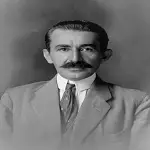
Memorie.al / On August 13, 1933, in the city of Thessaloniki, the former Prime Minister of Albania, Hasan Prishtina, was treacherously and brutally murdered. During my years of residence in Thessaloniki, in the archives of this city, I discovered an old newspaper that described the event of the assassination of the distinguished patriot Hasan Prishtina. In the newspaper “New Macedonia” dated 14.8.1933, a photograph of the deceased Prishtina and a photograph of the assassin, Ibrahim Çelo, were published. The newspaper of that time wrote about the life, activities, and property in Thessaloniki of Hasan Prishtina and brings us a true fact regarding the date of his murder, which to this day many Albanian historians who have dealt with his figure have gotten wrong, writing August 14, 1933, as the date of the murder, but according to the contemporary newspaper, the date is August 13, 1933.
Description of the assassination from the Greek newspaper of the time, “New Macedonia”
“New Macedonia” dated August 14, 1933, one day after the murder of Hasan Prishtina, wrote about the event that shook Thessaloniki on August 13, 1933. The newspaper of that time noted that Hasan Prishtina is the owner of the present-day building “The School for the Blind.” The newspaper of the time describes the tragic death of the patriot, the great politician Hasan Prishtina.
On the pages of the newspaper it was written: “Another murder that took place on Tsimiski Street shook Thessaloniki. The Albanian politician Hasan Prishtina was killed at the corner of Tsimiski and Vogatsikou, in front of the ‘IVI’ grocery store. The Albanian Ibrahim Çelo, 38 years old, unemployed, fired five times at the former Albanian prime minister Hasan bey Prishtina.
The murder was carried out at 2:00 PM on August 13, 1933. On Tsimiski Street, an elderly gentleman, well-preserved and with sympathetic features, was seen walking alongside and conversing with a well-dressed, lively person, whose tone of voice also betrayed him. They reached the intersection of Tsimiski-Vogatsikou streets and were heading toward the ‘IVI’ grocery store, just two steps away from the haberdashery of the invalid J. Janopullo.
The man with the grim appearance swiftly drew a revolver of the ‘SMITH’ brand and fired at his interlocutor, who was Hasan bey Prishtina, who fell onto the pavement. Passersby, gathered by the two shots, saw the assassin brutally and unspeakably throw himself upon the victim and fire three more bullets at him, two in the chest and the third in the head, as the fatal shot, to be sure of completing the act of murder. Immediately after his crime, the assassin, to escape the danger from the gathered crowd that set out to catch him, took off running down Vogatsikou Street.
From the shock, he fell into the window display of the ‘Beharnae’ shop, damaging its awning, but he recovered himself, rushing towards Paleon Patron Street, where he was surrounded by the crowd that was pursuing him with dark intentions. The assassin entered the residence of the doctor, Mr. Dukidhis, where he surrendered to the police guard.
But he could not escape the fury of the crowd. The passersby who followed him and the neighboring residents of every age and social class, without knowing his identity or the motives for the murder, indignant at the brutality shown by the assassin toward the victim, as soon as they saw the police squad arrive, rushed forward shouting: ‘Tear him apart, tear him apart, the murderer!’
While the policeman tried in vain to save the assailant, the mobs rushed at him and began to punch him, causing bruising on various parts of his body. They would have truly torn him in half if he had not managed to enter another house, on Paleon Patron Street, where he was sheltered by the owner of the house, who hastened to close the outer door to the enraged crowds.
Shortly after, the police secretary, non-commissioned officer Mr. Zografo, arrived, and the assassin was transferred by motorcycle to the Third Police Section. Hasan Prishtina, overcome by his wounds, was meanwhile sent to the General Hospital, where an autopsy was performed on his body. At 2:50 PM, Officer Sotiriu began the investigation with an interpreter, asking the assassin if he knew the Greek language; he replied that he knew Albanian, French, and Turkish.
The assassin on Hasan Prishtina
The assassin emphasized that his act was dedicated to political motives. Meanwhile, he claimed that the former prime minister of his homeland was a komit (guerrilla insurgent) and collaborated with the Bulgarian-Macedonian committee with the aim of killing the King of Albania, Ahmet Zogu. The assassin says that Hasan Prishtina told him these plans fifteen days earlier, when they were coming from Vienna (Austria), and pressured him to become the leader of the komit band and go to Tirana to kill King Ahmet Zogu.
Prishtina, continues the assassin, promised me a monthly reward and a bonus reward after the act of murder, but I opposed these proposals of his, because I am pro-regime of King Ahmet Zogu and did not wish to become a tool of Hasan Prishtina, whom they call a traitor in Albania. Ibrahim Çelo lived in Nice, France, and was a fruit merchant; he was married to a Spanish woman, with whom he also had children.
There, a few years earlier, he had met Hasan Prishtina, who had moved to Nice for relaxation, and they had established family ties. During their acquaintance, Hasan Prishtina had told him about his youth, the difficulties he had gone through after leaving Albania for Turkey and Bulgaria. In Turkey, he had found old friends and fellow fighters against the Young Turks. He participated in a secret association with his compatriots for the Albanian cause.”
A commemorative demonstration was held in front of Hasan Prishtina’s house in Thessaloniki on the 80th anniversary of his murder. Afterwards, bouquets of fresh flowers were placed at the site where the assassination attempt took place. Today, Prishtina’s house functions as a school for the blind.
After 80 years, Hasan Prishtina was commemorated at the site where he was killed, in Thessaloniki
Bouquets of fresh flowers, after 80 years, were placed at the site where, on August 13, 1933, Hasan Prishtina was treacherously murdered. The 80th anniversary of the assassination of the patriot was marked for the first time in Thessaloniki, at the very place where the hero was killed. The Association of Albanian Historians of Macedonia, assisted also by Mehmet Prishtina, a descendant of Hasan Prishtina’s family, organized a commemorative demonstration on the occasion of the 80th anniversary of the assassination of the patriot Hasan Prishtina.
“The commemorative demonstration is organized in front of Hasan Prishtina’s house in Thessaloniki. The aim is to commemorate the great figure of our nation at the site of the event,” said the chairman of the Association of Historians, Skënder Hasani, to “Lajm.” Present at the demonstration will be leaders of the University of Pristina, ‘Hasan Prishtina,’ leaders of the State University of Tetovo, leaders of the Institute of Cultural and Spiritual Heritage of Albanians, representatives of the Albanian lobby in the world who have come to their homeland for vacation, representatives of the historians’ association, etc.
An invitation was also sent to the historian Llalla, since, as is known, all the information is based on the materials he himself provided about Hasan Prishtina, including the death photo, but he finds it impossible to be present at this commemorative event in Thessaloniki. Hasan bey Prishtina was one of the most prominent personalities and figures of our National Movement. This distinguished ideologue and tireless leader of the general uprising for the independence of the Albanian lands gave all his wealth for the Albanian national cause.
It can freely be said that his military activity during the months of May-August 1912 prepared the raising of the Flag in Vlorë. Hasan Prishtina was born in 1873 in Vushtrri, but his family was from the region of Drenica, Polaci (now Hasan Prishtina). Hasan Prishtina’s real surname was Berisha, but with the departure of his grandfather Haxhi Ali Berisha, from Polaci to Vushtrri, he changed his surname from Berisha to Polaci. After his election as a deputy in the Turkish Popular Assembly (1908-1912), he changed his surname again, but this time from Polaci to Prishtina, and thus he became known as Hasan bey Prishtina.
He completed his political-legal studies in Istanbul. The chauvinism of the Young Turks against Albanians and Albania incited hatred among the Albanian deputies, members of the Turkish Popular Assembly, who undertook a secret meeting to start the Uprising (1909-1912) in Albania. Esat Pasha Toptani took charge of the region of Central Albania and the Mirdita region; Myfti Bey, Azis Pasha, and Syrja Bey took charge of the region of Toskëria. Ismail bey Qemali set out for Europe to collect funds and weapons for the uprising. Hasan bey Prishtina took charge of organizing the uprising in Kosovo, together with Bajram Curri and Isa Boletini.”
Hasan Prishtina, Minister of the National Government of Vlorë
On November 28, 1912, he participates in the declaration of Independence of a diminished Albania. In 1913, he was entrusted with the duty of minister of the National Government of Vlorë. Hasan Prishtina was the director of the daily “ZUKRE” (‘Aphrodite’) which was published in 1911. Due to the extraordinary circumstances, within two years the newspaper changed its name about 20 times, producing 412 issues. And the director’s name was mistakenly written as; “Pessembe Mebusu Hasan” (the Thursday deputy). In 1914, when Prince Wied came to govern Albania, Hasan Prishtina was elected Minister of Public Works in the Durrës government.
In 1918, Hasan Prishtina, Kadri Prishtina (Hoxhë Kadriu), Bajram Curri, and many others formed the “National Defense of Kosovo” Committee with their representatives in Rome and in the mother state Albania, while in December 1919 the Committee appointed him as the head of its delegation to the Paris Peace Conference, where he demanded the unification of Kosovo with Albania. He participated in the preparation and organization of the Congress of Lushnja (1920) and in April 1921 was elected deputy for Dibra in the Albanian parliament.
He distinguished himself as a fighter for the protection of the “neutral zone” of Junik from Serbian and Zogist forces, as a leader of the National Liberation Movement of Kosovo against Serbian rule. On December 7, 1921, Hasan Prishtina was elected Prime Minister and Foreign Minister by the Albanian Popular Assembly, but on December 10, 1921, he resigned after objections from several deputies led by Ahmet Zogu. Thus, to avoid bloodshed among Albanians, Prishtina remained only a deputy of that Assembly.
With the establishment of relations between Albania and the Kingdom of Serbs, Croats, and Slovenes in 1922, the Government of Ahmet Zogu and Xhafer Ypi revoked the parliamentary rights of Hasan Prishtina, Bajram Curri, Hoxhë Kadriu, and many other leaders from Kosovo in the Albanian Popular Assembly, and began the persecution for their elimination. This was the agreement made by Prime Minister Ahmet Zogu with the Foreign Minister of the Kingdom of Yugoslavia, Mr. Ninçiç, in 1922.
In January 1922, the Tirana government reached an agreement allowing the Serbian army to pursue Hasan Prishtina and other Kosovar leaders even within the territory of the Albanian state. At the end of February 1923, Hasan Prishtina and Bajram Curri rose up against the Serbian regime in Kosovo. This uprising was suppressed because the government of Ahmet Zogu did not support them. After this, 3,500 Kosovar Albanians were expelled from their homelands to Turkey./ Memorie.al