

The Enigma of the Novel “Betrayal”
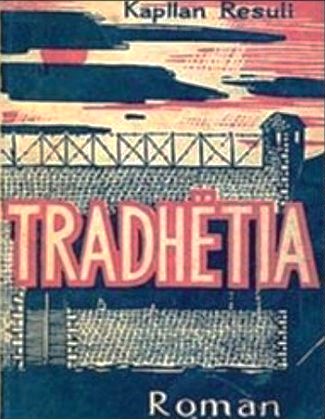
Memorie.al / In the history of Albanian letters in Kosovo and Macedonia, we often encounter works that, besides carrying artistic value, also bear dark shadows of enigmas, which are not simply related to art, but to the mechanisms of power and secret services. One among them is the novel “Betrayal” (Tradhtia), which since its publication has raised many questions: who is the true author of this work? Is Kapllan Resuli the “original writer or just a figure used by the UDB apparatus to steal and instrumentalize a manuscript that did not belong to him, but which was linked to certain agentive combinations according to the secret plans of the UDB, while Kapllani was in the prison of “Idrizova” near Skopje?
In the memory of many contemporaries, Kapllan Resuli was rumored to be a man linked to Yugoslav secret networks, a devout informer of the UDB, who reported on Albanian intellectual movements and national activities. This suspicious connection, reinforced by the sudden manner in which he appeared on the literary scene, has raised the suspicion that the novel “Betrayal” is not the fruit of his own thought, experience, and literary style, but the result of a well-organized robbery.
The fundamental question remains: who was the silent author? Was he an imprisoned Albanian intellectual, a fugitive, or a voice extinguished by repression? The UDB knew how to use such methods: manuscripts confiscated during arrests, texts obtained during interrogations, or even creations that were disregarded, in order to present them under a fabricated name, manipulating the reader and appropriating the spirit of a true author.
“Betrayal” as a novel is not simply a literary work; it is also a suspicious historical document. The way it is written, the themes it touches upon, and the ideological vision it conveys do not always match the intellectual level of Kapllan Resuli, who was not previously known as an established author. This contrast between the “work” and the “authorship” is one of the strongest arguments that raise the suspicion that we are dealing with manipulation.
Thus, the novel remains an open enigma, a “case” to be researched not only by literary critics but also by historians of secret services. Whether “Betrayal” is a testimony to a painful Albanian reality, or a fabricated montage by a foreign service, this is the question that still awaits an answer. And as long as the silence continues, the shadow of betrayal will weigh not only upon a name, but upon our very cultural memory.
Literary analysis – traces of an invisible author
The novel “Betrayal,” if read carefully, carries an internal tension that makes you doubt its declared authorship. The text displays a refined style, with a narrative flow that does not match the experience and literary profile of Kapllan Resuli. The structures of the work, the use of symbols, the way moral and political conflicts are treated, as well as the language with deep philosophical nuances, resemble more an author with broad humanistic culture, perhaps someone who personally suffered the weight of persecution and political intrigue.
In fact, it is unusual for an unknown writer to suddenly emerge with such a complex work, without any prior creative trace that would testify to his gradual development. This aligns with the hypothesis that the novel may be a foreign manuscript, confiscated or stolen, and then published under another name.
Historical-political analysis – the UDB and the practice of manuscript theft
The history of Albanians under Yugoslavia after 1948 is filled with painful cases where the UDB and the KOS (Counterintelligence Service) were not limited to physical persecution, imprisonment, and liquidations, but also to cultural manipulations. In prisons, during interrogations, they often confiscated manuscripts of Albanian poets, writers, and intellectuals. Many of these works disappeared without a trace, while others, according to testimonies, were used for propaganda purposes – being published under the names of individuals who served as their collaborators.
Kapllan Resuli, for whom there is evidence and rumors that he was part of the UDB’s information network, emerges as a typical figure of this mechanism,. He benefited from secret institutional support to come forward as an “author,” while in fact he may have been merely the bearer of a false name on a stolen manuscript. This also explains his strange rise in the literary world, a rise that was not based on proven talent, but on the game of secret services.
The open enigma – between art and manipulation
Thus, the novel “Betrayal” remains a double testament: on the one hand, as a literary work that deals with the pain of a turbulent time and the dilemmas of betrayal, on the other hand, as a document of political and cultural manipulation. Was it the fruit of a true Albanian author, who was silenced and disappeared from history, or was it the product of a cold UDB scenario to test the influence of literature on Albanian public opinion?
The questions remain open, as do the shadows that weigh upon the very title of the novel: “Betrayal.” Perhaps one day, with the opening of archives and new testimonies, the silent author of this work will be revealed. But until then, the enigma remains alive – and with it, the bitter memory of a time when even literature became a weapon and prey of espionage. Because all that I am writing is a topic with great historical and literary weight, related not only to the fate of a literary work such as the novel BETRAYAL, but also to the enigma of the relations of Albanian intellectuals with the Yugoslav UDB in the post-war period, as was the case of Kapllan Resulbegović and many others like him.
Confiscated manuscripts – literature as prey of secret services
In post-World War II Yugoslavia, Albanians were under strict political and police surveillance. Any different thought, any line of poetry or narrative containing national spirit was considered a threat. The prisons of Niš, Idrizova, Goli Otok, and Zenica were not only places of physical torture, but also “secret archives,” where voices were extinguished and manuscripts disappeared.
Many Albanian intellectuals entered dark cells with manuscripts in their pockets or with written memories, but they were confiscated during interrogations. There is no shortage of testimonies that some of these texts were not destroyed, but ended up in the hands of special sectors of the UDB, who selected them and used them according to political interest.
This dark practice raised the suspicion that even the novel “Betrayal” might be the fruit of such a manuscript, taken from an imprisoned or persecuted author, and then published under a controlled name. The secret services were not limited to confiscating manuscripts. They needed “reliable figures” to carry the stolen authorship on their backs. Thus, collaborators and informants came into play, people who, for a privilege, a small protection, or a quick career, agreed to become tools of the apparatus.
The informant, in this case, needed no talent. He only had to be obedient and dependent on the system. The foreign manuscript was placed in his hands, he appeared as a “writer,” received public attention, but in fact performed a dual role: he hid the true author and served as an extension of official propaganda.
Kapllan Resuli – a suspicious figure in the UDB labyrinth
The name of Kapllan Resuli is precisely linked to this practice. For many contemporaries, he was more a man of the services than a man of letters. The information circulating in intellectual circles speaks of his ties to the UDB and the fact that he reported on comrades, on young writers, and on any suspicious political movement. His sudden emergence with the novel “Betrayal” is incomprehensible for such a profile. Without a creative past, without a visible process of literary development, he immediately appears with an important work, allegedly written by him. This contrast reinforces the suspicion that Resuli was not the author, but merely the “name-bearer” for a foreign manuscript taken under UDB control.
If this assumption is true, then we are dealing with a flagrant case of cultural manipulation, where an Albanian work was appropriated, deformed, and dressed with a name that served the repressive apparatus. The greatest irony is the very title of the work: “Betrayal.” If the novel is indeed stolen, then we have a double betrayal: betrayal of the silent author, from whom the word and identity were taken, and betrayal of Albanian culture, which was used as an experimental field by secret services.
Thus, the novel does not remain merely a literary text, but turns into a document of manipulation and hidden violence. In it, art, politics, and espionage are intertwined in an enigmatic knot, where every page is a question: who is the true author? To this day, the UDB archives are not fully open. Many documents remain closed, many confiscated manuscripts perhaps still rest in the dark drawers of the services. Only their opening and the testimonies of survivors can reveal the true author of “Betrayal.” But until that happens, the novel will remain a living mystery. A bitter reminder of how, in the time of the UDB, even literature became a victim of betrayal.
A group of sources from recent years (dossier-books, investigative articles, public testimonies) claim that the true author of the novel “Betrayal” is Haki Limani, while Kapllan Resuli/Resulbegović (a name used synonymously in these publications) only appropriated the authorship to himself, aided by UDB networks. These claims are not unanimously accepted: there are also writings that treat Resuli as the author of the novel. The debate over authorship remains open, but is now accompanied by more published evidence, which is summarized below.
In socialist Yugoslavia, especially against Albanian activists, political arrests, persecutions, and confiscation of materials (manuscripts, statutes, programs, and notes) were documented. Exhibitions and files on Adem Demaçi and the LRSBH (League of Revolutionary Students of Bosnia and Herzegovina) include lists of items confiscated during raids (official records, writings, and manuscripts). These are indicators that literary/political documents often ended up in the hands of the UDB.
The broader Balkan context: Testimonies of former prisoners and studies on prison literature in the region and in Albania speak of confiscations, losses, or burning of notebooks and texts of imprisoned authors — demonstrating how easily creativity disappeared or was recirculated under repressive regimes. Although this literature focuses more on Albania, it helps to understand the “ecology of risk” for manuscripts in the Albanian space during the 1950s–1980s.
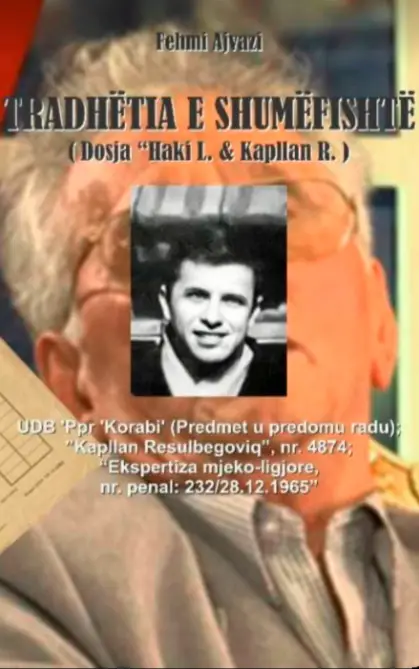
A line of articles and a dossier-book by Fehmi Ajvazi (The Multiple Betrayal, 2023) claim that Haki Limani is the author of “Betrayal,” while Kapllan Resuli/Resulbegović appropriated the novel and published it under his own name, in coordination with (or by benefiting from) UDB networks. These sources also mention Resuli’s connections with security apparatuses, which would have favored the “cover-up” of authorship…!
There are also voices that relativize Ajvazi’s dossier, calling for stronger evidentiary standards (e.g., the complete chain of the manuscript, philological comparison, graphological expertise). Thus, the debate on the probative force continues. Some Albanian journalistic writings present Resuli’s “escape” and literary ascent as a project of the “UDB kitchens” in Skopje with connections in Belgrade (an accusatory approach, not archival documentation). These remain public claims that need to be placed alongside more verifiable sources. There exists a corpus of published accusations that link Resuli to security networks and to the appropriation of “Betrayal.” There are also methodological objections that seek stronger step-by-step evidence.
Kapllan Resulbegović (Resuli) – profile of a suspicious figure (according to sources)
Documentary sources from Memorie.al present investigative processes, testimonies of contemporaries, and citations about Resuli during his stay in Albania (e.g., his claims about publishing “writings with a UDB orientation” in the press). These materials reflect the climate of suspicion and surveillance surrounding him in Albania, but they do not themselves prove the theft of authorship.
Some authors (Avni Dehari, Fehmi Ajvazi) and cultural and news media cite documents, family testimonies, and contemporary accounts to support the thesis that Haki Limani wrote “Betrayal” and that his manuscript reached Resuli through dark channels. According to them, this “deconstruction” comes after ~59 years from the events and is based on the dossier-book The Multiple Betrayal.
Today we have many voices and documents that strongly push the thesis “Haki Limani – author of Betrayal; Resuli – appropriator supported by UDB networks,” but we also have texts that take Resuli’s authorship for granted. Without a material link (original manuscript + scientific expertise + archival document directly connecting the manuscript to Limani), the case remains open — although the balance of new sources tips the scales towards the Limani thesis.
Since its publication, the novel “Betrayal” has been accompanied by doubts about its true authorship. A group of researchers and publicists claim that its author is Haki Limani, while Kapllan Resuli/ Resulbegović appropriated it, with the blessing or support of the Yugoslav secret services. On the other hand, a part of Albanian letters has recognized Resuli as the genuine author. This dossier collects the facts, testimonies, and counter-arguments surrounding this enigma.
After 1948, Albanians in Yugoslavia found themselves under a repressive regime that targeted not only political activity but also cultural creativity. The prisons of Niš, Zenica, Idrizova, and Goli Otok became places where many manuscripts were confiscated and disappeared. The case of Adem Demaçi, where documents, writings, and manuscripts were confiscated along with his arrest, is an illustrative example of the UDB’s constant practice. This makes plausible the hypothesis that a novel like “Betrayal” may have passed from the hands of an imprisoned author to the secret apparatus of the services.
Besides confiscation, the UDB also used another mechanism: collaborators. They often appeared as “writers” without being so, bearing names on foreign manuscripts. Thus, regime propaganda obtained a ready-made work, while the true author remained in silence or in prison.
According to the book “The Multiple Betrayal” by Fehmi Ajvazi, the novel belongs to Haki Limani, while Kapllan Resuli merely appropriated it, supported by UDB networks. Publicist Avni Dehari and some cultural portals have supported this narrative. However, critical scholars warn of a lack of incontrovertible evidence (original manuscripts, philological expertise).
Skopje – Belgrade: the shadow relationship
Yugoslav archives still keep many files closed. Some of the accounts about Resuli link him to the services in Skopje and Belgrade, portraying him as a figure loyal to the apparatus. This repressive context, where Albanians were often accused, convicted, and lost manuscripts, makes the thesis of appropriation plausible – even if it does not prove it definitively.
The novel “Betrayal” is more than a literary text: it is a political and cultural enigma. There is sufficient evidence to raise the suspicion that its author may be Haki Limani, and that Kapllan Resuli/Resulbegović benefited from the UDB apparatus to publish it in his own name. But incontrovertible material evidence is still lacking. Until then, “Betrayal” remains a symbol of “multiple betrayal”: towards the author, towards culture, and towards the truth. / Memorie.al