By Prof. Dr. Alfred Frashëri
Part Two
– Without bread and without oil, there is no independence and progress for the Homeland! –
Memorie.al / Life, activity and the events within it are preserved in our memory and reawaken over the years, to remind us how we lived and worked, how we behaved in society and family, our achievements, our mistakes, but above all, the people, comrades and friends with whom we shared joys and sorrows on our life’s journey. In my life, work in the oil fields began in September 1953, when I received my appointment as “Electrical Technician at the Drilling Enterprise, Patos”, signed by minister Shefqet Peçi, and continued in various institutions and roles related to oil exploration until the end of the 1980s. Now that we are on the threshold of the 100th anniversary of the discovery of oil in Albania, I remember with respect the people who with devotion, enthusiasm and sacrifice worked in the 1950s at the Patos oil field, among whom I also worked. I felt a spiritual need to tell about them and the great work they did. This anniversary stirred my memory and gave me the desire to take up my pen and write my memories, to express the feelings I had and have for those years.
Continued from the previous issue
The training of oil specialists was considered very important even in those years. In 1951, the first group of technicians in the field of geology and oil – as it was called in those years, the “overloaded mineral class” – finished their studies at the “7 Nëntori” Polytechnic. Many of the young technicians went to Patos and Kuçovë: Abedin Xhomo, Adem Cani (Nurja), Anesti Spiro (Qirinxhi), Asti Papa, Dhimitër Paparisto, Hasan Hamza, Hysen Uzuni, Muharrem Seseri, Niko Goxhobashi, Petraq Xhaçka, Pirro Tasellari, Protoko Murati, Skënder Guranjaku, Tomi Kristo and the only girl technician, Veronika Todri (Meko). I remember some verses of a song they sang when they set out to the field for practice: ……/ “Our mineral class / has a future”! This first generation of oil technicians were taught and instilled with love for the profession by the passionate teacher, Marko Manahem.
I also remember another song about the youth of the Polytechnic, composed by our friend Agim Mero, which all of us students sang willingly and with inspiration every day at 7:45 am, before entering class, lined up in front of the school. Among other things, the song’s lyrics said: “We are the sons of the Polytechnic / for whom a bright future awaits /…” The students of this class became in 1951 the first Albanian oil technicians, whom I met at the Polytechnic, befriended in Patos, and have kept this friendship as a precious thing for these 66 years that have passed since those times. Therefore it was a great pleasure for me to meet the first Albanian female geologist, Veronika Todri (Meko), to talk and remember Patos of the 1950s, the people and the work done. She told me about the first practical training that the students of this class did in the drilling wells at the oil fields in 1950.
After a month of practice, the students returned to school and each prepared a course project under the direction of teacher Marko Manahem. After finishing their third-year exams, at the request of the Ministry of Industry, several students were sent during the summer holidays to work in the Geological Oil Expedition, led by the renowned doctor of geological sciences, Zinaida Andrejevna Mishunina. This group included Asti Papa in Patos, Veronika Todri (Meko) on the team of Russian geologist D.M. Manujlenko, who was conducting geological surveying by routes in the coastal area, Piro Tasellari with geologist Romanov, who was surveying the Selenicë area, as well as Skënder Guranjaku, who worked on the drilling team. Alongside these students, three Albanian students studying at the “Gubkin” Oil Institute in Moscow also came to the expedition: Ziver Meko, from the petroleum geology department, who worked with Z.A. Mishunina’s team, as well as Teki Biçoku and Hasan Topçiu, from the geophysics department, who worked with the seismic team in Fier.
In September, the students of the “mineral class” returned to the Polytechnic and continued their fourth year. The diploma projects, due to the strict maintenance of geological state secrecy, were drafted in Kuçovë under the direction of Soviet oil engineers, where their defence also took place. Moreover, unfortunately, their teacher Marko Manahem was not allowed to go to “Stalin City” and be on the commission for the diploma defence. They prepared their diploma projects very well and defended them with praise. The future technicians were divided into three groups: geologists: Adem Cani (Nurja), Asti Papa, Petraq Xhaçka, Skënder Guranjaku, Veronika Todri (Meko); for drilling: Anesti Spiro (Qirinxhi), Dhimitër Paparisto, Muharrem Seseri, Protoko Murataj, Tomi Kristo; and for oil production: Abedin Xhomo, Hasan Hamza, Hysen Uzuni, Piro Tasellari and Niko Goxhobashi. They began work as mid-level technicians in the oil fields in August 1951.
The geology department was opened at the Polytechnic Institute of Tirana in 1951, and the first geological engineers began to be trained. In the decade 1950-1960, from the benches of the Geological Department of the Polytechnic Institute of Tirana, the following geologists went into the oil industry: Hazbi Shehu (1957); Jorgo Kola and Sezai Hoxha (1958); Asti Papa, Hidai Haxhi, Mynyr Arapi, Viron Papingji, Vllash Janopulli (1959); Dhimtër Gjenerali, Reshat Myftari, Sabaudin Starova, Tomi Kristo, Viron Cane (1960). In 1962, the department of petroleum engineers for well drilling and oil and gas extraction was opened, as well as the department of petroleum geologists, within the Faculty of Geology and Mining at the University of Tirana.
From this Faculty, over the years, 345 petroleum geologists and 1,074 petroleum engineers (drilling and production) have been trained, respectively: 20 geologists and 189 petroleum engineers (1961-1970); 116 and 171 (1971-1980); 142 and 387 (1981-1990); 67 and 259 (1991-2000); only petroleum engineers, 68 (2001-2010); geophysicists, 65 (1961-1978); in the period 1973-2009, 106 geophysicists were also trained, many of whom worked in the oil industry.
An important event for the oil industry was also the opening of the Oil Technical School in Kuçovë, with director Gani Qemo, whom I knew as a distinguished teacher at the “7 Nëntori” Polytechnic in 1949 and later when I worked in oil, therefore I retain the greatest respect for him. Instruction at the Technical School was given by the best engineers that the oil industry had at that time. In 1954, the first generation finished their studies and graduated as Geological and Drilling Technicians, who immediately went to the fields of the Patos and Kuçovë enterprises. Among them over the years were: Haxhi Qalliu, Gjergji Foto, Filip Strakosha, Kastriot Muskaj, Koli Mone, Leonidha Marku, Luftulla Peza, Mihallaq Xheka, Pertef Nishani, Rushan Liço, Sezai Hoxha (Kuçi), Simon Ranxha, Simon Poreçi, Tasi Rrapi, Thoma Kerenxhi, Vasil Nasi, Vangjel Ndrio, etc. Many of them worked in Marinëz, during its discovery and later during its exploitation. Most of the oil technicians studied and graduated as petroleum and gas geologists, for drilling and well exploitation. And after graduation, they returned again to the oil industry and fields.
The activation of such a large number of geological and petroleum engineers, together with the technicians trained by the “7 Nëntori” Polytechnic and later by the Oil Technical School in Kuçovë, brought an extraordinarily great contribution to the discovery of new oil and gas fields, their exploitation, as well as the progress of the Albanian oil industry itself. The Patos Drilling Enterprise was led by Sinan Xhemili, Prokop Murra (as Plenipotentiary after him) and Polikron Cane (from 1952 and throughout the 1950s), and later by engineer Ramadan Perhati, Pandeli Qyrana (Deputy Director, 1952), Piro Bozdo (Chief Engineer, 1952), replaced by engineer Ramadan Perhati after his transfer to the Faculty of Geology and Mining; chief accountant Theodhori Jani (brother of the geological engineer Perikli Jani); the technical supervisor of the drilling branch was technician Anesti Spiro (Qirinxhi) (1951 – autumn 1953), until he was transferred to the General Directorate in Kuçovë with the duty of engineer in the Production Directorate within the Combine Directorate (1953-1955, when he went abroad for higher studies); its administrative supervisor was master Pjetër Leka (1950).
Drilling of wells was directed by the Soviet advisor Surkov, a Romanian engineer Valentin Shtuka (1953-1954) and technician Ciprian (1951-1952); the first Albanian engineers trained abroad, who came to the field in 1952 and later: Perikli Trebicka (1952–) for derrick mechanics; for well drilling, Ibrahim Meçule (1952–), Ramadan Perhati (1955), Bekim Sinoimeri (1956–); as well as among the first oil technicians trained at the “7 Nëntori” Polytechnic who came to the field in 1951, among whom stood out Tomi Kristo (1951-1955 when he began higher studies), who with great competence carried out the technical direction of deep drilling, such as “Ardenica 2” and “Ardenica 3”, etc.; Dhimitër Paparisto (1951-1953), who worked as a drilling technician until he was transferred to the General Directorate of the Combine in Kučovë as a norms referent in the planning branch (1953-1954 when he left to perform military service); Haxhi Qalliu, Muharrem Seseri, who in 1953 was transferred to the General Directorate of the Combine, Protoko Murataj, Skënder Guranjaku, for shallow wells carried out in the Selenicë area; the distinguished drilling master, Sotir Skorovoti (1950–); masters of breakdowns: Pandeli Sofroni, Koli Mone, etc.
Among the well supervisors, for their responsible work, technical knowledge and courtesy, the following remain in my memory: Kapllan Hajdari and Petro Olldashi – “Heroes of Socialist Labour”, Belul Hatibi, Qemal Mahmuti, Sali Alushi, Zaho Cane, etc. In the Patos Workshop, two Polish mechanics also worked, repairing derrick engines. All of them worked with devotion and great responsibility. While writing these lines, I remembered a couplet they sang to Pandi Qyrana: “Cry, oh Pandi Qyrana, cry / will you bring out water, or will you bring out oil”?
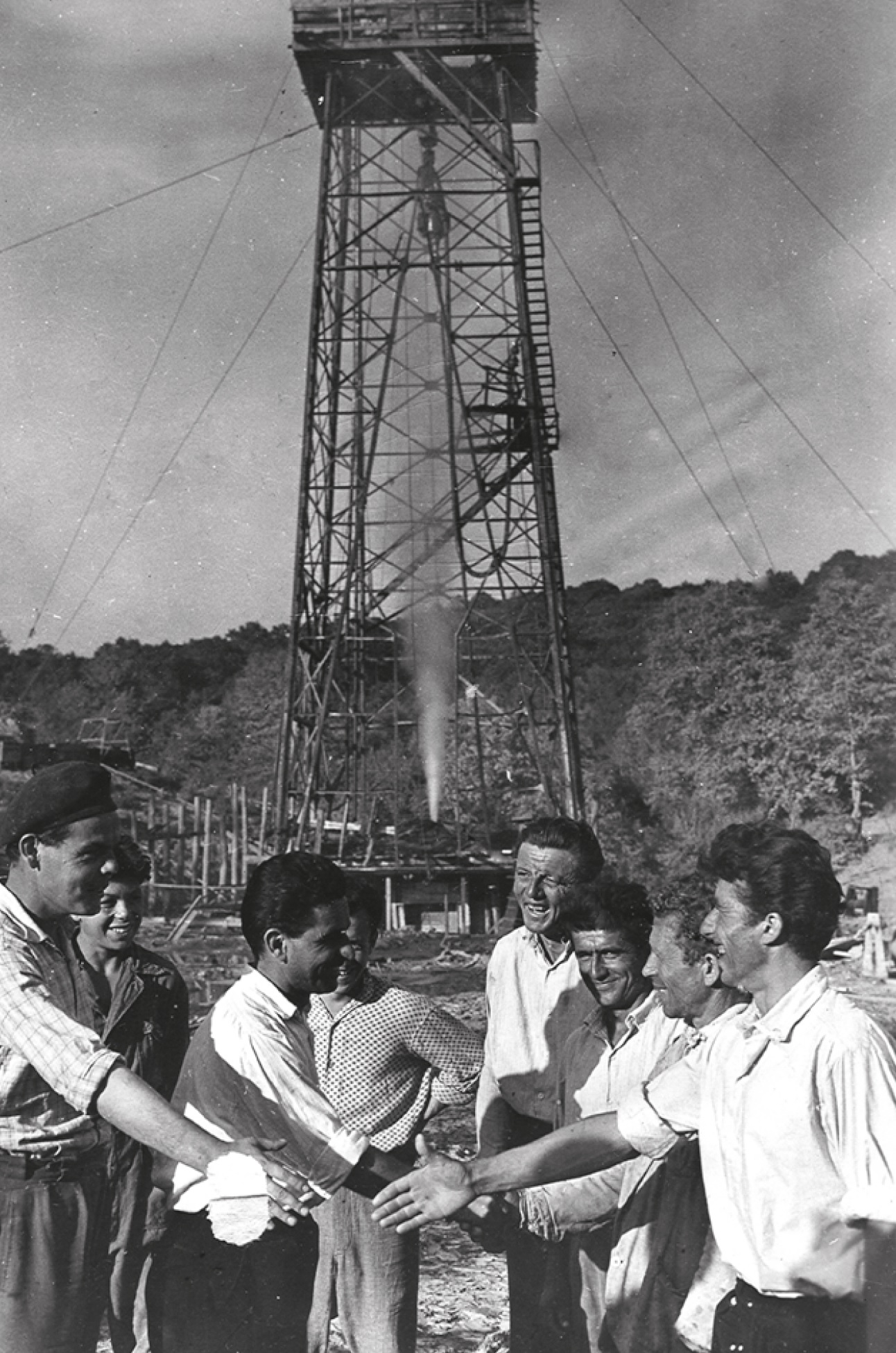
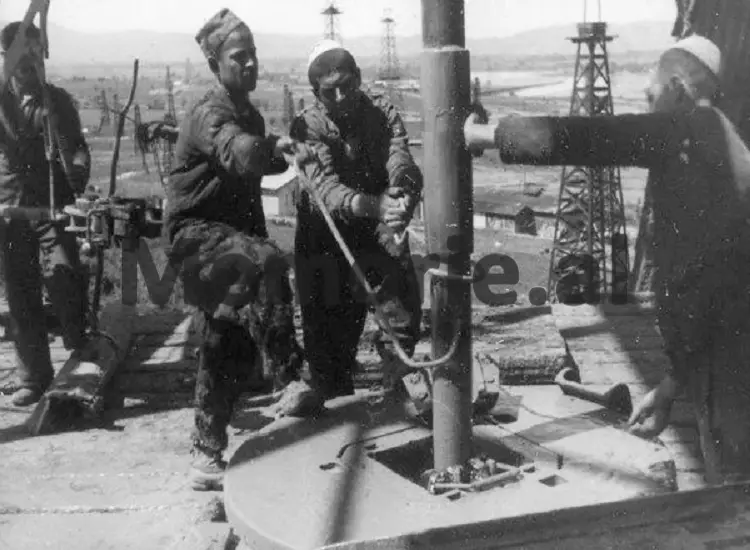
The 1950s were the years when Albanian oil workers, drillers, technicians, masters, engineers, etc., put the rigs for deep well drilling into operation, mastered the technology of drilling and completing these wells. Thus was created the technical-technological base for the accomplishment of tasks for the exploitation of oil fields in Kuçovë and Patos and for the search for new fields.
The geological survey of the Patos area was carried out by the Soviet geologist A.G. Llalliev (1952), of the Ardenicë – Roskovec region by S.L. Bizova (1953-1954), of Frakull – Kraps by E.A. Shantar (1954), of Lushnjë – Pekisht (1953) and Murriz – Pekisht by S.V. Egupov (1955); the survey of the Marak – Llixha – Elbasan area was carried out by M.N. Rozanov and S.S. Drozdov (1956) (Teki Biçoku, 2004). The calculation of reserves and the development plan for the Kuçovë and Patos fields were done by geologist V.N. Vinjukov (1955), who carried out the syntheses “Geological structure and oil-bearing of the Patos field” and “Geological structure and oil-bearing of the Kuçovë field”.
The discovery and processing of the Patos and Kuçovë fields was carried out by engineers M.P. Lisenkov, M.N. Kochetov, M.I. Kamishnjikova, while N. Baranov made the synthesis of the Frakull – Ardenicë region (1958) (Biçoku, 2004). Llalliev A.G. and Papa A. (1952), in the framework of synthesising works, constructed the structural map of the Patos field. Mishunina Z.A. and Papa A. (1954) constructed the map of oil manifestations in Albania. Also working on these problems were Servet Pasho, Ziver Meko, Asti Papa and Beqir Aliaj (S. Pasho, 1952, 1956; Z. Meko. 1953; A. Papa, 1952, 1953, 1954; V. Cane, 1962).
The Drilling Enterprise carried out the drilling of production wells within the field, such as those in Margëlliç, as well as delineation wells, among which I remember well 515 in Lalar, south-west of Patos, where we spent New Year’s Eve 1954 doing logging, wells in Rusinjë to the east, as well as wells 97, 502, 505 to the north towards Zharrëzë. The geodesist Nasuf Dizdari, of the General Directorate of the Combine, whom I recall with much love and respect as I write these lines, for his humour even on rainy days and his tireless work, determined the well sites in the field according to the project coordinates.
Within this site, the position of the well foundation was determined by the chief engineer and chief geologist, depending on the relief. With the extraction of oil from the delineation wells to the north, we courageously moved further north, to Marinëz, to search for new oil layers, also based on seismic studies that had already been carried out in that area and the picture of the structural situation was known (Biçoku T, 1953). We moved from the known towards the unknown, as we used to say later. Well 542 was designed, with supervisor Qemal Mahmuti, etc. In the framework of synthesising the results of drilling the delineation wells of the Patos field, the Geological Branch of the Drilling-Exploration Enterprise in Patos, led by chief geologist Beqir Alia, designed the well “Marinëz 542”. The project was approved by the Chief Geologist of the Oil Combine, Servet Pasho (V. Cane, 1962, personal archive of Gj. Foto).
These wells were designed based on the synthesis of the oil-gas-bearing of the Patos field carried out by the Soviet geologist Vinjukov V.N. (1955), who consulted and collaborated with Albanian geologists. I carried out the first preliminary logging records in Marinëz, while operators Vasil Nasi, Pertef Nishani and Asim Zeqja carried out the final logging records upon completion of drilling well 542. The well perforation was carried out by technician Vangjel Ndrio, Perlat Hoxha and master Nasi Prifti. Master Koli Mone was at the forefront of extinguishing the fire and closing the gusher in June 1957; alongside him, many oil workers fought the fire, Dhoskë Tundja, etc., and even firefighting specialists. The fire was so great that in Tirana, the sky glowed red at night towards the hills of Sauk, south of which lay Marinëz.
Seeing the trail of flames in the sky, I, a student who had just finished my first year at the Institute, remembered the well where I had recorded the logging diagram, rejoiced greatly at the discovery of the great oil, but was also distressed by the fire and its consequences. The gusher fire was extinguished by explosion after about a month. The discovery of the Marinëz field was of great importance in terms of strengthening the Albanian economy, expanded the field of oil exploration in sandstones, revealing new oil-bearing layers beneath those of Patos, which formed the Marinëz oil-bearing suite, placed below the Driza – Patos oil-bearing suite, and also opened the way for the discovery of new oil and gas fields by Albanian specialists.
The drilled wells were documented and studied by the Geological Branch of the Drilling Enterprise. This branch analysed all the geological data of each well, analysed the mud and the samples taken, studied the geological phenomena indicated by changes in the drilling fluid (clay solution), wrote the geological biography of the well, and arranged all the geological, logging and drilling data in a separate file. The Geological Branch controlled the implementation of the technical parameters of the well project and monitored all operations during its drilling until its handover to the Production Enterprise. It carried out daily control of the properties of the well’s drilling fluid.
Alongside this activity, its geologists, together with the Soviet geologists, also worked on the geological mapping of the Patos area, as well as on problems of field development. (Llalijev A.G. and Papa A. 1952, Papa A. 1953, Mishunina Z.A. and Papa A. 1954). The first chief geologist was technician Asti Papa (1951-1954). After his transfer to the Geological Directorate in Tirana, the direction of this branch was taken by technician Adem Cani (Nurja) (1954–), who had worked on exploration wells, technician Filip Strakosha (1956–), and after them, the geological engineer Beqir Alia, who had returned from studies abroad. Also working in this branch were collectors Paskal Sinani (1951–) – supervisor, Aleko Cane, Haxhi Agaj, Vasil Dhrako, etc. In 1955, students Koço Plaku and Beqir Aliaj came from Moscow and did their practical training.
Detailed documentation, centimetre by centimetre, and study of the layers drilled by the well using advanced electrical methods were carried out with modern technology called electrical logging. When I started work in September 1953, besides recording logging diagrams for specific electrical resistance of the rocks and for spontaneous polarisation potential, we also measured the distortion of the wellbore, recorded the diameter size of the wellbore, the specific electrical resistance of the clay solution filling the wellbore, as well as temperature changes with electric thermometers along its entire length. The recording was done with a semi-automatic station.Memorie.al