

By Erneta Shevroja
Memorie.al / The Irish researcher, Jon Halliday, in his book about Enver Hoxha, titled “The Artful Albanian,” attempts to decipher the mysteries, intrigues, betrayals, paranoias, murders, maneuvers, relations between figures, conspiracies, and plans within the fortress of the communist regime in Albania, but also of all the countries of the communist East. The figure of Enver Hoxha is at the center of researcher Halliday’s book, while all the leaders of the East, starting from Stalin and later Khrushchev, are treated in relation to Enver Hoxha. Referring to observations, reports, testimonies, secret documents, details, etc., the researcher provides a description of the figure of Enver Hoxha, who left behind every Eastern dictator in terms of the speed of consolidating his power.
In the book, Halliday speaks about Stalin’s strong suspicions regarding Enver Hoxha, while describing Enver Hoxha’s five meetings with the leader of the Soviet Union. “Unlike most post-war Eastern European leaders, he was truly very handsome, even very attractive, to both women and men. He knew how to exploit this attraction beautifully. He was a perfect actor. He combined this ability as an actor with an unshakeable determination to prove that he was always right, but he also had the stubbornness to continue until he exhausted his opponents. These are qualities for winning and maintaining power. They are also qualities that infuriate the interlocutor,” writes the Irish researcher in the book “The Artful Albanian.”
Stalin’s Suspicions
The Irish researcher writes that Stalin was very suspicious of Enver Hoxha. The Albanian dictator was among the only ones in the Soviet Bloc who did not seek help and did not have the need for the Soviet army.
“Molotov was speaking good words to Stalin, who was both curious and suspicious of the only leader of a communist regime in the Soviet Bloc who had no historical connection or contact with the Soviet Union. And this was true not only regarding Enver Hoxha as an individual, but almost the entire leading group in Albania. Moreover, Albania is the only country within the Bloc that was liberated by itself, without the need for the Soviet Red Army to step on its territory,” says Jon Halliday in the book about the figure of Enver Hoxha.
Khrushchev’s Doubts
The Irish researcher, Jon Halliday, in his book on Enver Hoxha, describes the memoirs of Dictator Khrushchev regarding Enver Hoxha. In the book, it is stated that Hoxha was always vigilant over the people who surrounded him and always suspicious of their friendship.
“What gives Hoxha’s memoirs a striking uniqueness over all other memoirs, even those of Khrushchev, is how he intertwines his intelligence and observational skills with a brutal candor and devious self-praise. In truth, he lets it all out. And he ruminates. In a small corner of the Balkans for 25 years, he had to rack his brain to interpret signs and decipher the actions, messages, and ruses of his friends and enemies,” writes the researcher.
Why did Enver Hoxha break with Tito, Khrushchev, and Mao Zedong?
The Irish historian, Jon Halliday, in his book “The Artful Albanian – Enver Hoxha,” brings facts and evidence on how Enver Hoxha broke close and friendly relations with the most influential leaders of communist states.
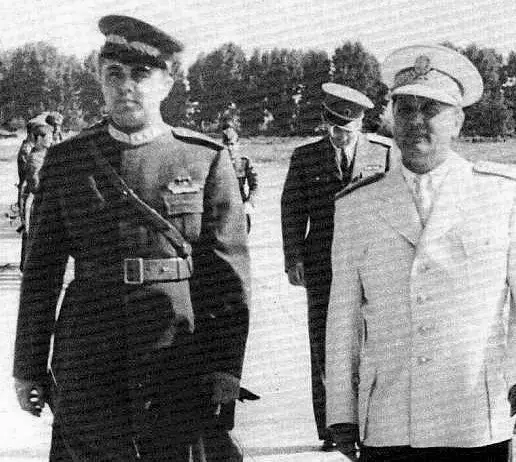
Halliday affirms that during the conversations Enver Hoxha held with Josip Broz Tito, he raised the issue of Kosovo several times. But, not only did Tito not take responsibility for this issue, according to Enver Hoxha, but Belgrade was preparing the annexation of Albania.
“In Hoxha’s account of his ties with Tito and the Yugoslav regime, there is both truth and fiction at the same time. Hoxha’s fundamental accusation that Yugoslavia aimed to annex Albania is correct. Therefore, his reasons for viewing the Yugoslavs’ motives with suspicion seem appropriate. On the other hand, his leap to the accusation that, by wanting to annex Albania, Yugoslavia also extorted its assets, finds no support in the documents we have seen. On the contrary, Yugoslavia gave Albania great help during the period 1945-‘48, in a purely economic sense,” the book states.
Also, Enver Hoxha criticized Tito quite a bit. “Enver Hoxha criticizes Tito mainly on a personal level, that he led a luxurious life, behaved with arrogance, and did not devote much time to getting to know problems in specific fields, especially economic ones. Hoxha recalls a conversation about Kosovo. What he says is believable, but cannot be verified. It is impossible for Tito to have expressed himself so openly, even for a matter of principle,” says historian Halliday.
The breaking of relations with Moscow
Historian Jon Halliday narrates in his book how relations between Tirana and Moscow were broken after the death of Stalin. Enver Hoxha had extremely close ties with Stalin and even took him as an example in his decisions, but the coming to power of Nikita Khrushchev would seal the end of relations between Albania and Russia.
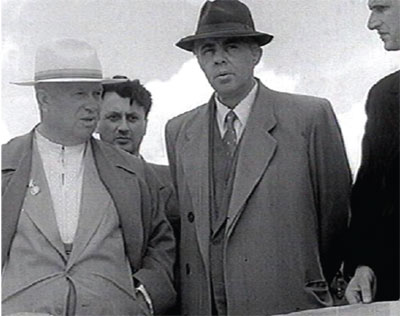
“Until the end of the 50s, relations between Moscow and Tirana, on the surface, seemed good. According to Hoxha, and this is completely believable, relations began to cool shortly after Stalin’s death and, since Khrushchev began to seek reconciliation with Tito, they took an irreversible downward turn. Khrushchev’s reconciliation with Tito in 1955 and his denunciation of Stalin’s crimes in 1956 were the two main issues behind the cooling of Soviet-Albanian relations, to which were added the differences they had between them regarding personality, Hoxha with Khrushchev,” the book states. Meanwhile, Khrushchev also had no regard for the communist leaders of Albania, especially Enver Hoxha.
“Once again, we have two versions that conflict quite a bit with each other, that of Enver Hoxha and that of the other side. In his memoirs, Khrushchev expresses himself bitterly about the Albanian leaders, especially about Hoxha, Prime Minister Shehu, and the Minister of Defense, Balluku, saying that; ‘they are worse than beasts, they are monsters.’ Khrushchev says, quite rightly, that: ‘The rift that grew deeper between the Soviet Union and Albania was born primarily because the Albanians feared democratization,’” says Halliday in his book.
The breaking of relations with China
According to Jon Halliday, Enver Hoxha managed to end cooperation with China as well, while this communist state was very generous with Albania and helped it with aid without any kind of interest. Halliday narrates: “Enver Hoxha said that China was exercising economic, military, and later political pressures on Albania, comparing these with Khrushchev’s pressures.”
“Enver Hoxha describes in detail the economic and, finally, political pressures that China was exercising against Albania and compares these with Khrushchev’s pressures. But, as he presents things at this point, Hoxha shows himself to be very narrow-minded and, by removing them from the ledger, very inaccurate. Above all, the aid that China gave to Albania during the period in question was quite large and especially farsighted and generous, in the sense that it was intended to give Albania the opportunity to build a relatively wide industrial base and walk on its own feet,” the book states.
“Not far off, but by the middle of 1975,” says Halliday, “while Enver Hoxha in Albania was condemning several leading cadres accusing them of collaborating with the Chinese, China was signing an agreement to give Tirana large amounts of aid, without any percentage of interest. / Memorie.al