
Part two
Memorie.al / The Special Operative Group that was created immediately after the arrest of the former Minister of Internal Affairs, Kadri Hazbiu, and his deputy, Feçor Shehu, in mid-October 1982, headed by the Deputy Minister of Internal Affairs, Zylyftar Ramizi (who also held the function of Director of State Security) and with Enver Zeneli and Hasan Ulqinaku as his subordinates, among other measures, such as the study and analysis of a large number of archival files belonging to a long period (1945-1982), also called upon and requested some of the former high officials of the leadership of the PPSH (Albanian Party of Labour) and former senior leading cadres of the Ministry of Internal Affairs, State Security officers, etc., to submit in writing what they knew or suspected regarding the “hostile activity” of Kadri Hazbiu, Feçor Shehu, or other persons with whom they had been connected by work or not, during the period they had served in that ministry, or in the Internal Affairs Branches in districts, in the Political Detection sector, near our diplomatic representations accredited in various countries of the world, etc.
Among the former high officials of the PPSH and leading cadres and State Security officers, etc., who responded to this call, providing their written testimonies to the Special Operative Group, were: Liri Belishova (former member of the Political Bureau and secretary of the Central Committee of the PPSH for propaganda, art, and culture), Nesti Kerenxhi (former Major-General, Director of State Security and Minister of Internal Affairs), Xhule Çiraku (former Lieutenant-General, Director of the Second Directorate of State Security and Deputy Minister of Internal Affairs), Rexhep Kolli (former Lieutenant-General, Director of State Security and Deputy Minister of Internal Affairs), Zija Kambo (former Major-General and Commander of the Republic Guard), Zoi Themeli (former Lieutenant-General, Director of State Security and Deputy Minister of Internal Affairs), Myftar Tare (former Colonel and Deputy Minister for Political Detection, arrested in 1949 and released), Nevzat Haznedari (former Major-General and Head of the Investigation Department at the Ministry of Internal Affairs), Hekuran Pobrati (former Colonel and senior State Security officer), Feti Smokthina (former Colonel and Commander of the Republic Guard), Zylfi Saliu (former Colonel, senior State Security officer, head of Internal Affairs Branches in several districts, and deputy of the People’s Assembly), Lelo Sinaj (former senior officer and Director of State Security), Halil Zeneli (former Colonel of State Security and head of Internal Affairs Branches in several districts), Ilo Manushi (senior officer and Director of the Cadre Directorate of the Ministry of Internal Affairs), Mark Dodani (former Lieutenant-Colonel, senior State Security officer and deputy head of the Sarandë Internal Affairs Branch), Xhemal Bejto Fasllia (former judge and senior State Security officer in the Ministry of Internal Affairs), Ibrahim Kubati (former agronomist graduated in Bulgaria, director of hunting reserves in several districts of the country where the high leadership of the PPSH went hunting, political prisoner), Ali Kubati (former officer of Political Detection in several countries of the world and deputy chairman of the Executive Committee of Tirana, political prisoner), Nexhip Pajo, former senior officer of the Ministry of Internal Affairs, etc.
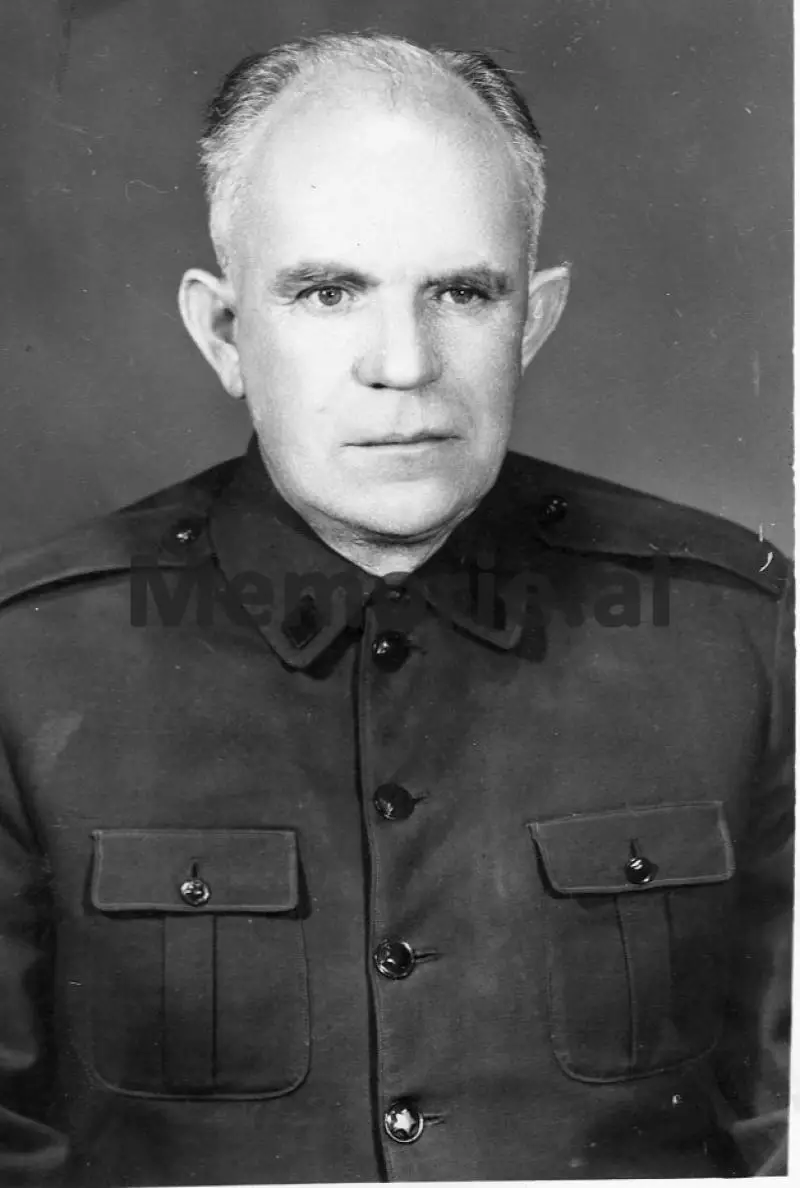
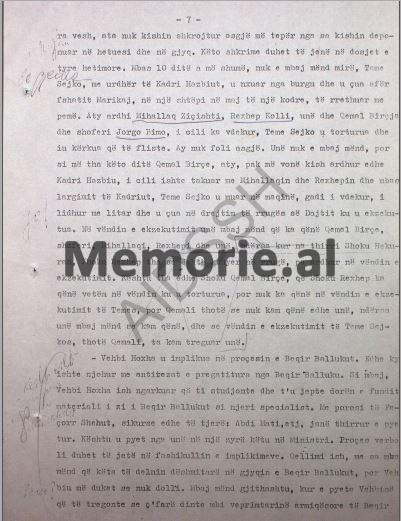
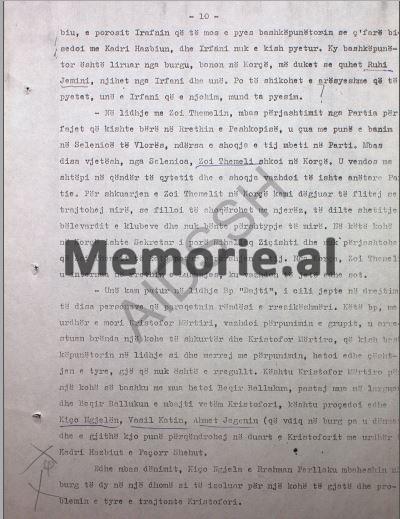
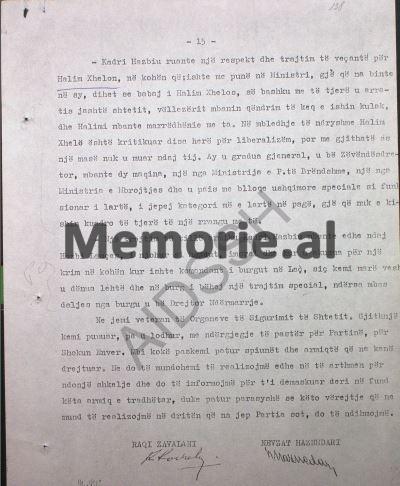
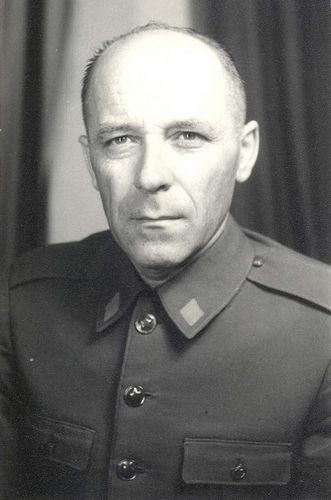
From the aforementioned letters or reports sent to the address of the Special Operative Group at the Ministry of Internal Affairs, or personally to Minister Hekuran Isai, in the years 1982-1983, in previous issues we have published the letters of Liri Belishova, Hekuran Pobrati, Xhule Çiraku, Mark Dodani, Ibrahim Kubati and Nexhip Pajo, whereas in this article, we are publishing the letter of the former senior State Security officer, head of the investigation department at the Ministry of Internal Affairs, Major-General Nevzat Haznedari and his subordinate, the investigator Raqi Zavalani.
In their letter, they provide a detailed overview of the main events they had faced from 1950 to 1982, starting with the groups of saboteurs who had landed in Albania at that time, such as: Zenel Shehu, Hamit Matjani, Halil Branica, Tahir Premçi, etc., as well as highlighting the “hostile activity” of Mehmet Shehu, Kadri Hazbiu, Feçor Shehu, Mihallaq Ziçishti, etc., or of a series of high officials who had been condemned by the Party, such as Tuk Jakova, Bedri Spahiu, Dali Ndreu, Liri Gega, Teme Sejko, Panajot Plaku, Taho Sejko, Tahir Demi, Halim Xhelo, Kadri Hoxha, Zenepe Ashiku, etc. For more on this, etc., the document in question, which is part of a voluminous file (found in the archival fund of the Authority for Information on the Documents of the former State Security), is published for the first time (together with the respective facsimiles) by Memorie.al.
Continued from the previous issue
THE SECRET DOCUMENT WITH THE REPORT-INFORMATION OF TWO HIGH OFFICIALS OF THE MINISTRY OF INTERNAL AFFAIRS, NEVZAT HAZNEDARI AND RAQI ZAVALANI, ON THE “HOSTILE ACTIVITY” OF KADRI HAZBIU, FEÇOR SHEHU, MIHALLAQ ZIÇISHTI, ETC.
SECRET
Single copy
Tirana, November 5, 1982
Regarding the issues related to the hostile activity of the enemies: Kadri Hazbiu, Mehmet Shehu, Feçor Shehu and Mihallaq Ziçishti, we provide some clarifications that we think are of interest to be kept in mind, specifically:
Comrade Nevzat Haznedari clarifies:
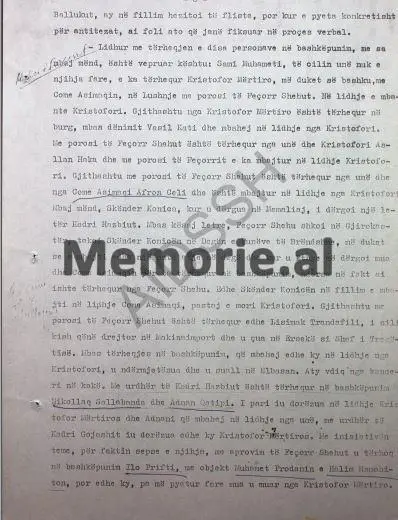
After this letter, Feçor Shehu went to Gjirokastër and met Skënder Konica at the Internal Affairs Branch; it seems to me he kept him there overnight at the Branch, and when he returned, he sent me and Çome Asimaqi to recruit him for collaboration, whereas in fact, he had already been recruited by Feçor Shehu. Even Skënder Konica was initially kept in connection by Çome Asimaqi, and then Kristofori took over.
Also, by order of Feçor Shehu, L. T. was recruited, who had been director at Makina-Import and was sent to Ersekë as Head of Trade. After the recruitment for collaboration, he too was kept in connection by Kristofori; he was mediated and moved to Elbasan. There he died of head cancer. By order of Kadri Hazbiu, N.S. and A.Q. were recruited for collaboration.
The first was handed over to Kristofor Mërtiro for connection, and A.Q., who was kept in connection by me, by order of Kadri Gojashi, was also handed over to Kristofor Mërtiro. On my initiative, because I knew him, with the approval of Feçor Shehu, I.P. was recruited for collaboration, with the objective of following and surveilling Muhamet Prodani and Halim Ramohiti, but even he, without asking me at all, was taken over by Kristofor Mërtiro.
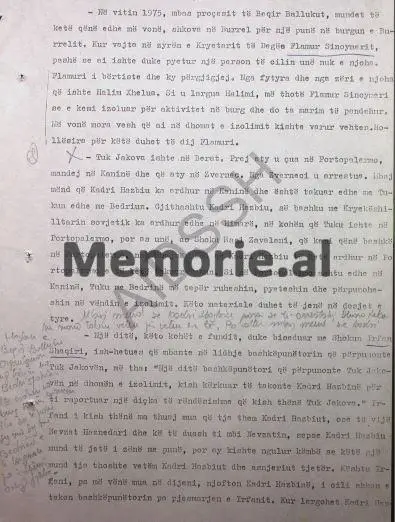
In 1975, after the case of Beqir Balluku (it may have been later), I went to Burrel for some work at Burrel prison. When I went to the office of the Branch Head, Flamur Sinojmeri, I saw that he was questioning a person whom I did not recognize. Flamuri was shouting at him and he was answering. From the face and voice I recognized him as Halim Xhelo. After Halimi left, Flamur Sinojmeri told me that we have isolated him for activity in prison and we will take him as accused. Later I learned that he had hanged himself in the isolation rooms. Flamuri should know the details.
Tuk Jakova was in Berat. From there he was taken to Porto-Palermo, then to Kaninë, and from there to Zvërnec. From Zvërnec he was arrested.
I remember that Kadri Hazbiu came to Kaninë and met with Tuku and Bedriu. Also, Kadri Hazbiu, together with the chief Soviet advisor, came to Himarë at the time when Tuku was in Porto-Palermo, but neither I nor Comrade Raqi Zavalani, who were together in Porto-Palermo, remembers Kadri Hazbiu coming to Porto-Palermo to meet Tuku.
Both in Porto-Palermo and in Kaninë, Tuku and Bedriu were more guarded, questioned, and processed in the place of isolation. These materials should be in their files. These days, recently, while talking with comrade Irfan Shaqiri, former investigator of Tuk Jakova, he told me: “One day, the collaborator who was processing Tuk Jakova in the isolation room had requested to meet Kadri Hazbiu, to report something important that Tuk Jakova had said.
Irfan told him: tell me, so I can tell Kadri Hazbiu, or let Nevzat Haznedari come and you tell him, because Kadri Hazbiu may be busy with work, but he insisted that he could only tell Kadri Hazbiu and no one else. So Irfan, without informing me, notified Kadri Hazbiu, who went and met the collaborator without Irfan’s participation. When Kadri Hazbiu left, he instructed Irfan not to ask the collaborator what he had discussed with Kadri Hazbiu, and Irfan did not ask. This collaborator was released from prison and lives in Korçë; I think his name is Ruhi J., known by Irfan and me. If it is deemed reasonable to question him, Irfan and I, who know him, can ask him.
Regarding Zoi Themeli, after his expulsion from the Party for the faults he had committed in the Peshkopi district, he was sent with work and residence to Selenicë in Vlorë, while his wife remained in the Party. After several years, from Selenicë, Zoi Themeli went to Korçë. Regarding Zoi Themeli’s move to Korçë, we heard it said that he was treated well, that he began to socialize with people, to go out for walks on the boulevard and in clubs, and it did not make a good impression. At that time, the First Secretary in Korçë was Mihallaq Ziçishti, and it is not excluded that Zoi Themeli had his support.
From Korçë, Zoi Themeli was interned in the Lushnjë district, where he continues to live even today. I had in connection B.p. “Dajti”, who provided information regarding some persons of importance and danger. This B.p. was taken over by order of Kristofor Mërtiro; he continued processing the group; they were arrested within a short time, and Kristofor Mërtiro, who had the collaborator in connection and was dealing with the processing, also investigated their case, which is irregular.
Thus, Kristofor Mërtiro, for a time together with me, investigated Beqir Balluku, then I was removed and Kristofori kept Beqir Balluku alone; so he also processed Kiço Ngjela, Vasil Kati, Ahmet Jegeni (who died in prison without being sentenced), and all this work was concentrated in Kristofor’s hands, by order of Kadri Hazbiu and Feçor Shehu. Even after sentencing, Kiço Ngjela and Rrahman Përllaku were kept in prison, both in one room, isolated for a long time, and their problem was handled by Kristofori.
Comrade Raqi Zavalani clarifies:
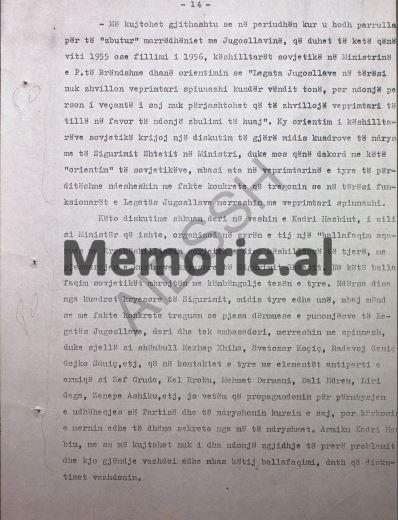
Regarding the enemies of the Party Dali Ndreu and Liri Gega, who were directly followed by the former Second Directorate of the State Security Directorate, I want to say that their processing was deep and complete, and that through this processing, all their activity was uncovered in depth, both with other anti-party elements and with officials of the Yugoslav Legation, and the enemies Kadri Hazbiu and Mihallaq Ziçishti were informed in detail of all the data that emerged, but they never stopped or oriented us on what needed to be done further.
For example, these two enemies, especially in the period before the Tirana Conference, while developing an intense hostile activity, used various expressions, such as: “People must be mobilized for the truth”, “That there are contradictions between the main Party Leader and Mehmet Shehu”, they used the lowest words against the main Party Leader, they asked the officials of the Yugoslav Legation: “if some cadre were to escape from Albania to Yugoslavia, how would they be received by the Yugoslav Government?” and their answer (Svetozar’s) was: “there the greatest decorations await them”, etc. The enemies Kadri Hazbiu and Mihallaq Ziçishti showed no preoccupation to stop this activity by arresting them, but passed over it in silence.
During the period of the Tirana Conference, when the anti-party element was thrown into an almost open hostile activity against the line of the Party and its sound Leadership, we as the central apparatus not only mobilized and activated all the agent network we kept in connection, but we also requested the districts to act as well, even in this situation. On this basis, information was greatly enlivened, both here in the center and from the districts that worked seriously in this direction. While the Tirana Directorate, which operated precisely in Tirana, I say with competence, we had no information from it.
He clarified that at this time, the Director of Internal Affairs of Tirana was the enemy Feçor Shehu, who was also a member of the Bureau of the District Party Committee. During the work process and daily struggle against the anti-party element, where the former Second Directorate and the Tirana Directorate operated, there were cases when the enemy Feçor Shehu spoke with contempt about some B.p. who were very good and had a high work performance in dealing with the anti-party element.
For example, I recall a case when at the Tirana Internal Affairs Directorate, the work of the agent network in this direction was being analyzed, and among other things, the contribution of an agent with the pseudonym “Vullneti” was mentioned, who processed Dali Ndreu and Liri Gega to the end, as well as many other important targets. The enemy Feçor Shehu used the lowest words against that B.p., saying: “That one is a whore, you have worked with such people and boast…?!”
I remember that this analysis was done in 1957. At the Tirana Conference, I remember that besides others, a number of employees of the Ministry of Internal Affairs were implicated for anti-party activity, such as Vesel Ahmeti, Asaf Kondi, Kopi Niko, Koçi Lubonja, etc., but against these, only some criticisms were enough, made in the basic organizations, while no measures were taken by the enemies Kadri Hazbiu and Mihallaq Ziçishti to remove them from the Ministry of Internal Affairs.
Although in the period after the Tirana Conference, it was discovered that many former various cadres here in Tirana had developed intense hostile activity, both before and during the conference, the measures taken against them were very mild. Only a minority of them were arrested, some were recruited for collaboration, and for some others, only a criticism made in the basic Party organizations sufficed, and those persons who were interned or removed from Tirana were placed in the best cities, such as Durrës, Lushnjë, Berat, Elbasan, Fier, and Vlorë.
And there they were assigned privileged jobs, for example, Qazim Vaqarri, who used the most hostile words against the main Party Leader, even calling for terror against him, was appointed Director of a Commercial Enterprise in Vlorë, while Nesti Zoto, who was one of the most active anti-party elements at the Tirana Conference, was sent to Lushnjë and there was assigned responsibility in the Trade of Lushnjë, etc.
These treatments given to the anti-party element of that period lead to the opportunistic and supportive stance held at that time by the leadership of the Ministry of Internal Affairs, headed by Kadri Hazbiu and Mihallaq Ziçishti, where the influence that the enemy Fiqrete Shehu may have exerted is not excluded. I remember that a few years ago, when Fiqrete Shehu was a member of the Central Committee of the Party and Director of the “Vladimir Iliç Lenin” Higher Party School, a brother of hers died somewhere in a district, and for the memorial lunch she hosted her kin here in Tirana, at the house of the Yugoslav Perso Frashëri, who was an agent of Yugoslav Intelligence and the liaison of the enemy Liri Gega with the Yugoslav Legation. The food items consumed at this lunch came by car from the Reception Directorate.
Regarding Asaf Kondi, besides the fact that his name came out at the Tirana Conference as a man who supported the hostile views expressed by the anti-party element at the Conference, during the process of recruiting the B.p. “Lundra” for collaboration, I remember that this B.p. was also implicated for hostile activity. I also remember that Bardhyl Spahiu – brother of Hulusi Spahiu, condemned as an anti-party element, former employee of the Ministry of Internal Affairs – after his brother’s arrest, was removed from the Internal Affairs organs, and provided some materials that implicated for hostile views some cadres of the Internal Affairs organs, whose names I do not recall now.
I think it is of interest that these materials be restudied. I also remember that during the period when the slogan was raised – which must have been to “soften” relations with Yugoslavia, in 1955 or early 1956 – the Soviet advisors at the Ministry of Internal Affairs gave the orientation that: “The Yugoslav Legation as a whole does not develop espionage activity against our country, but some individual person in it, it is not excluded that they may develop such activity in favor of some foreign intelligence.” This orientation of the State Security advisor at the Ministry, not agreeing with this “orientation” of the Soviets, because in their daily activity they encountered concrete facts that showed that the officials of the Yugoslav Legation as a whole were engaged in espionage activity.
These discussions went all the way to the circle of Kadri Hazbiu, who, as minister, organized in his office a “clarifying confrontation” with the chief Soviet advisor and some other advisors, with the participation of the main cadres of State Security. In this confrontation, the Soviets stubbornly defended their thesis, while some of the main Security cadres, including myself, I remember with concrete facts we showed that the vast majority of the employees of the Yugoslav Legation, down to the ambassador, were engaged in espionage, giving as examples: Rexhep Xhiha, Svetozar Kosiç, Radevoj Gojko Saviç, etc., who in their contacts with hostile anti-party elements such as Zef Gruda, Kel Rroku, Mehmet Dermani, Dali Ndreu, Liri Gega, Zenepe Ashiku, etc., not only propagated the overthrow of the Party leadership and a change in its course, but also sought to obtain various secret data.
The enemy Kadri Hazbiu, as far as I remember, did not give a clear solution to the problem, and this situation continued even after this confrontation, i.e., the discussions continued. Kadri Hazbiu maintained a special respect and treatment for Halim Xhelo at the time he was working at the Ministry, which was noticeable to us. It is known that Halim Xhelo’s father, together with others, escaped abroad, his brothers held a bad stance and was kulaks, and Halimi maintained relations with them.
In various meetings, Halim Xhelo was criticized several times for liberalism, but nevertheless, no measure was taken against him! He was promoted to general, became deputy minister, had two cars, one from the Ministry and one from the Ministry of Internal Affairs; from the Ministry of Defence, he was provided with special food rations as a high official; he was given a higher salary category, so much so that other cadres of his rank did not have it. With such treatment, the enemy Kadri Hazbiu also treated Hazbi Lamçe, known as a thief, immoral, and when he was accused of a crime while he was commander of the prison in Laç, as we have learned, he was lightly sentenced and in prison received special treatment, while after release from prison, he became an Enterprise Director.
We are veterans of the State Security Organs. We have always worked tirelessly, with a clear conscience for the Party, for comrade Enver. Over our heads, we have had spies and enemies who directed us. We will try to also address any transgressions in the future and will inform to unmask these enemies and traitors to the end, bearing in mind that these observations we can make in the light given to us by the Party today will help.
Raqi Zavalani
Nevzat Haznedari
Note: Comrade Ylli, you should talk with these comrades, so that they remember other things. /Memorie.al
Enver Zeneli
16.11.1982