

– The well-known researcher and historian, Kastriot Dervishi, publishes archival documents that refute the version of communist historiography –
Memorie.al / Perhaps few people know that on November 28, 1948, the Presidium of the People’s Assembly declared Vasil Shanto a “National Hero,” i.e., equal to Skanderbeg. Shanto’s name is carried today, excessively, by neighborhoods, streets, schools, etc. The deceitful artistic film “Militanti” was also made, which RTSH and other TV stations broadcast up to 2-3 times a day in order to faithfully continue the deceptions of communist propaganda. The film reflects the same lies as other written materials from the communist era. Normally, under these circumstances, it is legitimate to ask: what did this individual do that the state has so many obligations towards him? Did he perhaps strive for the territorial integrity of the Albanian state, or did he hold high state functions and provide extraordinary assistance?!
To learn the truth, it is enough to look at the document of the time, published censored in the 1986 edition of the General Directorate of State Archives, dedicated to heroes, from which the essential part has been removed. Vasil Shanto was not killed in a skirmish with Germans, or with Ballists, or with “reactionaries,” or for the “liberation of the homeland,” but while carrying out a private task, for which he may even have been paid.
The event is witnessed by the person who remained alive, a certain Naun Zafirof, who was an officer of the Royal Yugoslav Army, captured as a prisoner by the partisans of Josip Broz Tito. After being released in Kolašin, Montenegro, he seeks to return to his birthplace, Ohrid. There he meets Officer Rifat Manjani, who introduces him to Vasil Shanto.
They ask Vasil to become their escort, and the latter agrees. It was a journey that was interrupted by a random gendarmerie ambush, which aimed to stop four armed men, without knowing at all who they were. With Vasil was another communist, Reshit Rusi, who was also killed together with Vasil Shanto.
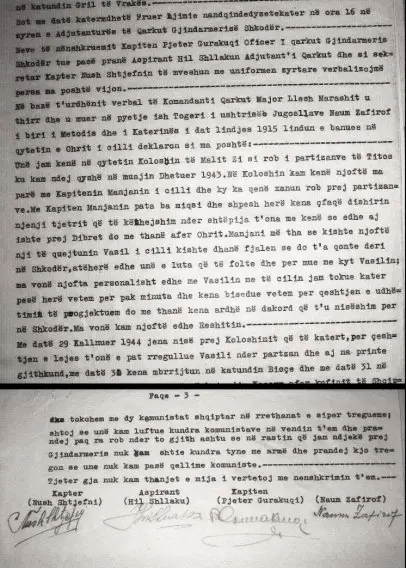
The archival document with the interrogation record by the Gendarmerie of Shkodër District of the former Yugoslav army officer, Naun Zafirof, who was with Vasil Shanto at the time of the killing
Interrogation record of the former lieutenant of the Yugoslav army Naun Zafirof, son of Metodi and Katerina, born in 1915, born and resident in the city of Ohrid.
Present at the interrogation, dated February 14, 1944, at 16:00 in the office of the Adjutant’s Office of the Shkodër Gendarmerie District: Captain Pjetër Gurakuqi, Aspirant Hil Shllaku, and Secretary (Kapter) Nush Shtjefni.
Statement as follows:
I was in the city of Kolašin, Montenegro, as a prisoner of Tito’s partisans, where I stayed from December 1943. In Kolašin, I previously became acquainted with Captain Manjani, who was also captured as a prisoner by the partisans. With Captain Manjani, I formed a friendship, expressing the desire to return to our homes – he to Dibër and I to Ohrid.
Manjani told me that he had met a certain person named Vasil, who had given him his word that he would take him all the way to Shkodër. Then I also asked him to speak to this Vasil about me. Later, I met Vasil personally, meeting 4-5 times for only a few minutes, and we talked only about the planned journey, i.e., we agreed to set off for Shkodër.
Later, I also met Reshit. On January 29, 1944, all four of us set off from Kolašin. The matter of permission was arranged by Vasil with the partisans, and he led us everywhere. On January 30, we arrived in the village of Bioçe, and on January 31 at 5:00 in the morning, we arrived at Kosorr near the Albanian border. Here we ate and drank, taking bread with us.
We set off and traveled all night, sometimes on roads, sometimes through mountains, until we encountered gendarmerie patrols, and the result is known. During the journey, Vasil instructed us to walk carefully and without fear that we might be detected by any patrol.
Coming into Albania, according to Vasil’s word, we were confident that we would arrive safely, because he had promised us so, therefore we set off with full conviction that nothing would happen to us.
I declare that from the moment we entered the Albanian border until where the event occurred, we did not enter any Albanian house, nor did we eat bread or sleep. We only ate the food we had brought with us in the village of Kosorr, and we rested outside several times, without entering any house.
I was armed with a hand “machine gun” (submachine gun), English type, which had a magazine with 32 rounds. Vasil also had a “machine gun” of German type, but I do not know how much ammunition he had; I remember he had three magazines in the bag of his “machine gun,” which surely must have been loaded.
I also had a revolver, but I do not remember well. Vasil also had hand grenades, but I do not know how many. For myself, I had no grenades. Captain Manjani had a long Yugoslav rifle and a semi-automatic revolver and a belt of ammunition.
Reshit had a German “machine gun.” I do not remember whether he had grenades or not. The partisans gave me the “machine gun” in Kolašin, a couple of days before I set off for Albania. To be freed by them, I had obtained a report from the doctor that I suffered from a heart condition and that I could not endure the hardships, I could not eat the partisans’ food, and thus they gave me the weapon for the journey.
I knew that Vasil and Reshit were communists, but both I and Captain Manjani traveled with them only for them to show us the way to Shkodër. Here Manjani would present himself to a personality named Gjon Marka Gjoni, and from him we would obtain permission to continue our journey to Dibër and Ohrid.
I had with me a personal document of mine, which the gendarmes took from me. From the village of Kosorr almost to the border, a villager accompanied us, but from the Albanian border onwards, I swear to you that no one accompanied us. In the event that we encountered the gendarmes, Reshit had separated from us.
All three of us tried to flee by a path that led to the foot of the mountain, but there too we found ourselves surrounded. Then I, seeing myself in danger, as the gendarmes were constantly firing at us, shouted: “Don’t shoot, don’t shoot!” and I threw the “machine gun” to the ground.
I was captured. I could not fire a single round because the chase happened very quickly. I also recall that Captain Manjani did not fire either. While Vasil, even after my surrender, threw grenades and fired at the gendarmes. As for Reshit, I do not know which direction he took.
I declare to you that I am not a partisan, but I was their prisoner. I had no other intention for coming to Albania, except for what I have stated above. I am a soldier. In general, I have not been involved in politics.
Only the fate of war caused me to fall prisoner to the partisans and to meet the two Albanian communists under the circumstances I have described.
I add that I fought against communists in my country and that is why I fell prisoner. Also, during the pursuit by the gendarmerie, I did not fire my weapon at them. Therefore, this shows that I had no communist intentions.
I have nothing else to say; I confirm this with my signature./Memorie.al
Kapter (Secretary) Aspirant Captain
Nush Shtjefni Hil Shllaku Pjetër Gurakuqi , Naun Zafirof