By James Cameron
Part Three:
Albania, the Last Marxist “Paradise”
Published in “The Atlantic” magazine, 1963
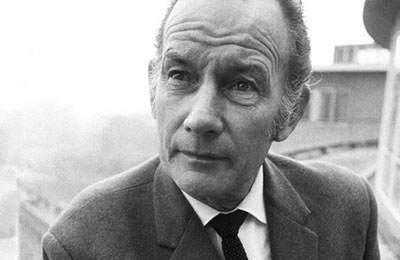
Memorie.al / Born in Scotland and educated in France and England, James Cameron has been a reporter for more than twenty-five years. As a chief foreign correspondent for the London News Chronicle, he was among the first Western observers to travel freely through Mao Zedong’s Red China; his account of life inside the Communist nation was presented in his book Red Mandarin, published in 1955. Now, he tells us how he managed to penetrate Albania.
Continued from the previous issue
A Tourist in 1960s Tirana
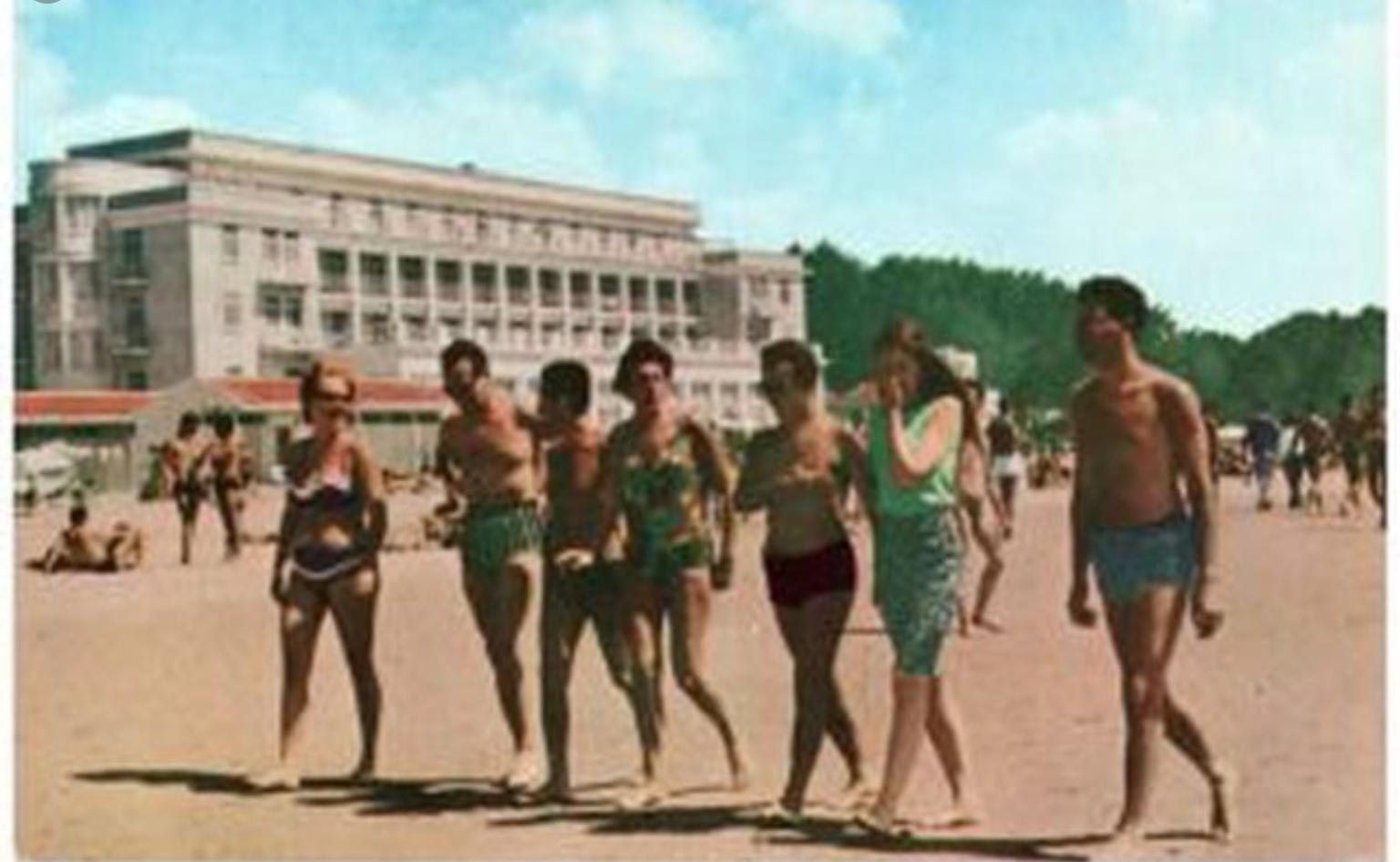
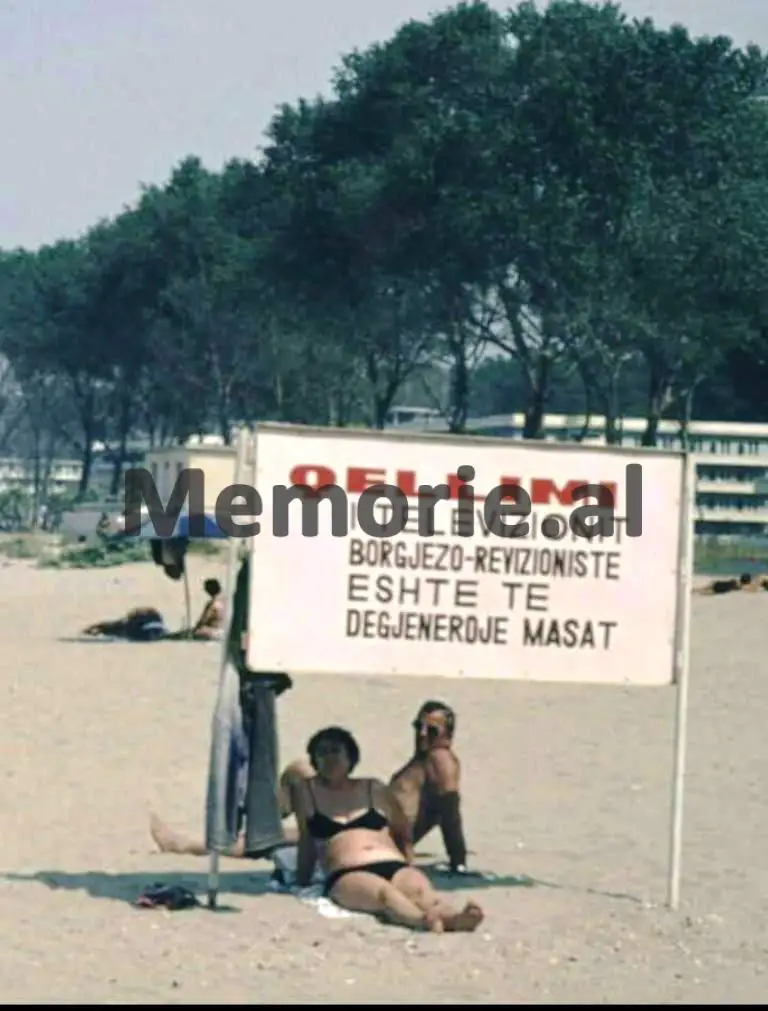
For anyone who’s greatest ambition was nothing more than relaxing after a day of sunbathing and a brain numbed by the sea, I suppose there was little wrong with the beach at Durrës. But for anyone seeking even a fraction more from the Albanian experience, it was a dull anesthesia. On either side of our hotel stretched other facilities – smaller hotels, villas, holiday homes, rest bases for trade unions and government institutions – and every single one of them was completely empty.
However new some of them were – indeed, some were barely finished, with glassless windows and unplastered walls – they had somehow already acquired an air of neglect and rejection. The seventeen of us staying at the Hotel “Adriatik” echoed and rattled around its emptiness like dried peas in a tin. Every day, the waiters “philosophically” set the restaurant tables for three hundred diners, yet every day they served the same seventeen guests.
The food was almost, if not quite, indescribably terrible. I am no gourmet at the best of times; moreover, over the years, I have eaten under such adverse circumstances and from so many truly horrific kitchens that I have come to consider myself almost as much a connoisseur of bad food as other men are of good. But here in Durrës, it was something that surpassed anything I can remember.
It is very difficult to define its nature, other than to say it was Balkan food taken to its most desperate conclusion: pasta that had been cooked – or apparently so – many days prior, then subjected to a process of compression; vague and impossible chunks of stale meat subjected to brief and insufficient heat; hollow tomatoes stuffed with a kind of vegetable sawdust.
It puzzled me that there should be no fish at all, until the explanation came: there were no fishermen. There were no fishermen because there were no boats. With Italy only fifty miles away across the Adriatic, who would allow a fisherman to cross the horizon, since he would surely never return?
Thus, for my stay in Durrës, I lived almost entirely on bread, which was remarkably good, and apricots, which were plentiful, and cognac, which was better than anything else. One crushing disappointment clouded the week: here was the first place in the entire world where I found a wine completely undrinkable – which is no small statement, as I can drink almost anything.
Throughout all our activities, so to speak, we were accompanied by and aware of a quite effective number of those who, in societies such as this, are inaccurately called “secret police.” They sat in corners, peered at and eavesdropped on couples at the edges of bars, and lurked around lobbies in a nearly invisible manner. They were always found grouped around tables in those uninviting, cold parts of hotel lobbies where no normal guest would ever sit, and whenever one caught their eye – which happened extremely rarely – they would drop their gaze to the table.
They were, by any standard, the most conspicuous secret police I have ever seen in a fairly long experience of their profession. They were always dressed in shirts and suits just slightly less worn and outdated than everyone else’s, and they stood out simply because they were better shaven. The only thing they had in common was their footwear: leather shoes, apparently produced by local factories, built in such a way that they emitted a harsh, piercing creak with every step.
These individuals had several names; they were called the “Sigurimi,” or sometimes “grains.” All societies run under this system invent euphemisms for their guards; for some reason, in Albania, they had come to be called “Historians.” It was not a bad name, combining respect, loathing, and a sort of loose accuracy.
The “Historians” rarely ventured into the blinding light of the seashore, preferring to sit together in their mysterious and silent group inside the hotel premises. Therefore, I spent most of my time in the sea or on the beach. In one direction lay a small pier or quay; in the other, there were only about two hundred yards to walk before coming upon the soldiers. They hovered around a concrete house, setting up their machine guns and spitting out cherry pits they had just finished chewing.
Beyond that point we could not go, “because,” I was told, “we have not yet cleared the minefields from the war.” It seemed a curious reason. After dusk, a battery of searchlights erupted from a cliff across the sea. Somewhere along that coast had been the site of the submarine base built years ago by the Soviet Navy. The Russians had withdrawn months earlier, but, according to legend, not before the Albanians had managed to seize two of the underwater vessels. But that was several miles away, somewhere to the south. Two hundred yards was the limit of my investigations, and being already in an awkward position, I was not prepared to push my luck.
Opposite the hotel, in the sea lanes outside the harbor of Durrës, a ship would occasionally enter or leave. One ship never moved, because it was half-sunken and rested at an angle on the seabed. Not long before our arrival, the inevitable had happened: one of these rare visitors to an almost deserted port had, by some incalculable error, chosen to cross the path of another, and against all imaginable odds, they had collided. That ship remained there throughout my time in Durrës and is undoubtedly still there.
Nevertheless, Durrës was the lifeline. The previous year, the Albanians had managed to import a cargo of grain; it had been bought by the Chinese from Canada, paid for in clearing rubles, and shipped across the Atlantic on West German vessels. Such was the connection to the outside world—as complicated as it was fragile.
I was already aware of a severe incapacity that I had subconsciously feared since the hour of my arrival in Tirana: I had nothing to read. This was not, as often happens, a result of bad management; by confiscating my books at customs, Albania had stripped me of all my resources. There was nothing to read in the hotel – nothing whatsoever, of any kind or in any language. It was as if the art of conveying thought through the written word had never been invented; Caxton had lived in vain.
I could have filled an hour or more trying to learn a word here and there from the main newspaper, Zëri i Popullit (The People’s Voice), but, as mad as it sounds, I was not allowed to have one. Stretching incredulity even further, when I asked our guide-cicerone to translate one or two headlines for me, he said that even this was not possible. Since it is a human belief that he might have feared anything other than the “institution of besa” had slipped into a publication as censored as Zëri i Popullit, I could only assume in the dark that this was part of my punishment for that unpardonable “isolation.”
If so, it was effective; I took to biting my nails for want of something to read. What I wouldn’t have given even for Tristram Shandy. I was, therefore, immensely relieved when the authorities suddenly told us we could go on an expedition. They would send us to Kruja, a hilltop town of great historical importance, about twenty miles up in the Central Mountains. We must stay together, they said, and not bring shame upon the country, and if anything went wrong, we must return by the same route. The trip to Kruja felt like liberation after the days spent on the beach at Durrës.
We were all accommodated in a very old “Ikarus” bus that looked less degraded than usual (it had two new tires, I noticed – one “Barum” from Czechoslovakia and one from New China), but nevertheless, I am sure it would not pass any known test in the Western world. I noticed with some alarm that the play in the steering wheel was so great that the driver seemed to steer the bus as if it were an ocean liner, spinning the wheel round and round at every turn.
For the first time, one could see that the village road behind the hotel was arched every 100 meters or so with banners, inscribed with congratulations for various high-ranking personalities or officials of the country’s leadership. The Albanian word for “Long Live” or “Hail” is very onomatopoeic, appearing with those two golden ‘r’s on the bright red fabric.
“Long Live the Party of Labor of Albania!” The banners read “Rroftë Partia e Punës e Shqipërisë” (they could well have done with just “The Party,” without the rest), and “Long Live Marxism-Leninism” and “Long Live Comrade Enver Hoxha!” (Another quirk of the Albanian language is this word shoku, meaning “Comrade,” pronounced “shok-u” and giving an extraordinarily fantastic sound to every greeting: “Good morning, Comrades!” “In the words of our great leader, Comrade Enver Hoxha…”)
The journey to Kruja was the most electrifying experience I had known for some time. The road – narrow, broken, and covered with bare stones, winding like hairpins – curves upward through landscapes of the most breathtaking beauty, which could not be appreciated by anyone so gripped by anxiety as they looked over the terrifying precipices around which we roared and skidded.
Something of our fear must have communicated itself to the driver, a wild-eyed highlander of boundless joy and confidence; as he pushed the creaking bus around the bends, he would sing: “Hup-la!” I was truly glad when we climbed the final terraces of olives and acacias and went cheering into the main square of Kruja.
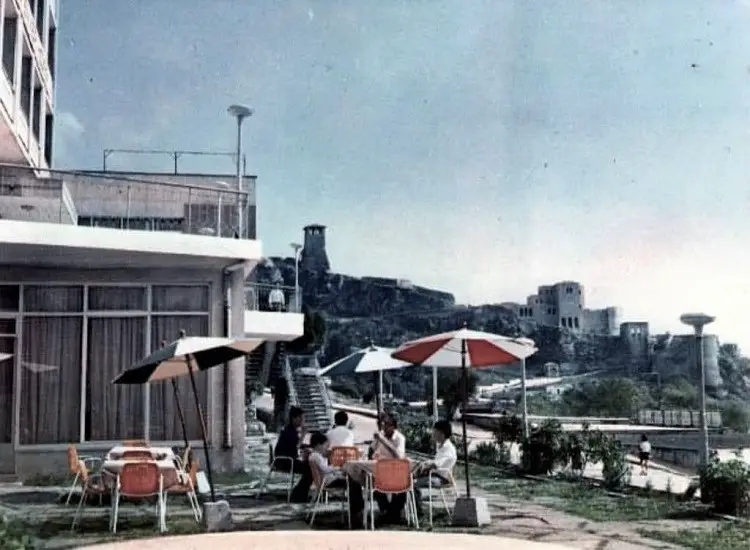
Kruja was truly impressive – a strange and wandering little town stretched across the slopes of a magnificent mountain; all red tiles and limestone, rose bushes and open channels, streets of large cobblestones that defied carts, and at the summit, the remains of a most prominent and dramatic fifteenth-century fortress. Kruja holds a special place in Albanian memories of historical pride because for years it was the home, fortress, and headquarters of the incomparable national hero, Skanderbeg.
The great Skanderbeg made the fastness of Kruja the enduring center of Albanian resistance against the Ottomans in the 1450s. He had been one of the Sultan’s most famous generals until he suddenly reunited with his people against his old master. For thirty-five years, then, his “eagle’s nest,” as the Kruja fortress was called, held out against the Turks, defying four sieges by 120,000 of the Sultan’s men. In the end, it was conquered only by hunger and that after Skanderbeg’s death.
Even now, five centuries later, the place seemed impregnable. From every corner of the town, the view stretched across several kilometers of wild mountain slopes – ridges like saws, valleys like wounds. We were given an hour to wander. It was so hot, and the opportunities for any kind of possible mischief so small, that the “Historians” gathered under the shade of a tree and smoked good tobacco. I walked up and down the main street of the bustling town and wondered at the extravagant number of barbershops, always full: did these heirs of bandits ever do anything other than cut hair?
I came upon a place like a café. Outside, it was marked in large letters: “Klub.” Calculating that the membership conditions were unlikely to be difficult, I entered and asked the neat little waitress for an ouzo – not because I particularly like Albanian ouzo (which, unlike the Greek variety, turns a menacing shade of green with water) but because it seemed the least ambiguous thing to order, and because it cost only eight lek, about five cents.
The club was full of silent men drinking ouzo and grouped in studied, abandoned poses, suggesting that at any moment they might rise and sing some operatic chorus of brigands. It was the reaction I was used to: every eye in the room turned at once to fix upon me for a long, reflective stare; then they turned away and did not look back.
It seemed extraordinary, in this country where the main slogan was “Work Above All,” how much endless time the citizens had for the simple “profession” of sitting still. Every small café, at almost any hour of the day, had half a dozen workers in baggy trousers dozing for more than a minute. When, one wondered, did they fulfill their norms, or were the norms in Albanian society set at a level that allowed for unlimited free time? Or, as I felt, was it that at least one part of every group, everywhere, was “guides”?
At this moment, I realized I had run out of matches and glanced at my neighbor at the next table to ask for a light. He offered me a box, which, with the friendliest smile, he urged me to keep. He could not have given me anything more diverting. Until this time, I had seen only one variety of matches – a brand called “Jumbo,” made in Poland, but whose label mysteriously declared itself to come from an Indian firm of distributors in that most unlikely of countries, Mauritius.
This had seemed “rum” enough, but my new variety was even more extraordinary, as it was called (even in English) “Channel Island Match,” and its label bore an unmistakable map of Jersey and Guernsey – the most improbable sources of matches in the world.
As I pondered this, a uniformed policeman entered the Club, his long boots creaking like rusty gates, and sat at a table. Immediately, the silence became somehow more curious and more profound. Without anything obvious happening, one was aware of a different kind of stillness. Moreover, in a way impossible to explain, it became immediately clear which of the customers in the Club at that moment were “guides” and which were not.
The policeman ordered nothing and very soon walked out. Within a few minutes, I heard the bus in the square, waiting for our return.
We went back to the beach at Durrës, and life returned to normal with a variant of electrifying excitement: that Saturday, we had visitors. Albania, it seemed, also had an unpleasant weekend, and for an hour or two, our deserted playground took on a small but encouraging appearance of a controlled holiday. Up and down, there were small parties of Albanians on their day off, drinking beer in the sun, feeding their babies, playing with rubber balls.
On our special terrace at the Hotel “Adriatik,” the VIPs appeared – a party of Czechs with bronzed skin, and certain there was no food, they ordered a round of lemonades. Then another party arrived – a dozen Chinese – who settled at the extreme end of the terrace in a narrow enclave, which the hotel staff isolated even further by removing chairs to empty the hall. And finally, with no greeting to be seen, a quiet, civilian man in swimwear said, smiling: “J’ai le plaisir de vous dire bonjour.”
In the People’s Republic of Albania today, only three Western missions remain: the French, the Italian, and the Turkish. They are the remaining diplomatic corps, the “Robinson Crusoes” of Foreign Affairs. Their buildings – a trio of small villas in Tirana – are obscure, their movements strictly limited, their housekeeping problems formidable. One of them was our visitor at the beach in Durrës. He had heard of our presence; he possessed a perfect and brilliantly attentive manner, for which I pray he will one day be rewarded with the highest possible preference – the chance to put away a bottle of diplomatic whiskey.
Before leaving, the lonely diplomat sighed a little and said: “Life could be worse for the three of us, but it would be untrue to hide that it is extremely boring. Truly, deadly. There is no chance for an American acquaintance. I once wondered, idly, if the British might be attached to this country one day. I am not passionately engaged in politics. But it would be wonderful to have, finally, a fourth for bridge!” The next day, the relevant authorities came with their bus to take me to Tirana. Finally, there was a plane to Bari and on to Rome.
One final argument remained. Since my return ticket to Amsterdam was useless now, it was necessary to pay for a new one, and, they said in a tone at once tense and careless, I had to pay in US dollars. “In dollars?” I asked reproachfully, “surely not for you?” “It is the rule,” they replied impatiently; fifty dollars and sixty cents.
Now, it happened that I was allowed to pay in dollars for my person; moreover, I had the exact sum in my possession. At this, they were scornful; they would not allow me to use coins. How, then, could I produce fifty dollars and sixty cents without using coins? “Give us,” they said, “the next banknote.”
The only US banknote I had left was a five-dollar bill. “From this,” I asked, “do I get change?” “Of course,” they replied. “In what?” “Why,” they said – starting to lose patience – “in lek.” I must give you five dollars, so I take four dollars and forty cents back in lek? “And what do I do with that lek?” “Well,” they replied, “there is this difficulty: you are not allowed to export lek.”
“So,” I said, “not without premeditation, you propose to confiscate my change and keep four and a half dollars; I’ll be damned if I agree to such a deal.” “It’s the rules!” they shouted, but the bus was already moving; the “guides” were signaling frequently, telling us we were late. They snatched the fifty dollars and gave me my ticket, but they stood their ground: they took no coins. Albania owes Great Britain three million pounds for those three ships destroyed by sea mines in the Corfu Channel in 1946; I owe Albania sixty cents.
They drove me back through Durrës to the outskirts of Tirana, passing the hurried lines of people I had never known – people who looked and acted as their fathers once had under Mussolini, under Zog, under the endless succession of Sultans and Kings. And the leaders who had ruled and exploited them; all the conquests they had overthrown, only to fall into another.
They may never have been free men, but they looked like free men. They had the highest birth rate in all of Europe, and their children were clearly loved. They lived there and were not, perhaps, obsessed with the curiosities of inter-Marxist rifts. When I smiled, they smiled back immediately.
When I reached the airport, the plane was waiting. A “guide” took me aside quickly – the first one I had really spoken with. In broken French, he told me: “I should have offered you cognac; I am sorry about the books.”/Memorie.al