
Dashnor Kaloçi
Part Three
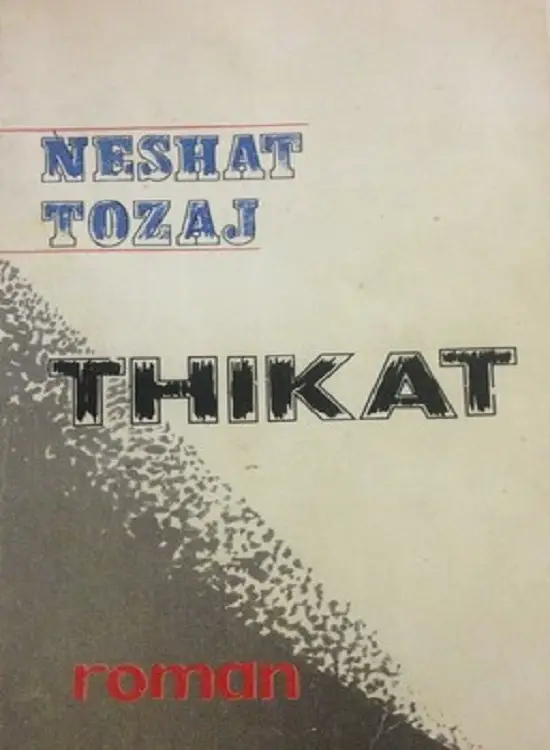
Memorie.al /publishes several archival documents extracted from the Central State Archive in Tirana (from the former Central Committee of the PPSH), taken from a dossier marked “secret” dating from the years 1980-1982, which deals with the sensational incident of the slashing of tires of several vehicles belonging to the foreign diplomatic corps accredited in Tirana. Following Enver Hoxha’s great concern and his phone call to the Minister of Internal Affairs, Feçor Shehu, to whom, in the height of his anger, the “Commander” said: “If you do not find out within 24 hours who and why damaged the vehicles of foreign embassies in Tirana, find a hole and crawl into it!” The alarm raised by the Minister of Internal Affairs, Feçor Shehu, who called all the main directors of the ministry he led to an emergency meeting and after making clear to them the “Commander’s” great concern that the event might create a diplomatic incident with several states, the State Security organs and other structures of the Ministry of Internal Affairs, within 24 hours, managed to uncover the author of the “crime”, Prendushme Deda, a worker of the Capital’s Municipal Enterprise who worked in street cleaning, who was caught red-handed in front of the “Dajti” Hotel while slashing the tires of some of the vehicles of the diplomatic corps in Tirana. The rare testimony of the former Director of the Central Forensic Laboratory of the Ministry of Internal Affairs, Neshat Tozaj, given shortly before he passed away, regarding the heated debates and his clash with Minister Feçor Shehu, when he, as head of the laboratory he directed, refused to sign the expert report that would classify the cutting tool used by the cleaning worker to slash the tires of some vehicles with “CD” plates as a “cold weapon”! Feçor Shehu’s threat to his subordinate, whom he immediately dismissed from his post, sending him as a scriptwriter to the “New Albania” Film Studio, and Tozaj’s long odyssey to restore his honor and dignity, sending letters of complaint to Prime Minister Mehmet Shehu and then to Enver Hoxha. This caused and brought about the first cooling and clash between the two highest leaders of communist Albania at that time! Enver’s accusations against Mehmet Shehu, as to why he had kept the sensational event that shook official Tirana hidden (for fear of a diplomatic incident with several states), where after his death and the arrest of Kadri Hazbiu and Feçor Shehu, that event re-emerged “on stage” and as a result, all members of the “hostile group” who had been accused of damaging the vehicles of foreign embassies were released from prison and internment, and Neshat Tozaj was reinstated to his workplace. A few years later, he wrote the novel “The Knives”, which would cause a great sensation at the time!
Continued from the previous issue
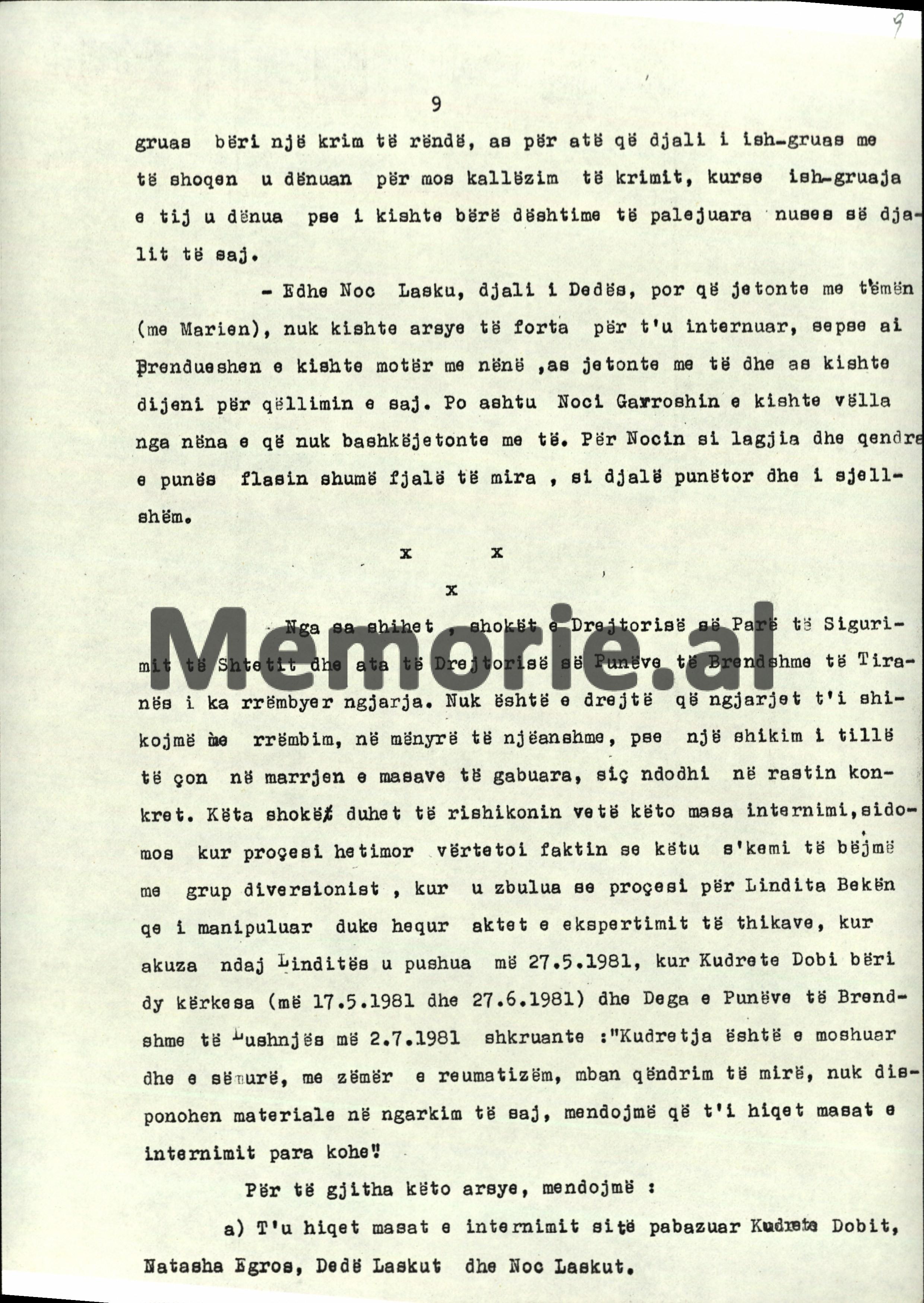
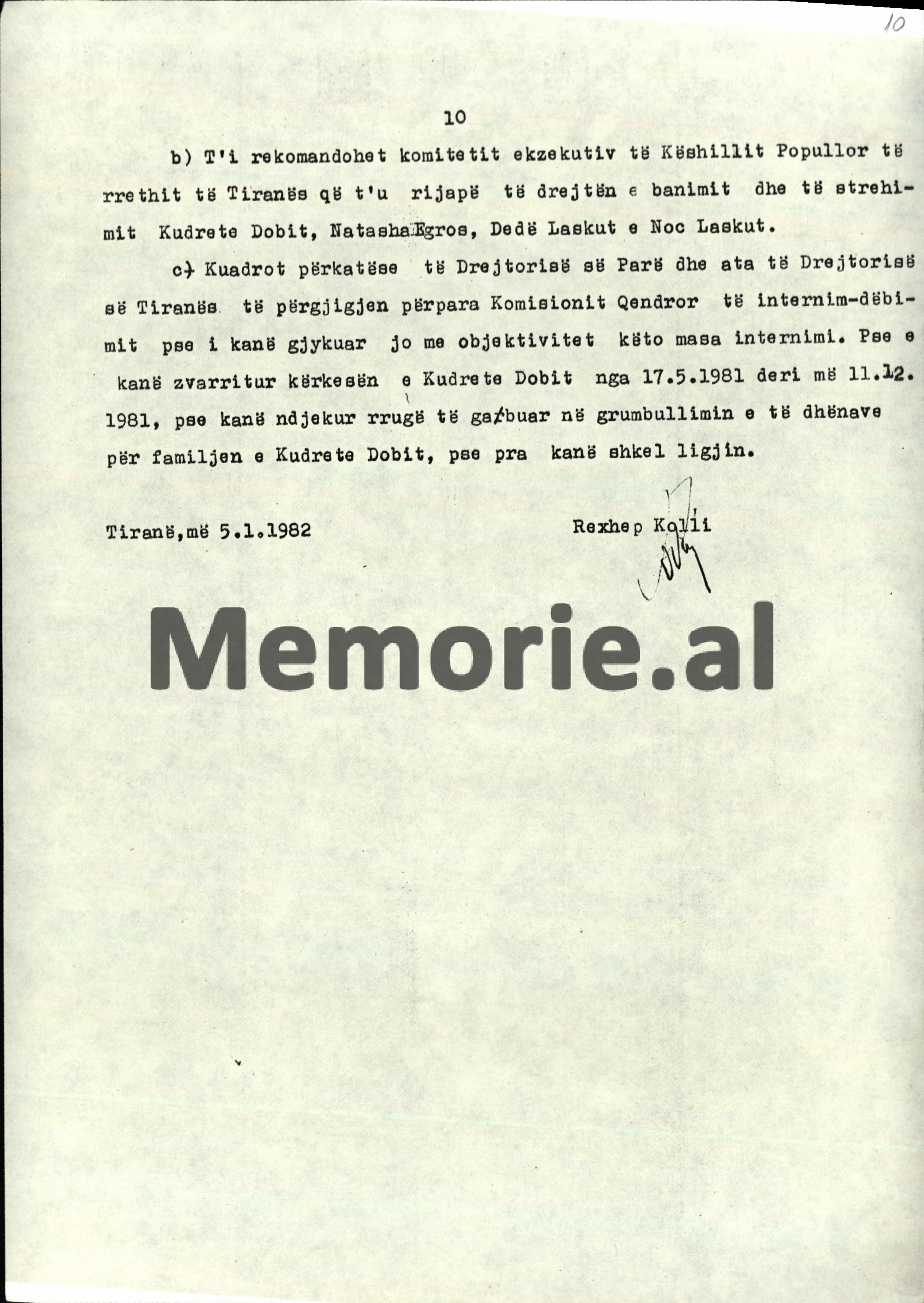
The secret document with the report drafted by Rexhep Kolli, a high functionary in the apparatus of the Central Committee of the PPSH for the organs of the Ministry of Internal Affairs, sent to his superiors, regarding the problem of the “Hostile criminal group” that had been arrested and sentenced for damaging the vehicles of foreign embassies in Tirana!
Secret Date: 16.3.1982
R E P O R T
Comrades Zef Loka, Elham Kadia and Koço Josifi, on 8.12.1981, told us that they had decided to call Lindita Beka as a witness in the trial of Perikli Shqevi and then to advise her, while regarding K. D., they gave the opinion that she should be released from internment.
Three days later, the Director of the First Directorate of State Security reports that supposedly, the comrades of the Tirana Directorate “as early as October 1981 verbally expressed the opinion that their proposal made officially on 4.8.1981 should not be taken into account, since several issues had arisen that needed clarification”!
On 25.12.1981, comrade Zef Loka told us that we finally decided that: they should advise Lindita Beka after the trial of Perikli Shqevi, where she had been called as a witness, is over.
So, what are these oscillations and which one stands, that which comrade Zef told us on 8.12.1981 and on 25.12.1981, or that which comrade Kadri Gojashi says in the report dated 11.12.1981?
We say it once again that these are not correct actions; they show that the comrades have not properly internalized the Party’s materials and comrade Enver’s lessons on objectivity, the spirit of partisanship in handling issues, on carefully distinguishing the hostile from the non-hostile.
They do not see that with their illegal actions, they unjustly condemned this girl, interned her family, and when she was proven innocent, they did not apply the law for her to return to her workplace and give this girl moral and material satisfaction; they caused her to fall into mistakes by leaving her without work, without pay, and without a home.
- Dedë Lasku and with him his son Noci, were interned on 6.11.1980 with the justification: “Seeing that his son (Gavroshi) and his wife Lefkothea, have been arrested for serious crimes.”
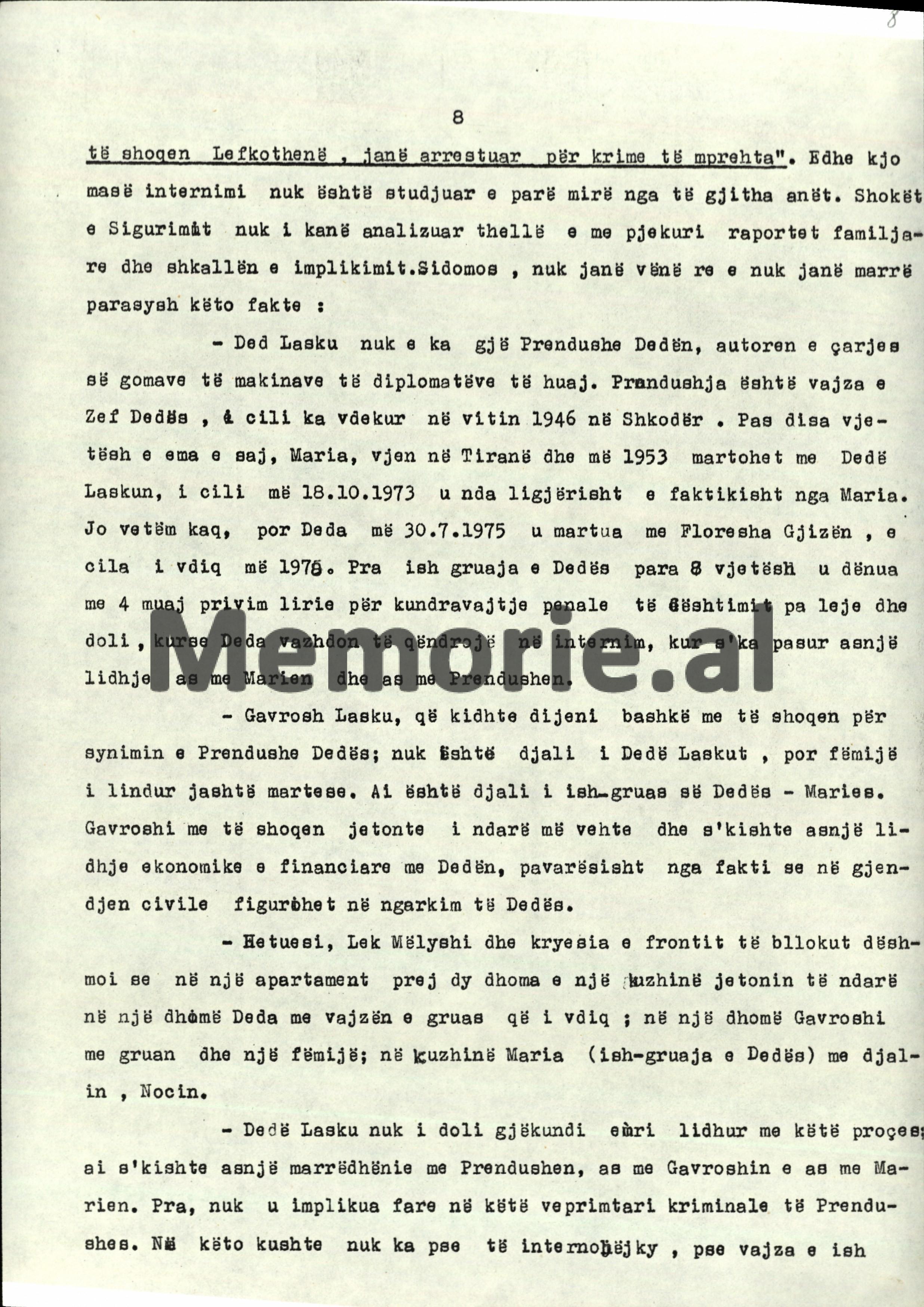
- This internment measure too has not been studied and examined properly from all sides. The Security comrades have not deeply and maturely analyzed the family relations and the degree of implication. In particular, these facts have not been noticed or taken into account:
- Dedë Lasku has no relation to Prendushe Deda, the author of the slashing of the tires of foreign diplomats’ cars. Prendushja is the daughter of Zef Deda, who died in 1946 in Shkodër.
- After a few years, her mother, Maria, comes to Tirana and in 1953 marries Dedë Lasku, who was interned in 1975. So Dedë’s former wife was sentenced 8 years ago to 4 months imprisonment for a criminal offense of unauthorized departure and was released, while Deda continues to remain in internment, even though he has had no connection with either Maria or Prendushe.
- Gavrosh Lasku, who together with his wife knew about Prendushe Deda’s intention, is not Dedë Lasku’s son, but a child born out of wedlock. He is the son of Dedë’s former wife – Maria.
- Gavroshi and his wife lived separately and had no economic or financial connection with Dedë, regardless of the fact that in the civil status records he was listed as Dedë’s dependent.
- The investigator, Lek Mëlyshi, and the presidency of the Block Front testified that in an apartment of two rooms and a kitchen, living separately in one room were Deda with his deceased wife’s daughter, in another room Gavroshi with his wife and one child, in the kitchen Maria (Dedë’s former wife) with her son, Noci.
- Dedë Lasku’s name did not appear anywhere in connection with this trial; he had no relationship with Prendushe, nor with Gavrosh, nor with Maria. So he was not implicated at all in Prendushe’s criminal activity.
- In these circumstances, there is no reason for him to be interned, neither because his former wife’s daughter committed a serious crime, nor because his former wife’s son and his wife were convicted for failure to report a crime, while his former wife was convicted because she made unauthorized visits to her son’s bride.
- Even Noc Lasku, Dedë’s son, but who lived with his mother (Maria), had no strong reasons to be interned, because he was Prendushe’s half-brother (same mother), neither lived with her nor knew of her intention.
- Likewise, Noci considered Gavrosh a half-brother (same mother) and did not live with him. Regarding Noci, both his neighborhood and his workplace speak many good words, as a hardworking and well-mannered boy.
***
From what is seen, the comrades of the First Directorate of State Security and those of the Tirana Internal Affairs Directorate have been swept away by the event. It is not right to view events with haste, in a one-sided manner, because such a view leads to mistaken measures, as happened in this concrete case.
These comrades should have reviewed these internment measures themselves, especially when the investigative process proved the fact that we are not dealing with a diversionary group, when it was discovered that the case against Lindita Beka had been manipulated, by removing the knife expert reports, when the charge against Lindita was dismissed on 27.5.1981, when K. D. made two requests (on 17.5.1981 and 27.6.1981) and the Lushnjë Internal Affairs Branch, on 2.7.1981 wrote:
“Kudretja is elderly and sick, with heart and rheumatism, she behaves well, no material is available against her, and we think that the internment measures should be lifted prematurely.”
For all these reasons, we think:
- The internment measures should be lifted as unfounded for K. D., N. E., Dedë Lasku and Noc Lasku.
- It should be recommended to the Executive Committee of the Tirana District People’s Council to restore the right of residence and housing to K. D., N. E., Dedë Lasku and Noc Lasku.
- The respective cadres of the First Directorate and those of the Tirana Directorate should answer before the Central Commission for Internment-Exile as to why they have judged these internment measures without objectivity. Why they followed a wrong path in gathering data on K. D.’s family, why they violated the law.
Tirana, 5.1.1982 Rexhep Kolli
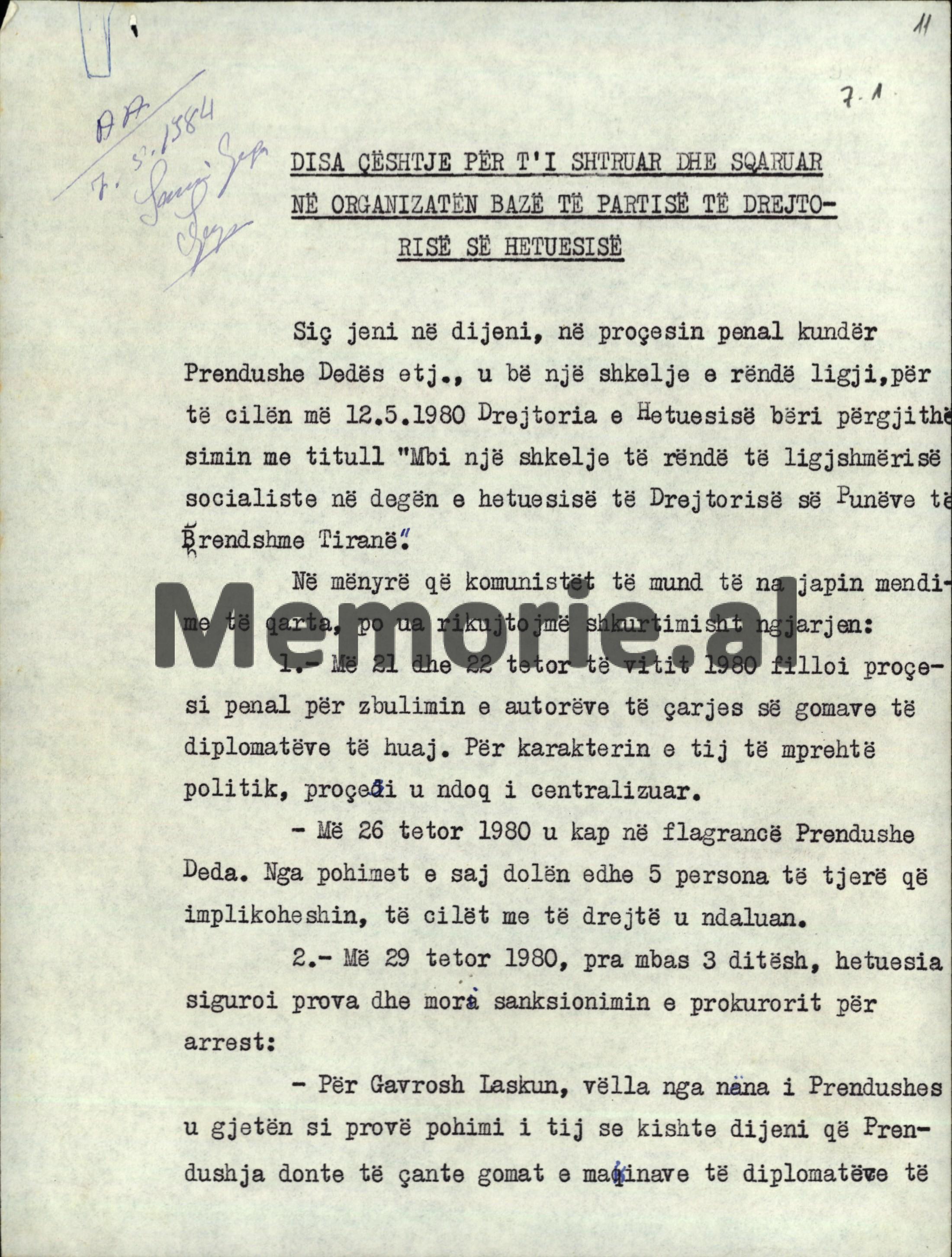
SOME ISSUES TO BE PRESENTED AND CLARIFIED IN THE BASE PARTY ORGANIZATION OF THE INVESTIGATION DIRECTORATE
As you are aware, in the criminal trial against Prendushe Deda et al., a serious violation of the law occurred, about which on 12.5.1980 the Investigation Directorate made a generalization entitled “On a serious violation of socialist legality in the investigation branch of the Tirana Internal Affairs Directorate”.
So that the communists can give us clear opinions, we will briefly remind you of the event:
On October 21 and 22, 1980, the criminal trial began to discover the perpetrators of the slashing of the tires of foreign diplomats’ vehicles. Due to its sharp political character, the trial was followed in a centralized manner.
On October 26, 1980, Prendushe Deda was caught red-handed. From her statements, 5 other implicated persons emerged, who were rightly detained.
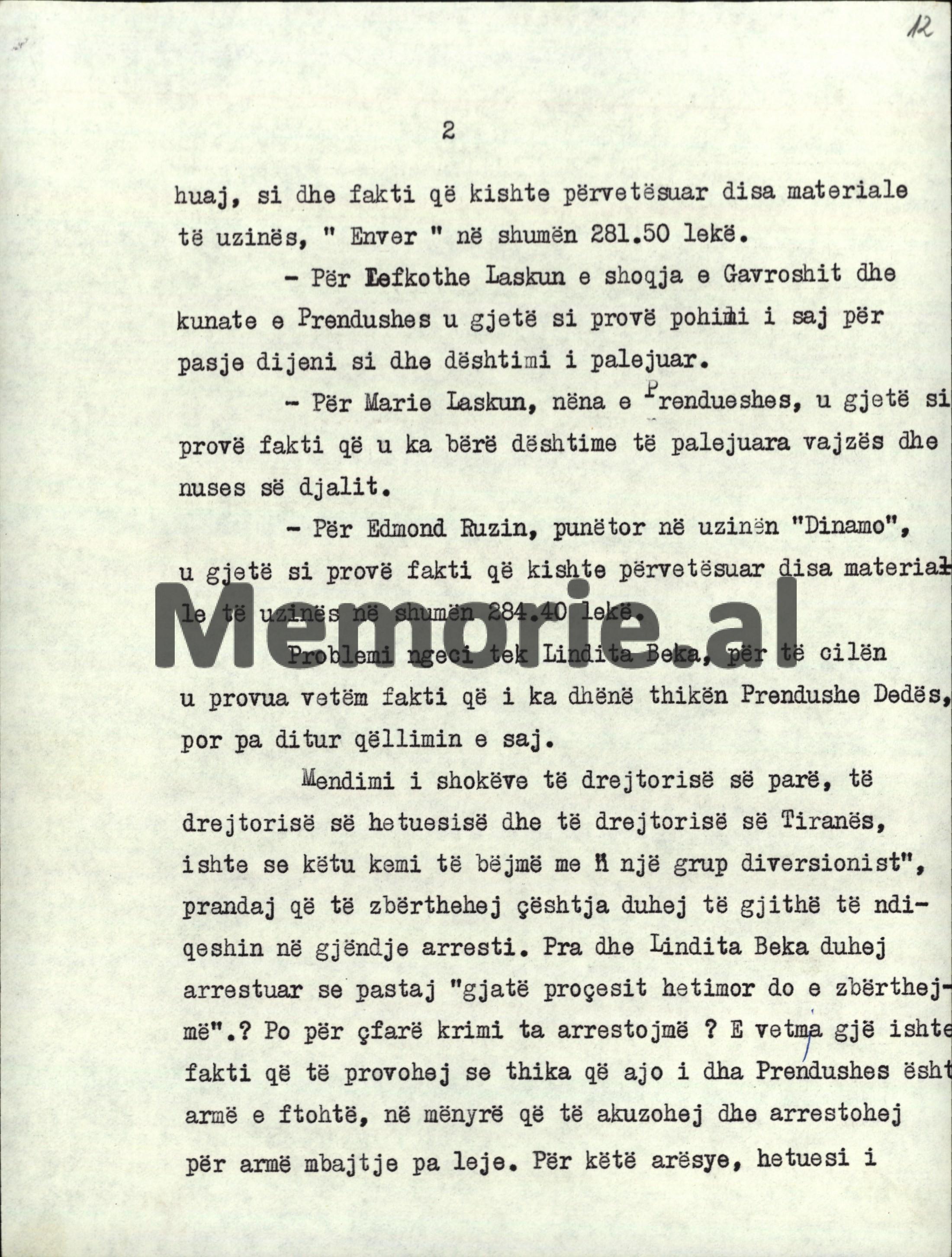
- On October 29, 1980, i.e., after 3 days, the investigation secured evidence and obtained the prosecutor’s sanction for arrest:
For Gavrosh Lasku, Prendushe’s half-brother (same mother), evidence found included his statement that he knew Prendushe wanted to slash the tires of foreign diplomats’ cars, as well as the fact that he had embezzled some materials from the “Enver” factory worth 281.50 lek.
For Lefkothe Lasku, Gavrosh’s wife and Prendushe’s sister-in-law, evidence found included her statement of having knowledge as well as unauthorized absence.
For Marie Lasku, Prendushe’s mother, evidence found included the fact that she made unauthorized visits to her daughter and her son’s bride.
For Edmond Ruzi, a worker at the “Dinamo” factory, evidence found included that he had embezzled some factory materials worth 284.40 lek.
The problem stalled with Lindita Beka, for whom only the fact that she had given the knife to Prendushe Deda, but without knowing her intention, was proven.
The opinion of the comrades from the First Directorate, the Investigation Directorate, and the Tirana Directorate was that we are dealing with “a diversionist”, therefore to unravel the issue, everyone should be kept under arrest. So Lindita Beka should also be arrested because then “during the investigative process we will unravel it”?
But for what crime should we arrest her? The only thing was to prove that the knife she gave to Prendushe is a cold weapon, so that she could be accused and arrested for illegal possession of a weapon. For this reason, the case investigator, Sokol Koleka, turned to the Central Forensic Laboratory for forensic examination of the knives.
On 28.X.1980, Neshat Tozaj and Anesti Prifti drafted expert report No. 145, concluding that the knives are not cold weapons.
On 29.X.1980, Kapllan Koka drafted expert report No. 146, concluding that: the knife found on Prendushe meets the characteristics of a cold weapon, while the knife found at Edmond Ruzi’s workplace meets some of the characteristics of a cold weapon.
The case investigator, comrade Sokol, again turned to the Central Forensic Laboratory and the Laboratory on 29.X.1981, with act No. 101, concluded that the knives found on Prendushe Deda and Edmond Ruzi do not meet the conditions of cold weapons; the conclusion given in act No. 145 dated 28.8.1980 is well-founded, while that of act No. 146 dated 29.X.1980, made by expert Kapllan Koka, is not well-founded.
In these circumstances, the Tirana investigation decided and released Lindita Beka on 29.X.1980. It was reported to comrade Elham and he informed the minister.
Comrades Elham Gjika, Neshat Tozaj, Sokol Koleka, Kapllan Koka and Faredin Poçari were called to the minister. Comrade Feçor also held the opinion that this girl should be arrested, so he told these comrades that as experts, they should review the conclusions once more.
Neshat Tozaj refused to participate in a re-examination, maintaining the opinion given in acts No. 145 dated 28.X.1980 and No. 101 dated 29.X.1980.
Faced with this fact, Sokol Koleka was ordered to call comrades Faredin Poçari and Kapllan Koka as experts. These two comrades drafted the expert report on 29.X.1980, while the case investigator’s decision to call them as experts was made on 30.X.1980.
Not only that, but comrade Faredin Poçari corrected the investigator’s decision, removing all those parts where it was stated that previous expert reports had been made. So, with a change of decision, the traces of the three previous acts were erased, leaving only the act drafted by Faredin Poçari and Kapllan Koka, which classified the knives as cold weapons. /Memorie.al
Rexhep Kolli
Tirana, 7.1.1982