Introduction
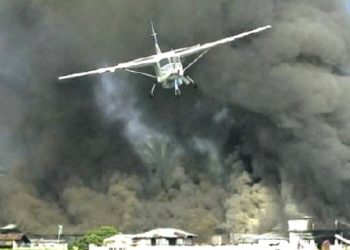
Memorie.al/ On the morning of October 29, 1944, the Royal Air Force (RAF) Halifax JP 244,148 squadron took off from Brindisi on a special mission to deliver supplies as part of the Special Operations Executive (SOE) to Albania. The plane was to land supplies on the plateau of the mountains of Çermenika in Albania. Shortly after takeoff, communication with the crew was lost. The plane caught fire and crashed, taking with it the lives of the crew members on board. They were: Pilot Edwin John Stubley, Sergeants Charles Mabbs (pharmacist), Alfred Coote (driver), John Thompson (railway worker), Ernest Logan Brown (policeman), Austin Donnelly (glass transporter), and Richard Charles Knee (clerk).
Precisely for this reason, on October 20, 2021, at the British War Memorial in Tirana Park, a ceremony will be held in honor of British Sergeant Peter Twiddy, led by the British Ambassador to Tirana, H.E. Alastair King-Smith.
WHAT WERE THE SPECIAL OPERATIONS EXECUTIVE (SOE)?
In the course of World War II, with the fall of France into Nazi hands, the immediate need arose to create a British volunteer fighting force that would wage a different kind of war against Hitler’s armies. This force was named the Special Operations Executive (SOE). Its mission was to carry out acts of espionage and sabotage behind Nazi lines. The fighters of this formation would derail trains, blow up bridges, and sabotage weapons factories. They would help organize guerrilla warfare in all countries occupied by the enemy.
On July 16, 1940, British Prime Minister Winston Churchill appointed Hugh Dalton as the political head of the SOE and immediately ordered him to begin field operations. The organization employed 13,000 members, of whom 3,200 were women. It was officially disbanded on January 15, 1946. SOE agents in June 1941 managed to blow up the French Pessac power station. This act was received in London as a success and created the conviction that it was not only bombs that would destroy the German war machine. This operation led to hundreds of others across Europe and as far as the Far East, in Japan. In 1942, an SOE squad killed Hitler’s deputy, Reinhard Heydrich, with a grenade. In Greece in 1942, they destroyed the Gorgopotamos Bridge, cutting off supplies to Rommel’s army in the desert. In Norway, they destroyed a heavy water plant, ending the Nazi dream of producing an atomic bomb. The SOE could strike the enemy at any time and any place.
WHAT WAS THE ROLE OF THE SOE IN ALBANIA?
Among the most important actions undertaken by Great Britain toward Albania was the inclusion of our country on the SOE operations map. A large number of British boys and girls came to Albania to face a completely unfamiliar terrain and situation.
Besides other countries such as France, Poland, Germany, Holland, Belgium, Italy, Yugoslavia, Hungary, Greece, Crete, Czechoslovakia, Norway, Denmark, Romania, Abyssinia, and Southeast Asia, the SOE also operated in Albania. A small liaison group entered Albania from Greece in 1943. The SOE agents included Julian Amery, Anthony Quayle, David Smiley, and Neil “Billy” McLean.
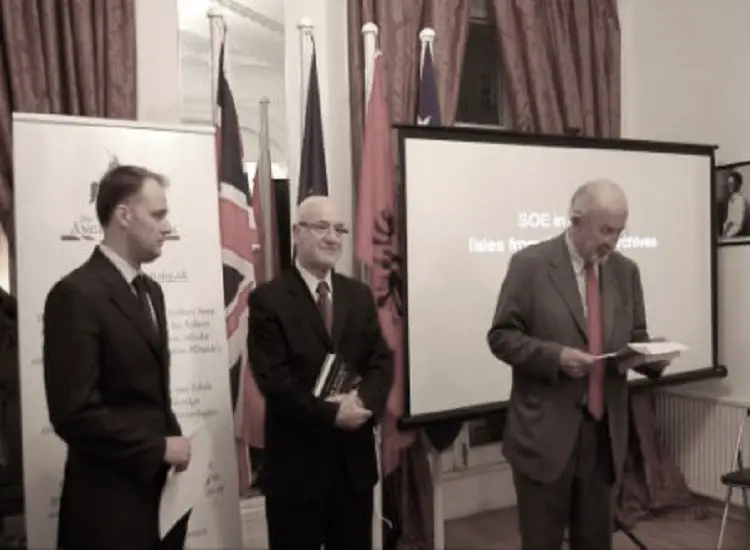
How did SOE operations develop in Albania? This has been best described by Roderick Bailey in his book The Wild Province.
SOE ON ALBANIAN SOIL
According to Roderick Bailey, in 1943 a small elite team of British soldiers began parachuting into the mountains of occupied Albania. They were members of the SOE and their task was to find and arm guerrilla bands and attack the enemy as much as possible. They had never set foot in Albania and did not know what awaited them there.
Struggling to survive in extreme conditions and in very difficult terrain, these young British men lived under the constant risk of falling into enemy hands, where certain death awaited them. Besides diseases and the impossibility of a clean life, there was also the fact that the Albanian guerrillas were in conflict with one another. In this extraordinary book, the author used interviews with survivors, long-hidden diaries, and recently declassified documents that testify to the extraordinary story of the SOE in Albania.
According to its documents, by 1945 the SOE had sent to Albania 7,000 rifles, 5,000 semi-automatic weapons, 1,800 light machine guns, along with 16.5 million rounds of ammunition, 240 mortars with 25,000 bombs, and 25,000 grenades, in addition to pistols and sixty semi-heavy machine guns. They also sent 28,000 pairs of military uniforms, 57,000 pairs of military boots, 14,000 blankets, 390 lanterns, 6 jeeps, and one motorboat. They also sent hundreds of tons of food.
Of the first group of 50 British who landed in Albania, 16 were killed while 17 survivors were decorated. During that period of SOE activity in Albania, 53 members of these forces lost their lives.
The author begins his dramatic narrative with excerpts from Ismail Kadare’s work *The General of the Dead Army*. The story of the bone remains of these fallen British is very painful. They can by no means be regarded as invading enemies of Albania. On the contrary, they came as liberators and gave their lives to encourage and help the Albanian people to liberate themselves from fascism and Nazism. The SOE was officially disbanded on January 15, 1946. After the war, they made great efforts to recover the remains of their fallen, both everywhere else and in Albania.
The regime of Enver Hoxha, which had taken a completely pro-Yugoslav and later pro-Soviet course, placed many obstacles in the way of the British recovering the remains of their sons and daughters. The author tells how, despite all the government’s obstacles, an officer named MacIntosh found extraordinary support among the Albanian people, who were so generous to him. Thus, in February 1946, after going village to village and shore to shore in search of them, he managed to collect the remains of the British fallen in Albania. Unfortunately, MacIntosh was expelled by the Albanian government as a “reactionary and enemy of the Albanian people,” and his mission remained unfinished. But the worst had not yet happened. The British government entrusted the task of retrieving the remains to the French embassy. In 1950, a French attaché went to visit the British cemetery in Albania.
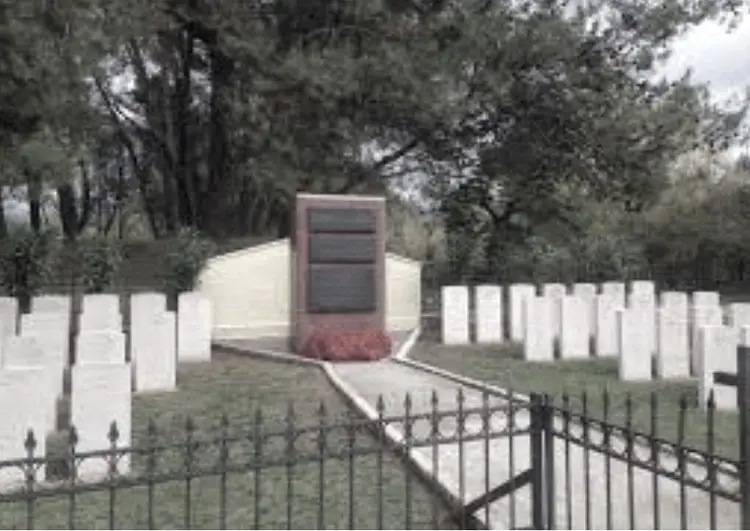
He found no trace of them. The Hoxha government had hidden them and would not allow even the dead to rest in peace in their own place. The right of these people to rest in a quiet place was “won” only after the fall of the communist dictatorship in Albania. They were gathered and placed in a cemetery in Tirana Park.
On November 11, 2012, the British Ambassador to Tirana, H.E. Mr. Nicholas Cannon, and the then Prime Minister Dr. Sali Berisha organized a memorial service at the British cemetery in Tirana Park. There were 53 fallen, but only 46 of them have headstones above their graves.
Albania owes a debt of honor to these fallen for their contribution to the liberation of our country. After returning home, the SOE veterans who served in Albania served their country in various fields of life. Many of them became distinguished people and accomplished politicians. Let us highlight a few:
Harold Julian Amery, Baron Amery of Lustleigh (1919–1996), British Conservative politician who served three decades as a leading figure of that party and 42 years as a member of parliament. He served as an SOE liaison officer for the Albanian anti-fascist resistance movement in 1943–1944 as part of the group called the “Three Musketeers,” together with Major David Smiley and Colonel Neil McLean.
John Anthony Quayle (1913–1989), a great English theater actor, served as a British secret service officer during the war. In 1943, he arrived in Tragjas, Albania. After the war, he devoted himself to acting and directed the Shakespeare Memorial Theatre, where he laid the foundations for the creation of the Royal Shakespeare Company. He played the roles of Falstaff, Othello, Henry VIII, and also performed with Laurence Olivier, and has an endless gallery of roles. For us Albanians, he remains a beloved figure, not only because he served in Albania but also because he was a permanent active member of the Anglo-Albanian Association (AAA).
Colonel David Smiley (1916–2009) was a British secret service officer. In World War II, he fought in Palestine, Iraq, Persia, Syria, and also operated with the SOE in Albania and Thailand. He wrote the book Albanian Assignment.
Margaret Hasluck (1885–1948) served in the SOE. After the war, and after the execution by the communists of her Albanian friend Lef Nosi, she fell seriously ill and died in poverty in Dublin in 1948. She was helped by her SOE friends in the last days of her life, anonymously.
Billy McLean (1918–1986). In 1943, McLean joined SOE missions and parachuted into occupied territories in Albania. In April 1944, McLean, together with a small team called the “Three Musketeers” – which included David Smiley and Julian Amery – tried to reconcile the different political groups in Albania to fight together against the Nazis, but they could not achieve it. He served ten years as a member of the British Parliament.
THE STATUE OF THE SOE HEROINE IN LONDON
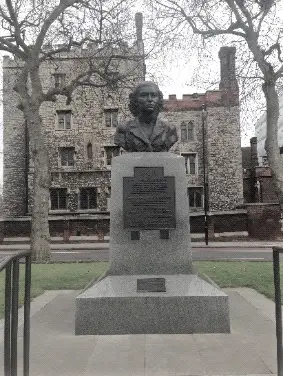
In London, there is a bronze statue representing the members of the SOE. Whenever I passed along the River Thames, on the road leading from Lambeth Bridge to the London Eye, I would stop in front of that bust. It is the monument of a woman with a very sharp gaze, a very beautiful portrait, with very regular features, looking far away. In it, you find no deformation expressed as a phenomenon of modern art; it preserves the proportions and natural ratios of a classical sculpture, carved on the basis of the principles of realistic aesthetics. There is neither glorification nor added features to make her a super-human, super-heroine, super-woman, super… In it you find all that the famous French sculptor Auguste Rodin would teach his students about the form-content ratios of a sculptural work. And why not, also our own Odhise Paskali.
I have stopped many times in front of that bust. I have even photographed it every time I passed by. On one occasion, I used its photo in my book Albanian-British Realities as an illustration in the part dealing with the British group known as the Special Operations Executive.
This portrait is dedicated precisely to those brave people who managed to enter the Nazi enemy’s rear lines across Europe.
I would stop with respect in front of it every time I passed by, because it represents those who saved the world from catastrophe. One day during my walks along the Thames, I met the author of that sculpture.
He was Ivan Saxton, and he was cleaning that bust with his own hands. He told me how he had made that work, using as a model a member of the SOE who had lived in that area of London where the bust stands.
“That heroine inspired me for this work, and she also posed for me,” Ivan told me. “In fact, I saw in her features so many elements of a representative of this organization. I tried to express them all in one portrait.”
The Special Operations Executive is the only foreign soldiers in the long history of Albania who came to our country not as conquerors but as liberators.
Therefore, I will go with respect and desire to participate in the ceremony organized by the British Embassy in Tirana Park on October 20, 2021, at 11:00 a.m., at the invitation of the British Ambassador to Tirana, H.E. Mr. Alastair King-Smith./Memorie.al