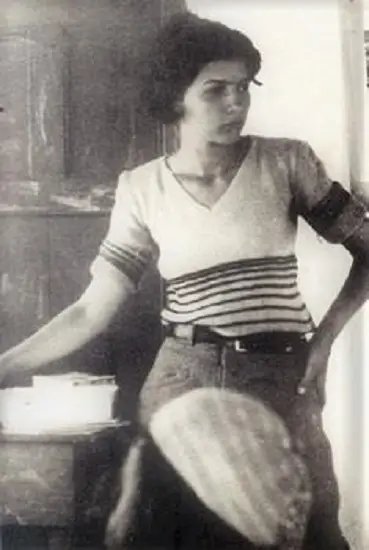


Memorie.al/Sabiha Kasimati, one of Albania’s outstanding intellectual women and the country’s first female scientist, was executed by firing squad simply for being such. It is no coincidence that she came from a well-known intellectual family from Libohovë. Her father, Abdurrahman Kasimati, had completed his university studies in medicine in Turkey, where he worked as a doctor and lived with his entire family until 1927.
In that year, he returned to Albania, first settling in Korçë, then in Elbasan, where he served as a doctor and enjoyed the respect and gratitude of the citizens, as well as the esteem and friendship of that city’s notable figures: Aqif Pasha Elbasani, Lef Nosi, Visarion Xhuvani, Ethem Haxhiademi, Sotir Paparisto, Aleksandër Xhuvani, and others.
Sabiha Kasimati was born in Edrene (Adrianople), Turkey, on September 15, 1912. She spent her childhood there, nurtured by her parents with love for Albania as well as for European culture.
When the family returned to their homeland, she settled with her brother in the city of Korçë, where she began her studies at the French Lyceum of that city. She was the first woman to graduate from this Western school, in 1930. As a student, she already mastered several Eastern and Western languages, and spoke French so excellently that she amazed even the French professors at the Lyceum.
After graduating from the Korçë Lyceum, she worked for a time as a teacher at the Korçë female normal school, teaching moral education and French. Later, she transferred as a lecturer to the Albanian-American school in Kavajë, where she taught biology.
In 1936, she was able to fulfill her burning desire for higher education. The Albanian state awarded her a scholarship to study at the University of Turin, in the Faculty of Biological Sciences, which she completed successfully with a perfect score of 30/30, con lode (thirty out of thirty with honors). In the summer of 1941, she also defended her doctorate. The department offered her a position as an assistant in fluvial ichthyology, but she refused and returned to her homeland. In Albania, she worked with the enthusiasm of a young, cultured woman and with the will of a young scientist seeking to serve her needy country. She was appointed a lecturer at the “Nëna Mbretëreshë” (Queen Mother) Women’s Institute in Tirana. After several years of passionate work, she was forced to go to Italy for medical treatment at a sanatorium in Turin. After recovering, around 1945, she returned to her homeland.
She began working at the Institute of Sciences – as the first scientific nucleus was then called – directed by Professor Selaudin Toto, who was later executed by the regime.
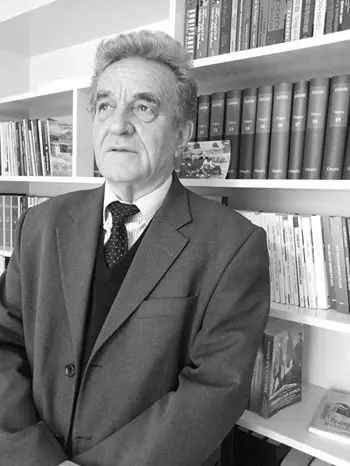
Dr. Namik Kasimati, Sabiha’s nephew, recalls: “As an ichthyologist, Sabiha completed a scientific study on fish in Albanian waters in 1948. Enthusiastic, she went to Durrës and told her friend Durie Hulusi: ‘I am happy to have completed a study on fish that will serve not only Albania but also other countries bordering Albania.’”
Dr. Sabiha Kasimati was appointed head of the zoology sector, but she focused solely on ichthyology. She had researched that field since her university studies, so upon returning she researched, traced, and studied the entire marine and lake ichthyological fauna of Albanian waters and completed the monograph “The Fishes of Albania.”
Sabiha was a complete intellectual who had studied in the West – a philosopher and biologist who knew well the essence and the unnatural, inhuman manifestation of the totalitarian communist system being established in Albania. She was deeply disheartened by the severe blows being dealt to the country’s intellectuals, especially those who had studied in the West, many of whom were her colleagues.
Military courts were sentencing the Albanian elite to execution and harsh imprisonment. She was particularly shaken by the execution of her director, the scientist Selaudin Toto, as well as of opposition intellectuals such as Gjergj Kokoshi, Suad Asllani, Sulo Klosi, Shefqet Beja, Professor Stanislav Zuberi, and especially by the sentencing of the first Albanian female writer, Musine Kokalari. Thus, Sabiha began to express her discontent with the regime and with Enver Hoxha – her former classmate at the Korçë Lyceum.
These grievances of hers, as well as her origin from a large, entirely intellectual and democratic family, caused Sabiha’s name to be placed on the State Security’s blacklists as an “opponent of the regime.”
Dr. Namik Kasimati recounts: “Because Sabiha had graduated from the French Lyceum together with Enver Hoxha and knew him well, she requested a meeting.
Sabiha: ‘I have come to tell you that you are killing all the intellectuals. I want to ask you: with whom do you intend to build Albania – with tinsmiths or with cobblers?’
Enver: ‘You have read too many French Enlightenment thinkers. I advise you to read Marx and Lenin.’
Two days later, Nako Spiru, whom Sabiha considered a friend, called her for a coffee and during the conversation told her: ‘Sabiha, you must sew your mouth shut – not with a safety pin, but with a babushka (a larger pin).’
Sabiha recounted these conversations to her brother, Dr. Hivzi Kasimati, my father, who lived in Korçë and whom Sabiha met often.”
(Dr. Namik Kasimati, memoirs)
Sabiha was sincere, carefree, and did not think that death was stalking her. She had the courage to speak the truth to Enver Hoxha’s face, but also to meet fearlessly with the friends and comrades who had been unjustly struck by the dictatorship. Once, she went to the internment camp in Jubë, where her friends Tika Tezha, Felatun Vila, and others were working as prisoners. However, Tika told her: ‘Sabi, do not set foot here again, because you are in danger. We know what our backs have endured – we were forced to inform against you, so that you too would end up in prison.’”
The resumption of mass terror in 1951 also claimed Sabiha’s head. The decision to carry out this massacre was not made in a courtroom, but in the Political Bureau of the Albanian Party of Labor (PPSh), specifically at the meeting of February 20, 1951, under the pretext of a small amount of dynamite thrown into the courtyard of the Soviet Embassy – an explosion that only broke a few windows on the evening of February 19, 1951, at 7:15 p.m.
The party-state leadership was urgently convened, and at the proposal of the Minister of Internal Affairs, Mehmet Shehu, it was decided to take extraordinary repressive measures “without regard to the laws in force.” (All Bureau members, including E. Hoxha: “We agree with these measures.” – Minutes of the Political Bureau meeting, February 20, 1951).
The arrests carried out immediately, according to the Political Bureau’s decision of February 20–23, 1951, were illegal because they were made without any prosecutor’s arrest warrant or court decision. (Only later were the arrest warrants and trial records fabricated.)
The arrests were made based on death lists prepared in advance by the State Security within the Ministry of Internal Affairs. (Archives of the Ministry of Internal Affairs)
Sabiha was arrested on February 20, 1951, under the pretext of the “bomb” at the Soviet Embassy.
She was included in the list of the Second Sector of the State Security Directorate, compiled by Captain Rasim Dedja. Next to her name, a cross was placed, meaning she would be shot. The compiler of the blacklists testifies: “The assessment of the persons to be executed – and who were in fact executed – was made directly by the leadership of the Ministry, which at that time was Mehmet Shehu, together with his deputy minister Kadri Hazbiu, who oversaw State Security.”
Mehmet Shehu was the Minister of Internal Affairs, directly interested in the event. He proposed at the Political Bureau meeting that 10–15 people be executed without trial, and the Bureau unanimously approved it, together with the “commander” (E. Hoxha) – thus he had a free hand. Nothing was done without the dictator’s approval.
Enver Hoxha approved all the actions and the names of the victims, which had been selected and marked with a cross. But Enver personally added the names of Sabiha Kasimati, Reiz Selfo, Manush Peshkëpia, and Qemal Kasoruho – all from the Gjirokastër region, whom he knew personally. For example, Reiz Selfo’s name was not on any of the original lists.
Once upon a time, Reiz Selfo had had the courage to speak the truth to Enver Hoxha’s face, and Hoxha took revenge on him, just as he took revenge on Sabiha Kasimati, who had told her former classmate: “I have come to tell you that you are killing all the intellectuals. I want to ask you: with whom do you intend to build Albania – with tinsmiths or with cobblers?”
The crosses were placed by the highest party and state leaders. The execution of Sabiha and twenty-two other intellectuals had been decided by the Political Bureau of the CC of the PPSh, by its decision of February 20, 1951. There is no example in any communist Eastern country of a Party Political Bureau deciding to kill people – moreover, without trial and in violation of even the laws of that time!
The indictment of the military prosecutor Siri Çarçani is dated February 25, 1951, and contains absurdities: “They have placed themselves at the service of foreign imperialist spies; they have become members of a terrorist organization. They have propagated the violent overthrow of people’s power and have issued slogans in favor of a new war being unleashed by the American-British imperialists and their satellites.” (Archives of the Ministry of Internal Affairs, file of the bomb at the Soviet Embassy)
This is a collective accusation of terrorism, unsupported by any evidence. The accused had no connection or collaboration with each other; they were not members of any designated political or terrorist organization; none of them is mentioned in the indictment as having participated in the bomb-throwing at the Soviet Embassy – the very reason for which they were arrested!
As is publicly known, the persons who actually threw the dynamite – such as Qazim Laçi, Hysen Lulla, etc., members of the “National Unity” organization – were arrested those same days, kept secretly under investigation for eight months, and were sentenced to death or heavy imprisonment for throwing the dynamite at the Soviet Embassy. So it was others who threw the dynamite as an anti-Soviet, anti-Stalinist act.
Siri Çarçani testifies: “To my knowledge, the Supreme Military Court did not conduct a trial against these defendants.” Likewise, the Director of State Security, Rasim Dedja, testifies: “No trial was held for the execution of these persons, and I say this because they were taken directly from the offices of the Ministry of Internal Affairs to the place of execution.” (Record kept by the General Prosecutor’s Office, 1992)
Because the execution without trial caused a stir both inside and outside Albania, the Supreme Military Court, in collaboration with State Security, after the 22 arrestees had already been shot, began the procedures to draw up false, fictitious trial records as if a trial had taken place. Two falsified judicial records of the Supreme Court exist. One is dated February 26, 1951:
“The Military Court, chaired by Lieutenant Colonel Shuaip Panariti, members First Captain Vangjel Kocani and First Captain Nonda Papuli, and secretary Hidaji Bejo, began examining the case on February 26, 1951, and pronounced the sentence of death by firing squad for all the accused, based on Law No. 372 of February 12, 1946. This court decision is final and immediately executory.” At the bottom, the President of the Supreme Military Court, Shuaip Panariti, and member Vangjel Kocani signed; the other member, Nonda Papuli, and the secretary, Hidaji Bejo, did not sign. (Record dated February 26, 1941 [sic])
A member of the Supreme Military Court panel and its vice-president, Vangjel Kocani, testifies: “I remember well that in 1951 an event occurred in Tirana – it was said that a bomb had been thrown at the Soviet Embassy… A few days after this event, or about a week later, I was called by the President of the Supreme Military Court, Shuaip Panariti, and he told me: ‘You know that a bomb was thrown at the Soviet Embassy. The Security Service has made arrests, and some of the arrestees – 22 people – have been executed without trial. Therefore we must sign a formal criminal court decision, since we cannot hold a trial because the Security Service executed them without trial…’ Shuaipi told me that the court decision is a formality, has no consequences, and we must do it because it is an order of the state leadership – and at that time the Prime Minister was Enver Hoxha.
Shuaipi told me: ‘Vangjel, don’t worry, since the decision is a formality and in fact we are not judging anyone.’ He instructed me that regarding this fictitious criminal decision, ‘you must keep your mouth shut and tell no one, because it is a great state secret.’
After that, we went with Shuaipi to the offices of the Ministry of Internal Affairs. Shuaipi presented me with the typed court decision and I signed it. When he gave me the decision to sign, Shuaipi did not show me any investigative file; I saw no kind of investigative material.” (Record kept at the General Prosecutor’s Office, 1992)
The secretary of the Supreme Court, Hydai Bejo, testifies: “I did not sign when they brought me the decision, because I did not know whether a trial had been held or not. I could not sign without having been at the trial. Likewise, Nonda Papuli also refused to sign. We could not do otherwise.” (Testimony of Hydai Bejo, according to the record)
But not only the signatures of the judicial panel members are missing; other data normally recorded in such minutes are also missing; furthermore, the dates are confused – everything is contradictory, drafted in haste. One falsified record is dated February 27, 1951, when the accused no longer existed – they had been killed on the night of February 26, 1951, and buried. Moreover, one of them, Jonuz Kaceli, had been killed by torture in the dungeons of State Security and was thrown out a window, with the claim that he had committed suicide!
All these maneuvers and legal violations could neither cover up nor hide the massacre carried out without trial and without any proven guilt.
Sabiha did not accept the accusation of terrorist acts, participation in terrorist organizations, or serving foreign agents, but she bravely admitted that as an intellectual she was opposed to the totalitarian regime and its communist ideology: “I have been against the people’s power because it does not conform to my ideology. I have never believed that revolutionary acts could lead to socialism. I have been associated with a group of friends who were also enemies of the Communist Party…”
They killed the intellectual, the pedagogue, the scientist, the distinguished democrat, the martyr Sabiha Kasimati – without trial! In the middle of the night of February 26, 1951, tied with barbed wire, together with 21 men from all over Albania, she was shot and thrown into a common grave near the Beshir Bridge. Peasants heard her cries until she gave up her soul. Her remains now rest in the National Martyrs’ Cemetery, in a common grave with the 22 martyrs executed that bloody night.
Uncle Kadri from Mëniku, who discovered the grave, recounts: “Later, when the place where they were executed began to be deforested, a tractor driver working there fainted when he saw the tractor dragging a woman’s corpse – they covered it again. It was the still undecayed body of Sabiha Kasimati!”/Memorie.al