
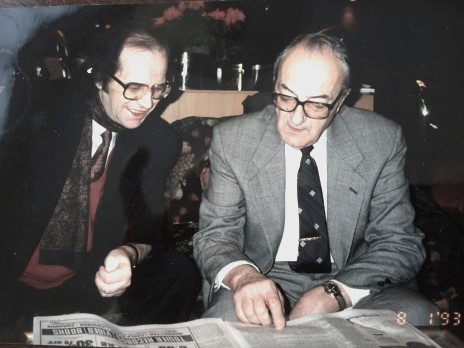
By SAMI REPISHTI
Part Seventeen
Sami Repishti: – “In Albania, the communist crimes of the past have been neither documented nor punished; there has been no ‘spiritual cleansing,’ no conscious confession, and no denunciation of ordinary communist criminals! –
‘Under the Shadow of Rozafa’
Memorie.al / During the 1930s and 40s of the last century, with the descent of the unstoppable fascist and communist storm over Europe, and sooner or later over the entire world, “fate” seized the Albanian nation by the throat. Like all young people, I too found myself at a crossroads where a stand had to be taken, even at the risk of my life. Then, I said “no” to the dictatorship and took the path that had no end – a sailor in a vast sea without shores. The rebel act that almost killed me simultaneously liberated me. I am an eyewitness to life in the fascist and communist hell in Albania, not as a “politician” or a “personality” of Albanian macro-politics, but as a student, as a young man who became aware of his role in that time and place, driven by love for the fatherland and the desire for freedom; simply, as a young man with heightened sensibility, faithful to himself and to a life of dignity.
Continued from the previous issue
The next day, again by order of the Presiding Judge, the questioning of each of us began, one by one. Many of the accused did not understand the indictment and did not answer. “This means you accept it,” the judge would conclude. Others replied that they did not understand. The judge would grow angry and respond in a mocking tone: “Of course, now you don’t understand anything…! But as for the crime committed, you understood that much, didn’t you?!” At times, the exchange took on comic tones, as if the dialogue were in two foreign languages. The “accused” was charged again with stubbornness and refusal to admit guilt or ask for forgiveness, while the victim returned to their place, unaware of what was being done behind their back. Over the judicial process, absurdity reigned! The charge against me was made by reading the first part of the deposition, signed during the investigation.
Entire paragraphs were read by the judge, followed by the question: “Do you admit it?” Every time I made an effort to clarify, because the indictment did not reflect my statements, the judge would intervene with a threatening tone: “Defendant, do you admit it or not?!” I found myself in an extraordinarily difficult situation! An affirmation weighed on me with activities I had not performed, while a denial meant submission to torture upon returning to the cell. The officers in the investigation offices and in the cells had made this clear before the trial. A sharp “yes” or “no,” as requested by the judge, was a trap for the accused, though I was fully convinced that the sentences were not handed down by the Court, but by the City Party Committee. The Court was a “legal” facade for the Party’s illegal act. But torture was something else. To return to the cell and be subjected to merciless torture for long hours was the great fear that covered me like a shroud of death.
Cold sweat covered my body. In this state of indescribable tension, I began to say: “I do not remember, Mr. President!” Then, the prosecutor would rise and attack with a phraseology that proved he was not clear on the content of my deposition. He accused me of acts outside my “case.” This allowed me several times to clarify or to say directly: “That is not in my case, Mr. President!” The prosecutor grew angry, leafed through the file, became nervous, and replied: “Regardless, you are guilty of criminal activity…! You will not escape justice…!” Disturbed by the created confusion, the judge interrupted and asked me: “Do you accept the deposition you signed?” – “Yes!” I replied, determined not to endure another session of torture in the Sigurimi. – “Sit down!” he ordered. The lawyer cast a glance at me and did not open his mouth at all. The most painful scenario was experienced with the indictment of the Bishop of Zadrima.
Entirely innocent, the high-ranking cleric answered courageously and denied every charge directed at him or the Catholic Church. In a moment of sharp confrontation, when the judge asked him contemptuously: “Who are you to speak like this?” the Catholic prelate replied with a full voice: “I am a Bishop of the Albanian Roman Apostolic Catholic Church.” The hall fell into total silence for several seconds. The judge was caught unprepared, and the prosecutor, with a powerful voice, shot back: “You are a traitor! That is who you are, a sworn enemy of the people!” The Bishop did not reply. The prosecutor’s words were followed by the maddened cries of the spectators in the hall: “Down with the traitors!” “Down with the traitors!” And then, as if by command, the crowd began to sing partisan songs. A great commotion broke out in the hall. Before the microphone, the unshaken Bishop looked at the judicial panel, which allowed a public demonstration in the courtroom and remained silent.
The prosecutor stood and fully enjoyed this “spontaneous” popular manifestation. Our guards laughed. We were frozen in our chairs by the manly stance of the Bishop, the scandalous manifestation of the court, and the turning of the judicial process into a political comedy, despite the tragic element that permeated it throughout. After the prosecutor’s “pretence,” where the “hostile activity” of all the accused was “categorically proven,” the “lawyers” appeared. One after another, they asked for mercy for their clients without consulting any of us and without adding anything more. This petty behavior seemed to me more like a silent agreement concluded between the judge and the defense lawyers, who were miserable in their duty out of fear and for the sake of securing a piece of bread, without honor. The judges were insistent on not allowing any alibi for the lawyer, or any judicial, technical, or substantive reasoning that could prove the opposite of the prosecutor’s accusation.
But the lawyer was free to prepare a defense by appealing to the “clemency” and “humanism” of the judicial panel, to have mercy for a young man, a poor illiterate, or a peasant who knew nothing but agricultural work, or a highlander who had never seen the city with his own eyes…! The Court’s decision was harsher than expected. Nine of the accused, including the Bishop, were sentenced to death. The others received sentences ranging from 15 years, as I did, to life imprisonment. The resistance against communism gained a new dimension those days. The experience of the “trial” provided me with additional material for my further political formation – a stronger shield in the fight against the corruption of communist propaganda in our country. This experience steeled my will to fight any kind of dictatorship, and primarily the red Stalinist dictatorship!
Upon returning to the Sigurimi prison, those sentenced to death were separated from us. Locked in separate cells, they awaited the day of execution. On the evening of that fatal day, the electric lights in our cells were not turned off. The guards passed before the doors, opened the small windows, and asked the same stale question: “Well, how many years did they give you?!” Out of disgust, I did not tell the truth. And their response was just as stale: “Well, you escaped the bullet? Don’t complain!” As if a long sentence of fifteen years in prison were nothing more than a stroll in the public garden. After all this suffering came the mockery…! In the silence of the cell, my thoughts went to the comrades of the group who were sentenced to death, a sentence that none of them deserved.
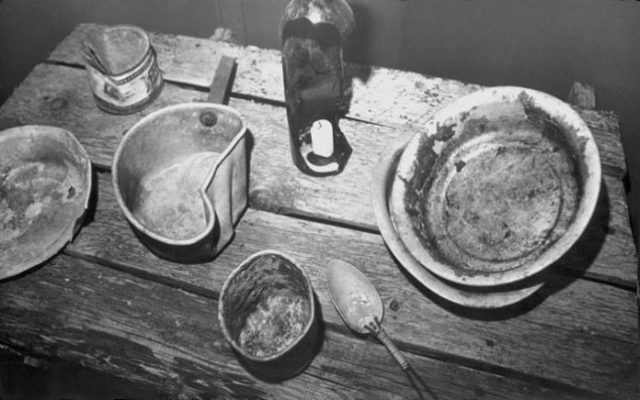
From the Bishop, a victim of anti-Catholic prejudices, to the highlanders accused of participating in the Postriba Movement, none were guilty of a crime that deserved the death penalty. The very fact that nine of them were sentenced to the firing squad showed the inconceivable depth of the “power’s” hatred for its “enemies,” and the monstrosity of the injustice enforced against them. Locked in the Sigurimi cells, the nine new victims of the red dictatorship would spend days without light and dark nights alone, without contact with family, without food, and without sleep, from the anxiety of waiting for the morning of death and facing the execution squad. Their treatment during these days was beastly, and the accounts of others portrayed the behavior of guards and officers like those of wardens in the circuses of ancient Rome: they would bring the prisoners out, insult them, beat them badly, and provoke their responses, which, in the Sigurimi mentality, served as justification for new tortures.
For the stubborn, the Sigurimi had “discovered” the breaking of leg bones before execution, in order to make their escape impossible…! That night, I did not close my eyes from the shock of the presence of death, which danced a macabre dance in the nine cells around me…! The next day, those sentenced to long years of imprisonment were transferred to the general prison of Shkodër!
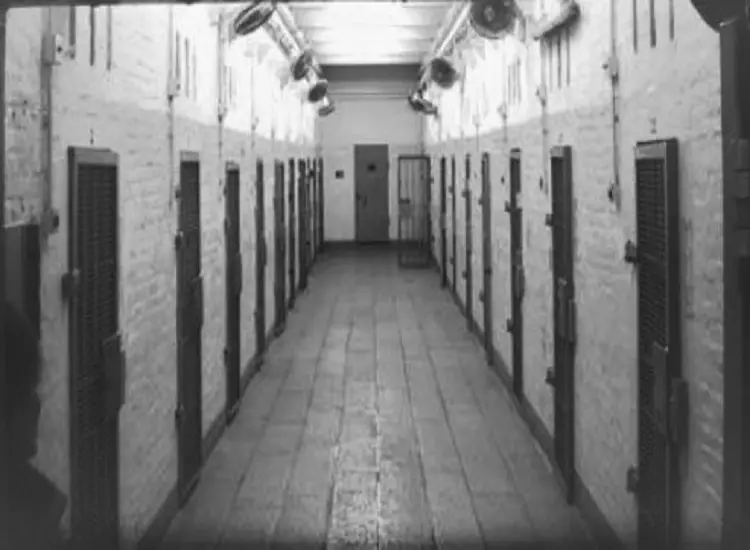
November 28, 1947. In the early hours of the morning, we gathered our rags and prepared for the transfer to the big prison. Chained two by two by one hand, with the other hand we held the clothes over our backs that served as our bedding. A fine, persistent, weary rain was falling, as rain usually is in Shkodër. From the Sigurimi courtyard, surrounded by a squad of guards, in long rows, one after another, we exited the main door and headed toward the big prison.
It was Flag Day! On government buildings and market shops, the red and black flags with the partisan star were visible. Soaked by the rain, not one of them fluttered. They hung limp, and from their bottom corners dripped water that looked to me like tears shed by the sacred symbol before our national tragedy. Nature itself wept along with man on this cold, wet, miserable Flag Day that saw no celebration. On both sides of the street, travelers were few, as if the world were tired of the painful sights of these days. Those who were seen looked at our column marching under the rain, surrounded, bent under the weight of rags, and remained silent. Not a voice, not a gesture. But I saw in this silence one of the most respectable forms of gratitude for our suffering, the expression of mercy from those tormented by fear, the brotherly solidarity of those who did not have the courage to revolt openly. Perhaps, I thought in that moment, I, the victim of red terror, represented for these frightened beings the heroic side of resistance against the red dictatorship.
This thought lifted me, revived me, and gave me the necessary courage to keep my head high during this forced march. Deep inside, I began to believe that the silent prayers of the few passers-by followed me step by step until we crossed the threshold of the big prison and joined the wide and unfortunate mass of this old, filthy, frozen building, which for more than a century had crushed the minds and battered the weary bodies of thousands of prisoners.
The prisoner who was chained to my hand was deeply shaken when he saw himself in the prison courtyard, which would be his home for many long years. I looked at him with pain and tried to calm him. He lowered his head and, wiping the raindrops from his face – and perhaps also tears – replied: “You are young, my boy! You don’t know what it means to be a parent, with a wife without help, and children who grow up as orphans… and I live here, with a noose around my neck!” Then, he thought for a moment, and with a half-voice, looking me straight in the face, added: “For us, my boy, there is nothing left but to die!”
After a thorough search of body and clothes, the formal registration was made in the office by a director with the behavior of a beast. The new prisoners were dispersed into the prison rooms, which were packed to the brim. The warm welcome we found was unbelievable. Known and unknown, everyone tried to give us heart, to help, to ease the bad and heavy impression of the first day in prison…! I was moved by such a great change of circumstances. Finally, I was not alone. Fourteen months in a cell, mostly isolated and constantly tortured, had taken their effect. I could not find words to say. During this period of suffering, I had almost forgotten the warmth of those who loved me.
Fortunately, the prison administration allowed every newcomer to wash in the bathroom – a cement cell with pipes of warm water. Cleaning my body for the first time after such a long time gave me a pleasure I could not explain, and I had the impression that I was entering normal life again. Water! Bath! Cleaning! Is it possible? The bedding and rags were full of lice. They were not allowed into the room. Tied together, they had to be taken outside for cleaning by the family. During the first night, I slept in the corridor, dressed in clothes borrowed from a friend.
It was cold. For security reasons, the window had no glass. The wind and a fine rain came inside. From time to time, I raised my head to see the prison courtyard, but carefully, so the guard wouldn’t see. With hands and feet without shackles for the first time in so long, I moved my legs, crossed my arms, and it seemed strange to me that I was unbound. Free in such circumstances, even such a basic pleasure took on extraordinary proportions. From the next room, I heard the snores of the sleeping prisoners, laid out in four narrow rows, the heavy sleep of lethargy, as if nothing were wrong.
Their monotonous noise, as boring as life itself in these open graves, reflected the meaningless life where we were condemned to live, and the night that was awaited with the joy of the day’s departure, without any event. Then, awakened by the anxiety of the night’s darkness, I would become nervous, revolt, and curse fate and those who slept that heavy sleep. How small is the man who is not aware of his own fate, of the crushing oppression of fate, of the limitations that fate imposes, and of the unavoidable end – the complete, unconditional, and merciless destruction of life. I was young…!
Beyond this often repulsive phenomenon, in the presence of the suffering elderly, the incurable sick, and the uneducated who got on my nerves with gestures and expressions without any meaning except their provocative effect, I often found in that crowd something that crossed the boundaries of the matter that is seen and touched – beyond the vitality that fades with time, beyond the wrinkled skin and the protruding spine, beyond the wounds and the wasting away in bed – something that, through the opaque matter of the body, glowed with a radiance that touched my heart like joy, satisfaction, peace, inspiration, and virtue.
There was something that unfolded, regardless of the seat where it resided – something non-material, harmonious, light-giving. What a sublime sight you are, O human being, who enriched yourself with the supernatural gift of love and understanding for others who suffer and die like you! Memorie.al