BY SAMI REPISHTI
Part Sixteen
Sami Repishti: “In Albania, the communist crimes of the past have been neither documented nor punished; there has been no ‘spiritual cleansing,’ no conscious confession, and no denunciation of ordinary communist criminals!”
‘Under the Shadow of Rozafa’
Memorie.al / During the 1930s and 40s of the last century, as the relentless fascist and communist storms descended upon Europe, and eventually the entire world, “fate” seized the Albanian nation by the throat. Like all young people, I found myself at a crossroads where a stand had to be taken, even at the risk of one’s life. Back then, I said “no” to the dictatorship and embarked on a road without end – a sailor on a vast, shoreless sea. The rebel act that nearly killed me simultaneously liberated me. I am an eyewitness to life in the fascist and communist hell of Albania, not as a “politician” or a figure of Albanian macro-politics, but as a student – a young man who became conscious of his role in that time and place, driven by love for country and a thirst for freedom; simply, a young man with profound sensitivity, true to himself and to a life of dignity.
Continued from the previous issue
I tried to delve as deep as possible into my mind to find the meaning behind these monstrous acts. What could justify such a stance, such an action? “In the name of the people,” the “proletarian revolution,” the “working class”? It was a series of instigating fables, not convincing arguments. My doubts that the “communists” in Albania had lost their humanity – the humanity that permeated the ideology and propaganda of the war days – were strengthened by the events I witnessed, especially during the days of imprisonment. These were the final nails in the coffin where hope for a moral rebirth lay lifeless, and consequently, any new political orientation for a “power” that won by force and stood only by violence. An army of fanatics, who willfully or unwittingly had embraced the spirit and program of the “Communist Party of Albania” (later the “Party of Labour of Albania”), marched in lockstep in their campaign to destroy the old world and build a “promising new world.”
In this dizzying march, the indoctrinated crowds trampled upon the most sacred rights of the majority of the population, who suffered the effects of this destructive labor and burned in the fire lit by the “revolutionaries” – who by now were merely convinced, arrogant, vengeful, and uncultured militants. I imagined Qemal Draçini under torture – the pain, the screams, perhaps even the prayers directed at the investigating officer and executioner to convince him of his innocence – and I trembled with the fear that had seized me after my own sessions of heavy torture. How was it possible for a human to descend so low as to torture another human being with such sadism?! What was that doctrine that advised and approved extreme violence against an opponent conceived as an “enemy” to advance its own “progressive” principles? What kind of man descends voluntarily into the underworld where people are forced to become dehumanized, going so far as to kill “enemies” with wood, iron, fire, rope – with any means that competes to cause the cruelest death possible? And naturally, how is it possible for an Albanian to kill an Albanian with such ease and such ferocity?!
Oh, how meaningless the expression “Albanian brothers and sisters” seemed – a phrase we learned so early and used so much. My dreams of an Albanian nation, united with a common ideal to build our homeland and save our people from the suffering, hunger, ignorance, and poverty that plagued them, were drowning in the pool of blood in communist prisons, in the river of tears that flowed every day in every town square and every village street of martyred Albania. Neither the songs from the official loudspeakers nor the hysterical shouts of the party and state leaders could drown out the general sobbing and the wailing of families in the homes of the killed and the imprisoned, who filled the jails and internment camps scattered from Konispol to Vermosh. Albania, dressed in black, would not let me rest, and the hysterical cries of the “rulers” foretold the coming of even harder days…! Albania had been inundated by ignorance, deception, hatred, instinctive revenge, and the organized mass violence of the red legions – mindless and heartless!
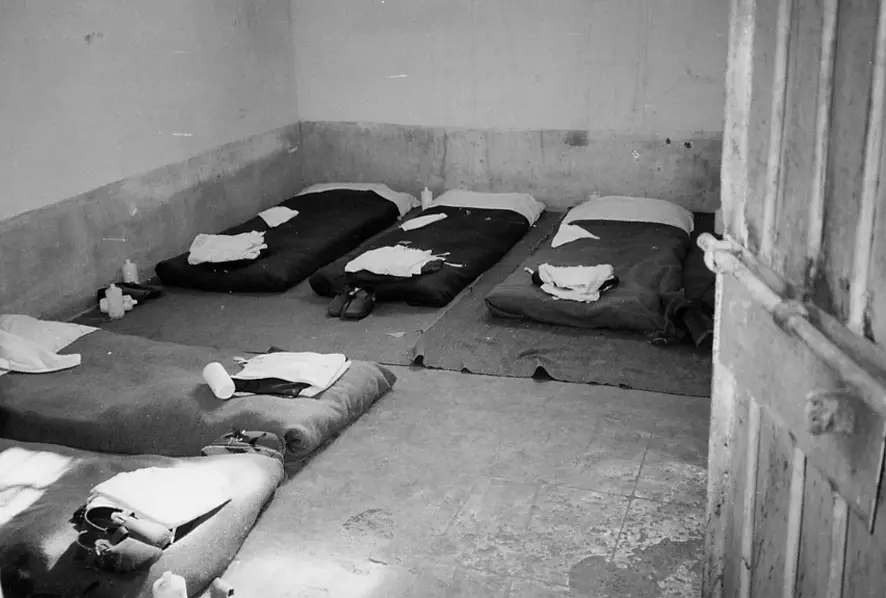
In the cell, the lightless day passed unnoticed, much like the dark night in sleep. It was a kind of slow death; interrupted by the attacks of the red guards upon prisoners “who speak loudly” or those returning shattered from the interrogation offices. In the morning, we were woken by a loud pounding on the cell door and the sound of a partisan boot or fist. Before we could even catch our breath, the door would swing open, the guard would unbind our feet, and with hands in shackles, two by two, we would grab the urine bucket, running like madmen toward the latrine. We would empty the full bucket, relieve ourselves together, and at the crazed shout of the guard, we would rise and run back to the cell. Often, the guard, exhausted from night duty, would dispel his boredom with the club or the chain he held, striking us mercilessly. During the day, the guard would open the small window and throw three rations of bread onto the floor. There was no other food, not even tea. Water was given once a day. Any communication with others was strictly forbidden. Cleaning was not allowed. Once a month, a barber brought from outside would cut our hair and shave our overgrown beards, always under the supervision of guards. Food from family was limited to once a week. We shared everything with one another; it was natural.
Despite all that filth, we survived; filthy in body, filthy in clothes, filthy in the place where we were, while the stench of urine took our breath away. Every day we heard sobbing and groaning. Some were sick. No one spared a thought for them. Others came from interrogation, followed closely by guards through the corridors of the Convent-prison. Nothing else was heard, and when silence fell, it was absolute – a silence of the grave! I had no measure of time, nor did I know how many days I had spent in this state. But the absence of further interrogation led me to understand that, after signing the “deposition” (procesi), the time for “trial” was approaching. The infected wounds improved every day until they closed, leaving indelible marks for life. One November day, the guard ordered me to gather my rags and, without giving me time to say goodbye to my cellmates, unchained my feet, bound my two hands tightly with animal chains, grabbed me by the arm, and we began to walk with my clothes loaded on my back. Outside, in the courtyard of the Convent-prison, a Security (Sigurimi) vehicle was waiting. Inside were three others whom I did not know.
Five minutes later, we were unloaded at the Security courtyard, from where prisoners are taken for “interrogation.” The fear of torture in a new interrogation almost paralyzed me. Again held by the arm by a guard, I was thrown into a small cell with a window of crossed iron bars that allowed in little light and air. Alone again. From the outer courtyard, the voices of guards, officers, and their footsteps could be heard. There was an unusual movement. In the cell, I was constantly in thought. When I rested, a great void was created all around me. I would stand up and begin to pace in a desperate attempt to recapture the lost thread of thought. Often, I spent hours trying to take the measure of the objects around me – the walls, the door, the window, the lamp, the floor, and the ceiling – comparing them with others from daily life in an attempt to establish contact with the world left behind. The next day, the guard brought me clean clothes from my family and ordered me to dress immediately. Despite the great fear of interrogation, I thought that clean clothes indicated something else – perhaps a transfer to a more “humane” prison.
When he returned, he told me to accompany him to the outer courtyard, where a barber waited to remove my hair and overgrown beard. In that miserable state, he found a word that broke the monotony: “You are young…!” he said. “Yes!” I replied. “I am a student!” He didn’t speak further, brought me back to the cell, bound my hands tightly, bolted the door, and left. I began to pace back and forth, resting my feet that had been freed from chains after so long, but only for a few minutes, because the door opened again. An unknown guard took me by the arm, walked across the courtyard, and entered the Security building. I understood nothing. He knocked on an office door, entered, saluted the officer, and left. In the office, the officer looked at me intently. He had a young and exceptionally unpleasant face. He ordered me to sit in a chair. He asked for my name and surname, and without another word added: “This afternoon, you will appear before the People’s Court. There you will account for the crimes committed, which are listed in your ‘deposition.’ I want to warn you: before the court, you have no right to deny even a single word from the ‘deposition.’ Do you understand? Otherwise, you and I will have long sessions – ve-e-ery long ones… Do you understand me?”
“Yes,” I replied shortly. “Now, you will meet the lawyer your family has hired.” The officer rang a bell. The guard brought the lawyer into the office – a man about forty years old, wearing glasses. I recognized his face but did not know his name. He greeted me politely, informed me that the family had asked him to provide my legal defense, and that he was ready to help me. “We will defend ourselves together,” he said. “I have read your deposition.” “We cannot defend ourselves together,” I replied without thinking…! “You are not the accused!” “I understand,” he said, “but there are some technical aspects of the ‘deposition’ that we must clarify together before we go to court this afternoon.” Before he could finish his sentence, the officer rang the bell, ordered the lawyer to leave, and turning to me with uncontrollable rage, said: “If you start your games before the court, don’t forget that you will return here…! I will take your very soul…! Do you understand? Now, return to your cell!” Around lunchtime, an officer handed me a copy of the indictment, which contained eleven points. According to this charge, I had made attempts “to overthrow the people’s power by force” in connection with “agents of foreign powers.”
Most of the charges were simple forgeries that had no connection to me. One of them was particularly dangerous because it concerned the fate of Kosovo, claiming my activity had “gravely damaged the brotherly friendship with Comrade Tito’s Yugoslavia.” Not allowing the accused to speak, to express him, to explain or justify his actions, means condemning the man, not the act. Was this precisely the goal of the communist leadership in Albania? Masters of the internal situation, they appeared as agents of a monstrous obsession that sought to justify the “Party line,” to extinguish every free voice, to eliminate every free person…! In this mental state, at two o’clock in the afternoon, they took me from the cell. An hour later, the trial session of the Special Military Court in Shkodra began.
XIII
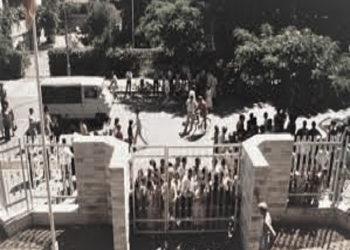
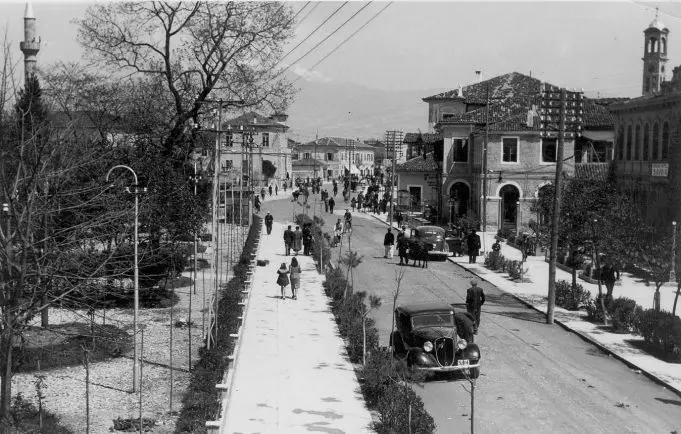
November 20, 1947. Our group consisted of twenty-two prisoners, bound in chains, two by two, and surrounded by two rows of armed partisans. The first two were clerics: a Franciscan friar and an imam. The others were villagers, merchants, two students, and an Albanian Catholic Bishop. As soon as we stepped outside the Security door onto the main road, a hysterical crowd began shouting: “Traitors! Traitors! A bullet to the forehead! A bullet to the forehead!” None of us spoke, nor were we shaken by this civic derangement. Among the thousands of people filling the sidewalks along the road leading to the courtroom, the majority were silent.
Our caravan moved slowly and with dignity, as if unaware of the comical act of the trial to which it was unconditionally submitting. On the contrary, it seemed to us that we drew strength from the sorrowful gazes, the respectful silence, and the secret gestures of encouragement. Everything in these frightened onlookers indicated the internal admiration of the masses, who could not find the courage to speak.
From long suffering and the strong impression the crowd made on me after nearly fourteen months of isolation, I was unable to recognize anyone. All appeared as unknown faces in this scene, as painful as it was hateful. The shrill voices of the communist elements and their followers drowned out every other noise around. Their perverse nature gave even more dignity to the cortege of victims, who marched with a steady pace toward the Court where their “death” by firing squad would be decided…!
In front of me, bound tightly with chains like the others, walked an old man wounded in the leg. His advanced age, the sufferings of prison, and the pain of the wound created great difficulties for him. Every time I looked at his profile – that face wrinkled by age and hard labor, and the lip he bit with his teeth so as not to let out a sigh or a complaint – I noticed his forehead, partially covered with a black scarf, dotted with sweat on this November day. Only that handful of dry bones knew the pain that coursed through him! Proud, a saint of innocence, for more than seventy years in a country that only asked and took from him, this silent highlander seemed completely determined not to give satisfaction to the onlookers, to those leering faces, even by letting out a single sound that would betray the physical weakness of the victim.
Around me I saw faces, and again face: unknown, dark, mysterious, expressionless, faces that ask, faces distorted by the spirit of hatred, faces…! It was a small monster of the Albanian world of that time: courage, indifference, fear, hope, hatred, and persecution…! This crowd of the oppressed, watching the victims of the struggle for their own freedom and failing to find the courage to express solidarity with those being sacrificed put me in a dilemma. How should I judge this paralyzed mass of my brothers and sisters?! Pity or condemnation?! I feared that from this state of motionlessness, of lifelessness, only death could come – the death of a society…! The accompaniment of the prisoners by armed guards and their parade before the masses who demanded our death with a repetitive refrain, was like the rage of dogs shown a piece of meat and denied it at the same time. The mere sight of the hideous figures shouting “revenge, revenge” with hysterical voices and gestures was enough to break the heart of anyone who thought and felt for another human being. I could not believe that the brothers and sisters of my country were so thirsty for our blood. That day, I saw it with my own eyes! What danger did a twenty-two-year-old student pose, who asked only for the right to live free?
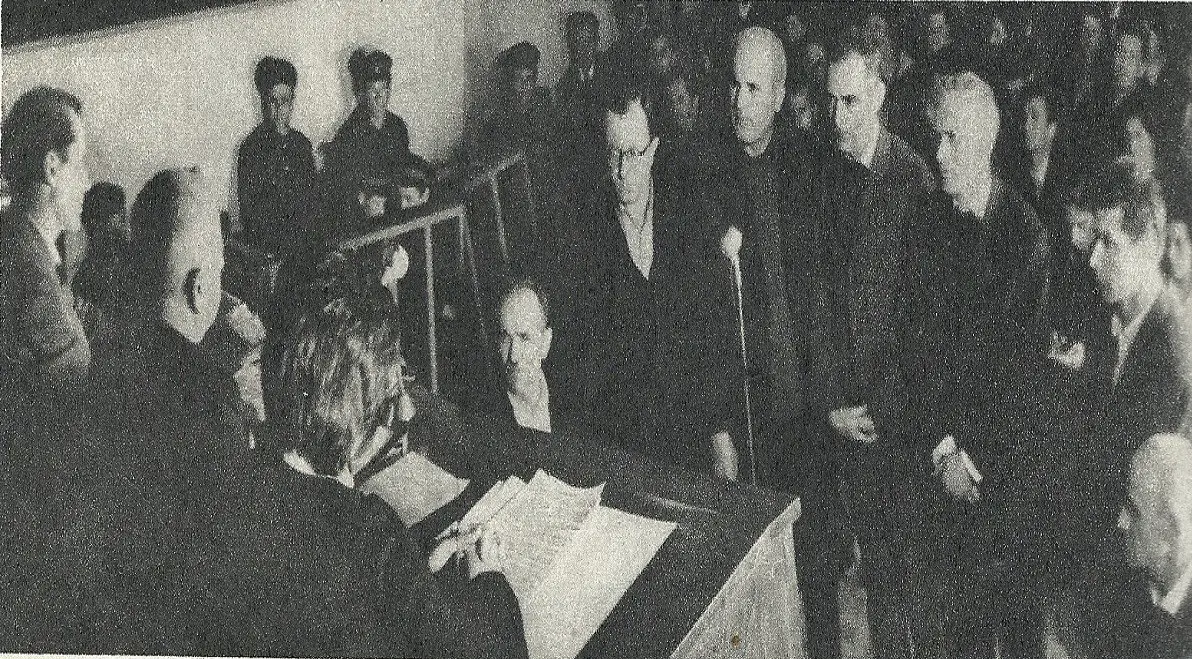
The city’s cinema hall had been turned into a courtroom. Twenty-two chairs were lined up where the orchestra usually sat. We sat down as ordered by the guards, waiting in silence for the arrival of the judicial body. Far from the body were the tables of the lawyers, who were not allowed to make contact with their “clients.” Around the group stood the red guards with weapons in hand. A policeman checked the microphones. Others came and went as if busy with important work. The hall was packed with activists carefully selected by the “people’s power.” They represented the “people,” in whose name a Special Military Court – of the “people” – judged our “criminal” acts against the “people.” Even before entering the hall, I heard a choir of shrill voices repeating pro-government slogans, partisan songs, and every now and then, as if it were an orchestra directed by a conductor, bursting into shouts: “Down with the traitors!” “Criminals to the rope!”
The guards watched and smiled with the satisfaction of the idiot who enjoys the noise around him. In his position, the armed Red Guard stood on his feet – a symbol of brute force exercised without mercy and without law against us – and smiled. I look at the crowd, maddened by hatred and drunk on the hysterical spirit that the union of hundreds of idiots produced in the hall, and at the scent of our blood they demanded. I recognized some of the loudest among them. They were family members of martyrs who fell during the war. It was not the first time, because the same faces appeared on stage every time there was a manifestation in the city or in the “people’s courts.” It was common for such noisy crowds to follow the lines of prisoners, especially when there were Catholic clerics among the groups – the most sensitive object of communist propaganda in Albania. Insults, curses, spitting, and attempts to beat them along the way had become common, always by order of the “authority.” Sitting between two villagers, peasants from Postribë, I had a strange feeling. How was it possible for hatred to fill the hearts of mothers and families of “martyrs” to the point of demanding the blood of strangers to quench the pain of their loss?!
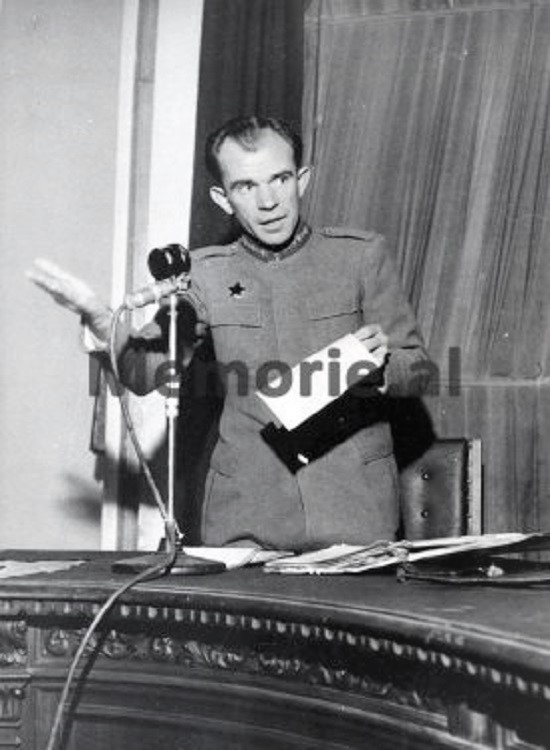
How was it possible that the mother of the “martyr” – my former youth friend, for whom I had shed tears two years earlier when he was killed – now screams before me, repeating: “Death to the traitors!” and looking me straight in the eye – me, the friend of her killed son?! This spiritual derangement, carefully cultivated by communist propaganda in Albania, saddened me because it promised nothing good. And I found myself in the center of the storm! With the entry of the judicial body – three judges and a public prosecutor – the group of four lawyers who would defend the twenty-two accused also entered. Some of the group – the villagers and the two clerics – did not have defense lawyers. We stood up and sat down again on command. At first, the prosecutor read a general indictment, including the most absurd and common charges for our deeply heterogeneous group.
According to the prosecutor, our group, who did not know each other, had conspired to overthrow the “people’s power” with the help of “international, Anglo-American reaction,” and that this activity had been discovered in time by the “revolutionary vigilance of the Party and the people.” The language of the prosecutor, who characterized us all as base individuals, without character, in the service of the foreigner and traitors to the fatherland, was not new. I had heard it many times before on the radio broadcasts of the city and the capital during a long line of judicial processes, especially those in Shkodra against “reactionaries” and the “Catholic Clergy.” But to hear the endless speeches of the prosecutor repeated, and I was the subject of the attack, with the “sword of Damocles” over my head, was a terrifying experience – not only for the catastrophic consequences that might follow, but also for the shaking of my political convictions, of the path I had chosen consciously, and of my determination to continue.
Pronounced with the solemnity usually created in courtrooms, the prosecutor’s words, despite their propaganda content and tone, had their effect. My concept of the judicial system as a protector of civil rights was still strong, but the scenario I experienced that day crushed it completely. My two companions beside me understood nothing of the phraseology used and asked for explanations, which I tried to summarize, giving the essence of the indictment in a few words. They lowered their heads. One prayed in silence, completely detached from what was happening in the hall. The other looked at the prosecutor, trying to understand something. The other prisoners listened in silence to the general indictment. Every time the prosecutor raised his voice, as if on command, the hall burst into shouts: “Down with the traitors!” “A bullet to the forehead!”
It was a macabre comedy that lasted more than an hour, with repetitions and more repetitions of the same theme…! The prosecutor’s speech was met with frenetic and long applause and the demand for our death penalty. The crowd had stood up and with an ovation greeted the prosecutor, who smiled with a special satisfaction. When the shouts ceased, the guards took us out of the hall. The authorities, concerned by the silence of the vast majority of the people during our passage through the main streets, put us in a closed military truck, away from the eyes of the mass waiting outside. This mode of transport was maintained until the end of the trial. It was proof of the failure of government propaganda among the people. Memorie.al