

By Ali Buzra
Part Twenty
LIFE UNDER PRESSURE AND SUFFERING
ASSESSMENTS, COMMENTS, NARRATIVES)
Memorie.al / At the request and wish of the author, Ali Buzra, as his first editor and reader, I will briefly share with you what I experienced in this encounter with this book, which is his second (after the book “Gizaveshi në vite”) and which naturally continues his writing style. The sincerity and frankness of the narrative, the simple and unmodified language, the accuracy and precision of the episodes, or the lack of a refining imagination, whether intentional or unused, I believe have served the author positively. He comes to the reader in his original form, inviting us to at least get to know unknown human fates and pains, whether by chance or not, leaving us to reflect as a starting point for raising awareness towards a catharsis so necessary for the Albanian conscience.
Bedri Kaza
Continued from the previous issue
Unfortunately, in the time of democracy after the ’90s, some people with vengeful tendencies managed to have careers, making the new system resemble the old one. Shefqet Dobra was and remained a dignified man, with the traits of a wise, brave, and proud highlander. Now at the age of 50, he did not try to pursue a military career, but worked in the state administration. The children grew up and he married them off. Today they are doing very well. His two sons and one daughter have immigrated to Italy and live there with their families. The other daughter is in Belgium. Shefqet made efforts to connect with his father, but it was not possible.
Through contact with a person who came from America, it was confirmed that his father, after the overthrow of the communist system, sought to know about the situation of his children in Albania. He called the post office in Librazhd by phone, but received an answer that the persons he was looking for were not in Librazhd. He reportedly expressed that he wanted to know if they were alive or if they had been killed. At an advanced age of over 90, and with a changed identity, he was unable to connect with his children. In 2002, despite efforts made, Shefqet was not granted a visa for America, due to mistakes made by the translator in the documentation regarding the year of Islam’s escape and Shefqet’s birth.
Later, he received confirmation from Xhelal Çela, from Ngurëza, who lived in Chicago that Islam had passed away at the age of over 100. Thus, Shefqet was unable to meet his father. They were separated by the state when he was 2-3 years old. He only imagines his father from his mother’s stories and through photos, but he never managed to know him or talk with him. This has been and remains his constant sorrow. His wife, Bukuria, after a serious illness starting in 2011, passed away in 2016. This was another heavy blow for him.
Shefqet Dobra, the sufferer who as an infant was in the macabre camps of the dictatorship, a political prisoner at a young age when he should have enjoyed life, now spends his old age with his sons and daughters, as well as his grandchildren, in Italy. He often goes to his daughter in Belgium, where he also meets the descendants of his father Islam’s many friends, as well as fellow villagers from Letmi, whose parents and grandparents escaped many years ago. The painful history of Islam Dobra’s family constitutes one of the tragic episodes of many Albanian families, which are part of the monstrous crimes of half-century communism in Albania.
Sali Burufi was the son of Tahir Burufi from the village of Letëm. Like many of his peers, Sali received religious education in the village, while also learning to read and write Albanian. There are no accurate data on where he completed his compulsory primary education, but relatives recount that he also finished high school in Tirana. During Zog’s time, he was mobilized as a soldier. There, his abilities, which distinguished him from others, stood out. With the interest of the command, the Ministry of Defense of the time enabled him to study in Italy. After completing his studies in Parma, Italy, where he graduated, he returned to Albania and was simultaneously appointed a gendarmerie officer.
He served in this position for several years in the Kruja area. Many years later, some elderly people from Kruja, in contact with villagers from Letmi, gave extraordinary impressions of his conduct there. During the war, he was not active with the ‘Ball Kombëtar’ and other nationalist forces, but stayed with his family. This was also the wish of Azis Biçaku, who had expressed that no matter how things turned out, Sali, as an educated person not involved with the politics of the time, should remain at the head and in defense of the village’s interests. But such a thing did not happen.
The partisan commands would not bypass and leave unpunished the former officer of the Albanian Kingdom, who in fact had been very careful and had not committed any act that conflicted with the National Liberation Front. However, they initially activated him by placing him as Chairman of the National Liberation Council in the village, while he was continuously surveilled. Very soon a pretext was found when one of the boys of the Dobra tribe was found with a letter that Sali Burufi had sent to Islam Dobra. It is said that in it, Sali was writing to Islam to be careful because there were military forces in the village.
Nevertheless, this remains an enigma, as it could have been a setup, i.e., organized, with the aim of trapping him. The letter could also have been placed in the person’s pocket at a moment of carelessness. They arrested him immediately. During the search of his residence, they found a photograph taken with Islam Dobra from military life. This strengthened their suspicions even more, while also constituting a pretext to eliminate him. After torturing him, they sent him to Librazhd and from there to Elbasan. In the prison cells, under the most inhuman torture, Sali Burufi, the noble and intelligent young man from the village of Letëm, died. He left behind five children, four daughters and one son, Tahir, who was a minor.
ISAK ALLA, THE HERO OF THE CAVES OF LIBRAZHD
The village of Zgosht is located 9 km north of the town of Librazhd. It stretches over several hills on both sides of the Librazhd-Dibër motor road. Dressed on all sides with oak forest, the village has good pasture for raising small livestock, particularly goats. But Zgosht has traditionally also kept sheep, for which it has mountain pastures. The Mountain of Zgosht, located above the village of Qarrishtë, is among the best for summer alpine pastures. In Zgosht live several tribes which historically have worked and lived together in harmony, while in cooperation with Letmi, they have worked on building irrigation canals, ensuring good opportunities for cultivating agricultural crops.
Thus, very early on, together they built the canal taken from the sources of Kusar, 40 km long, with which they sufficiently secured irrigation water for both villages. With the increase of arable land area, around the 1930s, they built the other canal, 13 km long, taken from a place called Gurra e Karajt, in the village of Kosharisht, with which they secured abundant water for irrigation. Traditionally, the tribes in the village of Zgosht have been compact in decisions taken on various problems, as well as in relations with other surrounding villages.
A brief history of the tribe and its most prominent names
One of the tribes that made a name and history in Zgosht is that of the Allaj family. Before the Declaration of Independence, around the years 1880-1890, on the hill above the place called Qafë-Drizë, there were two towers of Alla, in which three brothers each lived with their families. In one tower lived old Fez Alla, with his two brothers, Destan and Jonuz, while in the other, Selman Alla with his two brothers, Avdiu and Liman. The latter moved to Dorëz, where they had their lands, and his descendants live there even today. The Allaj families for that time lived well.
They were hardworking people engaged in agriculture and livestock. The men and women of the house worked themselves, and at the same time they also kept servants. In these circumstances, with a stabilized economy and authority in the village and region, old Feza Alla was called “Pasha”, while his first cousin in the other tower, Selmani, was called “Aga”. The designations “Fez Pasha” and “Selman Aga” were used as long as they were alive. Their families, probably around the year 1900, came into conflict with the administration of the Turkish state.
Even earlier, the men of the Alla family often lived the life of outlaws, as a result of opposing the payment of taxes, as well as military obligation in service of the Ottoman state. It is said that a Turkish military unit, with about 200 forces, surrounded their homes. Taking advantage of the darkness and the superiority of forces, they managed to take the towers, while the adult men of the families managed to break out of the encirclement. The women and children were still in the residence. The commander of the military forces allowed the women of the families to mediate with the men to surrender. It is said that the women, when they left the houses, took the other ammunition kept at home to the men.
Not only did they refuse to surrender, but they responded with gunfire to the army forces inside and outside the towers. The Allaj men called out to the commander of the Turkish soldiers, who according to oral accounts was called Maliq Caushi, to free the towers. On this dark night, Feza called from his position: “Do not harm the people of the house, for no one will come out alive! You are surrounded, not us…!” For nearly 24 hours, facing the unforeseen resistance and the attack of the Allaj on their own towers, the commander sought an agreement.
It is said that with the intervention of Beqir Hoxha from the village of Dorëz, it became possible to stop the conflict. According to the agreement, the soldiers and their commander left with all their weapons. The event resonated throughout the region, while “Fez Pasha” and “Selman Aga”, together with their brothers, remained a legend in the memory of the family, the village of Zgosht, and beyond. In this family environment, with a history and traditions of bravery, patriotism, and love of freedom, the young boys grew up: Nazifi, Zeqi, Isaku, Hamiti, Halili, Jakupi, Kamberi, Xheladini, etc.
The creation of the nationalist band to defend the village from war reprisals
At the end of the period of King Zog and the beginning of the fascist occupation, the main figure of the Alla tribe, as well as of the entire village of Zgosht, was the son of Selman Aga, Isak Alla. He was a nephew of the Hunçi tribe in Arrëz of Gizavesh. “His mother, who was called the Gizavesh woman,” testifies young Fez Alla, “was a lady, generous-hearted and very charitable.” From a young age, Isaku participated in the gatherings of the village and the region. He was distinguished for his loyalty and bravery, as well as a just and impartial arbitrator. He participated in resolving the conflict over the mountain with Stebleva, where it is said his word was accepted even by the opposing side. In 1933, although young, Isaku got involved in resolving the conflict that arose between the villages of Dorëz and Gizavesh on one side and Letëm and Zgosht on the other, regarding the extraction of the Canal that would be taken from Gurra e Karait. For this, on his initiative, the head elders of several villages in the area were summoned, with the aim of resolving the conflict smoothly.
From the testimonies of the elderly, it appears that the dispute was resolved according to the word of the head elder of Prevall, Hasan Musta (Troshku). It is said that the latter was a wise, prudent man, and a skilled orator. Hasan Musta is recorded to have participated in several assemblies to resolve various conflicts. But what was the final word of the head elder of Prevall to those present that made it possible to settle the dispute? Since the springs from which the water would be taken originated in the rocky territory of the village of Letëm, Hasan Musta told the participants in the assembly: “It is not possible for the cow to graze in Letëm and for Dorëz to take the milk.” With this word, the assembly ended, and thus Zgoshti and Letmi took water from the springs, while the other two villages took it further down. This division, established in the 1930s, remains so today.
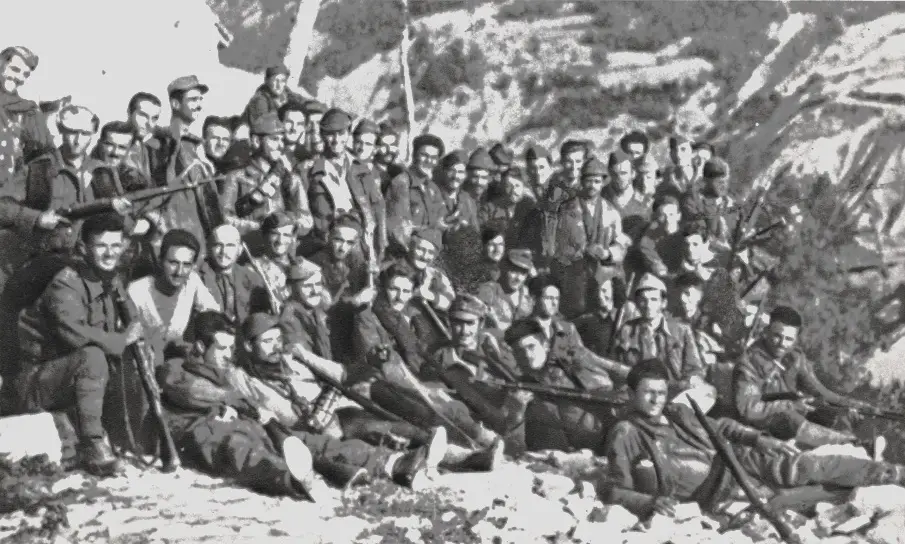
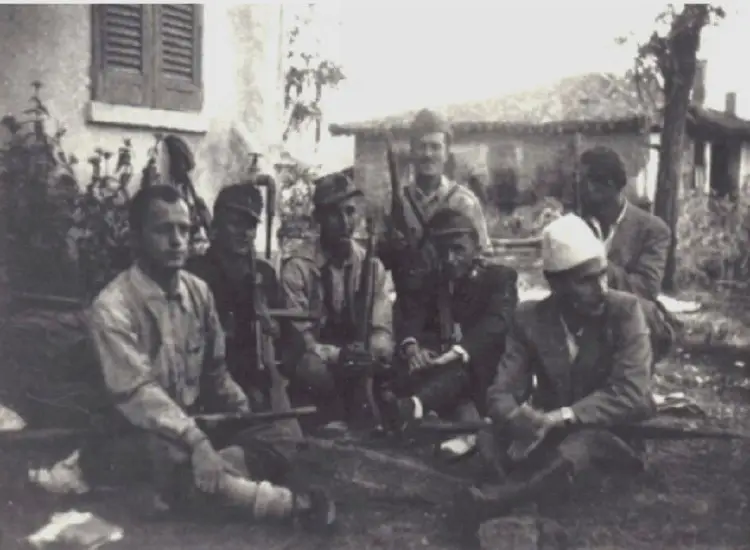
As in other villages in the area, also in Zgosht, after the fascist occupation of the country, a band was created for the purpose of self-defense, at the head of which was placed Isak Alla. According to oral data, it numbered about 50-60 armed men, who gathered when their leader called them. Being the leader of the band, as well as a very influential person, Isak Alla was summoned for talks by representatives of the District Committee of the Communist Party, at the house of Miftar Hoxha in Mirakë. There he was asked to join the communist movement and become part of it, together with his band. He refused to cooperate with the communists, and later together with his band he joined the organization of the ‘Ball Kombëtar’. During the years of the Italian occupation, Isaku maintained connections with the latter, employed people, and asked them not to harm his village, while he did not participate in any fighting, nor did he assist the Italian occupation forces in any case.
After the breakdown of the Mukje Agreement, with the aggravation of the situation between political forces in Albania, and after the arrival of the Germans, he established contact with the government of the Regency of Rexhep Mitrovica, a well-known figure from Kosovo. Meanwhile, he participated in a meeting in Orenjë with representatives of the National Liberation Front. This shows that he was inclined towards agreements and negotiations. There he was again asked to join them and fight against the Germans. From the elderly it is said that, in general terms, his responses were: “You are connected with the Yugoslavs; the German seeks a passage route and will not stay here. I do not know your Party, nor do I have trust. What’s important to me is the village. If we join you, my village, which is on the roadside, will be burned, and we’d rather mind our own business. Don’t bother us anymore, because if you do, we will burn ourselves and you too”! It is said that Azis Biçaku and Isak Alla were friends with Beg Ball. They fell out with him, and with Kostenja, because on orders from the partisan headquarters, an attempt was made to destroy the bridge in Lunik, where the Germans were to pass. “You are not burning,” they tell Beg Ball, “but Zgoshti and Letmi, which are on the roadside, are burning.”
The Zgosht band led by Isak Alla operated in cooperation with that of Letmi, led by Azis Biçaku. From the end of 1943 and throughout 1944, when the war between partisan and nationalist forces intensified nationwide, as I have also discussed above, the Zgosht band and that of Letmi moved to various areas, not only where the National Liberation Movement was supported, but also to areas that were supportive of nationalist forces. Both nationalist leaders, Isak Alla and Azis Biçaku, tried to avoid armed clashes with partisan forces, except for the case of Kostenja, against the leaders of the General Staff, and of Qafë Driza, against the Second Partisan Brigade. I have discussed both of these cases above.
In Kostenjë, the ‘Ball’ forces were in pursuit of the General Staff, where the English general Davies was accidentally captured, while in Qafë Drizë, the ‘Ball’ bands defended themselves from the attack of the Second Partisan Brigade, which had received orders to attack the villages of Zgosht and Letëm. Qerim Shpata, from Zgoshti, accompanied Isuf Biçaku, who returned from Belgium after the fall of the regime. On the hills of Qafë Drizë above Rrapuni, Isuf asked Qerim to stop, and on this occasion recounted the event to him. “Father,” he says about Azis, “was rolling a cigarette sitting on a stone. Kamberi was keeping watch beyond and observing. It was known that the Partisan Brigade was in Çermenikë and had operated in Funarës. In these circumstances, Isaku and Azisi had gathered the bands to be on alert for any possible attack. The day before, Azisi had positioned himself at Guri i Prasit (Lunik), while that day he approached Zgosht.
At the moment Azisi was rolling his cigarette, Kamberi, Isak’s brother, came hurriedly and told him: We are surrounded. Azisi closed the case, called out to the fighters and headed down towards the Zall of Rrapuni, to take the flanks. Meanwhile, towards the motor road, an armored car with a machine gun set off, which the partisans had at their disposal. Apparently, it had been taken from fascist forces during the fighting. Kamberi, who was distinguished for his courage in combat, with unprecedented speed jumped onto it, grabbed the driver of the vehicle, pulling him from his seat, and threw him to the ground, but did not kill him. The armored car went a few meters and stalled. Behind the armored car were the infantry forces advancing along the roadside and towards the hill, on both sides of it. Isaku launched an attack with his forces face to face with them. After several hours of fighting, as we also mentioned above, the partisan unit was routed, almost completely. / Memorie.al