From Ali Buzra
Part Eighteen
– LIFE UNDER PRESSURE AND SUFFERING –
(ASSESSMENTS, COMMENTS, ACCOUNTS)
Memorie.al / At the request and wish of the author, Ali Buzra, as his first editor and reader, I will briefly share with you what I experienced in this encounter with this book, which is his second (after the book “Gizaveshi in the years”) and which naturally continues his writing style. The sincerity and frankness of the narrative, the simple, unmodified language, the accuracy and precision of the episodes, or the lack of a refining, intentionally subsequent imagination or its non-exploitation, I think have served the author positively, who comes to the reader in his original form, inviting us to at least get to know unknown human fates and pains, whether by chance or not, leaving us to reflect as a starting point for raising awareness towards a catharsis so necessary for the Albanian conscience.
Bedri Kaza
Continued from the previous issue
The Dobra brothers, although they were burned out and had their property confiscated, had built their house and increased their livestock. At home, they spent the winter with their cousins, and spring arrived. The family of the Dobra brothers was united. It was distinguished by its unity and harmony. The men and women worked in agriculture and livestock. Truly with difficulty, but they still managed to secure bread and food, but the heavy tax they paid to the state did not allow them to improve their standard of living.
Although they were treated well, Islam’s two children felt the absence of their mother and brother, especially in the evening, when their cousins stayed close to their parents. The memories of spring in Mali i Letmit, in the Fields, as they call them, have remained indelible for Shefqet. The men did the mowing, while the women gathered the dried grass. The field echoed with the livestock and the shepherds’ flutes. There, in spring and summer, there was liveliness. Meanwhile, Islam’s two children, Hatixhja now 17 years old and Shefqeti 12 years old, kept hoping that their mother and Muhamet would also come.
One afternoon in June 1955, three policemen came to their house. “We have orders to take two people,” – they said and read the names: Hatixhe Dobra and Shefqet Dobra. The children were very upset. Tepelena terrified them. That night the policemen stayed there. The next day, their uncle, Brahimi, accompanied them as far as Librazhd. Escorted by the police, they went to Rrogozhinë, and from there, with a horse-drawn cart that took passengers to Lushnje, they were sent to Plug, where their mother and older brother, Muhamet, were.
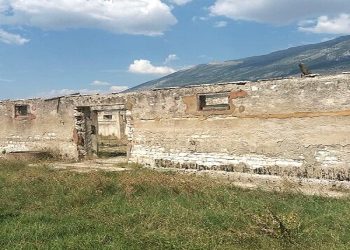
The Tepelena camp, from the end of 1954 until the beginning of 1955, was emptied. Most of those people who survived the horror were sent to other internment camps, but this time, not surrounded by wires and police. Regarding this, Shefqet writes in his book: “In December 1954, January 1955, the camp of Tepelena, which had swallowed hundreds and hundreds of lives of children and the elderly, young boys and girls, the place where people became sick and went mad, was once again transformed into an army battalion. The soldiers could now move freely; the mine-clearing of the field was paid for with hundreds of innocent lives of these people!
The soldiers are not to blame, they went home healthy. The souls of those who could not leave that accursed place will appear to the executioners in their dreams…! Mother and brother were settled in Plug, Lushnja. They were very surprised when they saw us. The police got a signature from mother confirming we were handed over and left. We were reunited once more as a family. Tepelena was the example of the madness and violence that the Albanian state devised for us, the place where one fought with death and only it won. It was the Albanian Gulag.”
In Plug, there were no wires, but every night there was roll call, and they did not have the right to leave without permission. Shefqet’s mother sent him to school in Lushnje, where he walked every day. One day, Emini, the son of Beqir who had been dressed as an army officer but was now released, came there. The teacher gave him permission for the last hours, and they went home together. The next day, Uncle Brahimi also came there. They spent a wonderful night. That night, Brahimi once again recounted the departure of Islam, six years earlier. He explained that Islam wanted to take the whole family with him, but the brothers did not approve. In the end, he insisted on taking Muhamet, but it was very risky. Mother and Muhamet knew about these things, but Hatixheja and Shefqeti did not. His cousin, Muharrem Hasa from Qarrishta, together with Brahimi, had gotten him across the border without problem, directing him to a friend they had previously spoken with.
Islam Dobra’s family was not left long in Plug. For the interned families, special instructions came from the Directorate of Internal Affairs of Lushnja. All four were sent to the villages of Çerma, where embankments were being built along the Shkumbin River, to prevent flooding. They share the best memories of the peasants of Lushnja from the villages of Çerma, who were very generous and hospitable. For some time they stayed in their houses while working there. There Shefqet finished the fourth grade of primary school. Even from there they were moved, sending them to the land reclamation barracks, on a hill, in Çermë Biçak.
In 1959, they were sent to Gjazë, where they found many of their fellow sufferers. After a few years, the families of Fiqir Dine, Muharrem Bajraktari, the sisters-in-law of Kolë Bibë Miraka, the family of Hamit Matjani, of Ismail Spahia, of Gjon Marka Gjoni, etc., who had been in Savër, were brought there. Shefqet, now 16 years old, worked at the clover threshing, where the thresher was mechanical and operated by hand. Since they worked in dust and smoke, he had secured a pair of goggles with rubber that fit well on his eyes. However, the sector’s agronomist saw him and didn’t hold back his words, calling him a petty bourgeois, saying “your time has passed,” etc.
One night, while working on irrigation, they called him to the offices where the agronomist, together with some other cadres, kept him until 5 in the morning, pressuring him that they would notify the Internal Affairs Directorate to send him to prison. The comrade he was irrigating with notified his mother, and she went to the offices. She entered and with a mother’s anger, spoke to them, saying weren’t they ashamed, keeping a child there all night. She took her son by the arm and walked out with him, telling them there was nothing they could do, since God had left them in their hands.
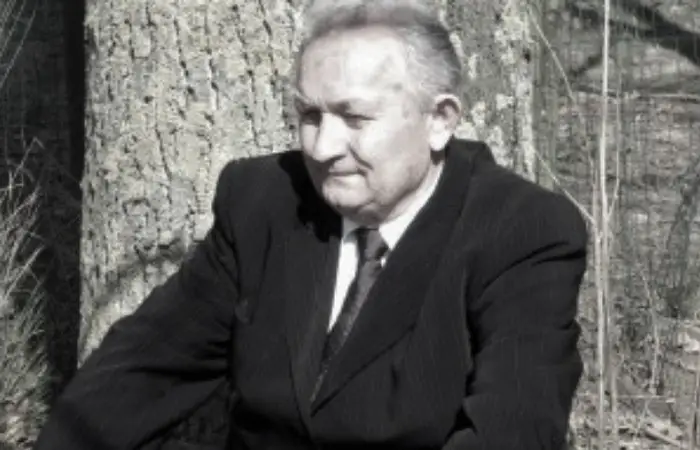
Shefqet Dobra, the man who survived internments and the prisons of Spaç and Qafa e Barit
In 1966, after being released from the army, which he served in a work unit, without the right to bear arms, Shefqet marries Bukurie Shpata from Zgosht. Bukurie fell in love with Shefqet and did not give up on marrying him, despite the constant pressure put on her. For a long time, they were not allowed to perform the wedding ceremony. She was not given maternity leave before birth according to the law in force. She was forced to do heavy work until the last days of her pregnancy. She gave birth to a son, whom they named Islam. Muhamet and Hatixhe had also married earlier, starting their own families.
Shefqet, eager for knowledge, with great sacrifice completed night high school, which he finished in Krutje, about an hour away from his residence. Most of the interned families held the title of “kulak” (wealthy peasant). In some cases, apparently also for provocative reasons, they would even be accepted into the ranks of the Democratic Front, but on condition that they not come into contact with kulak families. From internment, only for strong reasons were they allowed to come to their birthplace. Thus, they received a telegram from their cousin Feta Dobra, whose mother had died. He also informed them of the burial time.
The two brothers, Muhamet and Shefqet, set off and arrived on time in Letëm. The guest room was completely full of men. In one corner stood the deputy chairman of the cooperative, Emro Biçaku. Muhamet was placed near him. In the guest room, some greeted them and some didn’t, but something unpleasant happened. One of those present, a party member, took out a notebook and wrote a piece of paper, and after folding it, gave it to Emro. Emro, after reading it, crumpled it up and threw it in the fire, meanwhile starting to talk with Muhamet, which implied he did not approve of the letter’s content.
This situation was also understood by the master of the house, who shortly after entered the door and said: “I informed the cousins from Lushnja myself, to take part in the mother’s funeral, because they are family members, whereas for the villagers I have sounded the drum.” (The ritual of beating the drum with a mallet is still preserved today). Whoever wants to leave, the road is free. There is room for everyone here. As was learned later, the person had written in the letter: “Now that Lami’s boys have come, there is no room for everyone, either us or them here”! Years passed, and Shefqet and Bukurie gave birth to and raised four children. They worked in difficult work sectors from morning until evening. In November 1977, the families of the neighborhood where mostly the “declassed” lived were sent to work in the Sulzotaj sector, where pigs were raised.
Every morning at six o’clock, a “Zis” truck came to pick them up. As soon as the horn sounded, you had to be at the roadside. A communist was also assigned with them. The sector chief and the communist sat in front with the driver, while the workers climbed onto the open truck bed. It happened that the women, occupied with the children at home, wouldn’t come out immediately, but before they even reached the truck, the chief and his companion beside him would order the driver to leave, leaving them behind on foot. They were forced to walk the 8 km distance, in rain and cold. There were also cases where, upon arriving there, the brigade leader would tell them he had received orders from the chief not to accept them for work. The workers worked even in rain and mud.
In such cases, they were forced to carry the wet fodder about 1 km with a stretcher, because vehicles couldn’t enter. Sometime before, some pigs had died, and every day there was talk of hostile activity. In the evening, at five o’clock, work was stopped to return home. The workers waited at the roadside, pacing from the cold, wet and tired during the day, but the truck didn’t come on time. It returned after they had done other work. But even after the truck came, the chief and the communist often had dinner in the sector’s canteen, and then slowly went back once more out of “concern” to the pigsty, while no one cared about the people waiting in the cold. When they returned home, mothers would find their children asleep, and they would leave them the same way in the morning.
Even in summer, they recall, this place was very difficult for them, as there were many flies, which even covered the bread bags they hung on the poplars. Although there was a vehicle, they were made to load the pig manure by hand, in that high temperature, in the scorching heat of the day, where their noses were blocked by the heavy stench of the manure. The trailer was high, and the manure had to be thrown with a hook using arm strength. The straws would fall on their faces. In that heat, they dripped with sweat, but they couldn’t wipe their faces because their hands were dirty, and the flies wouldn’t leave them alone. After loading, they would ride on top of the manure, to unload it in the plot.
Besides the hard work and exhausting fatigue, they were also stressed by the fact that the Sigurimi (State Security) operatives and the “spies of 1200” constantly eavesdropped and surveilled them. Shefqet had completed high school and was distinguished by his abilities and intellect. As the son of a former escapee, he was the center of attention for the employees of the Directorate. The brigade leader, after they got to know each other, seeing not only his abilities, but perhaps also his character, as a just and dignified man, appointed him as his deputy. But the sector chief reprimanded him, saying he should not leave Shefqet as deputy. It is unknown whether this was a coincidence or by instruction?!
The State Security operated in strict conspiracy with various forms. The area operative starts calling him in, while other specific individuals approach him, making provocative conversations. He was now certain that he was in the crosshairs of the Sigurimi. During the time of the dictatorship, it happened that members of persecuted families, willingly or unwillingly, fell into the trap set, becoming captives in its service. Shefqet now found himself facing this situation. The area operative asked him for cooperation, to sign and inform against those who spoke against the regime.
For this, they also called him to Lushnje, to the Internal Affairs Directorate. The area operative finally told him he was facing a debt; either he would cooperate, which would provide testimony to put suspected people in prison, or prison awaited him personally. Shefqet continued working in Sulzotaj. They went there by truck. On the morning of November 2, 1979, the work front for the men was mowing alfalfa. After several days of rain, the ground was waterlogged. They worked with boots, which most of the men had with patches or sewn with thread, so that as soon as they stepped into the plot, they filled with water, and so they worked all day with wet feet.
After mowing several rows, they sat down to eat breakfast. At that moment, a person comes and tells Shefqet that the sector chief was looking for him at the office. He couldn’t eat anymore. He set off for the sector offices, while there, unusually, a quiet reigned. He knocked on the chief’s door, which didn’t seem calm. He asked the chief if he had called for him, meanwhile, he told him to sit down, without raising his head. Naturally, he had been ordered, but apparently, not being part of this scenario, he seemed to feel some regret. This was also because it was happening in his office. Meanwhile, for Shefqet, the situation was now clear, and in his mind, he thought of his elderly and deeply suffering mother, who had endured for over 35 years.
The door opened without a knock and 3-4 people entered, police and civilians. Four more stood outside the door, armed. They didn’t say, as usual, that in the name of the people he was under arrest, but one of them told him that there was an arrest warrant for him from the General Prosecutor’s Office and that from this moment he was under arrest. – “I will be your investigator, and together we will have time to clarify things,” – he said and began to read the document: “You are arrested because you have carried out hostile activity in various ways, with individuals or groups, whenever you could, against the party and the people’s power. On these well-proven grounds, we order the arrest of…..”! They had also obtained a reference from the sector of Çerma and one from the village where he was born.
– “The village of my birth does not know me, I left from there at age three,” – Shefqet replied. He reads him the reference brought from the village, telling him:
– “Do you agree?”
– “No,” – Shefqet replies, – “there is nothing true in that and it’s not about me”!
– “How is it not about you?” – he addresses him angrily.
– “Because I don’t recall doing anything.”
– “It’s the same; it’s about your father.”
– “There’s no law that I should answer for my father,” – said Shefqet.
– “We’ll clarify things in Lushnja,” – the investigator continued, – “but you must sign here.”
– “Let those who ordered the arrest sign it,” – Shefqet finally repeated.
They put handcuffs on him and sent him off with the police “Jeep” vehicle. They set off for the house. He, accompanied by two policemen, is taken out and left at the barber’s shed, while the other group heads to the house. Shefqet sees his mother in the garden, where he himself had worked a small plot to plant onions, while his mother was trying to plant them herself, so they wouldn’t be troubled when they came home from work. The special group entered the house, checking everything. From there they took out many sacks of books, to later select the “prohibited books.” Shefqet, as well as Ilir Biçaku, and many other persecuted individuals, were passionate readers. With their savings, they had bought many books, something which the mediocre leaders of the sector did not do. / Memorie.al