By Michele Brondino and Yvonne Fracassetti
Memorie.al / A Balkan country only 70 km away from the Italian shores, Albania caught the attention of Italians in the years 1990–’91, with the shocking migratory waves of Albanians in search of freedom and the hope for a better life: Italy was “AMERICA,” as director Gianni Amelio aptly described in his film. Today, about 500,000 Albanians are integrated into our society, while Albania is undergoing a complete economic, social, and cultural recovery. So, what had happened in Albania – a country unknown and mysterious until the eighties, which boasted of being the only state of the Dictatorship of the Proletariat, a place unreachable for foreigners?!
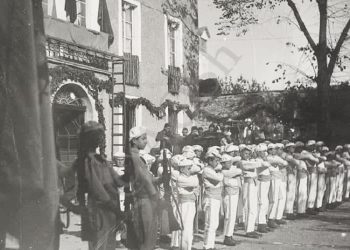
For two years, between 1982 and 1984, we had the rare – if not unique – opportunity to live this experience of the “Red Camp” established by Enver Hoxha. We were sent by the Italian government to establish cultural relations with Albania, which were previously non-existent. In those years, Albania’s hermetic system, closed to the world, was in total crisis and felt the need to emerge from its isolation.
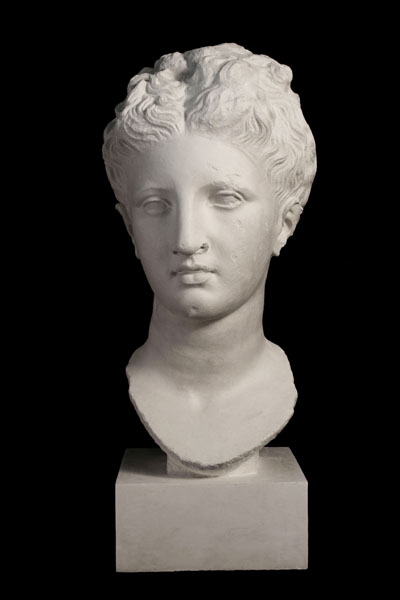
Italy caught the first signs of the crisis and began procedures to establish cultural ties. To soften the blow of this first opening of Albania to the world, our appointment as Cultural Attaché was subjected by the communist regime in Tirana to a condition of great symbolic effect: the return to Albania, from Italy, of the head of the sculpture of the goddess Dea of Butrint, stolen during the fascist occupation and gifted to Benito Mussolini.
We were in a privileged position: diplomatic status protected us; the only serious risk was immediate expulsion from the country. Undoubtedly, our daily life had many limitations, such as the inability to send our children to Albanian schools, not being allowed to socialize with Albanians, etc. However, the hardest part was the feeling of being “free” inside an iron cage. Communist Albania appeared to us as a vast forced labor camp, where humanity was lost in the animalistic exhaustion of physical labor and moral brutality.
The impact was striking. The first image of the scenario that opened before our eyes was at the border post with former Yugoslavia (Hani i Hotit): a gate with electrified barbed wire, which a soldier armed with a “Kalashnikov” and a red star on his cap opened and closed, leaving us stunned and somewhat shaken: we had entered the Fortress of Albania! The photographs we managed to take were all “stolen,” taken secretly at our own risk.
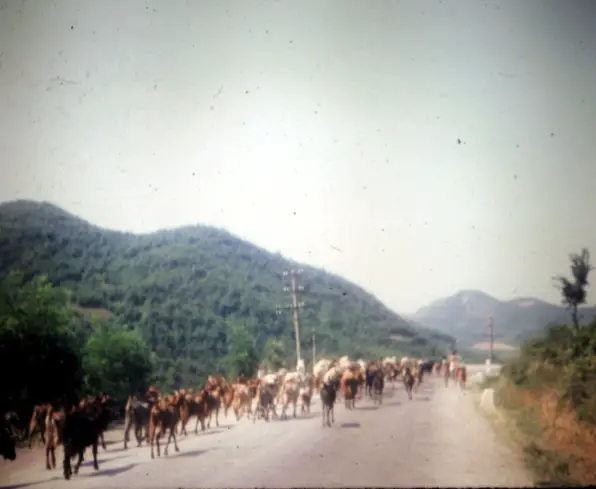
We discovered a rural world where the road belonged to man and animals alike, where there were no cars (only about 400 in the entire country, reserved for the nomenclature and the police), where the human toil of a world that lacked mechanization was visible everywhere.
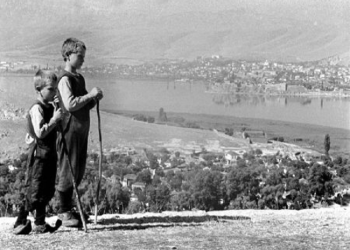
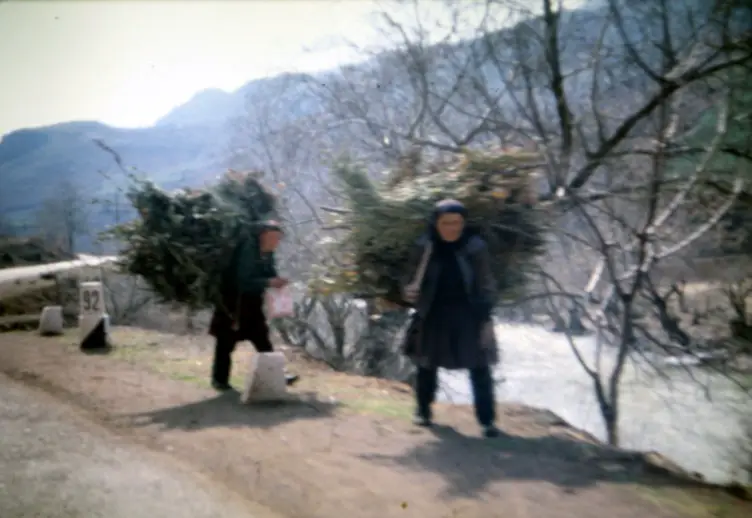
Upon arrival: fields filled with women digging the earth; agricultural carts pulled by oxen or horses; while on the national road, herds of cattle, mules, and donkeys – the only means of transport; men and women with backs bent under loads of wood, hay, or corn; barefoot children evoking the hardships of “The Clog Tree.”
In the city, extraordinary police control kept a mute population at a distance – a people terrified by the idea of a clash, even for a single word or look, with the iron fist of the “Sigurimi i Shtetit” (the Secret Police).
How could this have been achieved in the heart of Europe in the middle of the 20th century?! What had happened in Albania, a country unknown and mysterious until the eighties, which boasted of being the only state of the Dictatorship of the Proletariat and of atheism, unreachable for foreigners, and which proclaimed itself the “land of happiness,” as Radio Tirana did every day?! We need some historical data to understand Albania of this period. We summarize them into three essential points:
1) Albania: A country subjected for centuries to foreign domination and a place of identity-based resistance against foreigners (shqiptaria): the longest of the dominations was the Ottoman-Turkish rule, lasting five centuries from 1417 to 1912, the year Albania won its independence. The struggle to defend the homeland and identity began in the 15th century and is personified by the great national hero, Skanderbeg, whose statue stands out everywhere.
Later, France and Italy intervened in Albania during the First World War. In the post-war years of political instability that followed, it ended with the occupation of fascist Italy (1939–43), followed by the Nazi occupation, which ended on November 29, 1944, with the victory of the Albanian Resistance, from which emerged the Albanian Communist Party (PKSH) led by Enver Hoxha.
By appealing to his people’s love for their country, Hoxha stood as a national hero on the same level as Skanderbeg; he appealed to the masses, promising a free and prosperous society through communism.
2) The creation of National-Communism. It is a national-communism based on Albanian identity rather than communist internationalism. A communism founded on the Dictatorship of the Proletariat with a Stalinist seal, as shown by the statues of Stalin present in the main cities.
Initially, the results were striking. We recall an episode that hit us hard back then: an old Albanian, a former partisan, spoke to us in the alleys of the Old Bazaar of Kruja after hearing us speak Italian. It was a rushed and forbidden encounter, but we were far from prying eyes, and being so old, he had nothing left to fear. His words were enlightening: “In Albania,” he told us, “we could be happy. Communism freed us from three great plagues: from the foreigner (now we are free at home), from ignorance (illiteracy was 90% at the end of the war), but, of course, after basic needs are met, man asks for more.”
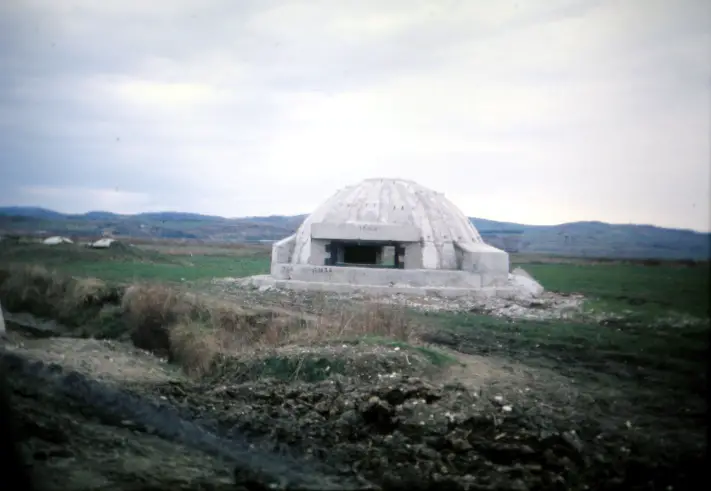
On the contrary, the tightening of the communist regime and the closure in every field were progressively leading Albania, in the ’60s and ’70s, into total isolation, where all foreigners were declared enemies. The Albanian people were fed with the psychosis of the enemy against their country, and to defend them, the land was filled with bunkers.
3) Isolation and Autarky. In fact, the history of post-war Albania is a history of successive ruptures and conflicts with its close friends: first with Tito’s Yugoslavia in 1948, then with the USSR after Stalin’s death, and finally with Mao Zedong’s China in 1978. Starting from the late seventies, Hoxha imposed total isolation on the country with the motto: “Albania will rely on its own forces!”
In the ’80s, Albania was already a “Red Camp”; the Albanian people were slaves to an iron regime, subjected to an indoctrination that led them from birth to death, with Enver Hoxha propagating that: “The Party is the heart and brain of the New Man.” Even the names of newborns had to be inspired by the communist model: Shpresa (Hope), Drita (Light), Përparim (Progress), etc.
In short, communist doctrine became the religion that replaced other religions: since the mid-1960s, Albania was an officially atheist country, complete with a Museum of Atheism, where all places of worship (Orthodox, Muslim, and Catholic) were not only closed and destroyed but used as warehouses, etc.
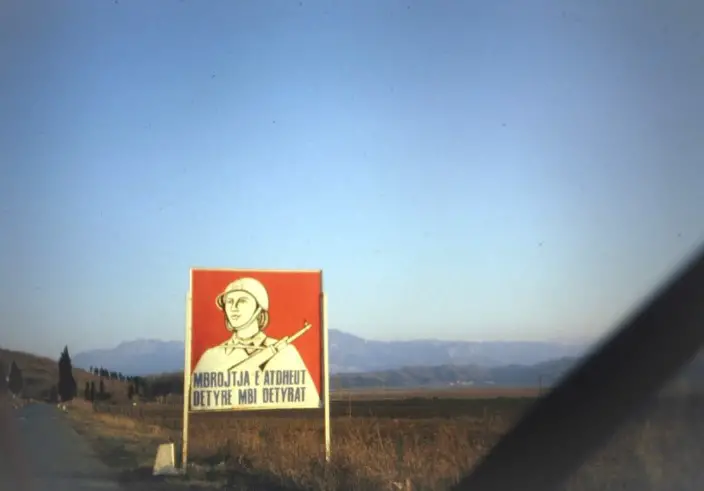
An obsessive propaganda followed the gaze and mind of the “New Man” to instill loyalty to the homeland and the party, the exaltation of communism and the supreme leader (Enver Hoxha), and the strength and preparation of men and women, with slogans and posters clearly reminiscent of fascist propaganda.
Framed thus physically and mentally, the Albanian people suffered “an incurable offense,” to quote the expression used by Primo Levi when describing the discouragement of trapped prisoners as the gates of Auschwitz opened. We speak of an incurable work because the fall of the regime opened a void: there had been nearly fifty years without education for citizenship, democracy, freedom, or critical sense – essential values and skills for managing the new era that was opening, for knowing how to restore a new ethic for managing freedom, consumption, and the common good, and for rebuilding interpersonal relationships poisoned by suspicion and fear.
On one hand, we believe it is our duty to reveal the catastrophic conditions in which Albania found itself when the regime fell, precisely because no assessment today can ignore the starting point from which the country recovered. On the other hand, we emphasize that today’s Albania, in full reconstruction despite the many limitations of chaotic and rushed development (speculative construction, corruption, general anarchy), transmits an enthusiasm that looks forward, carrying hope for many young people deprived of freedom and dignity for too long.
For this reason, after seeing the surprising progress made in 20 years, we must say: “Enver Hoxha’s dictatorship, yes, was a deep offense, but not an ‘incurable offense’.”
This dynamism and awareness are present in every aspect of today’s society, even in art, as evidenced by the exhibition of Artan Shabani (“Reflected Landscapes”), a young artist who arrived in Italy with the first waves of migration. Today he is the director of the GKA (National Gallery of Arts) in Tirana, a witness of a new Albania, confident in its future. / Memorie.al
Translated from Italian by Sara Molla
Note on the authors:
- Michele Brondino: Mediterranean historian and director of the Mediterranean Encyclopedia.
- Yvonne Fracassetti: French expert and former Cultural Attaché in various Mediterranean countries.