By Arben Shahini
Part Two
Memorie.al / On February 19, ’91, around 3:00 PM, the Plenum of the Central Committee of the PLA issued a statement asserting that students’ living conditions had significantly improved and rejected the students’ request to remove Enver Hoxha’s name from the University of Tirana as “unfounded.” The Central Committee’s resistance ended two months later when the name was finally removed. Numerous Special Forces, order maintenance, and rapid intervention units – equipped with rubber helmets, batons, tear gas, and border dogs – had blocked the road leading from the Artistic Lyceum to the Radio-Television building. They had also blocked the road with two army “IFA” trucks for this purpose.
Continued from the previous issue
The three days of the students’ hunger strike had heightened tensions in Tirana. Several hundred thousand people headed toward the “Studenti” City Cinema Club to express solidarity and support for the striking students. On February 20, 1991, the square in front of the Cinema Club was more crowded than ever. The crowd’s chants of “The students are heroes,” “We are with the students,” “Down with the dictatorship,” “Enver-Hitler,” and “We will remove the filth” provided great courage to the strikers. Nearly 900 striking students were barricaded inside. The strike’s organizing committee did not allow Albanian Television camera operators or any citizen who was not a student or lecturer at the University of Tirana to enter the premises.
Thousands of citizens and family members gathered in “Studenti” City, anxious for their relatives. We remember the slogans shouted outside: “Come join us here, here, together with us,” “Down with the bureaucrats,” and many other patriotic slogans. Only the television operator for the Democratic Party, Agim Buxheli, was allowed inside, capturing rare footage of the barricaded students.
From the balcony of the Geology dormitory, various orators delivered speeches against the government and the PLA, which were sacrificing students for the name of a dead man. Thanks to the well-organized Unions, especially the Miners, nearly 100,000 people gathered – workers, students, lecturers, and other citizens of Tirana – to protest in support of the hunger strike. The first to arrive were the miners of Valias, who, cheering from “Durrës Street” to “Studenti” City, managed to gather a crowd of nearly 10,000 citizens around them.
By 10:00 AM, there were approximately 100,000 protesters in “Studenti” City. Together, they cheered for victory and expressed their hatred toward the communist regime with slogans such as: “Oh Ramiz, you dog, we will hang you by a rope,” “Down with the dictatorship,” “Freedom, Democracy,” etc. At the end of several speeches, the talented actress Rajmonda Bulku, closing the solidarity rally, called on the protesters to march toward “Skanderbeg” Square.
Ms. Bulku’s call came at a moment when it seemed every protester heard her. A group, mainly consisting of family members and mothers of the hunger-striking students, headed toward the Presidency to meet Ramiz Alia. Meanwhile, the main mass of protesters headed toward the Artistic Lyceum. At the front of the march, we placed women and young children so that the police would not mistreat the crowd.
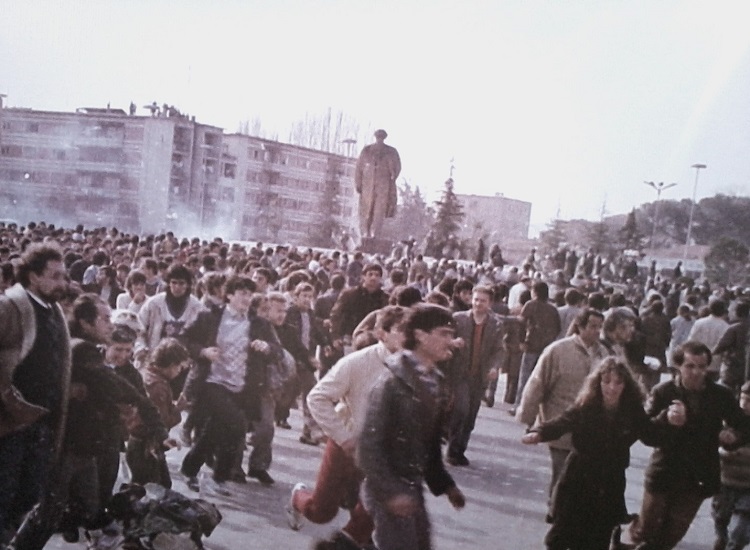
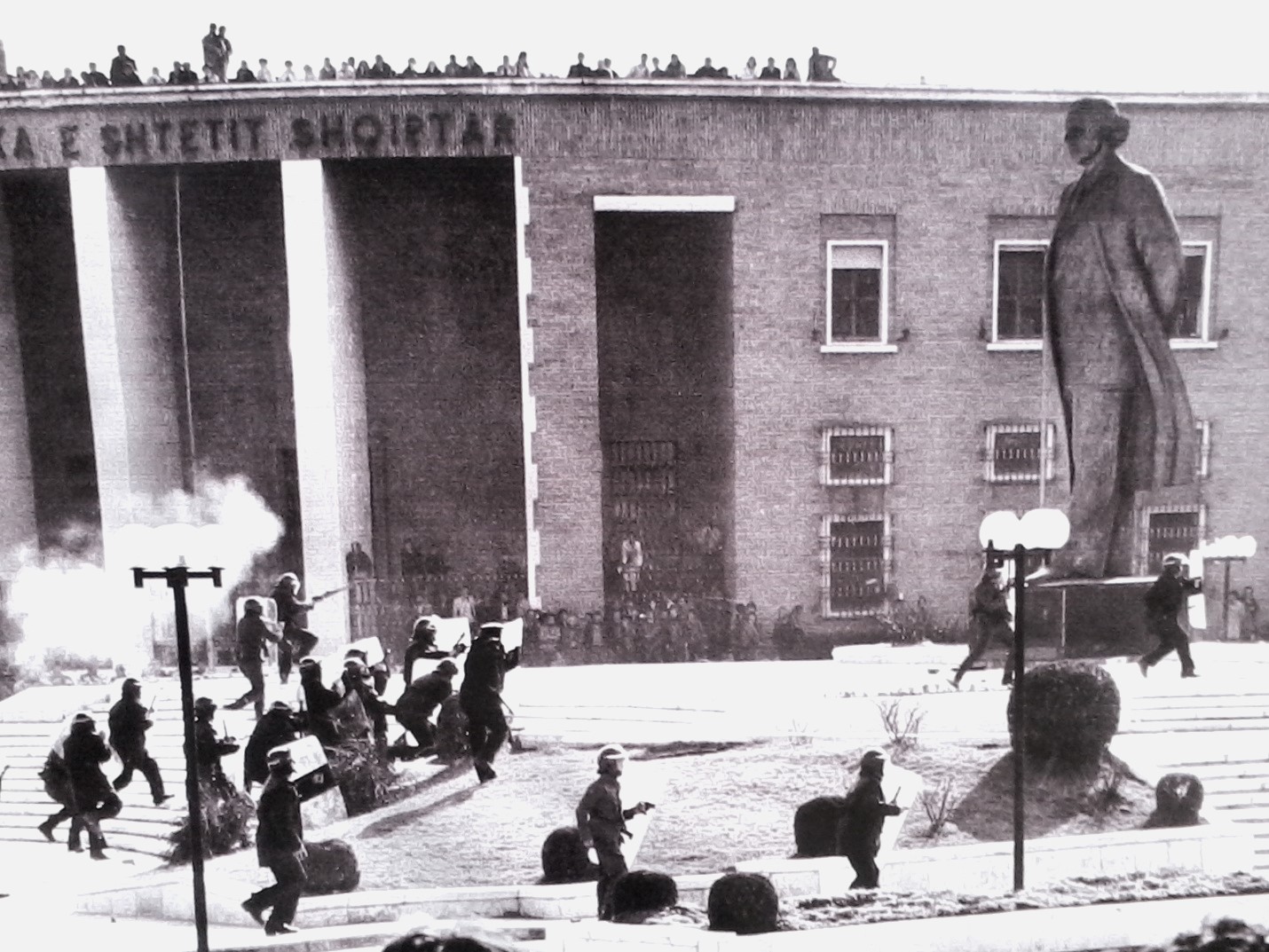
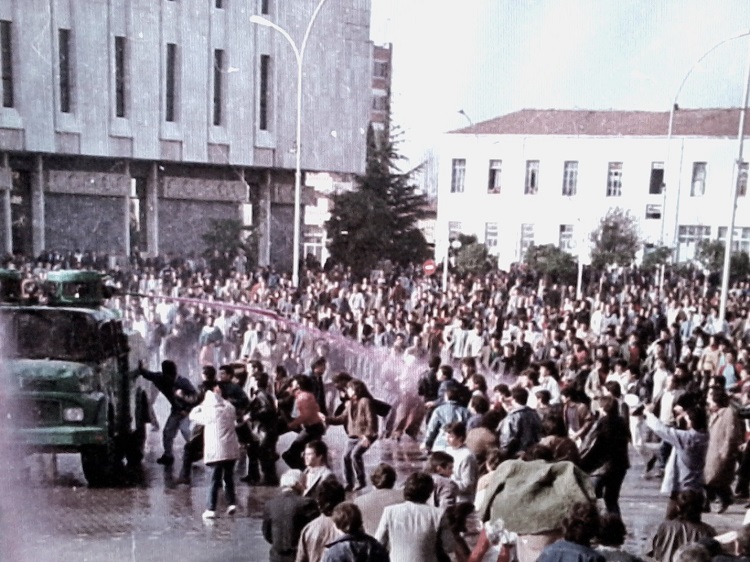
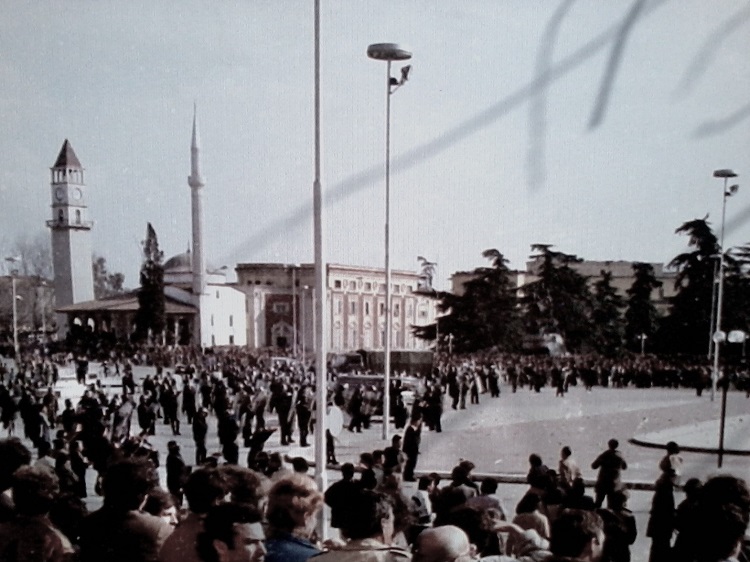
A mass of about 100,000 people moved through “Elbasan” Road. At the Lyceum, they were met by rows of police with helmets and weapons. Police dogs were set upon the people, and Kalashnikovs were fired over the heads of the protesters, who retaliated by throwing stones and hard objects at the police and Special Forces. The crowd pushed forward, now heading toward “Skanderbeg” Square.
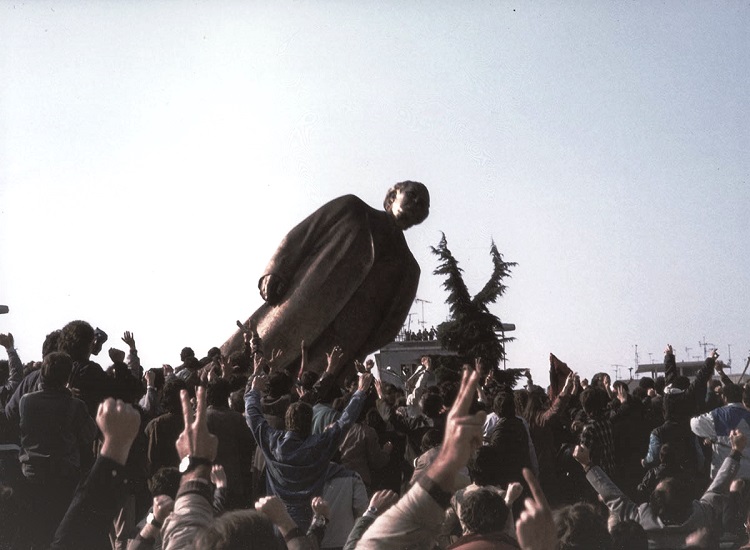
The battle for the square was decisive. After a clash between the people and the forces of the Ministry of Internal Affairs, the bust felt its first tremors. At 2:00 PM, the monument of Enver Hoxha fell to its left side after three or four violent shakes. Some had worked at the base of the bust, where the mounting bolts were located, while others had thrown a steel cable around its neck. Enver fell, and with him, his myth. Policemen and citizens embraced for a few moments in the square.
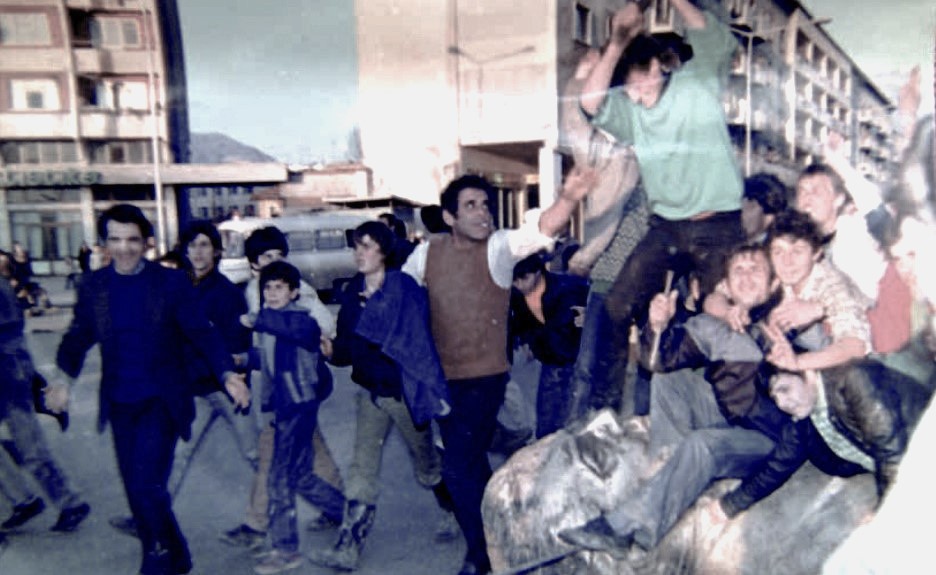
The atmosphere was electric. Thousands pushed and shoved to be the ones to trample the fallen statue. For eight consecutive hours, the statue of the dictator was dragged through Tirana. The hatred toward the dictatorship was clearly evidenced in those moments. After being toppled, the monument – now split in two – was tied with cables to a garbage truck, which began dragging it toward “Studenti” City, where the students’ hunger strike was still ongoing.
All along the way, people continued to spit on and kick the fragmented monument of the dictator. In the streets of Tirana, people were seen weeping with joy, unable to believe the monument had fallen. Everyone joined in a long line, continuing toward the building where the hunger strike was taking place. The meeting point was precisely there. Over one hundred thousand people in a giant chorus chanted incessantly: “We removed it, we removed it, we removed the filth!”
The Dictatorship’s Reaction
Immediately after the toppling of the monument, the government representative, Minister of Education Skënder Gjinushi, accepted that the dictator’s name would be removed from the university. Meanwhile, a news report from the cabinet of Prime Minister Adil Çarçani was published, stating: “Since it will be reorganized, the University of Tirana will no longer bear the name of Enver Hoxha. This decree enters into force immediately.”
Following the loss of the monument, the “Enver Volunteers” threatened to march on Tirana to restore the statue and declared they would name Vlora as the new capital of Albania. On February 21, 1991, at 11:00 AM, gunshots were heard from the leadership “Block.” A spontaneous gathering occurred, marching toward the “Block.” The crowd was stopped by Neritan Ceka at Hotel “Dajti.”
Under these circumstances, Ramiz Alia announced the creation of a Presidential Council; Adil Çarçani departed and was replaced by Fatos Nano, the former deputy director of the Institute of Marxist-Leninist Studies. On February 22, the situation worsened as a military revolt began at the “Enver Hoxha” United Officers’ Academy. The State Security (Sigurimi) began a crackdown on democrats. Many activists of the Democratic Party were struck in Tirana, Elbasan, Korçë, Fier, Lushnjë, etc.
The military personnel announced an Initiating Committee of the “Movement for the Protection of People’s Institutions.” They issued an ultimatum to political forces for a referendum on Enver, the implementation of the law for the protection of monuments, and placing the RTSH (State Radio-Television) under the direct authority of the Presidential Council.
The military sought revenge. On February 22, a meeting took place between them and politicians. The meeting saw a fierce clash between opposition representatives led by Abdi Baleta and the military. Baleta immediately declared that the military’s actions could be considered a coup d’état.
Tensions spiked following news that the military intended to move the dictator’s bust from their school to “Skanderbeg” Square at night. A crowd surrounded the Academy. Meanwhile, clashes occurred inside the school between students and military personnel, some of whom were against Enver. The military reached their peak pressure when they summoned Ramiz Alia to the Ministry of Internal Affairs. They demanded to know why he had not taken measures to protect Enver Hoxha. Ramiz defended himself by saying, “I had given the order to fire, but the order was not carried out.”
On February 23, Tirana woke up shocked by the bloodshed. According to reports at the time, four people were killed, including a policeman and a 12-year-old girl named Olta. She died while watching television in her home from a stray bullet. The country was heading toward catastrophe and despair. On March 6, 20,000 people boarded ships in Durrës and set off for Italy, leaving behind little hope for a life in peace and tranquility.
The First Photographers to Capture the Toppling
On February 20, 1991, all the world’s television channels broadcast as their lead story a volcano of hatred erupting upon a seven-meter-high bronze statue of the dictator Enver Hoxha. Although the monument was nothing more than a mass of bronze in Tirana’s largest square, its overthrow was the symbol of the collapse of a dogmatic system whose time had come to go. Lulëzim Lika, then a photojournalist for the Albanian Telegraphic Agency (ATSH), was one of the few who managed to capture this historical moment.
The photo of the toppling was broadcast by ATSH with the caption “View of the toppling of Enver Hoxha’s bust,” despite the irony that a senior position at the agency was held by Enver Hoxha’s daughter-in-law. This photo would change Lika’s career; the next day, “Reuters” editors asked him to work for the prestigious agency, with whom Lika still works today.
Armando Babani, another photojournalist, remembers always carrying his camera during those gray days. Students in their city were at the peak of protests. By chance, Babani was in “Skanderbeg” Square at the right moment. Hundreds had climbed onto the terraces and balconies of buildings adjacent to the bust. Several people pulled Babani up to a second-floor balcony so he could capture the historic moments. “Pull him up, he’s a photographer!” Babani recalls them saying.
“I might have taken 9 or 10 shots, and that was it – about a second and a half – because after that, people covered the bust. I didn’t know what would happen later, but today I say these were the photographs of my life,” says Babani, one of Albania’s most renowned photojournalists. Babani’s photos were published in the newspapers “Republika” and “Rilindja Demokratike,” while today the photos by Lika from ATSH, Babani, and an Italian photojournalist are found in media archives worldwide.
Fatmir Çepani, an operator at Albanian Radio-Television, was the only one to capture these moments on film. “With the camera on my shoulder, supporting the weight of dozens of people watching from above me, I managed to film what was happening in the square.” His 17 minutes of footage express the experiences of these historical moments – the chaos, the revolted crowd, bullets, stones, and armored police vehicles.
Foreign Agency Comments on the Toppling of the Dictator’s Bust
The British news agency “Reuters”, commenting on the toppling, wrote that a hated symbol of the Stalinist past had been brought down. A foreign diplomat, as quoted by the agency, noted that the statue of the founder of the communist state fell after a massive demonstration in the center of “Skanderbeg” Square. 100,000 people – not just students, but workers and intellectuals – gathered in the central square and across the wide boulevard. This was the most dangerous and complex event in Albania in decades.
In another report, the same agency discussed the name change of the University of Tirana. Albania’s communist authorities, it noted, knelt before popular protests and removed the name of the former Stalinist leader Enver Hoxha from the University of Tirana but warned that the country was on the brink of crisis.
Albania, previously the last bastion of Stalinism, has been engulfed by changes since last year’s first student movements. Alia legalized opposition parties and promised further reforms, but he had maintained a firm stance against the striking students, calling their demands undemocratic.
“Skanderbeg” Square, where thousands of Albanians toppled the massive statue of the former dictator, is the political heart of the country’s Stalinist system – Tirana’s equivalent of “Tiananmen” Square. In its commentary, the Yugoslav news agency “Tanjug” stated that the major unrest and destruction of the Enver Hoxha monument in Tirana recalled the beginning of the overthrow of the dictatorship in Romania the previous winter.
The destruction of the monument of the “father of the nation” was preceded by a small war between the police and the people, who pelted Special Forces with stones. Armored vehicles and tanks appeared in the streets, and shots were heard. Along with the monument, the agency emphasized, an era of Albania’s not-so-glorious modern history fell. The police could no longer protect what the people refused to let be protected. They abandoned their beloved leader and, in return, received kisses from the exalted masses.
Meanwhile, it was reported that the people destroyed the monument of Enver Hoxha in the coastal city of Durrës as well, while the same fate awaited the monument in Korçë. The “Romanian-style” scenes in Tirana resonated among Albanians in Yugoslavia, especially in Kosovo and Western Macedonia. Pristina students sent a telegram of support and solidarity to Tirana students. Telegrams were also sent by youth from Tetovo in the name of the Democratic League of Albanian Youth.
Regarding the toppling, the Austrian news agency “APA” wrote: The question of when the heroic leader of the Albanian people, Enver Hoxha, would be toppled from his pedestal was simply a matter of time. For years, his Stalinist regime bore responsibility for the catastrophic mismanagement of the economy and the isolation of Albania from the rest of Europe for over 45 years. With the toppling of his bronze memorial in Skanderbeg Square, six years after his death, an era finally ended – one which, based on Hoxha’s theory, was a permanent struggle against external enemies.
Hoxha was not a man who left things half-done. He radically directed the policy he built according to the Stalinist model. The state apparatus was entirely in his hands; he established a secret service named “State Security” (Sigurimi), which struck terror into the people. Just as King Zog had pursued “Red” opponents in the interwar period, Hoxha acted similarly after the war against any anti-communist element.
The wave of his ideological persecutions reached absurd proportions. Ultimately, as a purist, he held the view that only he represented the pure teachings of communism, thereby severing ties with the orthodox communists of the Bloc. He had no regard for the CSCE or human rights institutions.
Hoxha also glorified himself as a writer. His literary output flowed into more than 70 books, not to mention the literature written about him. The Communist Party kept his memory alive across the country with giant, Hollywood-style letters. “Glory to Enver” on mountain slopes or slogans placed on tall buildings…! Finally, the most expensive building in the country was dedicated to him: the beautiful futuristic Enver Hoxha museum (The Pyramid), built at costs reaching up to 3 billion shillings! / Memorie.al