Part Twenty
Excerpts from the book: ‘ALIZOT EMIRI – The Man, a Noble Library and Gazette’
A FEW WORDS AS AN INTRODUCTION
Memorie.al / Whenever we, Alizot’s children, shared “Zotia’s” (Alizot’s) stories in joyful social settings, people would often ask us: “Have you written them down? No? What a shame, they will be lost…! Who should do it?” We felt increasingly guilty. If it had to be done, we were the ones to do it. But could we write them?! “Not everyone who knows how to read and write can write books,” Zotia used to say whenever he handled poorly written books. While discussing this “obligation” for the Book among ourselves, we naturally felt inadequate for the task. It wasn’t a job for us! By Zotia’s “yardstick,” we were incapable of writing this book.
Continued from the previous issue
VACATIONING AT THE WORKERS’ CAMP
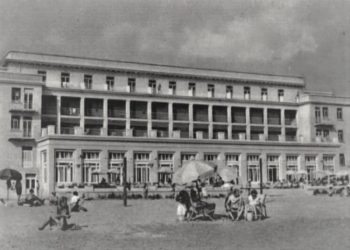
We had gone on vacation to the beach in Durrës as a family – the Emiri family. It must have been around 1972. Ibrahimi, the eldest son, had secured an apartment in a “Villa” from the Përmet quota, where he worked as the head of the Design Office, while I had secured a camp voucher from the N.N.I. Ballsh enterprise, where I worked as an engineer. We gave the voucher to Zotia so he could stay in the most comfortable conditions, while the rest of us gathered in the “apartment,” which was simply a room and a lounge where we all ate and slept, plus a bathroom. We felt privileged! We had a villa!!
We spent our beach time together as a family. At lunchtime, we would escort Zotia to the workers’ hotel where he would dine and rest. We did the same in the evening. In the family field, our parents’ harvests were bountiful! We spent an unforgettable fifteen days together.
With the Roommates
With his camp voucher in hand, Zotia was waiting in line to register at the workers’ hotel. Before he reached the counter, he heard his name being called. He turned his head and saw two of his friends from Gjirokastra: a talented teacher from the “Asim Zeneli” high school and a chemical engineer working in the scientific research sector for phosphorite enrichment.
– “What are you doing here?” the friends asked in surprise.
– “I’m registering,” said Zotia, his eyes lighting up when he saw them.
-“What do you mean, you in a workers’ camp?!”
– “For the time being, even us lazy ones will rest at the workers’ camp until our own camp is built,” Zotia said sarcastically.
– “Who are you sharing a room with, Zote?”
-“I don’t know, whoever I get assigned,” Zotia replied with indifference, as if it didn’t matter at all.
– “Are you serious, or are you joking?! No, that’s impossible!”
-“Yes, yes, I’m serious. I actually want to stay with strangers. They’ll surely be better than you,” Alizot began to tease them.
– “Get out of line quickly; we’ll share a room together. You’ve arrived as if by order!” They pulled Zotia out of the line and took his voucher.
Zotia acted more “troubled” than happy that chance had brought him together with such friends and protested.
– “Thank you very much, but I’m getting back in line. I’ll register in any random room because I get up at night and I don’t want to bother you; we can stay together and enjoy ourselves during the day.”
While Zotia was asking for his voucher back, they got in line and registered. They came out with the room keys in hand and went up to settle their things. Zotia, with his wooden suitcase, preferred the bed near the door since he would be getting up at night.
– “We’ll go out to shop for a few things,” Zotia told them, “since we couldn’t bring everything from home. What can you bring anyway? It’s just one wretched suitcase. And the wooden suitcase itself weighs more than the clothes!”
They left the camp in high spirits and went to the shops at the “Apollonia” beach area. The two friends had nothing to buy. Zotia approached kiosk selling beachwear and trinkets and asked the saleswoman loudly, so his two companions could hear:
– “Comrade, please, do you have chamberpots for adults?”
– “No, we don’t stock those.”
– “Well, where might I find one, please?”
Zotia, “annoyed” and silent, made his way toward the block of shops opposite. His two roommates followed behind, equally silent and baffled by the “item” Zotia was looking to purchase. He entered a shop; his friends followed immediately. Zotia asked the shopkeeper in a low voice:
– “Do you carry adult chamberpots, please?”
– “No, comrade, we don’t.”
– “Well, where can I find a single one, can you help me?”
– “Unless you have a friend at the hospital, I don’t know what to tell you, brother,” replied the shopkeeper, who felt sorry for the man in “need.”
Zotia left the shop fuming. He was talking to himself:
– “What have I done this time? How did I fall for this?!”
– “Listen, Zote, why do you need a chamberpot on the very first day?! we’ll look around during this time and have one brought from Durrës before we go back to Gjirokastra.”
– “I don’t want it for Gjirokastra; I want it for here. In Gjirokastra, I have my sets in order. But I was fooled into not bringing it; we even argued at home. ‘Why do you want this one,’ they told me, ‘it’s a bit chipped at the rim, it’s a shame in front of your roommates. Buy a new one in Durrës to have for whenever you go out visiting…’ But now?!”
– “But why do you need a chamberpot here?” the roommates asked, worried.
– “That’s exactly why I didn’t want to stay in a room with you. I’m old, and age brings its own whims. I relieve myself at night. To avoid tumbling down because I get dizzy, and to avoid breaking a leg or an arm, I don’t go to the latrine at all. I keep the chamberpot under the bed, sparkling clean. I get up, do my business, and cover the pot with a beautifully cut piece of cardboard. It doesn’t smell at all.”
The two Gjirokastrians were horrified when they realized what their roommate would be doing during the night. They weren’t reassured by the fact that Zotia had taken “strict measures” to prevent the bad smell from escaping.
– “Is this the Zotia we know or not?! In the bookstore, he never gives off this impression. Why didn’t you say that we should disinfect all the books we buy from Alizot!” they were muttering to themselves and each other.
– “Zote, don’t worry at all. At night, you have us,” they intervened insistently. “At whatever time you need, we will take you by the arm to the bathroom; the hallways are lit. Forget the chamberpot. You don’t want to bother us, but it is our duty to serve you.”
They ended the conversation. After dinner, they went for a walk on the shore and then went to sleep in the room. Each lay in his own bed.
– “Should we leave a light on so I can see when I get up at night?” Zotia asked.
– “Don’t sleep with worry, we told you—as soon as you move, we’ll be up, we’ll turn on the light, and we’ll proceed,” his friends reassured him, proving themselves true friends. They turned off the light; goodnight, goodnight.
In the morning, when it was broad daylight, Zotia woke up and sat up in bed. As soon as they heard a noise, the two “on-call” friends jumped up.
– “What’s the matter, what happened to you that you jumped up like you were startled?” asked Zotia, who had slept his fill.
– “Are we going to the bathroom?” the worried friends asked, having slept with one eye open.
– “Why, are we in the army here? We’ll go to the bathroom when there’s business to do, not when the command is given.”
– “Listen, Zote, you didn’t get up once last night to go to the bathroom; you snored all night long, only stopping when you rolled over. You left us on guard duty; we scoured the world for a chamberpot for your… behind. How do you explain this?!”
– “There’s nothing to explain; it explains itself. The chamberpot was for the first night. For the following nights, you will receive other assignments to keep your brains fresh, because you intellectuals, if left in comfort for a bit, lose your way.”
– “Didn’t I tell you Zotia would pull one of his stunts?” they were laughing before dawn, recalling the doubts they had expressed to one another.
-“You said it, you said it, but that was a dangerous joke because if Zotia’s problem were real, the Municipal Service would have to come clean our room today, and the culprit would be sought. I assure you, one of us two would have been blamed. And did he spare himself during the meal? It seemed as if he was eating just to spite us. He licked the plate clean. I was watching him with such anger. ‘This man,’ I said to myself, ‘even though he knows what ails him, he doesn’t hold back at all.’ At least he shouldn’t have eaten in the evening. I never thought I could actually hate Zotia!”
– “It’s in the past and forgotten,” Zotia told them, “but thank goodness, you had it easy this time -no fever, you got over the illness quickly…” and they were laughing and teasing about what might come next.
Do You Know the Comrade…?
We used to go to the beach together as a family. We would walk in a line from the villa to the beach, pick a spot, plant the umbrella, and lie on the sand like everyone else. One day, a man was coming toward us. He was in normal clothes – trousers and a shirt, not swimwear. He walked, stopped, turned his head everywhere, looked, took a few steps, and stopped again. He approached our feet, almost stepping on us.
– “Are you looking for someone?” Zotia asked, as if to bring him to his senses.
– “Yes,” the stranger said, without taking off his sunglasses.
– “Do you know the one you’re looking for?” Zotia continued.
– “Of course I know him, he’s a close friend. My apologies!” the man in trousers reacted immediately, thinking he had given the impression he was there to ogle the undressed people on the beach.
-“Listen, do you know him by his… behind? That’s what I’m asking,” Alizot clarified.
– “I don’t understand you!” said the stranger, taking off his sunglasses and lowering his head toward Zotia to see and communicate more directly with the person who spoke so strangely.
– “Well, you can see for yourself,” Zotia continued, “here there are only behinds, so I’m telling you, if you know him by his behind, keep looking; but if you don’t know him by his behind, you’re tiring yourself out for nothing, you’re wasting time and roasting in the sun while fully dressed!”
The poor man burst out laughing loudly – he had a voice loud enough to sound an army alarm. Those who were dozing in the hot sand woke up, wiping the sand that had stuck to their sweaty foreheads and cheeks, looking around startled.
– “You are quite right; I’ve been looking for my friend for over an hour, but it’s useless. I couldn’t pinpoint the reason why I couldn’t find him. I couldn’t put a name to it. At first, I was offended because your question seemed provocative. But no! You were right!”
– “Not all bad things come from the head,” Zotia told his new friend, “it turns out the behind can also be a cause; therefore, from now on, get to know your friends better, because look how things go – not only do you fail to finish your business, but you get embarrassed for nothing!”
A Stroll on the Beach
We had gone for an evening stroll by the sea. There was a large crowd of vacationers. It was impossible to walk as a whole family group. We had to split into at least two parts. And Zotia, taking advantage of the occasion, said to Fete, our mother:
– “Go on ahead, lest they think you are my wife,” – alluding that she didn’t “suit” him.
– “Oh, may I take your troubles and be sacrificed for you,” Fetia shot back laughing, “for you to tell me that – me, who filled your house with these ‘brave ones’!” (Referring to us!)
Zotia kept laughing at Fetia’s reaction. Perhaps it was also because Fetia considered us brave -“mother’s brave ones.” We didn’t quite understand. We didn’t dare ask. It was up to Ibrahimi, the eldest son, to clarify. If he were brave, he would have asked!
AT THE PIONEERS’ CAMP
In 1955, when Ibrahimi finished the fourth grade, the school had selected him to go to the pioneers’ camp in Libohovë as an outstanding student. Ibrahimi was very happy because he had never left Gjirokastra. Together with his friend, Sejdo Tartale, they packed their things into a single wooden suitcase and waited impatiently for the day of departure. The whole family had come out to see him off, as if he were going who knows where! And Libohovë was right there!
Boarding the pioneers’ vehicle was done according to a roll call read by the pioneer leader. As soon as he heard his name, Ibrahimi, who could barely pull the wooden suitcase, prepared to climb into the vehicle, when a man stopped him, saying: “Get off! You won’t go to the camp because your father is a private [merchant]!” Ibrahimi was devastated! Zotia tried to explain that Ibrahimi had been selected by the school as an excellent student, but it was in vain. The man from the Trade Unions—the one who appeared to Ibrahimi as the ugliest man in the world—wouldn’t budge. Ibrahimi got off, opened the shared wooden suitcase, removed his things, and left the suitcase to Sejdo, who was not barred from going to camp.
Three years later, after much effort, Zotia finally managed to secure a camp voucher for the pioneers’ vacation camp in Durrës in Ibrahimi’s name, as an excellent student. Ibrahimi had finished the seventh grade. By this time, Zotia had closed his private business and started working as a bookseller at the State Book Enterprise. Consequently, his children were now allowed to participate in social activities on equal footing with all pioneers. It was an extraordinary event for a student from Gjirokastra to go on vacation to Durrës.
It was the first time the boy was being sent away from home. Measures were taken to create the necessary “trousseau.” It wasn’t easy. There were no swimsuits on the market. They had to improvise them. In Gjirokastra, this wasn’t the same as in Durrës. They had no experience with beachwear; they didn’t know the patterns for cutting and sewing…! If you look at the photographs Ibrahimi took at the beach in Durrës and you don’t like them, don’t let it cross your mind that he isn’t handsome! Rest assured that the swimsuits are what make him look bad.
Finally, they got him ready and went to see him off at “Çerçizi Square” with that small wooden suitcase. The pioneers were being put on the bus one by one as their names were called from a list by the leader, Tomor Kotoni. After his name was read, Ibrahimi stepped onto the first step of the bus. They helped him lift the suitcase, and Zotia wouldn’t let go of his hand. The leader stopped reading the other names and turned to Alizot.
– “Why won’t you let go, Zote? Did you change your mind?”
– “No, Tomor, I didn’t change my mind, but I have a ‘bequest’ for you!”
– “Tell me!” said Tomor, who was friendly with Zotia.
– “You must take good care of my son!”
– “Of course, Zote, it’s as if you were there yourself, no worries at all,” the leader pledged.
– “Wait a moment so I can explain,” Zotia interrupted.
– “Go ahead!”
– “We have tied a red string around the boy’s ankle, do you hear?”
– “Yes?! What does he need the string for?!”
– “The string will be the boundary for the seawater. Meaning, if the sea level rises above the string, the boy is in danger of drowning.”
– “But no, Zote, you’ll roast the boy in the sun with that boundary you’ve set!”
– “Listen here, Tomor, even at home when we wish him in a basin, we don’t let him put both feet in at once – no, by no means. He must put one in, then the other.” Tomor laughed, as did all the parents who overheard what preventive measures Alizot had devised! / Memorie.al