


By DASHNOR KALOÇI
Part two
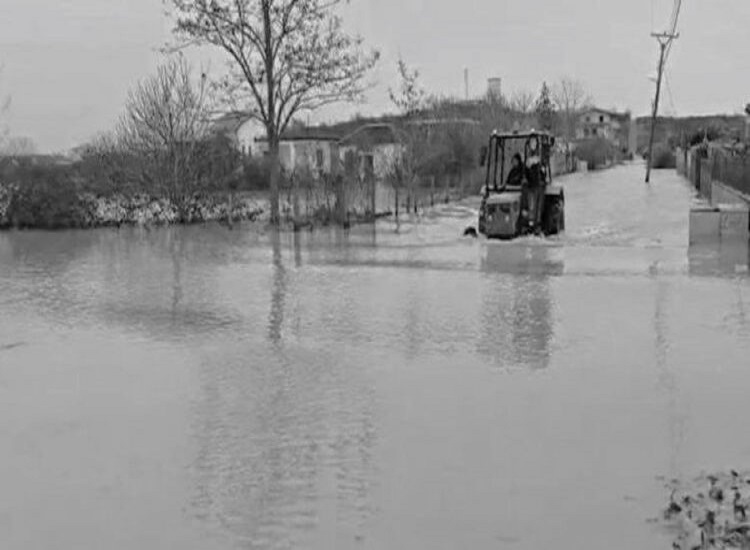
Memorie.al / The bad weather with heavy rain and snowfall that has engulfed not only our country but also our neighbors like Greece and Italy in the last two or three days – even reaching apocalyptic proportions, such as last night (January 21) when cyclone “Harry” struck southern Italy (prompting local authorities to issue a red alert) – is not an entirely unknown phenomenon. At the very least, our country has experienced and felt these “caprices of the weather” on its own shoulders not infrequently – not only during these three and a half decades of pluralism but also before the 1990s. In fact, during those years, it experienced situations far more difficult than those of recent years. Scenes and situations like those from a few days ago (January 7–10, 2026), where almost the entire country was gripped by severe weather with heavy rain and snow, resulting in rivers flooding, bursting their banks, and causing massive floods in several districts, were also seen in Albania in 1963, 1973, and 1985 – years which remain fresh in the memories of those who lived through them!
However, given the fact that the pre-90s regime (both under the leadership of Enver Hoxha and his successor, Ramiz Alia), just as it kept many extraordinary events secret, did not report (in the press, radio, or television) the severe weather events that occasionally swept the country!
In fact, it considered and kept them secret, and people did not know what was happening beyond their own city or village! All of the above is made known through secret archival documents (now declassified) extracted from the Archives of the Ministry of Internal Affairs. In these documents, the Administration and Studies Branch or the General Directorate within that ministry, in their daily operational communiqués, reflected not only extraordinary events occurring in all districts of the country but also the severe weather and its consequences.
Several of these documents, which concerned the severe weather events that gripped the entire country in January 1985, were published a few days ago. Similarly, in the previous issue, we published other documents belonging to December 1973, where severe weather with heavy rain and snow also caused massive flooding of lands, stables, and homes, as well as road blockages due to frost and avalanches, resulting in many losses of human life.
In this article, we are publishing archival documents belonging to April 1970, when severe weather with a massive cyclone swept almost the entire country, mainly the southern districts such as Fier, Berat, Përmet, Vlorë, Tepelenë, Gjirokastër, Sarandë, etc. There was significant damage not only to residential houses, hospitals, plants, factories, the power and telephone networks, stables, greenhouses, fruit trees, kindergartens and nurseries, warehouses, schools, military units, and other social-cultural objects, but also loss of human life. For more on this, we turn to the archival documents in question, published for the first time with their respective facsimiles by Memorie.al.
Continued from the previous issue…
ARCHIVAL DOCUMENTS CONTAINING THE SECRET OPERATIONAL COMMUNIQUÉS OF THE MINISTRY OF INTERNAL AFFAIRS REGARDING THE SEVERE WEATHER AND THE POWERFUL CYCLONE THAT ENGULFED THE ENTIRE COUNTRY IN APRIL 1970, WHICH CAUSED EXTENSIVE DAMAGE IN ALL DISTRICTS.
PEOPLE’S REPUBLIC OF ALBANIA SECRET
MINISTRY OF INTERNAL AFFAIRS Copy No. 1
GENERAL BRANCH Tirana, on April 9, 1970
OPERATIONAL COMMUNIQUÉ NO. 83
REGARDING THE CYCLONE OF APRIL 8, 1970
From 11:00 AM on April 8, 1970, over the territory of the People’s Republic of Albania, especially in the south-western part, there were strong winds with the epicenter in the district of Vlora.
In this district, the wind speed reached 42 meters per second and sea waves were at force 7-8. As a result of this cyclone in this district, as well as in the districts of Tepelena, Fier, and Përmet, various damages occurred, the most severe of which are in the district of Vlora.
- Near the village of Risili, due to the cyclone, the observation/deployment point of Military Unit 1580 collapsed, resulting in the deaths of Officer Mehmet Caci from Tërbaç, Vlora, and soldier Albert Agolli from Korça.
- At this same location, 8 other soldiers were injured. Furthermore, due to the cyclone, 6 civilians were injured in various locations across the Vlora district. Medical measures have been taken for them, and they are out of danger.
- In this district, all grain granaries (koçekët) and early tomato greenhouses have been destroyed. Likewise, the roofs of cultural-educational institutions in a large portion of the villages, as well as the roof of the Electric Bulb Factory, have been damaged.
- In the village of Peshkëpi, 300 houses were damaged, while in the village of Mifol, the cattle stables were severely damaged. In the oil refinery (distileria e naftës), production has been halted, and the roofs of the entire plant have been destroyed.
- In general, the commercial network around the villages of Vlora suffered damage to both buildings and merchandise. In the village of Nartë, 1,500 olive trees were broken, while in Peshkëpi, 300 fruit trees were uprooted and broken.
- Other damages of this nature occurred in other villages, especially in Ormen, Gorisht, etc. Electric power has been cut off in all villages, as well as in the Selenica mine, which is connected to the village of Gorisht.
In the District of Fier
The wind began at 11:30 AM, blowing strongly from the South with a speed of 17-20 meters per second. Various damages occurred in this district as well.
Thoughtful light weight padding: strawberries
For example, in the Kurjan cooperative, the SMT (Machine and Tractor Station) hangar and the early tomato greenhouses were damaged. Likewise, these types of greenhouses were also damaged in the Levan State Agricultural Enterprise (NBSH). There were roof collapses in various buildings of agricultural cooperatives, as well as in 8 state reserve warehouses in the village of Povelç, Mallakastra, which were completely uncovered.
In Patos, a residential building housing 5 families was damaged and rendered uninhabitable; additionally, the cattle stables at the Levan Farm and the “Çlirimi” Farm were damaged. In this district as well, there were interruptions to the electrical power and telephone networks. Simultaneously, damage was observed in the vegetable sales booths (barangave).
In the District of Tepelena
The strong winds continued in this district as well. Due to these winds, 4 people were injured; medical measures have been taken, and they are out of danger.
In addition to these, the Tepelena city hospital and the 8-year school in the village of Sinanaj were partially damaged. In general, many tile-roofed houses were damaged, and 4 state reserve warehouses were uncovered and damaged.
In the District of Përmet
In this district, due to the wind, various seedbeds (farishtet) were damaged and uncovered by the strong gusts, as were the roofs of several old houses. Damages of this nature caused by the wind, though to a lesser extent, also occurred in Berat and Lushnje.
Due to the storm, a Greek ship loaded with lumber has taken shelter since last night near Cape Rodon in the Durrës district, while a Yugoslav ship has taken shelter in Shenjan, Vlora district.
As a consequence of this cyclone, telephone communication in the districts of Sarandë, Gjirokastër, Përmet, Fier, Vlorë, and Shkodër suffered interruptions; for this reason, the radio-bureau (radio transmission) was put into use.
According to information provided by the Hydrometeorological Institute, it appears that river levels are raising due to the melting of snow.
HEAD OF THE GENERAL BRANCH
PETRIT HAKANI
PEOPLE’S REPUBLIC OF ALBANIA SECRET
MINISTRY OF INTERNAL AFFAIRS Copy No. 1
GENERAL BRANCH Tirana, on April 10, 1970
OPERATIONAL COMMUNIQUÉ NO. 84
VLORA
Regarding the notification made yesterday on the damage caused by the cyclone of April 8, 1970, in the district of Vlora, the following data should be considered final:
Casualties: 2 military personnel have died (one officer and one soldier); 19 others have been injured, including 8 soldiers, 2 children, and 9 citizens. Of the injured, 10 have been hospitalized and 2 remain in critical condition.
Damage in the Industrial Sector:
The wind uncovered 3,320 m3 of roofing made of asbestos (eternit) sheets and 700 m3of local and Marseilles tiles. The most significant are:
- The roof of the electric bulb furnace;
- The production roof of the State Food Enterprise (NISH Ushqimore);
- The roofs of the bakeries;
- Workers’ barracks in Gorishtë;
- Approximately 630 m2 of window glass was shattered;
- The walls of a warehouse under construction at the Fish Combine collapsed.
Due to the strong winds, electricity was cut off in several industrial sectors at the Novoselë water supply pumping station, but this has been resolved. However, in the Gorishtë oil zone and the Selenica Bitumen Mine, the power outage persists, and as a result, production is suspended.
Damage in the Agricultural Sector:
Approximately 6,000 m2 of asbestos (eternit) roofing and 350 m2 of local tiles were uncovered across 18 stables, 43 warehouses or hangars, 17 social-cultural objects, and 9 other facilities. Over 700 m2 of window glass was damaged. 6.5 hectares of tomato greenhouses were completely destroyed, and approximately 60 hectares of field-planted tomatoes suffered 60% damage. About 300 olive trees and 100 citrus fruit trees were broken or uprooted.
In the Sector of Communal Economy, Transport, and Construction:
Over 1,300 m2 of asbestos roofing and 2,270 m2 of local and Marseilles tiles were damaged in state and personal residences, as well as in buildings used by enterprises in these sectors. Additionally, all high and low-voltage electrical lines, both in the city and countryside, as well as telephone lines, were damaged. Over 700 m2 of window glass was damaged.
In the Trade and Collection Sector:
4,200 m2 of asbestos roofing and 600 m2 of local and Marseilles tiles were damaged across 63 trade units, warehouses, and hangars. 870 m2 of glass was broken.
In the Education and Health Sector:
1,950 m2 of asbestos roofing and 350 m2 of local and Marseilles tiles were damaged in schools and health institutions, along with approximately 2,000 m2 of window glass.
FIER
In addition to the previous damage reports, the following should be noted:
- In the villages of Damas, Kremanar, and Sinize, the roofs of primary schools were blown off. The children have been relocated to other buildings to continue their lessons.
- In the village of Ninash, the roofs of the cultural room, nursery, kindergarten, and the social club were removed.
- In the villages of Gorderovë and Bardhej, there is partial damage.
- The electrical network has been damaged by 30%. There is damage to olive and fruit trees, but these have not yet been quantified./Memorie.al
HEAD OF THE GENERAL BRANCH
PETRIT HAKANI