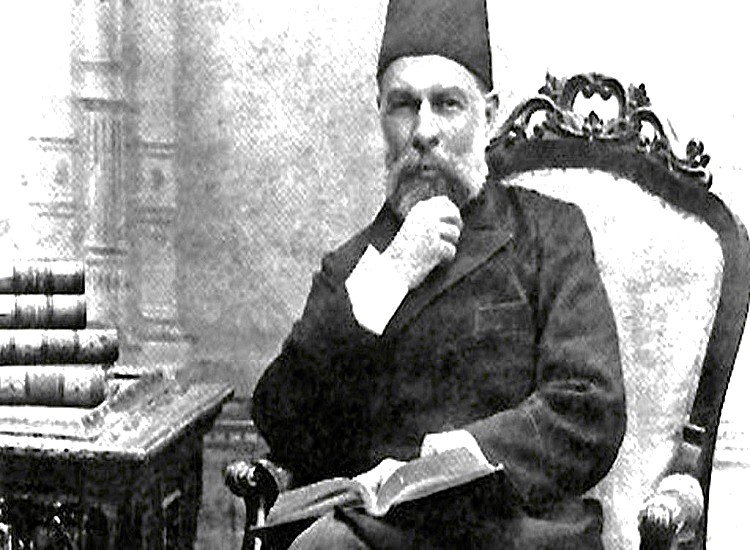

Memorie.al / Among the delegates participating in the Assembly of Vlora on the occasion of the Declaration of Independence on November 28, 1912, were seven delegates from Struga and Ohrid, not counting Ismail Qemali’s son and telegraphist, Qazim Bey Qemal Vlora, and Bejzat Saliu (telegraphist). Looking carefully at the document with the signatures of the signatories of the Act of Independence, the name “Dr. H. Murteza” is also engraved!? Struga, and naturally the people of Struga, take pride in all the figures and personalities of the National Renaissance, and among them Dr. Ali Murtezai – not only a delegate but also a signatory of the Act of Independence in the Assembly of Vlora on 28.11.1912.
Until now, nothing more has been published about this personality or at least the author of these lines has not encountered notes or publications regarding this figure of Albanian history in general. The unveiling of Dr. Ali Murtezai’s persona begins where his life and social, professional, and political activity started – in Struga!
“Chance is the king of the world,” says a folk proverb, and quite by chance, in the city of Struga, I met Dr. Genc Struga from Tirana. His surname, “Struga,” made me curious to know who Dr. Genc Struga was. He himself was even more curious to know his own roots. Regarding himself, he stated: “I am a doctor; I graduated from the Faculty of Medicine in Tirana and specialized in neurology in England.”
Lacking more detailed information, he only knew that he was of Struga origin, hence the surname of the lakeside city. Dr. Genc Struga began his narrative with these words: “My grandfather, named Zenel Struga, came from Struga to Tirana before World War II. He finished his pharmacy studies in Austria. Meanwhile, his brother (my father’s uncle), Ali Murtezai (Struga), was a doctor who also completed his studies in Austria or Romania (!?) and served as a doctor in Struga.”
That Dr. Ali Murtezai served as a doctor in Struga is also evidenced by the author of the monographic book dedicated to health in Struga, Dr. Stojçe Kovaçevski, stating among other things that: “he was the first Albanian doctor in these lands.” They came to Tirana and opened a pharmacy and a medical clinic. This is all I know about my grandfather. My father was born in Tirana and so…”!
Even Genc’s father, Gëzim Struga (with whom we spoke by phone at the time), did not provide a full explanation for the family, except to guide us to meet Ismail Ate! Ismail Ate explained what he knew, saying that this family is autochthonous to Struga!
The assertion of the family’s Strugan autochthony somewhat disoriented the search. To track down Dr. Genc Struga’s family (the descendants of Dr. Zenel and Dr. Ali Murtezai-Struga), we turned to many people: chroniclers of the movements, displacements, and migrations of Strugan people, as well as those involved in historical and historiographical research.
In this regard, Prof. Dr. Nebi Dervishi provided great assistance. Upon hearing the name, he expressed with full respect and pride: “Zejnel Efendiu (Struga), as his contemporaries knew him, was a pharmacist. Meanwhile, his brother, Dr. Ali Myrteza Efendiu (Struga), a physician by profession, was one of the Strugan delegates participating in the declaration of Albania’s Independence in 1912 in Vlora.”
“Both brothers, Zenel and Ali Myrteza, come from an honored, pro-education, intellectual family with deep national traditions. According to the records I possess, in 1935, they opened a pharmacy in Struga…” – highlighted Prof. Dr. Nebi Dervishi, among other things.
Continuing the research to fully clarify the identity of this family, we reached the conclusion (?) that this family arrived in Struga from Dibra and is a branch of the patriot Hoxhë Vogli, Said Najdeni – “Hoxhë Voka” or “Vogli,” one of the distinguished activists of the national renaissance!
What happened to this family? How did they come from Dibra to Struga? How did they abandon Struga? Who “inherited” their house and property? These are questions that require dedicated research through archival documents, but what is currently known is this:
The two brothers, Zejnel – the pharmacist (who finished pharmacy studies in Austria), and Ali Myrteza – the doctor (who finished medical studies in Austria or Romania), came to Struga and lived there until around the years 1936–’37, when they moved to Tirana, Albania, where they opened a pharmacy and remained.
Their house, very close to the Black Drin River and very close to the house of Dr. Ibrahim Temo, was “bought,” “nationalized,” or appropriated by the so-called Mitre Radozhda after their departure! Likewise, the land they owned in Struga was “embraced” by the same Mitre Radozhda, who, according to witnesses, was one of the influential and “authoritative” officials in the municipality of Struga. As witnesses claimed, the “Miladinovci Brothers” primary school was built on land that was the property of Zejnel and Ali Myrteza Struga’s family.
This more or less sheds light on the figure and personality of Dr. Ali Murtezai, one of the signatories of the Act of Independence in Vlora on November 28, 1912, being a representative and delegate from Struga and Ohrid, along with other delegates, led by Ismail Kemal (Qemali), and the other delegates:
Kaçorri (Dom Nikollë Kaçorri), Abdul Aziz Vehbi (Vehbi Dibra), Jorgji Karbunara, Elmas Boco, Vehbi Harçi, Qazim Kokoshi, Josif Minga, Rexhep Mitrovica, A. Rruçi, Abdi Toptani, Abas Dilaver (Çelkupa), Mid’hat Frashëri, Shefqet Daiu, Zihni Abas Kanina, Xhelal Kopernacka, Hajredin Cakrani, Qemal Elbasani, Iljas Vrioni, Salih Gjuka, Dhimitër Berati, Dhimitër Emanuel (Mborja?), Dimitri Zografi, Murat Toptani, Pandeli Cale, Luz (Luigj) Gurakuqi, Bedri Pejani, Spiro (Don) Ilo, Tanas Floqi, Lef Nosi, 1Mustafa Asim Kruja, M. Ferid Vokopola, Ymer Deliallisi, Xhemaledin Deliallisi, Nebi Sefa-Lushnja as well as the delegates from Struga and Ohrid:2
Nuri Sojliu, Zyhdi Ohria3, Xhemal Bey, and Dr. Ali Murtezani (who in all previous publications is noted as Dr. H. Myrteza), although there were other delegates from Struga such as Murat Barutçiu, Hamdi Bey Ohri, Dervish Hima (?), and naturally Qazim Bey Qemal Vlora, the son of Ismail Qemali and his cabinet chief. Likewise, Bejzat Saliu from Ohrid should be mentioned, who reportedly was a telegraphist in Vlora (a task he had also practiced in Ohrid). / Memorie.al