
Part Two
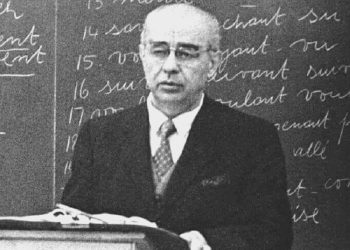
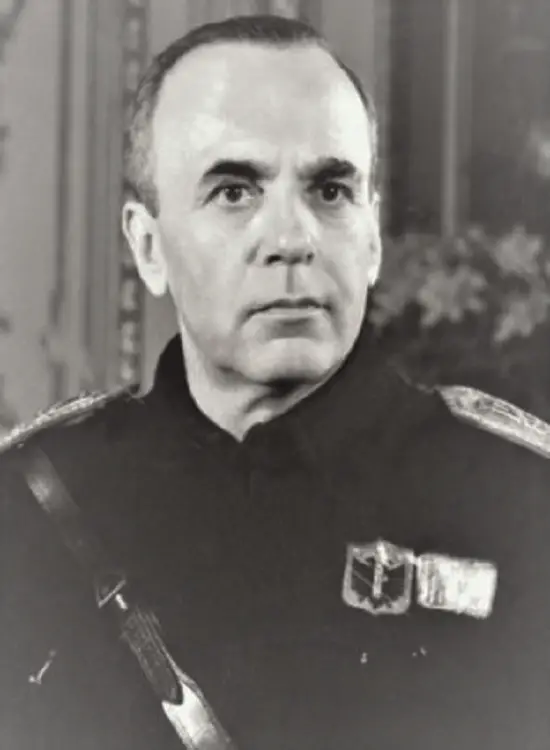
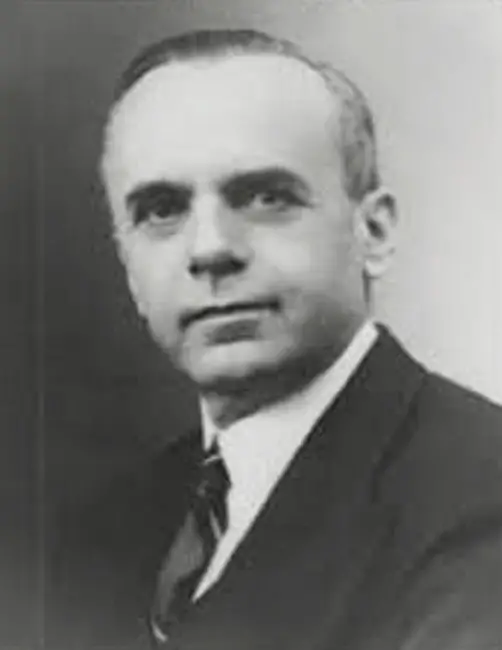
Memorie.al / Mustafa Merlika Kruja was born in 1887 in Krujë and had the opportunity to study – thanks in part to the support of a wealthy benefactor like Esad Pasha – at the local rüshdiye (middle school), in Janina, and at the Mekteb-i Mülkiye (civil service school) in Istanbul. After completing his education in 1910, he returned to Albania, having been appointed a teacher at the idadi (high school) in Durrës, and was later named Director of Public Education for the Sanjak of Elbasan. Mustafa Kruja was also active in the 1912 Albanian uprising against the Ottomans and in Vlorë, where, as the representative of Krujë, he was among the signatories of the Declaration of Independence and a member of the newly formed Senate. In 1914, he was appointed advisor for public education in the new administration of Prince von Wied, being one of his supporters.
Continued from the last issue…
Thus, in Albania, Western political morality was replaced by compromising agreements, as the ideologies of liberalism, fascism, and anti-communism were not widely known or deeply rooted in the Albanian world. In other words, political or public positions in Albania were not taken for ideological reasons, but for personal motives or advantages.
The Italo-Greek War, which for more than six months was fought primarily in Albania, also caused many grievances among the Albanian population, especially the soldiers fighting on the Greco-Albanian Front in southern Albania. The Greek advance and successes led to hundreds of Albanian desertions from the front, and resentment toward the Vërlaci government grew. Even the week-long visit of the Italian King Victor Emmanuel III in May 1941 did not go well.
An attempt to assassinate the King on May 17, 1941, failed; the King suffered only minor injuries. Meanwhile, during the fall of that year, the first armed actions by various anti-fascist resistance groups began to appear in southern Albania and around the capital, Tirana. On November 8, 1941, with the support and supervision of Yugoslav envoys, active leftist groups since the beginning of the Italian occupation formed the Albanian Communist Party.
Against this difficult backdrop, with the Vërlaci government unable to control the rising internal unrest, the Lieutenant-General (Governor) Jacomoni proposed Senator Mustafa Merlika-Kruja to Mussolini and Count Ciano as the new Prime Minister of Albania. He took office on December 4, 1941. Ciano considered the appointment of the 54-year-old Kruja and his cabinet – which replaced old politicians with new elite of intellectuals – as a gesture of tolerance toward Albanian nationalist extremists.
Mustafa Merlika-Kruja, who returned to Albania in the summer of 1939 from forced exile in France, was an ambitious politician, an anti-communist, and a fervent nationalist who enjoyed full support from Italy and was allowed more freedom of action than his predecessors. He was granted certain rights to make concessions toward Albanian autonomy, including incorporating members of the intelligentsia and common people into his government rather than the old landowners (beys), as well as establishing an independent Albanian army to operate alongside Italian forces – an army that had been dissolved after the 1939 invasion.
He was allowed to release a large number of anti-fascists from prison or internment and subsequently tried to distinguish between nationalist anti-fascists and communists, presenting him as a defender of nationalist irredentism. During the first phase of his government, the Italians viewed him with suspicion, fearing he was a nationalist extremist; later, however, according to Ciano, he proved to be more moderate. “Now that he is in power, he has realized that criticizing is easy, but acting is difficult.”
In fact, Kruja asked nothing unusual of Ciano, except for some minor corrections to the border with Montenegro and a return to the pre-April 12 changes concerning the Constitution and the flag: “They do not want the eagle imprisoned between the lictor’s fasces and the knots of the House of Savoy,” Ciano noted in his Diary.
During a meeting in Rome with Mussolini in February 1942, Mussolini emphasized to Prime Minister Merlika-Kruja his desire to grant Albania greater autonomy. This, according to him, was the only policy that would yield results; otherwise, Albania would also become a hotbed of rebellion and intrigue like other occupied states.
Mustafa Kruja’s cabinet lasted only thirteen months, from December 4, 1941, to January 19, 1943, when he resigned. After World War II, Mustafa Kruja admitted that he had been used by the Italians and their Machiavellianism to benefit from his nationalist devotion in defense of ethnic Albanian territories. It was again Jacomoni who proposed that he be replaced by someone from the old aristocracy, emphasizing to Ciano that; “Mustafa Kruja is a man who, in our interest, we had to consume.”
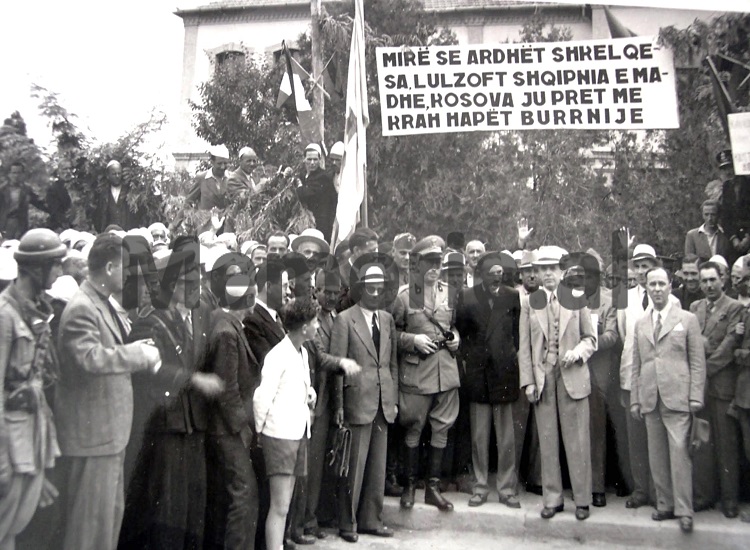
For the Italians, Merlika-Kruja was the perfect man at the right moment. The nationalism he perfectly represented throughout his life played a fundamental role in his cooperation with the Italians. According to him, especially after the creation of “Greater Albania” in 1941 – which included Kosovo and other predominantly Albanian areas in Yugoslavia and the Chameria region in northern Greece as a product of the Ciano-Ribbentrop agreement in April in Vienna after the invasion of Greece and Yugoslavia – Merlika-Kruja believed the Albanian national question would solve itself.
In his first speech as Prime Minister on December 10, 1941, Mustafa Merlika-Kruja praised the creation of Greater Albania as a great achievement for the liberated ethnic territories. He even created a Ministry for Liberated Lands, with Tahir Shtylla and later former Finance Minister Fejzi Alizoti and Eqerem Bey Vlora as ministers, and ordered a census for the liberated territories as well as an agrarian reform to distribute land assets confiscated by the Serbian and Montenegrin populations during the Kingdom of Yugoslavia to the Albanian population of those territories.
In appointing Mustafa Merlika-Kruja, Jacomoni and Ciano hoped to mobilize Albanians toward fascist policy by playing on their nationalist sentiments through propaganda, while simultaneously stifling any resistance attempts. Merlika-Kruja’s government was thus the first national cabinet of Greater Albania.
Mustafa Kruja’s nationalist feelings were openly displayed. He even protested against the statements of Anthony Eden, Cordell Hull, and Molotov regarding Albania on December 10, 1942, with US Secretary of State Hull declaring that, based on the Atlantic Charter, the United States wished to see a free, self-governing Albania with sovereign rights. This was followed by a similar statement from British Foreign Secretary Eden, with the reservation that post-war borders would be determined in negotiations if an agreement between Albania and its neighbors failed. Soviet Foreign Minister Molotov expressed the Soviet government’s sympathy for the struggle of Albanian patriots against Italian forces and the desire to see Albania restored to independence.
Immediately after these statements, Prime Minister Merlika-Kruja delivered a speech to the Fascist Grand Corporate Council (Parliament) on December 23, 1942, criticizing the Hull-Eden-Molotov declarations. He stated they threatened ethnic unity and national integrity as they did not accept the changes that had occurred in Albania after 1939. The national unity achieved under the fascist government (Greater Albania) would thus be lost.
While the Allies promised the Albanian people freedom and independence, Kruja argued that the immediate danger was not the Axis policy, but the communist threat within Albania itself. His nationalist enthusiasm led him to make the passionate declaration: “if the Albanian government were forced to choose between winning Kosovo and losing independence, it would choose to lose independence, because if we remain united with Kosovo, we will one day restore our independence.”
However, Merlika-Kruja’s government failed to realize the country’s nationalist aspirations. His simple political program showed his political dependence on the Italians; he was limited in his decision-making, as all decisions were submitted to the Italian Lieutenant-General for approval. His government saw limited success. Although he tried to maintain contact with nationalists who opposed him and the Italians, he failed to take measures against anti-fascist resistance groups, especially the communists, which led to the creation of the National Liberation Movement Army.
The relative stability during the first phase of Italian annexation did not last long, primarily due to administrative inefficiency, the failures of the campaigns against Greece, a deteriorating economic situation, and the growing strength of the anti-fascist resistance.
In January 1943, he expressed his desire to withdraw from active political life, and after September 1943, he did not collaborate with the Nazi Germans. In his personal post-war writings, Merlika-Kruja presents himself as a nationalist guided by one principle: “to protect and serve the Albanian national interest.”
His collaboration with the fascist regime was motivated by his nationalist convictions on one hand and his anti-communist sentiments on the other. He was ready to undertake any political act to serve the Albanian national cause, and it was precisely during the fascist occupation that the largest parts of Kosovo, Dibra, and Chameria were united with Albania. He was also motivated to collaborate by his opposition to Albanian nationalist resistance groups; he had personal relationships with many of their leaders dating back to their anti-monarchist activities.
To him, a communist victory after the war would signify the destruction of Albania, as it would reduce the country to its 1912 borders, leaving out half the nation. As he once wrote, one reason he accepted the premiership and collaborated with fascist Italy was his opposition to communism, which he believed would hinder Albania’s freedom. Thus, following the political activism of the leftist resistance and the creation of the Communist Party by Yugoslav emissaries, he accepted Jacomoni’s proposal to become the “Quisling Prime Minister of Albania.”
Conclusions
In his personal writings, published by his family in Albania, Mustafa Kruja describes himself as a nationalist whose political career was guided by the principle: “to protect and serve the Albanian national interest.” His collaboration with the fascist regime was motivated by nationalist convictions and anti-communist sentiments. He was ready to undertake any political act for the national cause.
This explains why Kruja served the Italians and Axis powers and rejected the Allied declarations of December 1942, which he believed risked Albania’s post-war national interests. He was also motivated by the activity of Albanian leftist groups. For him, a communist victory meant the destruction of Albania.
From the time he went into exile in 1944 until his death in 1958, Kruja did not involve himself in any political activity against the communist regime, nor was he a member of any Albanian political organization. Although he sympathized with Ernest Koliqi’s Independent Albanian Bloc and even attended their meetings in Egypt and Italy, he was not directly involved in their decisions. Kruja was granted political asylum by the United States in 1956, and until his death in December 1958, he devoted himself primarily to his writings. / Memorie.al