
By Fitim Refati
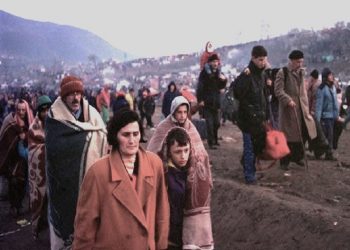
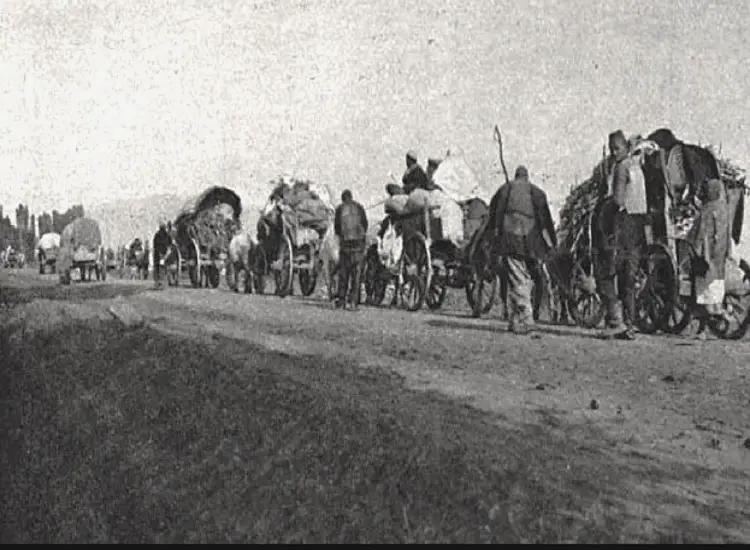
Memorie.al / The year 1914 mark a new phase in the process of mass emigration of Albanians from Kosovo, particularly those belonging to the Muslim religious stratum. The main direction of their emigration was the Ottoman Empire, and partially Albania and some other countries. It was carried out via the land route: Pazar i Ri – Mitrovica – Skopje – Thessaloniki – Edirne – Istanbul; and via the sea route from the port of Bar. This phenomenon was followed with great interest by the consular agencies of Austria-Hungary accredited in Skopje, Prizren, and Mitrovica.
Through telegrams, relations, reports, and often confidential briefings, they informed official Vienna with concern and in detail about the causes of the emigration of Albanians, the number of families, the total number of emigrants, the settlements and centers in Kosovo from which they emigrated, and their vicissitudes during the procurement of passports and the emigration route. According to Austro-Hungarian documents, the causes of the mass emigration of Albanians in the first half of 1914 were related to the state, administrative, military, and civil reprisals of the Serbs and Montenegrins against Albanians, following the end of the Uprising of 1913 and the Uprising of March-April 1914.
Combined factors, which manifested themselves through looting, fines, unbearable taxes and levies; requisitions, seizures, forced labor and corvée; violations of religious faith and family honor; military expeditions against homes and settlements; disregard of Albanians’ complaints by administrative and government bodies; mistreatment, torture, imprisonment, internment, burning of homes and settlements under various pretexts, killings and massacres; lack of trial and non-punishment of crimes, etc., forced Albanians to choose the path of emigration, to escape oppression, assimilation, and liquidation.
The emigration encompassed all social strata, organized into family and tribal groups. However, it could not be realized without securing the necessary documents; certificates and emigration passports. These documents were issued by administrative bodies, implementing arbitrary procedures, through which Albanians paid overdue taxes, sold properties and assets to secure the relevant document. The cost of a passport was 15 dinars, but its price fluctuated up and down.
In this context, on April 20, 1914, the Austro-Hungarian consul in Skopje, Jelička, observed: “Nevertheless, the Muslims (the majority of whom are Albanians, F.R), endure all these misfortunes, with the aim of being able to leave this country and often rejoice when, as the price of the sale of their houses, they take with them the equivalent of one year’s rent.”
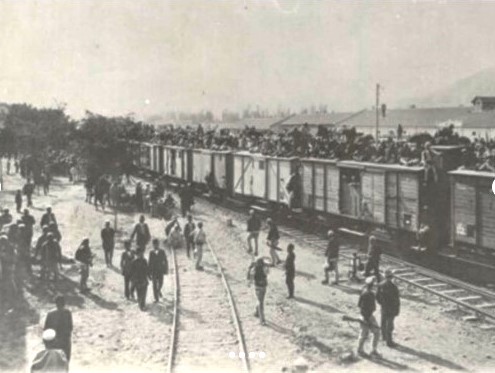
When they arrived in Skopje, they waited at the train station and spent the night in the cold, staying on top of the wagons and without any lighting.
These documents reveal that the main cities and surrounding villages where emigration was updated were: Skopje, Pristina, Pazar i Ri, Peja, Mitrovica, Vushtrria, Gjilan, Kumanovo, Presheva, Tetova, Gostivar, etc., while the areas around Prizren and Gjakova, according to the Austro-Hungarian consul in Prizren, Kohlrus, were relatively less affected by the emigration process, because being on the border with Albania, they hoped that the political situation in the Balkans would change in favor of their union with the Albanian state.
During January, February, and the first half of March, the documents of these consular agencies, especially from Skopje and Mitrovica, emphasize the emigration of tens and hundreds of Albanian families towards the Ottoman Empire. However, in the second half of March, when climatic conditions were more favorable, the emigration process reached alarming proportions.
Based on statistical calculations for March and April, compiled by the Austro-Hungarian consulate in Mitrovica, it was estimated that only from this administrative district 1,200 families had emigrated.
It is also reported that the emigration at this time also massively affected the Albanians of the bajrak of Astrazup, during and after the March-April uprising, who, according to the Austro-Hungarian consul in Prizren, Lehanec, were forced to move to Albania. However, the highest proportion of Albanian emigrants had the Ottoman Empire as their destination.
Based on daily information obtained by the Austro-Hungarian general consulate in Skopje, the flow of emigrants from Kosovo was so high that it risked emptying it of its native population. In a detailed report sent to all diplomatic centers of Austria-Hungary in Europe and beyond, on March 19, 1914, it is emphasized: “According to news arriving daily at the office, about 1,000 families (Albanian, F.R) emigrate per month through Skopje, coming mainly from the regions of Tetova, Ferizaj, Pristina, Pazar i Ri, Mitrovica, and Vushtrria…!
If we say that a total of 3,000 families emigrate every month, in reality this number may be higher. Since a family averages 5 members, this would result in a monthly number of emigrants of 15,000 people, respectively an annual number of 180,000 people.” It concluded that if emigration continued at this pace; “it could remove 70% of the inhabitants of Kosovo” from the 1,490,000 souls it had at this time in “New Serbia.” The emigration of Albanians enthusiastically drew the attention of the Serbian government.
Prime Minister Nikola Pašić and other ministers, during April, carried out visits to Kosovo, the main purpose of which was the usurpation of the properties and assets of the emigrated Albanians, as well as their redistribution for the needs of colonization.
The Austro-Hungarian consul in Skopje, Jelička, in his report dated March 19, 1914, stated: “Naturally, the Serbs, as far as possible, keep silent or conceal this great emigration movement.”
According to him, this exodus could not be hidden in the international arena, but it discredited the Serbian and Montenegrin regime in Kosovo and influenced the further decline of its economy, because it brought Kosovo a triple loss: in terms of producers, consumers, and taxpayers. Moreover, the Serbian administration, through town criers, called upon Muslim Albanians to emigrate, granting them passports at low prices and offering a 50% discount on Serbian trains.
In May, according to reports from the Austro-Hungarian consulate in Mitrovica, local officials and Serbs in Drenica exerted pressure on the Albanian population to emigrate as soon as possible, because the administrative authorities and the Serbian element could not tolerate coexistence with Albanians. The emigration of the Albanian population greatly concerned popular and religious leaders.
In the eastern regions, Idriz Seferi, Mehmet Agë Doda from Presheva, Hoxhë Myslim Efendiu, and others, in April and May, tried to prevent the emigration process of Albanians from the regions of Gjilan, Presheva, and Kumanovo. However, according to the reservation of the Austro-Hungarian consul in Skopje, sent to official Vienna on May 2, 1914, they; “…are trying in vain to prevent the mass exodus of the population…”!
To prevent the emigration of Albanians towards the Ottoman Empire, Hasan Prishtina, as Minister of Post and Telegraphs in the Government of Turhan Pasha Përmeti, according to the report of the Austro-Hungarian envoy in Durrës, Lowenthal, sent to Berchtold on April 25, 1914, proposed to the Albanian Government, and also to Austria-Hungary, the allocation of a loan for the housing and settlement of Kosovo Albanians in regions of Albania.
However, Hasan Prishtina’s proposal was not well received by the Government nor by official Vienna, because it would practically realize the depopulation of Albanians from Kosovo and would triumph over Serbo-Montenegrin ambitions for the national and cultural transformation of Kosovo. Due to the outbreak of the First World War, on July 28, 1914, fortunately for Albanians, mass emigration decreased, but did not stop completely. / Memorie.al