
Prof. Dr. Vebi Xhemaili
Part Two
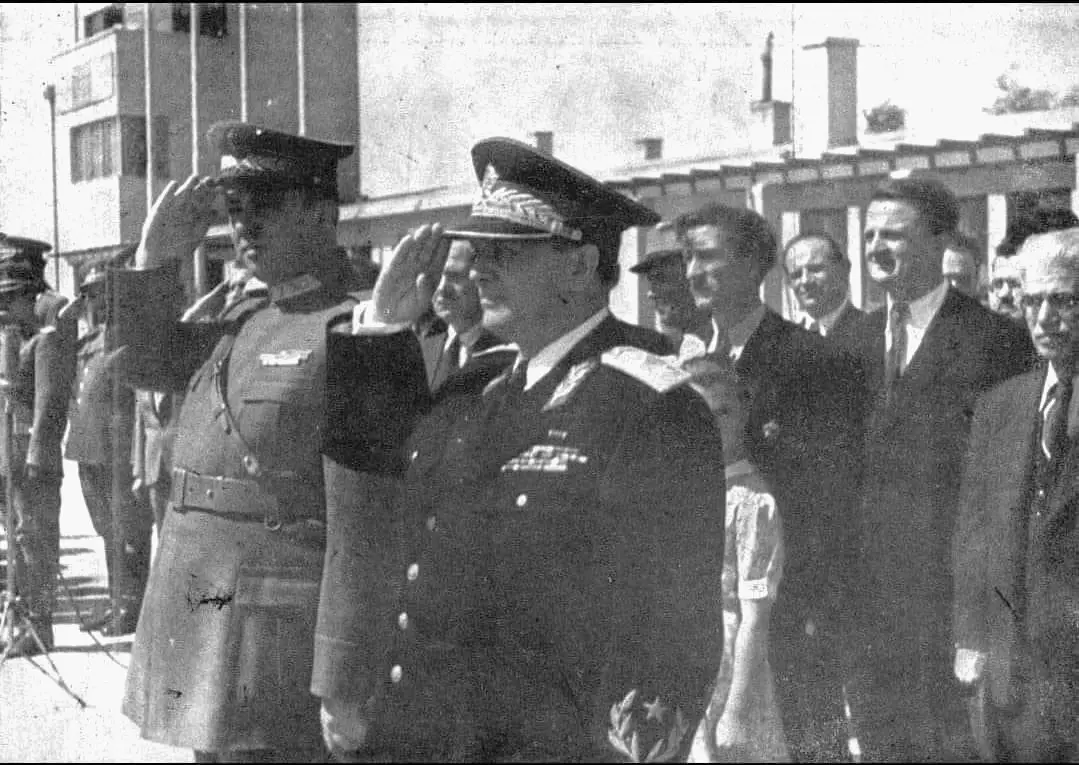
Memorie.al / The Yugoslav presence in Albania, following the establishment of diplomatic relations, began to grow through the provision of military and economic aid. Yugoslav envoys were stationed within Albanian state institutions in the capacity of experts. However, relations during 1945 focused primarily on the political and diplomatic spheres, and less so on economics. During this year, only one temporary agreement for the exchange of goods was signed. Yet, by Tito’s order, Yugoslavia sent substantial aid to Albania in the form of construction materials and grains, specifically wheat and corn. Albania was increasingly becoming subject to the will of the Yugoslavs, particularly that of Tito.
Continued from the previous issue
The Attempt to Create a Cult of Tito and Serbian Partisans in Albania
The sooner this issue is addressed, the sooner all those who took the wrong path and misinformed this people with “red ideology” will be convinced. For neither Tito nor Stalin were ever sincere toward the Albanians and their aspirations for national unification. Therefore, Enver Hoxha’s statement regarding Tito can no longer stand: “Every man, woman, and child knows Tito in Albania…”?!
(Tito became known in Albania only after the war, when the official press was filled daily with news and articles about Yugoslavia, the brotherhood with Yugoslav peoples, and Tito; when Enver Hoxha and other leaders praised the names of Tito and Yugoslavia to the heavens in every speech, forcing people to cheer for Tito and for Albanian-Yugoslav brotherhood and unity; and when portraits of Tito and Enver Hoxha stood together in every street, city square, village, and office…! V.Xh.).
“Tito represents the heroic peoples of Yugoslavia; everyone in Albania, young and old, loves Tito because he represents the glorious struggle of the brotherly Yugoslav peoples, because he was its heart and mind, because he taught and educated the peoples of Yugoslavia to live united and in brotherhood with one another, because he made them fighters for freedom and democracy, and because he taught them to love other peoples as themselves – first and foremost the small Albanian people, whom they helped and supported both during the War and now in peacetime…” declared Enver Hoxha! In all these praises for Tito, Enver Hoxha makes no mention of the state of siege in Kosovo, its annexation by Serbia in 1945, or the forced removal of Albanians and their resettlement in the eastern parts of Macedonia.
“Tito and the new Yugoslavia, the immortal work of Marshal Tito, were for us the mirror and the nearest example of the genius of this great man of the Yugoslav peoples; it was also a support and invaluable aid. The broad masses of our people did not see, and could not understand, their independence, freedom, progress, and the reconstruction of their country as separate from that of Yugoslavia. A small people like ours cannot survive and build a happy life without the friendship and support of the peoples of Yugoslavia.”
(Here it is clearly seen that the sovereignty of the Albanian people and state was already in the hands of the Yugoslavs, headed by Tito. V.Xh.)
“For the Albanian people, from the very first day of liberation, Marshal Tito stood by and helped our people with all his heart and all his strength. He recognized the democratic government of Albania; he was the first to send his ambassador to Tirana; he swiftly aided our people from the earliest days of liberation. Tito knew the suffering in his own country, but he shared the very morsel from his people’s mouth with the small Albanian people. Tito felt for our people…” declared Enver Hoxha.
(If one were to listen to this farce by Enver Hoxha, [they should know] how many mothers this satrap (Tito) left without their sons – with the number of killed reaching tens of thousands, whose graves remain unknown to this day, from Kosovo, Dibra, and Struga, to Preševo, along the road to Srem, Tivar, and Goli Otok… After the war, thousands were purged by Tito’s OZNA, founded in Kumanovo under Tempo’s directives, solely to eliminate Albanians who sought national unification.
Tito himself stated when visiting Skopje in 1946: “I thought I was in Albania, not Macedonia.” This signal from Tito was a green light for Macedonian chauvinist circles. They knew how to exploit it perfidiously. That is why today, Skopje’s national demographics figure at 30% to 70% in favor of those who came to these lands as vandals. Tito gave them a state, while for the Albanians; he made things worse than Nikola Pašić and King Alexander. Therefore, we do not agree with Enver Hoxha, even in his grave, that Tito supposedly loved the Albanian people so much. V.Xh.).
“The name of Tito and the peoples of Yugoslavia are closely linked to the protection of the freedom and independence of our country, threatened by the Greek neo-fascists and their supporters. From the early days, the British and American governments viewed the rise of the new democracy with ill will. In Albania, they have tried in every way to obstruct our people from the right path they had chosen and upon which they march with the greatest determination. Wherever it was necessary to protect the interests of our people, Tito’s comrades fought with the greatest resolve for our people. Kardelj and Moša Pijade, with their indictments, unmasked every attempt by the Greek monarcho-fascists and their supporters,” declared Enver Hoxha.
But the truth is entirely different: The Yugoslavs did not want to share Albania with any other state, as they already possessed Albania and its Government – a fact to which Enver Hoxha himself had consented during his visit to Tito in Bled.
Enver Hoxha Eliminated All Who Opposed Unification with Yugoslavia
“Albania is our ally,” said Moša Pijade at the Paris Conference, “and we are determined to uphold our obligations toward our ally to the end.” This is how Tito understood the alliance with the Albanian people, and the Albanian people responded to this great friend in the same manner: “Our friendship and alliance are defended with the ultimate sacrifice, and in this way, we not only protect the interests and existence of our countries but simultaneously protect peace in the Balkans and the world.
Our alliance with Yugoslavia does not resemble ordinary alliances signed by diplomats and erased according to the interests of those people or cliques that oppress nations; rather, our alliance is the most vivid expression of the aspirations of our two peoples, who fought together and worked together to reach this path,” declared Enver. Here too, Enver Hoxha is insincere, as up until the First Congress of the Albanian Communist Party in 1948, he eliminated from the political scene all Albanians who opposed Albanian-Yugoslav relations, as was the case with Nako Spiru and his wife.
“Just as the agreement for cooperation and mutual aid between our two countries is a guarantee for the independence and freedom of our country, the economic agreements between us complete this alliance and make it unbreakable. The abolition of customs barriers, the unification of our state plans, and the concrete aid the Yugoslav government is giving our country to recover and rebuild are the sound foundations and the security for a better life for our country. Those who do not wish our people well spread false slanders and spew venom, saying that Albania lost its independence and sovereignty by binding itself so closely to the peoples of Yugoslavia,” declared Enver.
Enver Hoxha, out of a great lust for power, was seemingly unable to accept this truth, even though it was very bitter. This was evident in the Corfu Channel incident, when the Yugoslavs laid minefields in Albanian waters, where the British Royal Navy suffered heavy casualties, with over 44 sailors killed. Albanian diplomacy went through a highly critical state, while the Yugoslavs, for their strategic goals in the Balkans, wanted Albania to attack the British fleet (V.Xh.). This situation worsened following the explosion of two British warships in the Bay of Corfu on October 22, 1946. In this underwater mine incident, one officer and 43 British sailors were killed, while 3 officers and 39 other sailors were wounded.
The Head of the Albanian Communists Surrendered Entirely to Tito
Regarding this period of Albanian-Yugoslav relations up until 1948, Enver Hoxha would state: “No, on the contrary, Albania secured and strengthened its independence and sovereignty by binding itself closely to the new Yugoslavia, in such sincere cooperation and brotherhood between two peace-loving, progressive, and neighboring peoples…
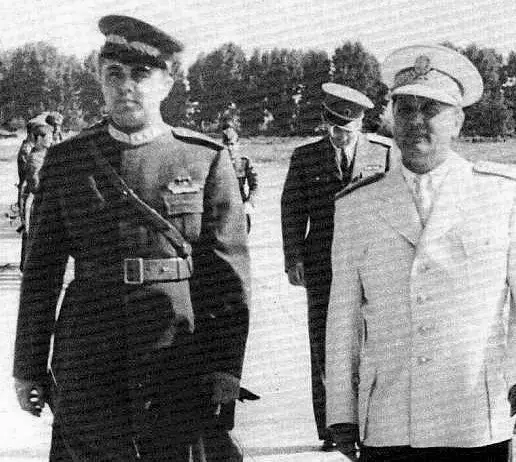
The hand so sincerely extended to the Albanian people is the hand of Tito, the hero of the peoples of Yugoslavia, the great builder of the new Yugoslavia. Our people know and appreciate this, and they cheer for Tito with all their heart. I have heard the heartbeat of the Albanian people for Tito; I also heard those of the Yugoslav peoples for their great leader during my trip to Yugoslavia, and I can say they run parallel. During my visit to Belgrade in June 1946, Tito received me as a comrade-in-arms, as a brother; he spoke to me with fire and love for my people…
The future of our peoples is secured, and we will build it with our toil and sweat… The Albanian people are not of Slavic origin, but a serious study of their history shows indisputably that great affinities bind them to the South Slavs. The geographical and economic position, the nature of our country with its traditions and customs, the freedom-loving and progressive spirit, the generosity, and the warrior character of the Albanian people are so similar to those of the Yugoslav peoples that they clearly explain our people’s tendencies toward the closest possible brotherhood and cooperation. Against these natural tendencies of both peoples, the chauvinists of both our countries and the oppressive imperialists worked with the greatest zeal,” emphasized Enver Hoxha regarding his first visit to Yugoslavia in 1946.
Enver Hoxha treats the demands of Albanian nationalism for freedom and equality in Kosovo and other Albanian lands as “chauvinistic.” On October 5, 1947, in Gjirokastër, Enver Hoxha would declare: “Think, comrades, what fate would have befallen the small Albanian people without democratic and friendly Yugoslavia! The small Albanian people would not have the freedom they have today, but would suffer black days and a dark fate. This is how we must value the friendship, brotherhood, and alliance that bind us to Tito’s Yugoslavia.”
Tito Began to Exert Pressure for the Annexation of Albania
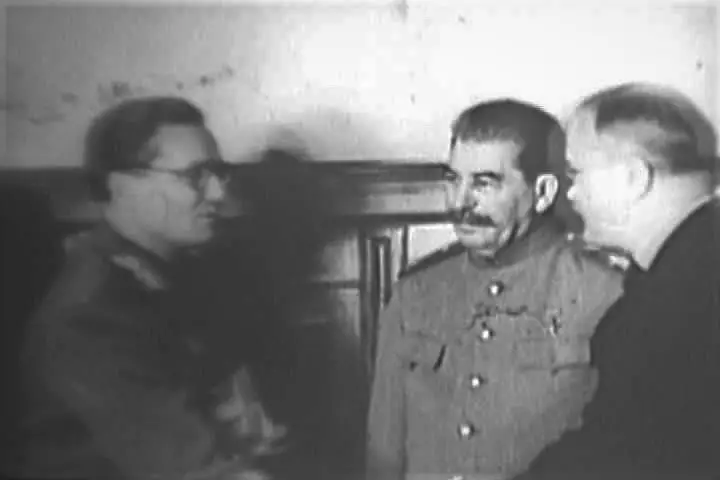
At that time, Tito’s plan for the creation of a Balkan Federation had come to the forefront, and for this reason, he signed a similar agreement with Bulgaria. The creation of a Federation that would include Yugoslavia, Albania, Bulgaria, and Greece was one of the main objectives of Yugoslav foreign policy in the post-war period. It must be admitted that Stalin also approved of this initiative, as he had no personal interest in it, telling Djilas in Moscow: “Yugoslavia has a free hand to swallow Albania whenever it wishes.”
Enver Hoxha: “Friendship with the peoples of Yugoslavia is sacred!”
At the beginning of the following year, Tito’s true intentions regarding Albania were fully revealed when the Yugoslav government proposed to Nako Spiru (who was on a mission in Belgrade to resolve disputes between the two countries) the signing of a secret agreement to secure and protect Yugoslav interests in Albania in the event of a change in the leadership of the APC. Although he was the Minister of Economy, Nako Spiru refused to sign, resulting in Albanian-Yugoslav relations becoming more strained by the end of his mission than they were upon his arrival in Belgrade.
A consequence of the failure of this mission was perhaps the fact that Koçi Xoxe began to mobilize again against his rivals in the party leadership. He exploited Nako’s opposition to the Yugoslav side in the fields of economy and trade. Meanwhile, General Dali Ndreu would say of these relations: “We conduct politics inspired by Yugoslavia and the Soviet Union, but we must conduct a national policy adapted to the needs and conditions of the country.”
On May 20, 1947, the Albanian government announced the arrest, trial, and sentencing of nine members (deputies) of the People’s Assembly, known for their anti-Yugoslav sentiments, on charges of plotting against the state. At that time, ties with Belgrade offered some economic advantage. In July 1947, Yugoslavia granted a loan of 40 million dollars to support that year’s economic directions, accounting for about 58% of the Albanian state budget. Nevertheless, resistance to Yugoslav influence grew steadily.
The Albanian government began to protest the prices the Yugoslavs set for raw materials, the method used to calculate the Albanian share in joint operations, their refusal to provide the projected capital for these operations, as well as the failure to establish a joint shipping company and their attempt to seize control of the country’s foreign trade.
Stalin Secretly Summoned Enver Hoxha to Moscow
In the summer of 1947, while Tito was busy organizing the Cominform (Information Bureau of the Communist Parties), Stalin secretly summoned Hoxha to Moscow. There, Hoxha was scandalized upon realizing Stalin’s ignorance regarding Albania. This lack of knowledge was proven during Stalin’s meeting with Edvard Kardelj – Tito’s foreign policy advisor – which took place around the same time. Stalin asked Kardelj several questions regarding the origin of Albanians, adding that “…they appear to be backward and primitive people!”
The Yugoslav ambassador replied: “However, they are very brave and loyal (besë)!” – thus, in a way, supporting Stalin’s view, as the latter added: “Yes, they can be loyal like dogs, but that too is a characteristic of primitivism.” After this visit, which passed largely without fanfare, Albania signed – naturally with Stalin’s approval – the Treaty of Friendship and Cooperation with Bulgaria. This treaty was a sign of independence from Yugoslavia.
Meanwhile, when the Cominform began to function in October 1947, Albania was the only country in the Communist Bloc not invited to participate, likely because it was considered that it would support Yugoslavia 100% in any resulting dispute, as Stalin himself foresaw serious problems with Tito. Soviet-Yugoslav relations deteriorated due to the plans of Tito and Bulgarian leader Georgi Dimitrov to form the Balkan Federation, which Stalin opposed.
The Soviet Union under Stalin was revolted by the demonstrative adoption of an independent foreign policy by its two satellites and primarily by the fact that Stalin’s opinion had not been sought beforehand. Toward the end of the year, as disputes between Moscow and Belgrade sharpened, Tito began to press for the annexation of Albania. Two military divisions and an air force wing were rapidly prepared to invade the country without Stalin’s approval, under the pretext that it was threatened by “imperialists” sheltered in Greece.
This fear was not entirely baseless, as the right-wing Greek government, with US support, had reinforced its old claims over Southern Albania. The attempt to subjugate Albania contradicted Yugoslavia’s communist preaching regarding “the voluntary union of both countries and the self-determination of peoples.” The situation was highly complex: the United Nations had begun accusing Yugoslavia of intervention in the Greek Civil War, and as long as it continued, there was a real fear of an eventual invasion of Albania by the Athens regime’s army with Western support. Consequently, although the Yugoslav divisions did not ultimately land in Albania, they remained ready at its borders.
During that year (1947), antagonisms between different factions of the Albanian leadership became more complicated and acute due to their involvement in the polemic between the Soviet Union and Yugoslavia. Toward the end of 1947, Koçi Xoxe and his collaborators, under Yugoslav instruction, began to intensify their dominance. Many members of the leadership, particularly the intellectual Nako Spiru, opposed these Yugoslav plans. In November, Spiru, knowing he was to be expelled under the charge of being a “chauvinist,” killed himself. According to the official Albanian publication, “his death was due to a fatal accident while cleaning his pistol”!
It is more probable that he could no longer resist the unrelenting critical attacks from Xoxe and the Yugoslavs. Spiru’s suicide led to the climax of the clashes between Tito and Stalin. In January 1948, Stalin used Tito’s stance toward Albania and Spiru’s suicide as a pretext to summon a Yugoslav delegation – which included Milovan Djilas – to Moscow, with the aim of discussing the aggravation of Albanian-Yugoslav relations and the disagreements over Tito’s uncontested plan for the Balkan Federation. Memorie.al