
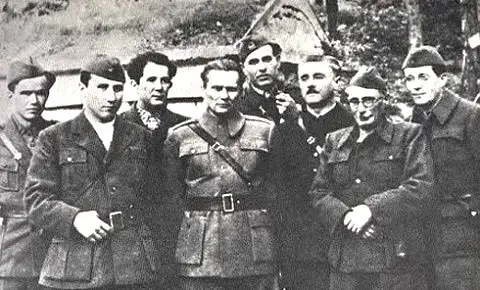
Memorie.al / It would be sympathetic and useful for those Albanian historians, political scientists, and Albanologists who have glorified the figure of Josip Broz Tito and the Yugoslav communist regime, to return to studies in this field and contribute to the dismantling of false myths, to which they have contributed with their pseudo-scientific work. Those who have declared Tito a friend of the Albanians and a man of the ages ought to recant their own doctrines. The speech of Josip Broz Tito before the military in Karagjorgjević on December 29, 1979, published in the book by the historian Vjenčeslav Cenčić, imposes the need for his entire stance towards Kosovo and towards Albanians to be reviewed and re-evaluated from the beginning, since the stance he leaves with that speech is completely different from what has been considered his stance towards Kosovo and Albanians.
The process of reviewing and re-evaluating his figure and his stance towards Kosovo and Albanians should be a long-term project of the Academy of Sciences and Arts of Kosovo, in the first place, and certainly also of history departments and institutes. In this short text, we are merely initiating a public debate regarding Tito’s political testament (always with the belief that the stenogram published by Cenčić is authentic).
Naturally, the task of researchers in the respective fields in the future will remain not only the authenticity of the published stenogram, but also the comparison of the theses and stances of this political testament with his earlier stances on the same issues, with the conclusions as well as the decisions of party and state bodies, to understand the reasons for the eventual change of stances in his political testament and to discover the agents who imposed such a change, if it is a change.
The stances that Josip Broz Tito presents in this political testament before the head of the Army, as he himself asserts, are synthesized from the report he received from General Nikola Ljubičić, a report also signed by all the Army commanders. From this statement by Tito, the logical conclusion emerges that he actually presented to the military the report he had received from them, which means that his relationship with the head of the Army was precisely: “the most fateful legacy,” as Viktor Meier names it in his book “The End of Yugoslavia: The Blow in Kosovo.”
Thus, he left his political testament as a military man, as a Marshal and Supreme Commander of the Armed Forces, not as a politician or statesman. In a word, just as he had come to power, by force of arms, so he was leaving, bequeathing the state and power to his subordinates in the Army, the generals. (From this, one can more easily understand the fateful role played by the Yugoslav Army in the 1990s in Slovenia, Croatia, Bosnia-Herzegovina, and Kosovo, commanded by the Serbian lobby, to whom Tito handed over the state at the December 1979 meeting in Karagjorgjević.)
Against the 1974 Constitution
Although Tito’s political testament has been published for some time, in Kosovo, researchers pretend it has not been published. But the almost complete silence of Albanian historians, political scientists, and intellectuals of Kosovo in particular, regarding all those dramatic developments from Tito’s death until the liberation of Kosovo in 1999, is incomprehensible. In fact, not only this period, but the illumination of the entire period of Slavic rule over Kosovo, and in this framework also of Serbian and Yugoslav communist rule, is of great importance for the history of Kosovo and Albanians in general.
Feigned amnesia, avoiding confrontation with the past, risks producing more confusion for the present and future of our country and nation. In this text, we will focus only on some of the expressed stances of Josip Broz regarding Kosovo and Albanians in his speech in Karagjorgjević on December 29, 1979, just to argue that it is indeed necessary to make a completely new return to the study of this period, with new approaches and new scientific methods.
First, Tito, from the beginning, asserts that the situation in Kosovo was bad and that he personally had been against the 1974 Constitution, which had given Kosovo wider autonomy. Tito says this decisively:
“The Albanian cadres from Kosovo are thinking that with the 1974 Constitution they have gained more rights and partly statehood, while I emphasize that I was against that Constitution, they can carry out state activities on their own initiative. It is impermissible that, bypassing the Republic of Serbia and also the federation, they develop state discussions with Albania. On their own initiative, without our knowledge, they have brought professors from Albania to faculties and schools to teach history with the Albanian program, to teach our children and students that Kosovo is part of Greater Skanderbeg Albania, which is temporarily under Yugoslavia.”
According to these statements by Josip Broz, several hypotheses can be drawn: 1) the Albanian leadership of Kosovo of that period must have been so strong as to have worked independently, on their own initiative, 2) Tito is afraid of the Army and justifies himself before them, and in fact asks them to correct the previous civilian policies of the League of Communists of Yugoslavia, 3) the anti-Serbian separatist forces are powerful and have challenged even Tito himself and the Army with their project of decentralization and separatism.
True, Tito later in his speech constantly accuses Kardelj and Bakarić as the architects of that constitution and that conspiratorial decentralization, just as he considers Kosovo’s autonomy as the cause of the potential crisis of the federal state, for which he says those who supported the 1974 Constitution must bear responsibility. So, the clearest thing from his testimony before the head of the Yugoslav Army is that he was categorically against the 1974 Constitution and especially against the expansion of Kosovo’s autonomy.
And since he says this so categorically and so explicitly, it follows that the false myth according to which Tito had given autonomy to Kosovo must be demythologized, and future analyses must go in the direction of stripping this person of the false merits for the advancement and development of Kosovo based on the 1974 Constitution. It turns out that those merits belong to Kardelj and Bakarić and all those who supported their project, among them certainly some Albanian cadres. But not Tito, since he was categorically against it.
Tito reinforces his constant and decisive stance against the autonomy of Kosovo, offered by the 1974 Constitution, with these words: “On the occasion of the adoption of the Constitution, I told Bevc (Edvard Kardelj) and Vlada (Vladimir Bakarić), as well as the whole constitutional commission, where Kardelj and his like-minded people outvoted me, that within 3 to 4 years, I will disprove them and prove that I was right. That I was right is shown by this situation in Kosovo but also throughout the country.”
Not even the political leaders of Serbia at that time were so categorically against Kosovo, since in the 1970s the so-called “Serbian liberals” were in power, led by Marko Nikezić and the well-known intellectual, Latinka Perović.
Serious accusations against the leadership of Kosovo
When it comes to Albanian cadres in Kosovo, Tito’s most denunciatory opinion is about Mahmut Bakalli, but also about Fadil Hoxha: “I have data that informants and high officers of the ‘Security’ teach Marxism at the University of Pristina, while I have received data that some like Bakalli and Hoxha and others have their own ‘private’ service, not only on the territory of Serbia, but also in other republics, especially for drug smuggling through Albanian ports. In fact, it is an open secret that in the Albanian navy, there exists a special sector for drug smuggling.”
Thus Tito is cited as having said at the meeting with the head of the Yugoslav Army in Karagjorgjević on December 29, 1979, about high Albanian leaders, one of whom, Fadil Hoxha, had at one time been his vice-president, while Mahmut Bakalli at that time, when Tito denounced him as a drug smuggler, was the chairman of the League of Communists of Kosovo. From this hostile tone of Tito towards Albanian leaders of Kosovo, it can be understood that the Serbian lobby at the head of the Yugoslav Army had devised a completely different policy from the League of Communists and the federal government and was preparing to take power, certainly with the approval of its supreme commander, Josip Broz Tito.
If this hypothesis of ours is also supported by other documents and evidence, it would emerge that Tito had turned into a bloody monster who, had he had the energy, could have attempted an even greater bloodbath than that carried out by his army successors, following his testament. Since he himself was “going away,” as he says on one occasion during that speech, he was instructing the military to make the law their own way. Tito tells them clearly what they should do after his departure from the scene: “If you, our Army, do not work in cohesion and unity, after my ‘going away,’ my predictions will come true.”
Lament for Ranković
Subsequently, Tito laments the fall of Ranković and swears that he was against his punishment. According to him, the punishment came from the conspiracy of Edvard Kardelj. Meanwhile, among the Albanians of Kosovo, the myth has circulated that Tito had brought down Ranković “because of his abuse against Albanians.” This simply was not true at all (the Stenograms of the 4th Plenum of Brioni, published in the Serbian media, I have read, and if they are authentic as well, nowhere is the abuse against Albanians mentioned, nor are Albanians mentioned at all).
Therefore, this myth about Tito’s alleged pro-Albanian role in the 4th Plenum of Brioni must be dismantled and eliminated as false. Such a myth was certainly produced by the military secret services to glorify Tito’s figure among uninformed Albanians. Unfortunately, this trick had much success, because the perception among a considerable part of the Albanian population of Kosovo was that Tito had removed Ranković because of his abuse against Albanians.
Warning of provoking an Albanian uprising in Kosovo?
In one part of his speech before the military in Karagjorgjević, Tito says that luxurious buildings with “silver platters” are being built in Kosovo and calls for investigations into this matter. Even this slander shows that he was not in control of himself (since he had been to Kosovo several times and certainly had an idea of its economic poverty), but he was a puppet in the hands of the Serbian lobby of the Army, led by Nikola Ljubičić, who would later play a powerful role in bringing Slobodan Milošević to power.
Tito also warns of an Albanian “uprising”: “We know little about the activities of the Albanian emigration, but look comrades, that emigration is collecting a ‘tax’ for the education of Albanians who will command what is often warned as the ‘popular uprising’ in Kosovo.”
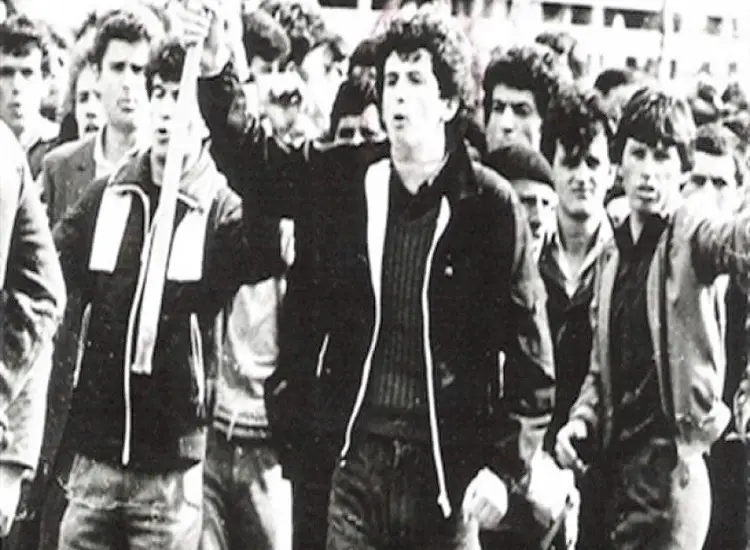
In the absence of documents, for now it is impossible to know whether this “early warning” had any connection with the demonstrations of 1981, with their possible provocation to begin the process of dismantling Kosovo’s autonomy. But it seems clear that the Serbian lobby in the Yugoslav Army patented a cause for intervention in Kosovo as well as in the emigration, where later there were liquidations of Albanian activists.
The bloody nature of Tito is evidenced by his own words in conversations with Josip Kopinič, when he asserts that on one occasion he had asked Ranković to physically liquidate Edvard Kardelj, but Ranković had refused to liquidate him. The man who seeks the physical liquidation of his closest collaborator, the ideologue of the party and the state, is cut exactly from Stalin’s cloth (indeed, there are historians who have now asserted that Tito was more Stalinist than Stalin himself).
If only because of this statement of his in Karagjorgjević, where Tito’s fierce anti-Albanian stance is revealed, Albanian historiographical studies should return to the study of his figure and the entire period of Serbian and Yugoslav communist rule over Kosovo. But now not to glorify that figure and that rule, as the majority of Albanian historians, political scientists, and even Albanologists of Kosovo have done. Perhaps it would be sympathetic and useful for those historians, political scientists, and Albanologists who have glorified Tito’s figure and the Yugoslav communist regime, to return to studies in this field and contribute to the dismantling of the false myths to which they too have contributed with their pseudo-scientific work.
Those who have declared Tito a friend of the Albanians and a man of the ages ought to recant their own doctrines. Now Tito’s figure and the period of Serbo-Yugoslav communist rule must be studied with genuinely scientific methods, which would enable us to better understand that historical period of our past and dismantle the false myths and, from there, the troubles of real and potential Yugoslav nostalgics among us. / Memorie.al