

By Sherif Delvina
Memorie.al/ When Serbs speak in the international arena about their rights over Kosovo; they raise the issue of Serbian churches and monasteries in Kosovo. To counter this Serbian deception, we must first inform readers about the division of the medieval period. It is divided into three periods:
- The early medieval period covers the timeframe from the fall of the Roman Empire to the end of the 14th century. The Serbs occupied Kosovo at the beginning of the 13th century, while by the end of the 14th century they had become the most obedient vassals of the Ottoman Empire. Thus, historically documented, the occupation of Kosovo occupies the smallest part of the first phase of the middle Ages.
- The High Middle Ages (from the 15th century to the first half of the 16th century). During this period, the majority of the Albanian people, in all their ethnic territories, were still of the Christian faith.
- The Late Middle Ages, from the second half of the 16th century to the end of the 17th century.
Franz Babinger, in *Mehmet the Conqueror and His Time* (Giulio Einaudi editore), states: “The year 1453 has rightly been characterized as the dividing line between the Middle Ages and the Modern Era.”
It is worth noting that during the three periods of the middle Ages, there was no documented complaint from the Serbian Church directed against Albanians.
During Ottoman rule, the Serbian Church found itself in extremely favorable positions. It was also supported by the Ottoman Grand Vizier, the Serb Mehmed Sokollu, and a former seminarian of a Serbian monastery. The Albanian population always protected the Serbian churches, even during the period when the majority of them converted to Islam. The Patriarchate of Peć, which was the seat of the Serbian Patriarchate, maintained close relations with the Albanians of the mountainous Rugova area, which became a refuge for Patriarch Arsen IV in 1737 when he was being pursued by the Turks.
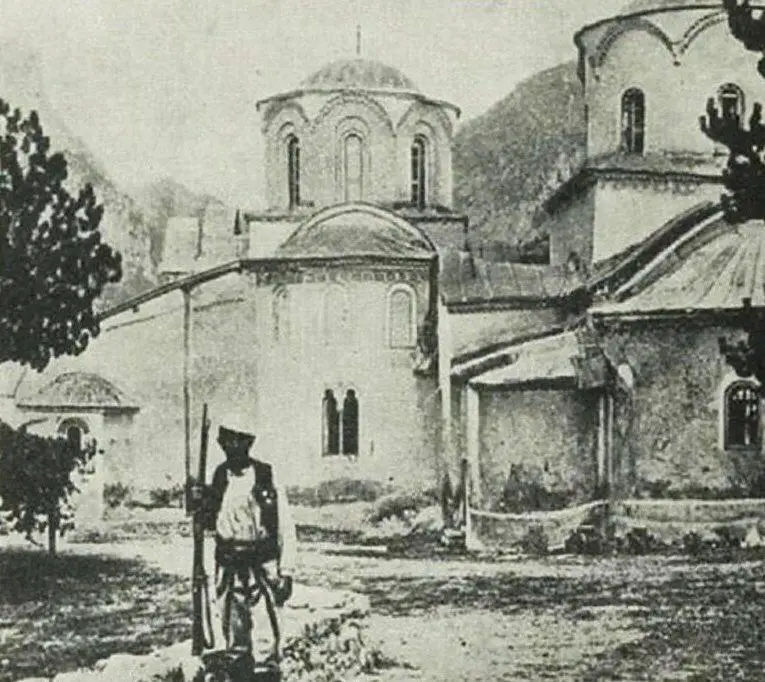
These Albanians continued to provide bodyguards for the protection of the Patriarchate, as well as for the Dečani Monastery. (*The Saga of Kosovo: Focus on Albanian-Serbian Relations*, Aleks N. Dragnić and Slavko Todorović, monograph on Southeastern Europe, distributed by Columbia University, New York, 1984). Marco Dogo, in the journal *Balkan National Identities in a Historical Perspective* (Ravenna, 1998), speaking about the historical literature concerning the Muslims of the Balkans, states: “As far as we know, the only case that has been neglected is the work of Čubrilović, whose writings aimed to present the Darwinian correctness of the de-Islamization model adopted by the Balkan states in their struggle for independence.” From what we have said above, the reward given today to the Albanian population of Kosovo for their protection of Serbian churches in Kosovo, as well as to their minority in this country during Ottoman rule, by the Serbia of *Načertanije* and of Čubrilović, becomes quite clear. During Ottoman rule, the Serbian Church in Kosovo was also supported by Christian Serbian *spahis* (cavalrymen). The Christian *spahis* financed a monastery built in Pljevlja (the Sanjak of Novi Pazar). Another *spahi* financed the painting of the Church of the Holy Apostles in the Patriarchate of Peć complex in 1633. Likewise, the help given by two other spahis, Miloš and Stojko, is documented (Kiel, Art and Society).
Even during the rule of the Ottoman Empire, the Serbian churches were respected. We quote Evliya Çelebi in *Travel Notes* (Sarajevo, 1979, p. 277). The author finds himself at the türbe (tomb) of Sultan Murad I in Kosovo, together with Maliq Ahmet Pasha: “When Maliq Ahmet Pasha saw this türbe, he was saddened. I, the poor one, said: My lord! The Serbs, in honor of the accursed Miloš, who killed the Padishah here, have built a monastery further up the mountain, where there are candlesticks embroidered with pearls and censers full of amber with the harsh scent of masses; with these, the monks serve the guests who come and go day and night. The endowments of this monastery are great and rich. The türbe of the Padishah Gazi has neither endowments nor its own personnel.”
Evliya Çelebi, when describing the killing of Sultan Murad, states: “From the army came out an infidel named Miloš Kobilić and killed his majesty Sultan Murad.” Three centuries later, Miloš Kobilić enjoyed a monument, while Sultan Murad I had an abandoned türbe.
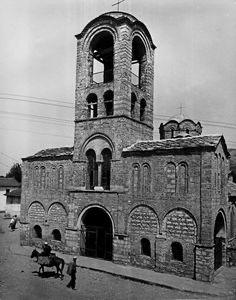
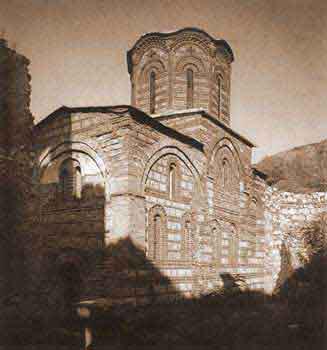
Many Serbian churches were built before the Serbs occupied Kosovo: even in Raška, the Church of St. Peter and St. Paul was built before the arrival of the Serbs, because the Slavs do not build churches dedicated to only two apostles; moreover, the inscriptions found in the village of Drenova, near Prepolje, in the ruins of that church, are written in Latin, which points to a time before the 10th century. The remains of the old Pustenik church at the Kaçanik Gorge, as well as those of the Lipjan church, speak of a pre-Slavic time. It is an undeniable fact that many churches in Kosovo, built during the Slavic occupation of Kosovo, were erected on the foundations of older, pre-Slavic churches. Such is the present-day Church of St. Prenda in Prizren, which was built by King Milutin in 1307 on the foundations of an old basilica. Regarding many church ruins in the Stalać district, archaeologists believe they were built before the time of Stefan Nemanja; even the foundations of the church in the village of Curlin near Niš speak of Western influences. Likewise, the churches of the Timok valley in Bosnia, as well as the old church of Prokuplje. This is discussed in History of Yugoslavia, Vol. I, cited by Gaspër Gjini in The Diocese of Skopje-Prizren Through the Centuries, 1992. “It is known,” writes Dr. Jahja Drançolli in *The Roots of Illyrian-Albanian Civilization in Kosovo*, *Rilindja*, February 10-12, 1999, “that King Milutin financed the reconstruction of the Church of Our Lady of Ljeviš in Prizren and of Gračanica Monastery, known as pre-Serbian constructions, built somewhere around the 6th-11th centuries, which according to important sources are considered Catholic constructions.”
Similarly, a record has been preserved about Dom Vita with 30 stone carvers (i.e., sculptors). This cleric-sculptor built the Dečani monastery. What draws even more attention here is the fact that all the known stonecarver workshops, for example those of Tivar (Bar), Ulcinj, Kotor, and Korčula, were run by Albanian masters.
At the beginning of the 13th century, the Church of the Apostles was built. In fact, this church, which today is part of the church complex of the Patriarchate of Peć, like the first two, is a reconstruction of an old building.”
In an inscription from 1334-1335 at the Stefan Dečani monastery, the *protomaster* Vita of Kotor is mentioned as the director of the eight-year construction work on that church. These churches, about which so much noise is made in the world, until the 14th century had nothing specifically Serbian about them. “The church buildings of the Nemanjić dynasty,” says Jireček, “have a Western style.” The white marble church of Studenica, according to Kondakov, is a monument in the Lombard style of Dalmatia. Dečani itself is an admirable construction with alternating rows of colored marbles. The sculptures – human heads, animals, birds, mythical creatures – are Western.”
Regarding the architecture of Serbian churches, Jireček points out in Serbian Civilization in the Middle Ages (Paris, 1913, p. 75): “Today’s art historians distinguish two periods under the Nemanjićs – the older one has features of Romanesque architecture, while the later one is of great splendor, with Byzantine influence.” Medieval art is entirely religious and did not develop in a one-sided line. Many churches in Serbia are of the Byzantine type. The Church of St. Nicholas in Kuršumlija reproduces the Byzantine type of church with a square-based dome. This church has both the style and technique of Byzantium. Likewise, the Žiča church reproduces the polychromy of Constantinople models; its curved brick constructions are like those of Greek and Macedonian churches, but with its single nave it follows the Western model. Whereas in the Dečani church, Serbian architecture departs more than in any other church from Byzantine models and, combining Byzantine bases with Western elements, has created its most original and picturesque monument.
Besides architecture, the importance of Dečani church is evidenced by the carved decorations on the two portals, the southern and the western, and on the windows of the western facade. On the western portal, Christ is depicted on the throne among angels, while on the southern portal, the Baptism of Christ and the depiction of St. George and the Dragon are shown. This decoration is in the Italian style, particularly that of Apulia (a region in southern Italy); both portals are the artistic work of the same artist, although the southern portal appears older (Sestieri, Medieval Churches in Kosovo). Sestieri is also worth mentioning regarding the church at Sopoćani. He says: “In the Sopoćani church (1272-1276), all parts were added to the initial nucleus. They were covered by the same roof, which clearly gives the impression of a basilica: we clearly see the mixing (interweaving) of the Italian and Western Adriatic form with the necessity of distributing Byzantine elements in the interior of the church.”
“This half-ruined church gives us precious testimony of connections with Italy, even regarding painting. And this is more important because, generally, among the figurative arts, only sculpture comes from the West, while painting is linked to the schemes and criteria of Byzantine art. In Sopoćani, in the fresco ‘The Deposition from the Cross’, which the Byzantines had already treated with symmetrical precision in the arrangement of the figures, there is the scene of the sorrowful Mary assisted by John. For the Byzantine, the group was nothing more than placing two figures side by side without any spiritual closeness, even separated in the gesture of holding hands, demonstrated by the fact that the hands were separated by a piece of cloth. Here, on the contrary, Mary’s sorrow is emphasized. The bent bust is supported by the helping hand, and the two hands that meet are separated by strips of cloth but are not joined in a consoling clasp. The presentation of this grouping is bold and clever, with powerful effect. The creation is dramatic, the work of a true artist who goes beyond his model coming from Italy. In fact, in Italy, this attitude had been expressed earlier by the ‘Master of St. Francis’, by Fra Guglielmo and Cimabue.”
In St. Giovanni Fuorcivita in Pistoia and in the upper part of Assisi, Fra Guglielmo and Cimabue had depicted Mary held by John, in a grouping with less dramatic intensity than in Sopoćani and with less felt spiritual closeness. They had introduced innovations regarding old Byzantine schemes: the contact of bare hands, without any obstacle. The painter of Sopoćani was inspired by these models, surpassing the intimate dramatic content, but the composition with a painted cross in the Sopoćani Museum, whose representation is almost identical to that of the Sopoćani church, shows us that all these paintings share a common center of origin, which is Italy.
The art in this mural painting is dynamic, while in the mural paintings of Byzantine churches it is static, as seen in the pavilions, which in Greece, during subsequent centuries, remained almost unchanged. Regarding the mural paintings of Orthodox churches in our country, after the fall of the Byzantine Empire, it is clearly stated that they belong to the post-Byzantine period; in fact, they belong to the European Renaissance, which entered Kosovo at the time of its occupation by the Nemanjićs.
It should be noted that Byzantine vestments had very little originality. For example, Byzantine costume was known only through the mural paintings of the old basilicas of Constantinople, Rome, Istria, Romagna, Lombardy, and from paintings in Alexandrian tombs. Even today we know how little originality remains in these mural paintings.
Let us cite Dom Lazer Shantoja: “The art of Apulia spread to the Balkans through Kotor and Northern Albania, thus creating in the bosom of Byzantine art a new style, more lively, more refined, full of passion, which was unjustly called Serbian or Macedonian, but which in fact was Italian in origin.” (Center for Albanian Studies at the Italian Academy, Dom Lazer Shantoja, AQSH, Fond 1261, File 610, 1939).
Paule Garde, in The Life and Death of Yugoslavia (Paris, 1992), testifies about the liturgical language. On this he writes: “The Orthodox peoples, Bulgarians and Serbs, use a local liturgical language, Slavonic, a Bulgarian-Macedonian dialect of the 9th century, which served the ‘Slavic apostles’, Cyril and Methodius, to translate the holy scriptures, by means of a special Cyrillic alphabet.”
In Nemanjić Serbia, besides crime, robbery also reigned. Travelers were in great danger when passing through the Nemanjić Serbian lands. On this matter, Jireček, in the cited work, informs us that it was not rare to see people whose clothes had been taken from their bodies, or prisoners brought upside down or left shackled in a pit like a bear.
Speaking of the Nemanjić Serbian army, the aforementioned author writes on page 76 of the cited work: “War was based, above all, on looting enemy lands, destroying orchards and vineyards, and burning houses.”
The Serbian kings fought against the Catholic faith. Conflicts between them and the Pope grew increasingly bitter. Pope Clement asked Milutin to liberate the Latin churches that he and others had occupied (Augusto Theiner, *Old Monuments of the South Slavs*, published by the Academy of Sciences of South Slavs, Zagreb, 1875, I.127-130). Catholics were persecuted, beaten, and killed.
It is worth mentioning the coronation of Stefan Nemanja I by Pope Honorius III. After being accepted as a son of the Church of Rome, he sent the Pope a pledge of loyalty and soon after returned to Orthodoxy.
In 1250, the regions of Pulat, Arbëria, and Kandavia returned to the Catholic faith. “This glorious act of ecclesiastical independence, declared by the Gheg Albanians, was recorded by Roman analysts in 1250, which further intensified the national hatred between Serbia and Albania” (Jakob Fallmerayer: *The Albanian Element in Greece*, Munich, 1857-1861).
The Serbs, yesterday as today, have considered the church a political institution. On this point we quote the early 20th-century historian Čedomil Mijatović: “The religious feelings of the Serbs are never deep or fervent. Their churches are generally empty, except during very large church festivals, as well as political festivals. The Serbs of our church consider the church a political institution.”
In 1319, Albanian nobles sent a letter to Pope John XXII, asking him to intervene against the severe persecutions carried out by Uroš II against Catholics (Farlati VII, 63). Only Uroš III, of Dečani, improved the conditions for Catholics. Theiner, in Monumenta Hungariae (I, p. 701), mentions the letter of Pope Clement VI, year 1346, addressed to Stefan Dušan, informing him that Prizren, Novo Brdo, Trepča, and Janjevo were under the jurisdiction of the Bishop of Kosovo. In another letter of February 7, 1346, Monumenta slavorum (I, 215, No. 280), the Pope writes to Uroš IV that several kings of Raška, Dušan’s predecessors, had kept the aforementioned churches occupied. The Pope requested that these churches be freed by him.
The Albanian people were threatened by the danger of Hellenization and Slavization; on this, academician N. Iorga states: “Albania, without the prestige and strength of the Venetian doges, would never have broken away from Constantinople; the very character of its race would have been struck, perhaps would have mixed with the Slavism and Hellenism of its neighbors, against whose Orthodox character it had fought for centuries, preserving its own nationality and aided by missionaries coming from the West… Thanks to the chivalrous vigor of the Italian Normans and the economic expansion of Venice, it almost completely escaped Byzantine sovereignty. Albania was reborn” (N. Iorga, A Short History of Albania and the Albanian People, Bucharest, 1919). Thus, it was the Western offensive that gave great help to our people in maintaining old political and religious ties with Europe.
Albania’s life-giving ties with the Vatican, as well as its medieval history, are faintly reflected in Byzantine chronicles. G. Petrotta, in Catholicism in the Balkans (Albania, Vol. I, fascicle III-IV, May-August, 1928), notes that the Byzantines were not interested in highlighting the ties of that people with the Holy See, which never weakened at that time.
On January 29, 1369, the Balsha brothers took an oath, converting to the Catholic Church. This influenced the defense of Catholicism in Albania, which warded off Slavic influence in our country.
The historical affiliation of the Serbian churches in Kosovo is striking: in most cases, they belong to Albanians. Emperor Stefan Dušan began the reconstruction of the Dečani church. He was forced to keep a military unit because the locals (Catholic Albanians) did not allow the masters to work on their sanctuary (S. Riza, Albanians and Serbs in Kosovo). Thus, it is unfair that the world community is misled by Serbian lies, that these churches today have Serbian military garrisons “to protect them” in order to achieve the revival goals of Emperor Stefan Dušan (!) Even today, the seal of Emperor Stefan Dušan continues among Serbs and Russians.
To show how pro-Western the Serbs are and how much they have protected Christianity, we will acquaint our readers with only four articles of Stefan Dušan’s barbaric Code.
Some articles of Stefan Dušan’s Code:
“Laws and rules of Emperor Stefan the Macedonian, worshiper of Christ, autocrat of Serbia, Bulgaria, Hungary, Albania, Hungaro-Wallachia, as well as many other lands. Laws established by the mercy of the most high God Jesus Christ in the year 6757 (1349), the twentieth indiction, on the day of the Ascension of our Lord.”
Article 6. Regarding Latin heresy, as well as the true believers who are part of this faith, the patriarch and metropolitans, as well as the bishops, must explain theology and the holy scriptures to the latter, so that they may return again to the true faith and to true Christianity. If anyone does not wish to return and come back to the true faith, he shall be punished with death, as is written in the works of the holy fathers, and the true believer, the Emperor, must uproot all this heresy from his state. He who does not wish to return to the Orthodox faith shall lose all his property; conversely, he who returns to the true faith shall immediately recover all his confiscated property. Heretical clerics of another community who seek to proselytize (people newly converted to another faith) shall be arrested, sent to the mines, or expelled from the country. I will consecrate the heretical churches and place them at the disposal of the true clerics, so that every person who has abandoned the latter may return to the former faith.
- The protopopes shall be attached to the great churches, and they must convert the Latins of all small towns and villages. If a single person who is not a true believer is found anywhere, he shall receive spiritual instruction, and they shall celebrate mass every day in the church. Every Christian must return to the true faith, as commanded by the apostles and the holy fathers.
- If a Latin cleric is found seeking to convert Christians to the Latin faith, he shall be punished with death, according to the principles of the holy fathers.
- If a half-believer is found who has secretly married a Christian woman, he must be baptized in the Christian (Orthodox) manner; but if he does not allow himself to be baptized, his wife, children, and house shall be taken from him; he shall be overcome with misery and forced to emigrate.
- If a heretic is found living together with Christians, he shall be scarred on the face and expelled; whoever hides him shall suffer the same penalty.”
Later, this murderous emperor went beyond the criminal articles of his Code. “Stefan Dušan forbade his subjects, believers of the Catholic rite, from attending Latin mass. If they broke the order, their eyes were gouged out.” (Aseman, Vol. V, pp. 57, 59).
Based on available documents, this order was broken by his German guard, who proudly said in a loud voice to Emperor Dušan: “It is better to obey God than men.” (Chopin, Danubian Provinces, quoted from the book Christian Serbia, Historical Studies, A. D’Avril, 1897).
Regarding the deceptive propaganda that the Serbs have carried out about the so-called “Old Serbia” and about the Code of S. Dušan, as well as the damage it has caused through misinformation, it is enough to mention *Travels in the Old Serbia* (London, 1865, by A.P. Irby and G.M. Mackenzie). There it is claimed: “The district lying northwest of Macedonia is called by the Muslim inhabitants ‘Arnautluk’, whereas by the Christians it is called ‘Old Serbia’; this place until the end of the 14th century was part of the powerful Christian monarchy that stretched from the Danube to the Adriatic. This monarchy was called Serbia; it remained in manuscripts, paintings, and architecture, together with the Code of laws (the Code of S. Dušan), which shows precisely that it was on the same level as those of present-day Christian states.” (No comment).
Slobodan Milošević applied the Code of Stefan Dušan point by point. It is enough to replace the phrase “Latin heresy” with the phrase “Muslim heresy.”
Regarding the condition of the Albanian population at that time, Brocardus Monacus, who traveled through several parts of Albania and presented a report to Prince Philip of Valois in 1332, informs us. We quote a few lines from the original, published in History of the Crusades… (It is possible that the author is Guillaume Adam, Archbishop of Tivar. A. Dussellier thinks it is he himself.) “Et quia dicti, tam Latini, quam Albanenses, sub jugo importabili et durissima servitute illis odiosi et abhominandi Sclavorum dominii e sunt opressi, populus scilicet anguariatus, clerus dejectus et minoratus…” (“These peoples, both Latins and Albanians, are oppressed in the most inhuman way under the unbearable and extremely harsh slavery, and the most disgusting and hated rule of the Slavs (Serbs). Certainly, it is a people hated by the Slavs (Serbs), a despised and humiliated clergy…”)
“Their bishops and priests are often found in chains, their nobles dispossessed… All of them together or individually think that they would sanctify their hands by dipping them in the blood of the aforementioned swords.” Thus the Serbs treated the Albanians; here lies the origin of the hatred for one another before the arrival of the Ottomans. The Albanians had the right to hate the Serbs, because they brought them slavery with all the evils that slavery brings when it enslaves a people.
Many Serbian historians take an unjust stance toward the Catholic Church during the Nemanjić rule; their arguments are baseless. Catholic clerics, according to them, are guilty because they tell the truth! We quote one of them: “Until this time, Philip of Valois had other worries and did not engage in territorial conquests in the Balkans. While Guy Adam, a member of the government of Philip VI, claims: ‘The present-day Albanians along the Adriatic coast are numerous, because this Catholic archbishop supposedly had 15,000 men he could arm. Then the entire Albanian population had 150,000 inhabitants. From this it appears that the coastal Catholic Church held a hostile stance toward the Serbs.'” (History of Emperor Dušan, written by Dr. Vladimir Nikolić-Zemunski, former member of Parliament).
During the rule of the Nemanjić dynasty in Kosovo, religious violence was used. To illustrate this, we quote Professor Skënder Riza: “The Albanians, before coming under the rule of the Serbian Nemanjić state, were predominantly of the Catholic faith. However, during Serbian rule, especially in the time of Emperor Stefan Dušan, the position of the Albanians worsened. A part of them, under the pressure of the Serbian state’s inquisition, was forced to convert to the Orthodox faith, although they accepted Orthodoxy only for show.”
- Jireček, in History of Serbia (I, Gotha, 1911, pp. 387-389), emphasizes: “The Patriarch of Constantinople, Kallistos, anathematized the new emperor (Stefan Dušan), the Patriarchate of Peć, and its clerics.”
To show that Stefan Dušan suffered from the chief of all vices, ingratitude (a Shakespearean characterization), we quote one of his deeds, taken from *Japigia*, an organ of the royal representation “Atdheu”, Bari, 1939. The document speaks of the granting of an annual income by this Serbian emperor to the Basilica of St. Nicholas in Bari. “The nephew of Uroš (Stefan Uroš II, 1282-1321), Stefan Dušan, having devotion to his grandfather Uroš and his father Stefan (Uroš III Dečanski, 1321-1331), allocates to the Basilica of St. Nicholas an annual income of two hundred *perpera*, an amount collected each year as a tax from the city of Ragusa, to be spent on candles and divine worship for the salvation of the souls of his grandfather and father and for the health of his son and his wife.” This charter was given to that basilica on August 30, 1346. The hypocrisy of the Serbian kings reaches its culmination here. The father of Emperor Stefan Dušan was killed by his own son, and then Emperor Stefan takes and pays the taxes of a commercial city like Ragusa (Dubrovnik) to the Basilica of St. Nicholas, so that this saint might intercede with St. Peter to transfer his father’s soul from hell to heaven. This is called: kill you and then pay for your soul! We add that Zhirinovsky addresses this emperor with adoration, saying: “Behold, an ancient country that has an emperor in heaven. – Serbia, our dear mother, you have given life to us all. Long live Serbia!” The Serbian people worship this emperor by paying for his soul with the money they took from Kosovo Albanians before 1999.
Finally, Milorad Tomanić, in The Serbian Church in War and the Wars within It (translated by Rustem Gjata and Esat Myftari), describes very well the cooperation of the Serbian Church with the Milošević regime. Accurate data are given on this; it is clearly stated that during the disintegration of Yugoslavia, the Serbian bishops, led by Archbishop Pavle, should not be separated from the crimes committed by Milošević’s Serbs.
Radovan Karadžić writes on this: “from the beginning of 1994, I consider the relations between the church and the state as extraordinary.’Our clergy is present in all our meditations and decisions, while the voice of the Church is heard as the voice of the highest authority.'”
Željko Ražnatović himself says that the greatest benefactor of the Patriarchate and its supreme commander was personally Patriarch Pavle.
In Yugoslavia, the “Three A’s” shone: bishops Amfilohije, Artemije, and Atanasije. These bishops were Mephistopheles in black cloth:
Bishop Amfilohije openly defended the existence of the state headed by his son-in-law, Vojislav Koštunica. The Serbian leaders, including their religious hierarchy, follow Goebbels’ principle: “Tell the lie many times, then repeat it, and people may believe it” and “ordinary people are generally more primitive than we might think. Propaganda must always be simple and repeatable.”
And when the Serbian people, despite the great efforts of their leadership, experienced one of their greatest failures and declines in history, they had again to be convinced that this was a sign of the particularity of their own justice. Metropolitan Amfilohije, for example, said: “God demands something great from this people, for He placed them at the center of world events” (Milorad Tomanić, The Serbian Church in War and the Wars within It).
It is worth noting that Archimandrite Artemije was consecrated Bishop of Raška and Prizren in June ’91, and his consecration was accompanied by a literary hour where the young poet Radoslav Ratanović wrote the famous panegyric “Hymn on the Lawn,” praising Slobodan Milošević endlessly. Likewise, Atanasije Jevtić says: “The Serbian people are again with the cross on their chest, in Kosovo and Metohija, in Dalmatia, in Krajina, in Slavonia, in Bajina, Lika, Kordun, Srem, Bosnia and Herzegovina. This people are accustomed to carrying the cross on their chest, because this is our destiny. May God help us that even now we carry this cross with dignity, as we have always done? Let us say differently from what the wise Jewish woman said about envious and aggressive Muslims: ‘We forgive you for the murders you have committed against us, but we cannot forgive you if you force us to kill you.'”
I wonder why Archbishop Pavle and other Serbian bishops, friends and inspirers of the criminals who went to The Hague, are not denounced and do not also go to The Hague. The people of Kosovo know Archbishop Pavle and Bishop Artemije well, because they worked there for years. The victims massacred among the people of Kosovo, as well as among other peoples of the former Yugoslavia, demand the bringing to trial and punishment of these barbaric criminals at The Hague. These servants of Satan must go to The Hague./Memorie.al