From Father Zef Pllumi
Memorie.al / After that long and difficult journey, I arrived at the Narrow Bridge. I stopped: it seemed to me that a different wind was blowing, a fresher one. Leaning on the railings, I watched where the water rushed with haste and noise. The foaming waves, though ceaselessly moving, were still there, as if rooted! And yet the abundant water kept coming, ever new… always new…! People and the works of humanity! They say the World moves forward! At least, that’s what all the young say – and they may be young or old. Many, so as not to say “everyone,” think they are giving something new to the world, to humanity! Nothing new under this sun! While the waters flow, the world stays put. When I read the Bible, or when I contemplate the pyramids out there in the desert, I ask: how is it possible that the man of the 20th century, at the peak of material civilisation, can be just as barbaric as the man of 40 centuries before?
The events told here are not fantasies, nor fabrications or slanders of political propaganda, but pale descriptions of that reality of historical hatred that unfolded in Albania for nearly 50 years. My country is not at the end of the world, or somewhere on its edge, but in Europe, where the fates of Western civilisation are forged. The events told here are extremely difficult to write, therefore the author asks for forgiveness, as he is not a writer, and kindly advises you to reflect deeply on these events and to seek the true cause of why they happened… Why?!
Violence becomes power
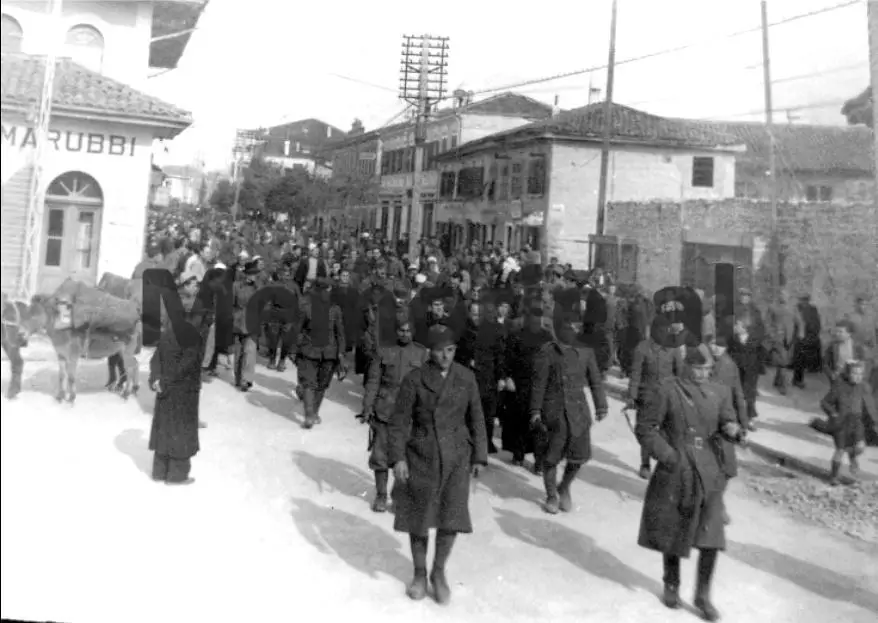
The tyrannical violence, called “proletarian,” exercised day and night, everywhere and without cease, without distinguishing village from city, accompanied by the screams of parrot-like slogans and inhuman tortures, by the lies and squabbles of servile or paid men: after all those bloody shootings, imprisonments and violent mass displacements, they managed to bend the free people of Albania, and thus partisan violence succeeded in becoming Government.
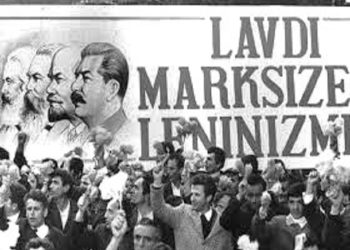
On 9 May 1945, Germany fell. The order came to ring all the bells. For the world, it was to be a great joy. But it was not for us. Stalin had emerged victorious. He was sung to in all the streets by groups of partisan units.
“We are Stalin’s sons,
who liberate the world far and wide,
and over the earth shall wave
the red flag, the partisan flag!”
After supper, as we gathered, talking about the day’s events, one man said: listen to the words of that song: my goodness, how many sons this Stalin has in this land of ours! “Leave it,” an old man replied, “here we had sons of Father Sultan, and whoever rules us, we call him father or uncle. But this war that just ended – how long will it last before another begins: the third one?”
“Why are you interested?! If it were these young men, all right, but you…?! Twenty years ago, certainly not.”
“I,” he said, “think that Churchill cannot stand Stalin having seized half of Europe, so soon the English and the Russians will be at war.”
“England has a twenty-year friendship pact with the Soviet Union, and she keeps her pacts, because she catches the hare with a cart.”
“It’s not a matter of pacts,” said another, “but Churchill himself, to destroy Germany, sold Europe with all its colonies to the businessmen of America, and the other half to the Russians. Throughout history, we see that many great political events are determined only by the personal whims of leaders. On this occasion, he only enjoys the high title of ‘Political Strategist of the Second World War,’ regardless of having thrown half of Europe into slavery, and the other half broken and writhing on the high road, begging for a piece of bread from the Yankees.”
“He who does, know what he does,” said the old man. “I think that he, together with America, will not let communism last long in Europe.”
“And you, Father Gjon,” asked another, “what do you think?”
“I differ,” said Father Gjon Shllaku. “This war was fought to bring the world a new era, that of the ‘United Nations.’ The Casablanca Charter leads us to a cooperation of all nations.”
“That is nothing else but a new version of President Wilson’s League of Nations: it encourages war more than it opposes it.”
“This Second War,” said Father Gjon, “became an ideological war. On one side the capitalist democracies, together with communism, and on the other, fascism and Nazism, which spoke of a New Order. Thus this cooperation will mould people so that: both the capitalists embrace the ideas of socialism, and communism will become democratic, and one day they will live together.”
“You’re not telling us anything, Father Gjon,” said the old man again. “Communism and democracy are two completely opposite devils and can never dwell together. The thief and the rich man live only to profit, while communism is like that devil that, when idle, rises up and beats and strangles his own children. Alas for us, this one has engulfed us, and we shall suffer until he lets us go. He will not let us go, until another comes to wipe his neck…!”
Meanwhile, in all the cities, the administration was strengthening, and more or less they began to organise even the forces that until then had been partisan. Some they dressed in police uniforms, others in other colours. Soon even officers could be seen, dressed in handsome uniforms, but it was not known which army they might belong to.
Even in the offices, some person with enough schooling began to take charge, although little work got done; they would send you now to him, now to another, until most of the time you were sent away empty-handed. – Financial and monetary laws were proclaimed, with draconian orders: They stamped the banknotes and imposed war taxes, super-profit taxes, profit taxes, and they collected all the gold that had been kept for centuries in jars.
In the tax commissions, they also appointed many merchants, to appear honest, but those poor wretches – no one even asked them, and later they ended up in prison as well. Finally, they carried out many reforms, and discussions began for the electoral law, which dragged on for a long time. During this time, important cultural activities also took place. Many people even began to think that these fellows had taken the right course and indeed with good will – that they were good young men who wanted to give a true development to the social condition of the Albanian people, so backward.
But many of the learned people had understood the situation. At that time, in the Franciscan Church, we had a church custodian who was very honest and loyal, but he also gave the signs of a simpleton, and whoever saw him made fun of him affectionately. Father Gjon Shllaku did the same. Whenever he saw him in the courtyard of the Friary or in the cloister, he would follow him laughing and say: “Hey there, Mark, how happy you are today! Everyone should have your head, which does not see what is happening: Come, let’s swap heads together!” Mark would run away like a child, because perhaps he thought that heads really could be swapped.
That’s how far things had gone: to envy a madman!
I recall
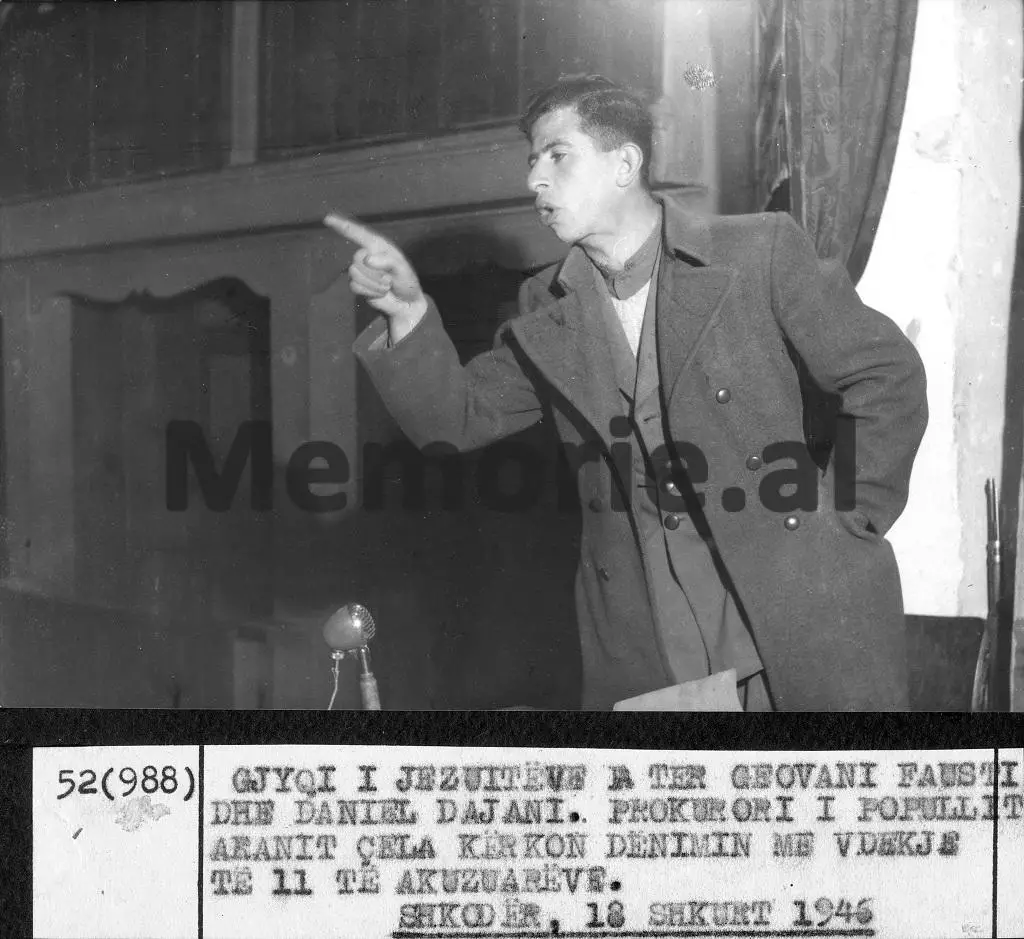
It was February 1946. In the Franciscan Friary of Gjuhadol, Father Frano Kiri had called a meeting of the most prominent lawyers, with the purpose of organising the defence that would be given to Father Gjon Shllaku, as well as to the organisation “Albanian Union” in the People’s Trial. It was known that the communist prosecutor was Aranit Çela. Half an hour after dark, the following persons came: Lawyer Dhimitër Bojaxhiu, Lawyer Ranko Cervenkoviq, Lawyer Tedeskini, and Lawyer Myzafer Pipa; there was another lawyer whose name I do not recall, and Professor Kolë Prela also took part.
I was there with a typewriter, ready for any request. – Father Frano Kiri reminded them that this meeting should not last more than three hours, since Shkodra was under a state of siege, and he put forward the request that Father Gjon Shllaku’s life must be saved at all costs. They spoke in turn and out of turn. For everyone, the situation was very grave. Professor Kolë Prela was a deputy, a close friend of Father Gjon Shllaku. He had come to draft a defence statement to present to the court. Nevertheless, the lawyers, with their prognosis, were not optimistic, and they even doubted the future of the Professor Deputy.
But he was determined to do so, even if it cost him his life. He took from his pocket a trembling sheet of paper on which he had noted the main points upon which the defence statement would be based. These points were discussed. The statement was drafted; I typed it and read it to them; they were all of one mind. Then began the question of which lawyer should undertake the defence. Everyone proposed Myzafer.
He replied that he would be very honoured to defend Father Gjon – indeed it was a duty to the Franciscans – but in this trial he was also heavily burdened with the defence of one of the leaders of the “Albanian Union,” and thus he might stand out, and instead of defending, he might even endanger him. Then they turned to Lawyer Dhimitër, but he too had a heavy load. Almost throughout this meeting, Lawyer Tedeskini had sat silent. They turned to him.
“You,” they said, “are the most suitable for this defence. You do not aggravate the prosecutor and judges, because you are always calm. You must defend him.” Then he spoke:
“Dear colleagues, I have studied for Justice.”
“Well,” they said, “so have we all studied for Justice?”
“Good, good,” he replied, “I say for myself that I have studied for justice.”
“What do you mean by those words? That we haven’t studied?”
“No, no,” he said, “don’t get excited. The thing is, these judicial processes of theirs – and especially these ‘People’s Trials’ – have nothing at all to do with justice.”
After these words, although until that moment the situation had been very grave and disturbing, a general hilarity burst out. When seriousness returned, Tedeskini explained that “these people” had accused Father Gjon Shllaku as chairman of the Christian Democrats, and the rules of the religious associations “Antonian,” “Daughters of Our Lady” and “The Third Order” they presented as statutes of political organisations. “These people” cannot understand anything outside the words: politics, spy, terrorist, therefore this defence for him was impossible, because it was illogical. The very fact that the accusation linked the organisation “Albanian Union” with these religious and educational associations gave the signal of a furious anti-Catholic attack.
Therefore, in these circumstances, the defence should be taken on by lawyers of a different faith. Muzaferi said that not only was he ready for this defence, but he himself, before the communists here, had a great disadvantage, because although he was a Muslim, he had studied at the Franciscan high school until the clerical schools were closed in 1933, and thus partisan logic would present him as compromised, as a collaborator. – And indeed that is what happened. – I do not remember very well how the lawyers divided the defences: they were all together, a group of defenders.
Nonetheless, during the court session, the prosecutor Aranit Çela demanded the arrest of Myzafer Pipa as a collaborator of the “Christian Democrats” and the “Albanian Union”. He was not arrested that day, but several months later, during the Postriba Movement. After such sufferings and tortures, he died shot in the courtyard of the State Security Section, under the pretext that he “tried to escape”.
The State Security Section at that time had its headquarters in the house of Pjetër Çurçia, near the English Clock. The small courtyard behind, with a peach tree in the middle, that short-tailed trunk by the door, those stairs above the WC, those cellars side by side.
O Great God, only you know that there the greatest crimes on earth were committed! That courtyard there is completely soaked with the blood of the innocent. During that time, they had organised gangs of ruffians who roamed the Catholic neighbourhoods of Shkodra, mainly around religious institutions, all night long, always late at night, yelling at the top of their lungs: “Death to traitors!” “Down with the dove of peace!” or “Down with the Pope’s dove!”
They assaulted the church doors as if to blow them up. They filled us with fear and terror: we were like sheep inside a pen, surrounded by rabid wolves. But during those days in Tirana, the shooting of Father Anton Harapi took place, which on the one hand increased even more the thirst for blood, while we others saw an open hecatomb waiting for us. On 22 February, the court sentence was handed down. Sentenced to death:
- Father Gjon Shllaku
- Father Gjon Fausti
- Father Danjel Dajani
- Mark Çuni
- Gjergj Bici
- Gjelosh Lulashi
- Fran Miraka
- Qerim Sadiku
The others were sentenced from 5 years to life. Among those condemned to death, Gjergj Bici’s life was spared; he spent many years in prison, was released, married, went to prison again, until he died. The others served their sentences, some in Burrel, and most in the annihilation camps of “forced labour”.
In the “Rozafat” Cinema-Theatre, when the death sentence for 8 people was read, the cinema hall almost collapsed from the insane applause and the piercing screams of that rabble that had appropriated and monopolised the name “people” and exploited it to give an ultra-criminal colour to the entire Albanian people.
We at the Franciscan Friary, with the utmost focused attention, followed the trial on the radio, directly from the hall of the “Rozafat” Theatre. When this macabre verdict was given, instead of a deathly silence, the clapping of hands was heard – the triumphant clapping of an unparalleled sadism. They began to screech songs of revenge, accompanied by displays so wild and animalistic that Father Mati Prendushi could not help but exclaim loudly: “Well done, O Serbian, for today you have succeeded in presenting us to the world that the Albanian, with or without a tail, is a true wild beast!”
And that savagery continued its displays of terror day and night around the Catholic institutions. The newspapers and radio boasted of this great success against the “enemies of the people.” “People’s Justice” (go and find the meaning of this legal term) with great imagination had succeeded in making a mountain out of a molehill, starting from the daring impulse of some educated lad and the immature actions of a few children, presenting them as if they were terrorist organisations, directed by those people or institutions that the communist party wanted to eliminate.
With anxiety, they waited for whatever might happen. Before the light of 4 March 1946 dawned, prolonged bursts of gunfire broke that deep silence that separates darkness from light. Those bursts came from the Catholic Grave-Yard on the bank of the Kiri stream. The city awoke terrified. It was a partisan custom to leave the executed lying there, sprawled on the ground, to instil fear in the people. Everyone understood what had happened. From all sides, people ran there to see. Those whose houses were nearby arrived so quickly that they found their blood still warm, gurgling. There was someone who took out a white handkerchief and dipped it in the blood of Father Gjon Shllaku.
But then, the partisan guard posted there would not let them come closer than 2-3 metres. Six bodies lay scattered irregularly, as they had been mowed down by the machine guns of the firing squad. One could see on the head only the final blow given to each by the prosecutor. The partisan firing squad had left in that truck, hysterically singing the well-known partisan songs. That day, they were to be rewarded by the command with two rations of food. One of them, in great confidence, told a Catholic youth: “I have never seen such brave men,” because they all died shouting loudly: Long lives Christ!
Until after midday, their bodies remained there lying, and the people went to see them. Then another partisan squad came, dug a common grave, against a deep cliff, and buried them there, in a row, with so many others who before them had been shot behind the wall of the Catholic Grave-Yard, under the shadow of two great oriental plane trees: Those two plane trees are still witnesses today of all that blood shed innocently among their branches. I often go there, and it seems to me as if I speak with them, and I see that from that time on they began to decay and grow old!/Memorie.al