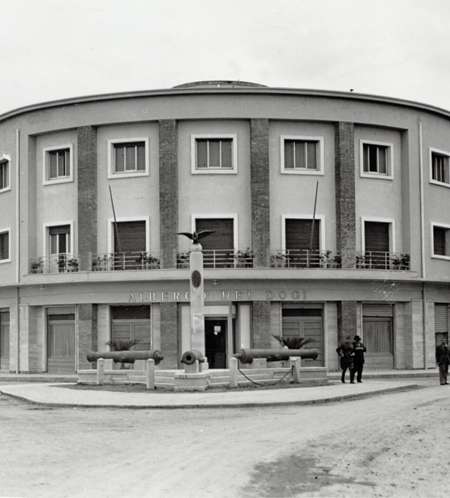
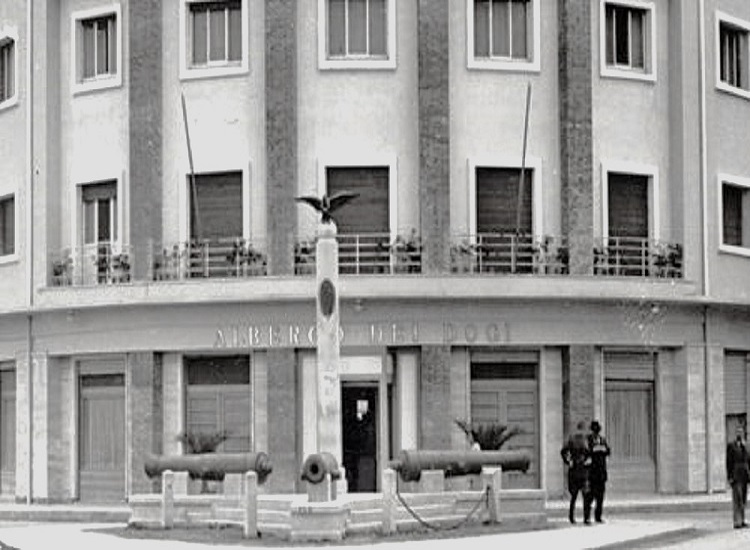
Memorie.al/An important aspect of the history of Hotel “Vollga” in the city of Durrës is espionage. Even when the hotel was still in its foundations, the owners of the entrepreneurial construction firm were placed under surveillance by the Secret Office of the Ministry of Internal Affairs of King Zog’s Monarchy. Supervision was carried out through the Prefect and the Gendarmerie Command of Durrës, as well as the Gendarmerie of Tirana. Although the Monarchy’s official propaganda never missed an opportunity to praise the excellent relations between small Albania and its great ally, Fascist Italy, the Secret Office of the Ministry of Internal Affairs continued its duty.
Due to the influence of the team of British instructors attached to the Albanian Gendarmerie (General Jocelyn Percy, Colonel Oakley Hill, etc.), this secret office was modeled after the British Special Branch, acting simultaneously as a counter-intelligence and intelligence organ.
Suspicions
Omer Fortuzi, co-owner of the Straccioli-Fortuzi firm, though a wealthy Albanian with no activity against the Zogist Monarchy was monitored for his links with the Italians, who were at that time close allies of Albania. Fortuzi had served legally as a mediator between Albanian landowners, primarily beys, and the Italian concessionary company EIAT (Ente Italiana Agricoltura), for the 99-year concession of their lands in the Sukth area.
In Tirana, Omer Fortuzi and his Italian partner were monitored directly by the capital’s gendarmerie, and results were reported to Mr. Harito, an official of the Secret Office. In Durrës, supervision was performed by the gendarmerie and reported to the Prefect of Durrës, Mark Kodheli, as well as directly to Tirana. Interestingly, Prefect Kodheli himself was also monitored due to his Italian wife.
The Zogist Secret Office was proven right when Prefect Kodheli, together with his wife, embarked on an Italian ship on April 5, 1939, and fled to Italy. From Radio Bari, he called upon Albanians to welcome Mussolini’s soldiers with flowers as saviors. The prefect’s escape is documented in the report of Captain Gjeluci of the Durrës Port Authority to the Command of the Armed Forces in Tirana.
Surveillance
Although Omer Fortuzi was considered an Albanian loyal to the fascist regime – being a member of the Albanian Fascist Party and a personal friend of Jacomoni, the King’s Lieutenant – he remained under surveillance by the State Police, the SIM (Military Intelligence Service), Italian customs, and the Royal Carabinieri.
The fascist regime had entrusted Fortuzi with the important post of High Commissioner for Transport and Supplies; however, surveillance remained surveillance. This is a feature of every dictatorship, where everyone except the Dictator is both a spy and spied upon. The surveillance of Fortuzi increased even further when his friend Francesco Jacomoni was replaced as Royal Lieutenant by General Renzo Dalmazzo.
Visit to Rome
In May 1943, Fortuzi was monitored during a visit to Rome because he was suspected of playing double or triple games. Italian spies documented a meeting between Fortuzi and Mehdi Frashëri, the former Prime Minister of King Zog, who was interned in Rome. Italian documents even detail the special rewards given to the agents who kept Fortuzi under surveillance, noting his high risk level due to his cunning and intelligence.
The paranoia of the Royal Lieutenant, General Pariani, was so high that he requested the police to monitor Fortuzi to ensure he did not meet high-ranking Italian officials in Rome, such as General Manlio Gabrieli or former Lieutenant Francesco Jacomoni. (A typical paranoid atmosphere for a dictatorship: the police monitoring Carabinieri officers!)
Spying Reports
On June 14, 1943, the Italian police chief, Agostini, wrote a biography of Omer Fortuzi, praising his honesty and intelligence but expressing the typical distrust Italians held for any Albanian, even a collaborator. Police official Ciccio noted Fortuzi’s arguments with high-ranking fascist officials like Pasquale Luigini or Corradino Berard.
Omer Fortuzi was spied upon everywhere: at the Rome and Brindisi railway stations, at the “Fiamma” Restaurant, at the Brindisi airport, and through customs. Reports included details about his female companion and her Greek-accented Italian, his friendship with an Italian carabinieri major, and even a quarrel with customs officers over luggage weight. The surveillance then shifted to Tirana airport, where agent Rafaele noted that Fortuzi’s luggage was picked up by an official of the Royal Lieutenancy.
Everyone Spies on Everyone
The building of Hotel “Vollga” shared Fortuzi’s fate. Correspondence marked “reserved” and “secret” shows the Italian Navy accusing the Albanian Ministry of Popular Culture, while the Ministry and the Tourism Entity accused the Navy and the Undersecretary of War. The SIM (Military Intelligence) informed on civilians, who in turn, through the OVRA (Fascist Political Secret Service), informed on the military.
When Hotel “Vollga” became a station for German troops, espionage continued. The ABWEHR (German Military Intelligence) gathered information on their former Italian allies and the Albanian resistance. The GESTAPO and the SD spied on elements of the German army itself for anti-Nazi or defeatist attitudes.
In 1945, the SEMP (People’s Defense Section) – the newly created Communist Intelligence Service under the direction of Yugoslav Colonel Safet Filipović – spied on military and civilians from British, American, and French missions, as well as any Albanians who had contact with them.
State Security (Sigurimi)
During the years of socialism, Hotel “Vollga” remained a bastion of the State Security (Sigurimi). From this hotel, intelligence work was organized to monitor hotel guests, the bar, and the restaurant. Special care was taken to watch foreigners – sailors and diplomats – and cigarette smugglers at the docks. Unlike Hotel “Adriatik” or “Apollonia,” the “Vollga” was open to Albanian citizens, making it a prime site for internal monitoring.
Alongside human agents, sophisticated eavesdropping equipment, known as T.O. (Operational Technique), was installed. This included “bugs” (electronic listening devices) of Chinese manufacture and, in the late 1980s, the French “Sagem” brand. Equipment included reel-to-reel and cassette recorders, binoculars, cameras, and video cameras with telephoto lenses – relatively modern for the time.
Significant is the fact that the last act of spying conducted from the premises of Hotel “Vollga” was the filming of the toppling of Enver Hoxha’s bust on February 20, 1991, at the number one entrance of the Port of Durrës. This footage became the basis for the legal prosecution of several anti-communist protesters. Among them was the internee Gëzim Mamaqi, who publicly desecrated the dictator’s bust on that day to the applause of anti-communist citizens of Durrës. / Memorie.al