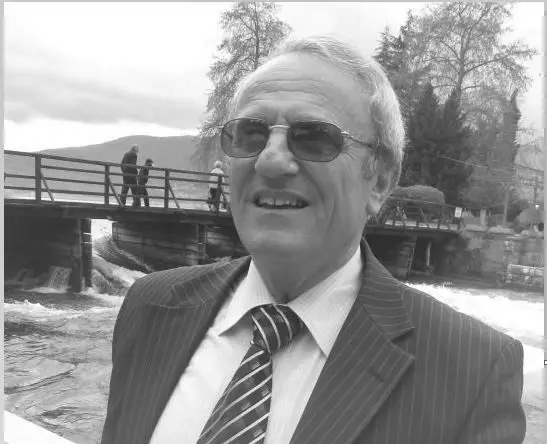
-NAZMI SEITAJ, REVIVES HIS MARTYR FRIENDS OF POETRY-
Memorie.al / Ever since I became acquainted with their tragic fate, I did not know with whom I could compare the lives and works of the two martyr poets, Genc Leka and Vilson Blloshmi. Perhaps with that of Joseph Brodsky, whose life was darkened by the Soviet secret police (KGB), and with that of Osip Mandelstam, whose poetry Akhmatova called of divine harmony. Whenever my road passed by Librazhd, I would stop at that sculptural group with their two screaming heads, and because that marble plaque at the imaginary grave in Starokunc would appear before my eyes, where quite simply and just as magnificently it was written: “To the bright memory of O. E. Mandelstam.”
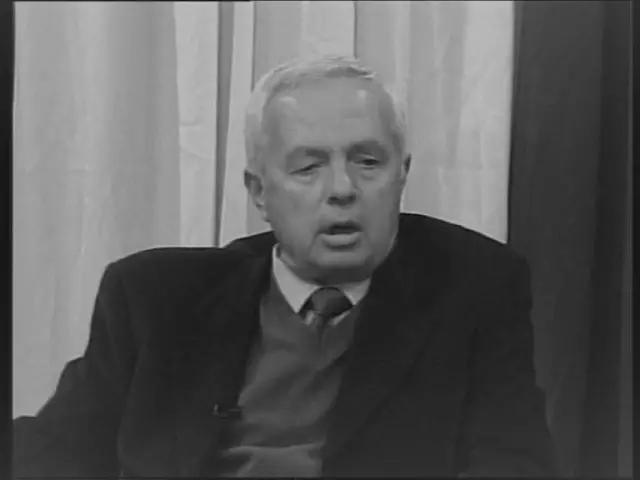
I knew that our two poets, executed younger than they, by the barbaric Albanian Stalinists, were quite talented, dissidents and apostles of freedom, and perhaps they needed no other words. But I was mistaken. Chance brought it about that a wonderful man and writer, Nazmi Seitaj, brought me several of his books, among them: “The Triumph of the Spirit”, dedicated to his two close friends, Genc and Vilson. He said that there were memories and stories there, but no; I found myself before an extraordinary novel, which also revealed another quality of theirs, their being an “intellectual beacon”, as Nobelist Brodsky put it for Mandelstam. Published in 2007 by “Globus R” of Petraq Risto, I am surprised at the silence towards such a literary‑artistic and especially historical work.
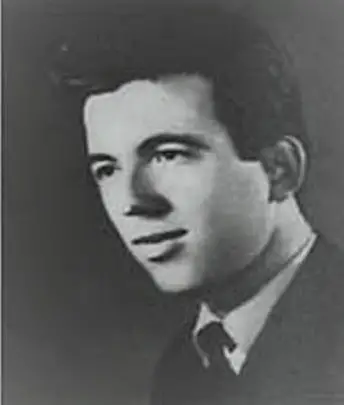
A work with truths that elevate those two figures until they can be placed without fear among those of whom our literature should be proud. With “stains” in their biographies – one with a father who had fled, the other labeled a kulak family, because they had supposedly sheltered saboteurs – being village boys, removed from their teaching duties, who herded livestock and worked with pickaxes, who chased bears away in the forest with firebrands, who performed military service in labor units with other de‑classed individuals, with the most elementary rights denied, with truncated schooling, followed at every step by spies and constantly under the threat of security intrigues, they had a titanic will for knowledge and culture.
They read tirelessly, seeking everywhere for books by the most renowned authors, often forbidden; they found incredible forms and ways to learn foreign languages, translated and wrote their own beautiful poetry even though they knew it would not be published. They found pleasure in music, in that superior thing that had emerged from the mind, soul and hand of Beethoven, Mozart, Schubert, Verdi and friends. They knew in detail the legacy of the masters of immortal music, down to their operatic creations. Here is how Genc expressed himself: “Everyone must know that we are not unhappy, that we are not miserable. Our spirit exults, because it is possessed by the majestic sounds of Beethoven.” While Vilson said: “Our fate is white. It has been sanctified by the ‘Titan of human pain’. We are happy, because we have found the light of life in the ‘Symphony of Fate’. Woe to him who has not been able to feel the climax of Beethoven’s symphonies.”
But they also knew by heart Pushkin, Lermontov, Paustovsky, Poe, Noli, Lasgushi, etc., etc., and they sought someone to discuss them with. Because the broad masses there in the cooperative or enterprise not only had not tasted these things, but were far from them, while with the more intelligent ones, it was risky, because you didn’t know whom to trust. But that is how man is built: he is often guided by what we call intuition. And intuition led them to Nazmi, who not only did not disappoint them, but remained faithful to them to the end. They had found their equal, an intelligent man, with a heart as big as the world, and with a strong character. And above all, with an astonishing memory that, even many years after their killing, brings back memories of them with the greatest accuracy. Of course, the author of the book has put many things of his own, from his own culture. But we are dealing with conversations among men of letters, indeed quite qualified ones, and they, even if approximately, are attested there.
It should not be forgotten that Genc, whose father had named him after the learned Illyrian king who fought the legions of the Roman consul Anicius, was engaged in linguistics, and Vilson, who had that name from the American president, our distinguished friend who did so much for Albania, was engaged in translations. In some respects, their lives, self‑formation and patriotism resemble that of the unforgettable son of Chameria, Bilal Xhaferri. Both of them, though unyielding in their hatred of the communist dictatorial system, had delicate feelings and a refined spirit, and just as Nazmi describes them to us, they often found inspiration, consolation, and even happiness in nature. This author himself, as if he were a student of the philosopher Seneca, whenever he went to them in Bërzeshtë, gives us nature idealized. He paints it with the most beautiful and optimistic colors and shades; he even finds comparisons there. When he speaks of Genc’s creativity he says: “The poems burst from his soul and his heart, just as in spring the meadow bursts with new flowers.”
There is a proverbial intellectual bond between those three poets; it is as if they had as their teacher Epicurus himself, who said: “Of all the things that wisdom provides for living one’s entire life in happiness, the greatest by far is friendship.” Nazmi lived in Elbasan from 1951, where he did not lack comrades, friends and acquaintances, but his mind was there with those two. On hot sunny days, in rainstorms, in mud and in cold, he would go to meet them and have “literary hours” with them. It is hard to find a similar example. Perhaps only in Remarque’s “Three Comrades”, where friendship prevails between O. Kasler, G. Lenz and Robert Lokamp, so convincingly told by the latter. And their end was more or less like theirs; more than Shakespearean. For the English genius, they are killed, but for power and, many, many times for love, not for the poems they wrote. Because those poems were somehow pessimistic.
But how could sincere poems be otherwise in the sad and wretched Albanian reality of those years? And it is precisely on this side of that ugliest of phenomena that the author of this book focuses. He does not dwell on the horrors and tortures of the investigation, nor on the base and undignified witnesses, nor even on their shooting, the careless burial and reburial. It has been enough for him to acquaint us in detail with their high human, cultural, artistic, spiritual values, with their burning desire for freedom. He has deemed it more reasonable, by portraying them as they were, with their humanity, love for life, for the girl Vilson met on the train, to whom he later sends a bouquet of flowers (like Robi with Pat), the joy when their friend came to visit, the carrying of a basket of mulberries to soldiers exhausted from hard work, the care not to cause trouble for others with their cursed “biography”, the gratitude to anyone who had once helped them, even just to find Moussa’s book “Mimi Pinson”, etc.
And see how little they asked for: Vilson: “We will sit by a spring, under the shade of a beech tree, and we will read Victor Hugo,” on some day off up on the peak of Sopot. But even this was not realized, just as the completion of “Ninety Days of Autumn” by Genc was not realized, because the obscurantists, enemies of culture and free spirits, put handcuffs on them and locked them in cells. Nazmi Seitaj knows well that within him Vilson expressed: “I will never see France and Paris, and I will die poisoned. Paris, art and love. Oh God, why was I born in this world!” While Genc, for his part, was aware that: “I am like Aesop, only true freedom warms me…! When the system changes from its roots, only then will the sun warm me… even if I am not alive, I will feel the warmth of my bones…”! Rightly, the author Nazmi Seitaj has compared him to Charles Lonseville of Konstantin Paustovsky – that is, the freedom‑loving and happiness‑dreaming Frenchman.
But both of them were much more than that; Alan Poe, a great poet but utterly futile for America. They too, such sweet and quite talented lyricists, were of no use to that Albania. On the contrary, they posed a danger to the dictatorship. Even there, in that wilderness where they lived. Because ideas, like poems, knew no barricades; they could easily cross any obstacle and reach everywhere, even the Capital. And this was more than true, if you read Genc’s poems: “Oh moon, why have you come out so sad, / Could it be that you are mourning for me? / Why do you look at me with teary eyes, / Has my life ended and I don’t know? / But even if I die, life has not ended, / Though I write my last poem”! Or Vilson’s “Sahara”, which spoke quite openly against, accusing that it did not know how to dream, it only ground stones, it has no song nor tears to weep, no friends, no comrades, and no daughter nor son. Such daring, perhaps only in Tabir Saraj of Kadare, have we seen at that time.
Nazmi Seitaj’s book has many events and many characters that, in the journey of their lives, intertwine with the fates of our heroes. But there are also evil and crooked people there. Whether they were recounted by the poets themselves, or whether they were sculpted by Nazmi’s masterful pen, they remain in memory and do not easily leave your mind. Such is the spy ‘Deko’ or the boastful and nostalgic ‘Xhemali’, who, being as low as he was a crook, sat all the time crammed into a rusty, dusty ‘Cadillac’ with collapsed, burnt and cracked tires. And this guy owned the 40‑volume French Encyclopedia. Seiti does not present these samples without reason; he means: “See how far Genc and Vilson stand from them. How worthy and virtuous they are. And see also how low that degenerate system had fallen, which precisely in them saw a possible threat.”
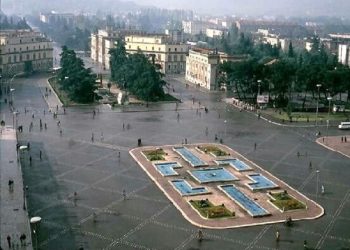
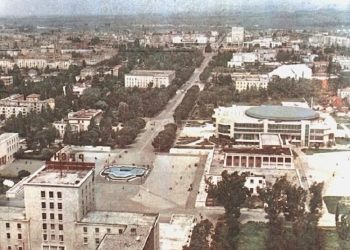
But they, even there where they are, in that square of Librazhd, above a pool of water, with their heads that seem to scream, remind you of the severed head of Orpheus, who sings eternally there in the river Ebro. Only Genc and Vilson not only seem alive, but also as if declaiming the verses of the Acmeist Mandelstam, who, because of his satire against Stalin, died interned in Siberia, saying: “After you took from me the sea, the run, the flight / And the earth with a roar you drowned in tears and wails / Where did you get to, what did you gain? The conclusion is clear: / The murmur of my lips you cannot erase.” So they, metaphorically, are again alive among us. And for this, their dear friend, the wonderful man and writer Nazmi Seitaj, has a special merit. However, one thing is more than certain: The sun of freedom, at least, is warming their bones. /Memorie.al