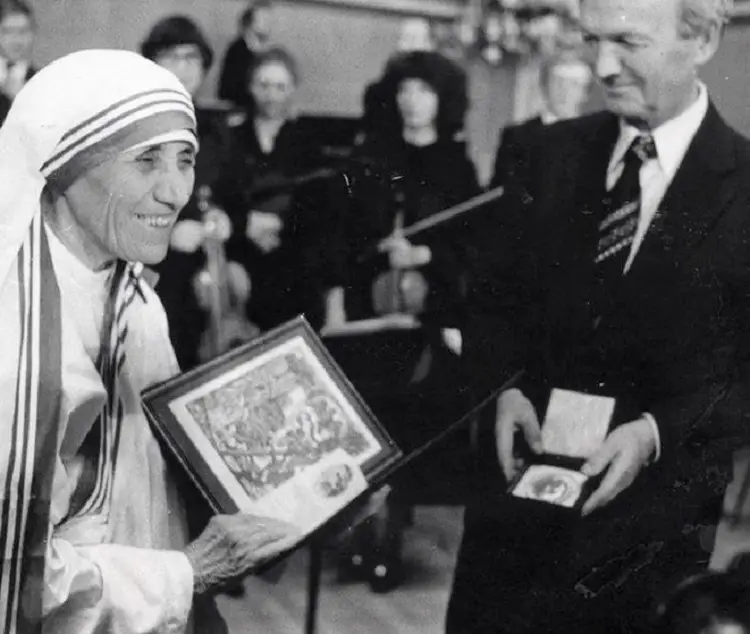
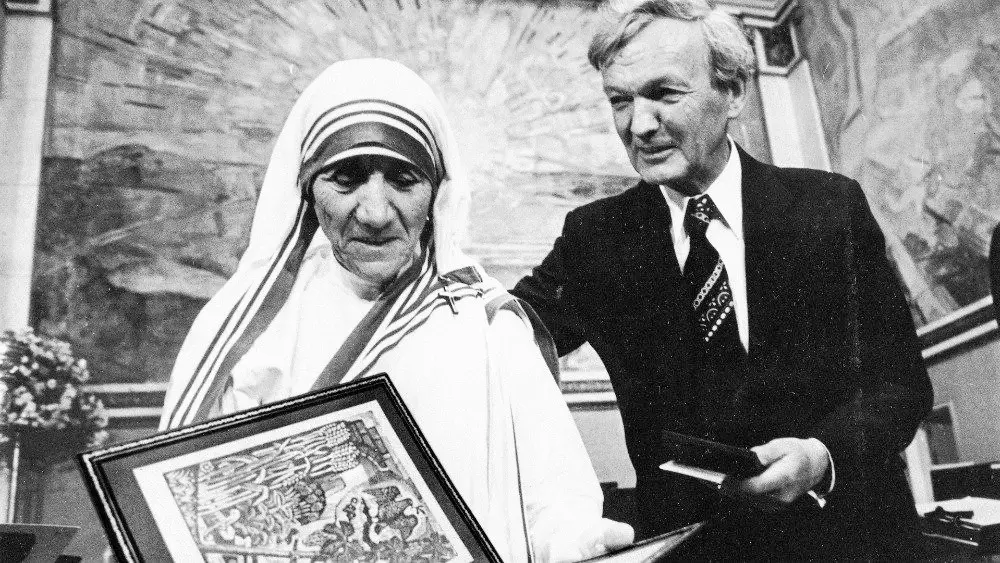

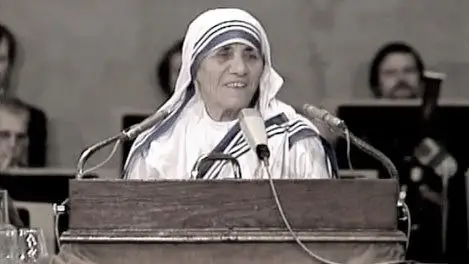

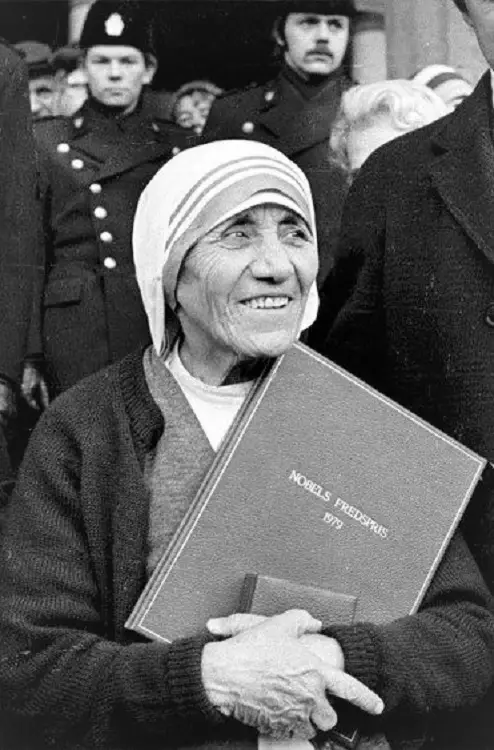
Blessed Mother Teresa’s Speech at the Nobel Peace Prize Ceremony, Oslo, 10 December 1979
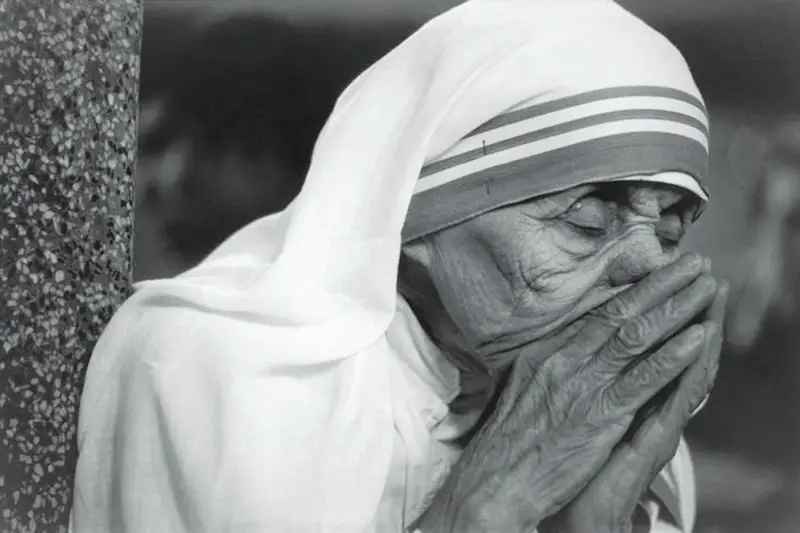
“Since we are all gathered together, I think that, in order to thank God for the Nobel Peace Prize, it would be truly beautiful to pray the prayer of St. Francis of Assisi – which always moves me greatly. We say this prayer every day after Communion, because it is so very fitting for each one of us. It makes me think that four or five hundred years ago, when St. Francis composed this prayer, people must have been going through the same difficulties we have today, since it fits us so well.
I think some of you have it with you, so let us pray together. Let us thank God for the opportunity we have, all together today, for this gift of peace, which reminds us that we were created to live this peace, that Jesus became man in order to bring this very good news to the poor. He, though He was God, became man in everything except sin, and He proclaimed openly that He had come to bring this good news.
The news was peace to all people of good will – it was the peace of the heart, which we all desire. God loved the world so much that He gave His only Son to give this gift to mankind. And how can we say He did wrong because He loved the world so much as to give His only Son? He gave Him to the Virgin Mary. And what did she do then? As soon as she felt Him alive within her, she hastened to give the news. And as she entered her cousin’s house, the unborn child in Elizabeth’s womb leaped for joy. The unborn baby was the first messenger of peace!
He recognized the Prince of Peace, he recognized Christ, come to bring the good news – for me, for you. And as if it were not enough that He became man, He also chose to die on the cross to show how great His love was for man – for me, for you, for the leper, for the hungry, for the one who wanders naked in the streets, not only of Calcutta, but also of Africa, New York, London, and Oslo. He insisted that we love one another, just as He Himself had loved us. It is clearly written in the Gospel: ‘Love one another, as I have loved you, as I love you. I love you, as the Father loved me.’ And the Father loved Him so much that He gave Him, and even more.
And we too must love one another, even unto pain. It is not enough to say, ‘I love God, but not my neighbor.’ St. John reminds us that we lie when we say, ‘I love God, but not my neighbor.’ How can you love God, whom you do not see, when you do not love your neighbor, whom you see, touch, and live with and beside? So it is very important to understand that love, to be true, must be such unto pain.
It pained Jesus when He loved us. It pained Him deeply. And to make sure we would remember His great love, He became the Bread of Life, to quench our hunger for love – our hunger for God, because we were created for this love. We were created in His likeness. We were created to love and to be loved, and He became man so that we might love as He loved us. He is the hungry one, the naked one, the homeless one, the sick one, the imprisoned one, the lonely one, the unloved one, and He continues to remind us: ‘You did it to me!’
He hungers for our love – and that is the hunger of our poor. It is that hunger that you and I must find, because it may exist even in our own homes! I will never forget the opportunity I had to visit a home where many elderly people were housed – all of them fathers and mothers with sons and daughters, all of them abandoned in that institution and… forgotten!
I went there and saw that they had everything – beautiful things – but all of them had their eyes fixed on the door. And I did not see a single smiling face. I turned to a sister and said, ‘How is this? How is it possible that people who have every good thing do nothing but stare at the door, and I see no smiling face? I am used to seeing our people smiling – even those who are dying smile faintly. They die with a smile on their lips.’
And she answered me: ‘This is how they are day after day – they wait and hope that one of their sons or daughters will come to see them. They feel wounded because they are forgotten. And you see, this is precisely where love must knock. Just as poverty knocks at our homes when we forget to love one another. Perhaps in our own family we have someone who feels lonely, sick, worried – and these are difficult days for everyone. Are we there? Are we there to help them? Is the mother there to hear the unspoken word of her son?’
I am amazed when I see, in the West, so many boys and girls on drugs, and I rack my brain to find the reason why this happens.
The answer is: because there is no one in the family who listens to them. The father and mother are always so busy that they have no time even for their own children. Young parents are in some office while their child wanders the streets, ready to fall into some trap. And we are talking about peace! These are precisely the things that destroy peace. But I do not abandon the conviction that today the most dangerous enemy of peace is abortion, because it is direct war, direct killing – the killing of a child by the mother’s own hand.
We read in Sacred Scripture. God says it very clearly: ‘Even if a mother could forget her infant, I will not forget you! I have carved you in the palm of my hand!’ We are carved in the palm of His hand – we are close to Him! And the unborn child, too, is carved in the palm of God’s hand. And what shocks me most is the beginning of that sentence: the words, ‘Even if a mother could forget…’ It seems impossible to me, but nevertheless, even a mother can forget, God reminds us – but I will never forget. Today, the most dangerous weapon against peace is abortion. If we are here, it is because our parents loved us. We would not be here if they had not loved us.”
“Many people are interested in the children of India and Africa, where thousands die from lack of food. But in other countries, millions of children are killed by their own parents. And if a mother kills her own child, why should we be surprised when people take each other’s lives?
Therefore, I appeal – in India and everywhere: ‘Give us your children, if you do not want them, in this year that has been dedicated to them.’ What have we done for children? At the beginning of the year, wherever I spoke, I said: let us work this year so that every child, born and unborn, is loved. And today, as the year ends, I ask: ‘Have we loved every child, born and unborn?’ I will remind you of something moving.
We are fighting against abortion through adoptions, thus saving thousands of lives. We have appealed to all clinics, hospitals, police stations: please, do not kill the children – we will take them. At any hour of the day or night, there is someone who needs help. We have many young mothers: tell them to come to us; we will care for their child, we will find a home for them. We have countless requests from childless families, and for us this is a grace from God. We are also doing another very beautiful thing: we are teaching our beggars, our lepers, our slum dwellers, our people of the streets, the methods of family planning.
And just in Calcutta, in six years – I emphasize, only in Calcutta – we have had 61,273 fewer children from families that would have brought them into the world, because they learned to practice this natural method of abstinence, of self-control, with mutual love. We teach them the temperature method, which is very beautiful, quite simple, and our poor people understand it very well. Do you know what they have told me? ‘Our family is healthy, united, and we can have children whenever we want!’ So clearly, these street people, these beggars, are doing far more than you and all the others who may know methods and means without destroying the life that God has created in us.
The poor are great people. They can teach us many beautiful lessons. One day one of them came to thank me and said: ‘You who have made the vow of chastity are the most capable people to teach us family planning.’ Because it is nothing other than self-control for mutual love. And I think we have said a very beautiful phrase. And these are people who perhaps have nothing to eat, perhaps have no shelter to rest in. Nevertheless, they are truly great people!
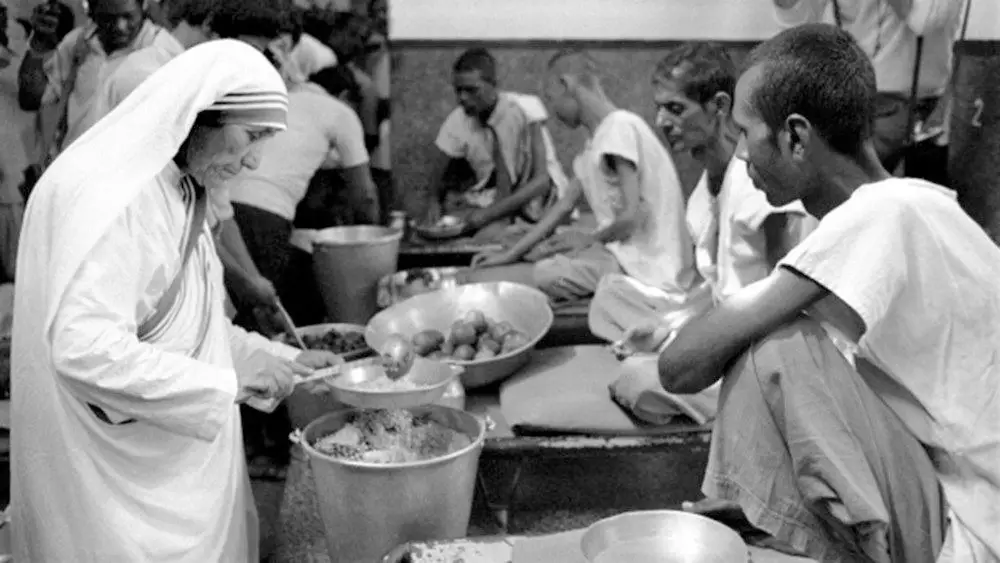
One evening we went out and picked up four people who had been left on the main road. Among them was a woman in a terrible condition. I told the sisters: ‘You take care of the first three; I will take care of this one, who looks worst.’ I cared for her with all the love I had in my heart. I laid her gently on the bed and saw a wonderful smile appear on her face. She took my hand in her hand – which was growing cold – and said one single word: ‘Thank you!’ Then she died. I could not help but descend to the depths of my conscience at that moment, facing that dead woman, and ask myself: ‘What would I have done if I had been in her place?’ The answer was simple. I would have tried to draw attention; I would have said that I was hungry, cold, in pain, that I was dying – who knows what other words. Whereas she gave I much more than I gave her: she gave me her last love. And she died with a smile on her lips.
Just like the man we found in a drain, half eaten by worms, and brought him home. He ended his life with the words: ‘I have lived like an animal on the street, but I am dying like an angel, in the arms of love and care.’ It was amazing to see the greatness of this man, who could speak like that, who could die like that, without accusing anyone, without cursing, without making comparisons. Like an angel! And this is the greatness of our people. And for this reason we believe that Jesus said: ‘I was hungry, I was naked, I was homeless, I was abandoned, unloved, uncared for, and you did everything you could for me!’
I believe we are not true social activists. Perhaps in the eyes of the world, our work may seem social, but in truth we are contemplatives in the heart of the world. Because we touch the Body of Christ twenty-four hours a day. We have this presence twenty-four hours a day, and so do you and I. You too can try and bring God into your families, because the family that prays together stays together. And I believe that in families we do not need bombs and atomic weapons, which destroy. To bring peace, it is enough to be together, to love one another. So let us bring this peace, this joy, this strength of God’s presence into our homes. And thus we will be able to overcome every evil, in a world where there is much suffering, much hatred, and much misery. Therefore, let us begin the battle of love precisely from our own homes, with our prayer and our sacrifice!
Love begins at home, and it does not matter how much we do. What matters is the love with which we do everything. It belongs to God, who is almighty, to judge the love with which we serve – the love with which we serve Him Himself in the suffering person. Not long ago in Calcutta, we ran out of sugar, and somehow the children found out. And a child of about four years old, the child of Hindu parents, went home and told his parents: ‘I will not eat sugar for three days. I will give my sugar to Mother Teresa for her children.’
After three days, the child’s father and mother brought the sugar to our house. I had never met them, and their child could barely pronounce my name, but he knew well what he had come to do.
He had come to give love. And you too are giving me love. Ever since I arrived here, I have been surrounded by love – by the great love that tries to understand everything. And it seemed to me that you were looking with special attention upon all the people of India and Africa. And it seemed to me that I was in my own home – completely at home, here among you! That is why I came to speak to you. I wish for you to see the poor right here, in your own home. And to begin to love them, right here. To become good news for your own people. And to say to your neighbor: ‘Do you know who I am?’”
“I lived a truly extraordinary moment in a Hindu family with eight children. A gentleman came to our house and said: ‘Mother Teresa, I know a family with eight children that haven’t had anything to eat for days. Do something for them!’ Without delay, I took some rice and set out. I saw the children, and in their eyes I saw the fever of hunger. I don’t know if you have ever seen such eyes. But I see them very often. I also saw the mother, who divided the rice and went out. When she returned, I asked her: ‘Where did you go?’ She answered simply: ‘They are hungry too.’ Who were they? I learned that she was speaking of a Muslim family. She had shared her morsel of food with them. I did not bring any more rice that evening, so that I could fully savor the joy that came from sharing food with others. I read that joy in the eyes of the children of that mother – she who did not have even a handful of rice, yet had so much love to give. So, then, love begins right at home. And I wish that you too would give love, just as you are giving it to me – for which I am very grateful.
It was an extraordinary experience, and I will take it with me to India, where I will go next week – on the 15th, I believe – carrying your love with me. With the conviction that you did not give me your surplus, but the love that hurts. Therefore I thank God that He gave us the opportunity to meet, to feel so close. This way we can help not only the children of India and Africa, but all the children of the world. And with this prize, which I have received as a peace prize, I will try to build a home for those who have no home. Because I believe that love begins at home, and that if we can build a home for the poor, from that home only love will radiate everywhere. And from love, peace will spread – the good news for the poor. For the poor of our own family first, of our own country, and of the whole world. But to do this, our lives must be woven with prayer!
I feel that the sufferings of Christ are re-enacted everywhere, and we share these sufferings, this pain, with Him. All over the world, not only in poor countries. And this, because I think it is much harder to remove the poverty of the rich Western world than that of the poor world. When I take a person from the street – starving to death – I give him a plate of rice, a piece of bread, and I have satisfied him. I have quenched the hunger that consumes him. But the person who is steeped in silence, who feels unwanted, unloved, frightened, cast out from society – how can I satisfy him? It seems very difficult to me. Our sisters are working for this type of person, whom we might call the poor of the West. A person who thirsts and hungers for a little love! So I invite you to pray for us, that we may be capable of becoming the good news ourselves, with the conviction that we can accomplish nothing without you, because it is precisely you who must stand by us in your own place.
You must know the poor. Truly, here people have material goods, they have everything, but I think that if you were to go from house to house, you would hardly find a smile that comes from the heart. And we must keep well in mind that the smile is the beginning of love. Let us therefore always meet with a smile on our lips, because when we meet like that, it is impossible not to do something good. Pray, then, for our sisters, for our brothers, for our co-workers spread all over the world: ‘Pray that they remain forever faithful to God’s gift that they love and serve Him in the poor, together with you. What we have done, we could not have done if you had not helped us with your prayers, with your gifts, by giving constantly. Only I do not want you to give me what you have left over. I do not want surplus. I want love – love unto pain.
A few days ago I received 15 dollars from a man who has not moved from his bed for twenty years. The only part of his body he can move is his right hand. And the only thing that gives him pleasure is tobacco. And so this man told me: I have not smoked for a week, to save this money that I am sending to you.
It must have been a terrible sacrifice for him – but also a very beautiful one. With the money from his unenjoyed tobacco, I bought bread for the hungry – for the joy of both parties: he gave, the poor received. And this is God’s gift to me and to you – to share love with others. And to do it as if we were doing it to Jesus. To love one another as He loved us.
To love Him Himself with undivided love. To love Him and one another at the same time, especially now that Christmas is so near. Let us keep the joy that springs from the love of Christ in our hearts. And let us share this joy with all those we meet. And this radiant joy is the true one. We have no reason not to be happy, because Christ is with us. He is in our hearts. Christ is in the poor we meet; in the smile we give and that is given to us. Let us pledge, therefore, that no child will be unwanted, and that we will welcome them with a smile on our lips, especially when it is most difficult to smile.
Not long ago I lived through an event I will never forget. About 40 professors from various universities in the United States came to visit us. They came to Calcutta, to our house. They were talking among themselves, saying that they had been to our home where we shelter the dying. We have such a home in Calcutta, where we have gathered more than 360,000 people from the city streets alone, and of that great number, more than 18,000 have died in peace with man and with God. They set out for God’s home after coming to our home, where we spoke to them about love, about mercy.
As I was speaking to them about this home and about these people, one of the professors begged me: ‘Mother, please tell us something that we can remember.’ And I told them: ‘Smile at one another, give some time to your families. Smile!’ And one of them, surprisingly, asked me: ‘Are you married?’ ‘Yes,’ I answered, ‘and often I find it difficult to smile at Jesus, because sometimes He asks too much of me.’ This is the truth, and from this comes love – when Christ is demanding, and yet we can give to Him with joy. And I say here that if I do not go to heaven for any other merit, surely I will go because of publicity – because it has purified me, sacrificed me, and truly made me ready to go to Heaven.
I think we should live our lives beautifully, because Jesus is with us, Christ loves us. If we would only think that Jesus loves us and that we have the opportunity to love others as He loves us – not in great things, but in small things done with great love – then Norway would become a nest of love. And how beautiful it would be if right here we were given a center for peace! From here the joy for the life of unborn children would radiate. If you become a light that burns in the world for peace, then truly the Nobel Peace Prize is a gift for the Norwegian people. God bless you!” /Memorie.al