By Assoc. Prof. Klejd Këlliçi
– THE GRAVES OF BRITISH, FRENCH, GERMAN AND GREEK SOLDIERS WHO FELL DURING THE SECOND WORLD WAR IN ALBANIA –
Memorie.al / In the late 1940s and beyond, as a way to recover legitimacy among their peoples, countries such as Germany and Italy began to show interest in recovering the remains of those killed in the global conflict, remains that were now scattered from Russia to Africa and the Balkans – including Albania. In 1947, the Albanian government identified all burial sites of foreign soldiers who had fallen in Albania and proceeded to send them to their countries of origin. This was a unilateral act, which did not take into account any specific will expressed by the countries of origin, especially for a country like Germany, which at that time did not enjoy territorial sovereignty.
The British army was the only one among the Allied forces that operated directly in the country, especially in cooperation with the partisan forces in several important actions along the Albanian coast. At the same time, the British air force, particularly from 1943 onwards, bore the main weight of support in coordinated actions against German troops. Although the number of killed was relatively small, about 35-40, communist historiography tried to hide this fact, or even to label them as enemies and their presence in the country as a dress rehearsal for what later happened in Greece in 1944. Whether supposed or real, the British danger, together with the Corfu Channel crisis, also involved the soldiers’ remains.
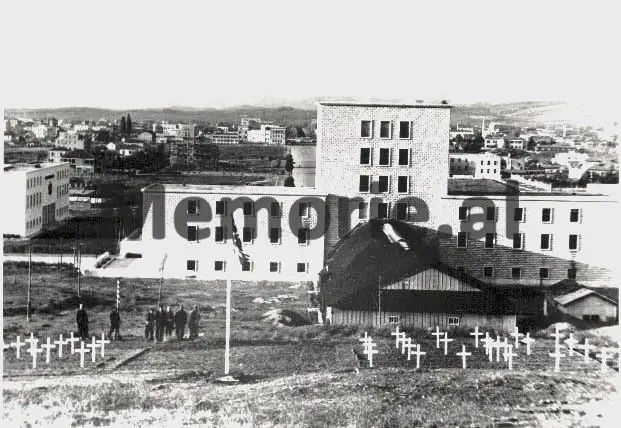
In 1946, after lengthy negotiations, the British Mission in Tirana managed to persuade the Albanian government to accept a military mission to search for the fallen. This mission, headed by Colonel McIntosh, managed with great difficulty to locate the fallen, which were scattered across the territory, such as aviators or soldiers from commando units who fell in the Sarandë-Himarë area in 1944. After many vicissitudes, the soldiers’ remains were gathered in Tirana. The bodies of British soldiers were temporarily buried behind the building of the General Command. Although the Albanian authorities promised the Imperial War Graves Commission that they would grant a plot of land for 99 years, they never fulfilled this promise.
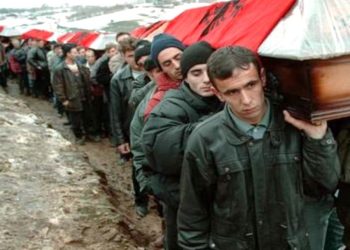
Nevertheless, the British colonel tried, even in the absence of an agreement, to at least secure the preservation of the burial site by placing the remains in a protected place where construction would not be possible. In 1948, next to the British cemetery, the ‘Martyrs’ Cemetery’ was provisionally placed. A chronicle of the time shows the funeral cortege escorting an unspecified number of coffins towards the hills of the lake, to place them on the hillside between the Polytechnic University and the Republic Guard. The camera avoids giving a wider view of the surroundings, perhaps precisely because of the few-metre proximity of these cemeteries to those of the British soldiers – as if to thus define the contribution of the martyrs and not to mix it with others.
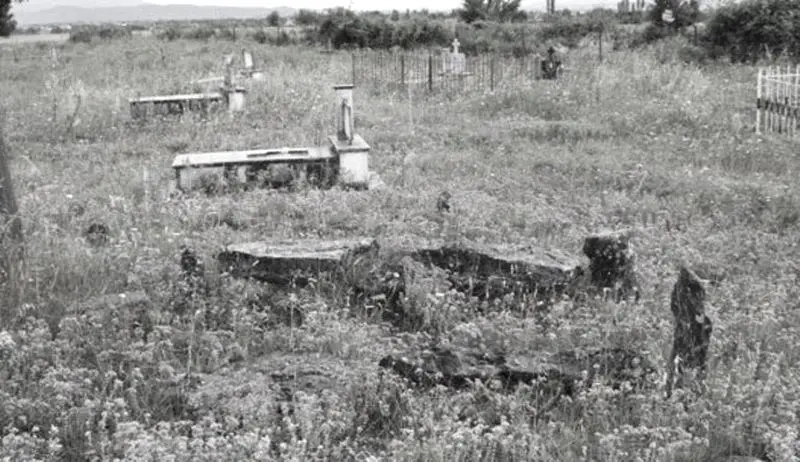
After the departure of Commissioner McIntosh and the British mission, silence fell over the soldiers’ cemetery. The British, although they tried to pursue this matter further, gave up in 1950, the year that marks the last contact with the Albanian government. In 1951, the Imperial War Graves Commission, through the International Red Cross and in the absence of any agreement between the states, asked the Albanian government for news about the state of the military cemetery. After the Albanian government examined the request, it was discovered that the British soldiers’ cemetery was still behind that building, but was now overgrown with brambles and weeds, and here and there only fragments of broken crosses were still visible. As the document also testifies, it “has been left at the mercy of nature”.
Despite the lack of an agreement with the British, the Albanian authorities limited themselves to neglecting the burial site, but nevertheless, the Executive Committee of Tirana, although it had forested the entire area, had taken care not to interfere with the cemetery’s perimeter. After this information, Mehmet Shehu, the then Prime Minister, writes: “I am of the opinion not to reply”, thus closing the case of the British fallen in Albania and further narrowing the meaning and contribution of others to the liberation of the country. War and martyrs were defined exclusively with Albanians, precisely to sustain and reinforce the official narrative: the liberation of the country by its own forces. With this logic, the history of new Albania began with liberation, and the monopoly of this narrative was held and transmitted only by the bodies of Albanian martyrs, exclusively communists.
For Albania, the Cold War did not begin simply with the country’s political positioning, nor with the Corfu Incident, but with the attempt to annul Allied contributions during the war, where the soldiers’ bodies were an essential symbolic element. Their location near the institutions and buildings built in the centre of Tirana during the fascist period, but now inhabited by the new regime, could only be alternated with symbols that were to establish an exclusive and exclusionary narrative, especially towards foreigners. At the same time, the search for dead bodies, especially of aviators, would enable Colonel McIntosh to travel throughout the country, which aroused suspicions of espionage. Thus the colonel, despite all his efforts, was expelled as a spy, so much so that this episode finds a place even in Enver Hoxha’s book, “The Anglo-American Danger for Albania”, where the recovery of aviators’ bodies is seen as a pretext for control and espionage by those now considered enemies.
- British soldiers’ cemetery behind the building of the Albanian Army Command, Tirana, 1946 (Source: A.Q.SH.)
The end of the Cold War is made evident, among other things, by the reappearance of bones and their remembrance. Its end does not simply mark the beginning of the new regime, but especially will be completed with care for the fallen, since only with this change does commemoration become possible. The discovery of the remains of foreign soldiers would also bring to light the identity insecurity that the communist regime had at the moment it decided to hide almost every trace of their presence. Their military status is incomplete, for without identifying marks, they are bones like all others. At the same time, the British state does not demand their repatriation, as it retains the right to maintain ownership over the body and to use it for certain political projections. In the case of the British in Albania, this agenda is produced through the indisputable fact of the fight against the Germans, and although Albanian historiography hides it, it uses it as a counter-argument, even considers the British role harmful in the long term, extending beyond the war.
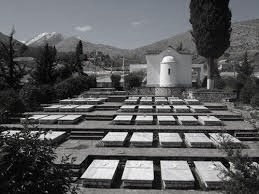
However, the memory of the soldiers, although unable to discover their fate, continues to be preserved and to play a strategic and important rhetorical role. The absence of a soldiers’ cemetery and of the desire to recover them does not prevent the state or the agency responsible for their remembrance from constructing a narrative also based on the impossibility of that remembrance. Thus, for those who fell in Albania, the Imperial War Graves Commission built empty graves with a memorial plaque at the Falerion cemetery in Greece, the closest place to where the soldiers fell. The dead must be commemorated not only in relation to their sacrifice, enabling connection and solace for their families, to minimally preserve the fundamental civilising aspect of honouring them, but also in the continuation of their “work” in the sense of the efforts of war. The lack of honouring, the obstruction and denial of commemoration and sacrifice of war, especially in the context of what came after the Cold War, preserves and makes more sensitive the decision to hide the contribution of British soldiers to the liberation of Albania. The end of the Cold War came not only with the “surrender” of communist countries, specifically Albania, but also with the revision of history through the recovery of bodies. Only in 1994 was it possible to recover the bodies of British soldiers and build the cemetery on the lake hills, next to the memorial cemetery of the Frashëri brothers.
Thanks to the interest of David Smiley, a former military attaché with the partisans during the war years, in the early 1990s the Imperial War Graves Commission managed to find the bodies of British soldiers, placed in a common grave a few metres beyond the first burial site, which had been destroyed, most likely during the expansion of the University building in the mid-1950s. Afterwards, the British soldiers were moved further up, to a piece of land near the memorial grave of the Frashëri Brothers. As if to give the symbolism of continuity and memory of the now-declining British Empire, the stones of the soldiers’ graves were taken from the British cemetery at Falerion and placed in those of Tirana. The location carries a strong symbolism, as it is the place where the first martyrs’ cemetery was moved from its original location at the foot of the hill. Later, the remains of German soldiers were also placed there, as if to mark an act of union and reconciliation between opponents (Germans and British), and also projects the country into an almost forced Europeanising orientation. Alongside the Germans and the British, we also have the Renaissance figures (Rilindasit), symbols of the European modernising direction of the country.
But at the same time, the construction of the monument manifests the suspended nature that such monuments cause. They remain suspended because they neither totally surrender to the host territory nor are they connected to the families of the fallen. This state ownership over the remains of foreign soldiers is disposed of exclusively. It seeks to neutralise the connection with the territory, to avoid misunderstandings, yet its direct connection with the country of origin creates a bridge that transcends the event itself. Thus, although the buried fallen belong to the Second World War, they are also commemorated on 11 November, the day the First World War ended. This duality symbolically transcends the commemorative moment, attempting to position Albania within a wider narrative than the global conflict, while at the same time marking the territory and inserting it into the almost global imagination of the former British Empire.
Following the same logic, the Federal Republic of Germany asked the Albanian government to facilitate the discovery of the bodies of German soldiers from the Second World War. In 1994, the now-unified German state had the monopoly and the right to recover bodies, mostly choosing to place them in the countries where they had fallen rather than returning them to Germany. With the consolidation of bilateral relations, the governments signed an agreement on soldiers’ remains, strategically expanding the boundaries and scope of the search. Not only soldiers of the Second World War were sought, but also those of previous conflicts, such as the First World War. The inclusion of this category seems intended to avoid the symbolic problems that the discovery of Second World War soldiers would cause, due to the historical circumstances and the problems they carried, thus evading them and making them more acceptable to the parties.
These integrative journeys through bones also appear as a bridge between Albania and other countries in the region. Gestures, even in the absence of diplomatic relations, mark the character and position of the state that produces them. In 1957, the Greek embassy in Moscow asked the Albanian state for information about a group of officers who, according to intelligence, were buried in Vlorë. Interestingly, this information was produced not by the Greek state but by the Italian government, which had meanwhile begun negotiations for the repatriation of Italian soldiers’ bodies. The end of the Second World War had reconfigured international relations, and thus also the bodies of former enemies, now positioned towards one another.
Alongside the problem of the Italians, the Albanian state concerns itself with identifying this problem, which adds precisely to the list of claims of neighbouring states over bodies. Although the first request of the Greek authorities was not taken into consideration, it is an attempt to geographically identify the positioning of the burial sites of Greek soldiers – a problem previously ignored, and why not, forgotten. The remains of these officers have the property of being identifiable and thus capable of producing the humanitarian and moral action of returning them to their families. In this context, the Albanian authorities try to identify them, although during excavations they face uncertainty, since the instructions in the documents do not match those on the ground.
The supposed bodies are not found where they should be, because the Italians themselves had already passed through and taken almost all the remains, in the absence of distinguishing marks. The Albanian authorities find themselves ambivalent before the discovered remains, because some of them have been taken by the Italians, who labelled them simply as unidentifiable, while the remaining ones bear no mark. “The general declared them to be Italians,” says the document, as if seeking to show that ownership over the body belongs to whoever finds and appropriates it first. The dilemma over identity is important, inconsistent with the documentation, but at the same time part of the diplomatic processes between countries. Thus, identity is discovered and constructed, even without an inherent correspondence between the bones and the body. What matters is that they are given an identity, as long as there is no conflict or claim over them; thus they are declared as such.
At the same time, as long as there are claims over them, the remains of foreign soldiers must be identified and kept under control, because in this way they serve the communication process between two countries. The special position of the remains is interpreted in terms of war, since the Greek officers had been interned in Vlorë and were killed while being transported to the internment camp in Italy. The humanitarian gesture of discovery is complemented by the Albanian side bearing the expenses, since the officers are classified as victims of fascism, and thus the act is a kind of missing justice recognised for the bodies that fell in a war considered common. The precedent of the officers serves to set in motion Greek-Albanian negotiations over bodies. Alongside other problems, these are seen as important for the smooth progress of the latter.
First comes the process of recognition and identification of the number of bodies, as that determines the nature of the intervention on the territory; then come problems of a logistical nature, and why not, of a political nature. If the Italians and the Yugoslavs accept the fait accompli to some extent – the former, given their status, accept even the violence or destruction of burial sites; the latter are aware of the time and effects it has on the bodies – initially, Greek soldiers in Albania did not have the status of occupiers; secondly, their burial sites did not have critical status, since in most cases they were buried either by locals or by the Italians themselves. The Greek state, unable to have relations with Albania, has taken little or no care for the fate of their remains. The situation of Albania is also critical, which sees its relationship with neighbours as a way to soften its path of self-isolation, and why not, sees the search for soldiers’ bodies also in a simple logic of profit from exhumation.
The Italian precedent serves as a model that the Albanian government takes into account when identifying the problem of the bodies of Greek soldiers.
In the late 1960s and early 1970s, the Albanian authorities faced private and state requests for soldiers’ remains. Initially, there were private requests which, even in the absence of state direction, came mainly through acquaintances and connections that Greek diplomats had with the Albanian state. Until 1973, in special cases where identification was possible, soldiers’ bodies were transferred to Greece, returning to “ownership” of their families. This process implied only the human aspect, where the state served as a neutral intermediary and facilitator of the body’s repatriation, where the latter was stripped of its military and symbolic properties to become an object of remembrance for a narrower group, the family.
Faced with these requests, the Albanian government asked local authorities to identify burial sites of Greek soldiers. The results were not as expected, as few districts reported new burial sites beyond the known ones in Dragot and Semjol in Tepelenë. In many cases, they are located in cemeteries of predominantly Orthodox villages, but without clear identifying marks, and in the worst case, in inaccessible mountainous areas due to terrain conditions. In Përmet, they have been confused by Italian exhumations, and it is unclear how many and where. Moreover, the Greek state’s data are deficient and incomplete. Claims over numbers increase when inter-state solidarities come into play.
Since in 1941–42 the Italian military authorities buried Greek soldiers alongside their own, as a sign both of respect and of sanitary concern, it was also the Italian authorities who informed the Greek authorities on the cemeteries. This is reinforced by information gathered by the Italian general Bandini himself in 1960–62, who, while recovering Italian bodies, also tried to identify and record those of Greek soldiers, both to mark the avoidance of mixing remains and to take into account the Cold War balances when both countries were now allies. Between 1970 and 1972, there is a kind of duality between public and private interest in the remains of Greek soldiers. On one hand, the Greek state is interested in the bodies and their identification, but without concretely expressing a solution to the issue referred to by the Albanians as “the problem of soldiers’ remains”, which as such needs to be resolved; on the other hand, there are the private interests of family members seeking the remains of their relatives who fell in the war.
Another important element is that of commemoration. Groups of veterans, and not only family members of the fallen, request such a thing. Constantly and in various forms, delegations and Greek authorities request the placement of a memorial monument together with a cemetery for the fallen. Then, the issue of the soldiers falls back into silence until 1977, when it is reopened again. And if in the preceding years the problem was raised only in terms of recognition, this time the Albanian state had to confront the weight of numbers. The Greek state claims the presence on Albanian territory of 12,000 fallen soldiers, while according to the Municipal Directorates responsible for cemeteries and for tracking possible military burial sites, the numbers are much smaller. Local authorities manage to identify only 650 skeletons, found in various burial sites, dispersed in what official documentation calls the “affected districts”.
Regarding the construction of a memorial, the Albanian authorities sidestep the request, also based on the lack of a precedent. The uniformity of collective memory in socialist Albania makes it impossible to accept monuments that offer foreign commemorative narratives. The French cemeteries of the First World War have escaped the attention of the authorities, despite constant pressure from the French government, and also because the regime does not claim any inherent control over the history of the First World War. In the official narrative, the French presence in that war is linked to a temporary benign political tutelage over the territory, and thus the monumental French cemetery brings few symbolic concerns to the regime. But the Albanian authorities’ mindset is also influenced by the fact that the bodies must be recovered and repatriated to the country of origin. The humanitarian element is always present, but it will be realised precisely through the efforts of the country – in this case, the Greek state – to recover the bodies of the fallen.
On the other hand, there is the tension between repatriation and commemoration, which is always present, especially in the case of fallen soldiers. This kind of tension is also noticeable in the reactions of the Albanian authorities, who find it difficult to understand the requests of Greek officials regarding the real aims in relation to the fallen. In analogous cases, these tensions have been refracted through the need and pragmatism of states to act as quickly as possible with the bodies of the fallen, in the dilemmas they faced between repatriations and the construction of special memorial monuments. Here we must also consider the importance and weight of the phenomenon. After the First World War, when the extraordinary number of victims dictated the policies of burying soldiers where they fell. The First World War provoked two almost antithetical phenomena in the element of soldier commemoration.
First, it produced strong national symbolisms; second, the First World War was labelled as “great”, as if to mark an unprecedented and thus unrepeatable event, where the commemoration of the fallen went beyond the nationalist narratives with which it was later clothed. In the case of soldiers who fell in the Second World War, the urgency of honouring is linked to the tensions existing between the losers and the winners, the great ideological confrontations between fascism and Nazism. Janz states that in the post-war period, commemoration of the dead was difficult, especially for those who lost the war – in this specific case, the Germans. Thanks to the continuation of the Cold War, German governments managed to build memorial monuments, collective cemeteries, in Western countries, while in the Eastern ones, including Albania, commemoration was impossible.
The key problem in the issue of soldiers’ remains is the fear of their symbolic use for advancing territorial claims in Albania. The issue of the soldiers becomes an obstacle that places the Albanian authorities in a dilemma between identifying the problem and maintaining good relations with Greece. While the foreign minister of the time, Malile, speaks of “closing the problem once and for all”, he simultaneously envisions eliminating and overcoming an issue that not only resolves the tensions brought by the monumentalisation of the Greek fallen, but also places the country on an equal negotiating and relational plane with Greece. In 1985–86, the Greek government handed over to the Albanian side a series of documents, maps, name lists, through which the Albanian authorities seek and identify the burial sites of the soldiers. Their aim is to prepare and resolve their problem as quickly as possible, in order to prevent any attempt to link them to the erection of a memorial.
When Karolos Papoulias visited Albania in 1987, the Albanian authorities were given to understand that the soldiers’ remains would be transferred to Greece, and the Albanian side prepares and, based on the documents at its disposal, identifies the possible places where the remains are located. Minister Papoulias at that time proposed the formation of a joint Albanian-Greek commission, which would have to identify case by case all the information, and then proceed with exhumations. This was not accepted by the Albanians, most likely because it would leave room for misunderstandings. The objections to the commission stemmed from the fact that the Albanians, thanks to information from the Greek state as well as their own efforts, knew where the bodies were located. Thus, the presence of a commission seems superfluous, not to say seen as an attempt to violate sovereignty. Thus, the remains of Greek soldiers remain suspended between the Albanian state’s desire to hand them over, the Greek side’s ambivalence about taking them back, and leaving them as they were in Albania.
Their problem is no longer a diplomatic issue; it now reaches the highest instances of the state. Minister Malile, in fruitless attempts to resolve this issue, informs the highest authorities, the Prime Minister and the Politburo, as if seeking support. If for the remains of Italian soldiers exhumation was a formal and even financial act, resolved through administrative means, the remains of Greek soldiers “weigh” much more. Their status is vague, since unlike the Italians, they fall neither into the category of enemies nor of allies. At the same time, it is connected to early Greek-Albanian problems, territorial claims and pretensions, as well as issues of an identity nature. This is also shown by the paradox of the so-called “Law of War”, according to which the two countries are still at war. Exhumation and transfer of bodies thus becomes imperative for the Albanian side, which, however, must also match Greece’s willingness to recover them.
Negotiations thus stall on several issues, such as the definitive identification of the bodies, which presupposes their joint search, the construction of a memorial, and why not, an individual grave for the bodies.
The only agreement is on finding and transferring them, accompanied this time by a military honour ceremony, which was not offered to the Italian mission in the 1960s. While the Albanian side stands ready to hand over the bodies, the Greek side insists on first discussing their fate, as if not to give up the demand for the construction of a memorial at the burial site. The fall of the communist system in Albania suspended the search for remains, which was never reopened. Oblivion, however, is temporary, as the physical remains of the soldiers continue to lie there, and moreover, part of them has already been identified. Once the existence of the remains is discovered and acknowledged, it creates a power relationship between the parties, and consequently an obligation, which once recognised cannot be undone. The return of the remains “home” remains only a hypothesis, as the Greek state is not fully invested in recovering them. As long as these remains are preserved, they will always be reused to forge a relationship in which, in the name of good relations between the two countries, the Albanian state becomes, almost reluctantly, their guardian./Memorie.al