
By Sven Aurén
Part Three
Translated by Adil N. Bicaku
Memorie.al/ publishes a report by the well‑known Swedish journalist Sven Aurén, originally printed in the Stockholm newspaper *Svenska Dagbladet*, concerning his four visits to Albania, starting in 1938 when he came for King Zog’s wedding and ending in September 1968, when he visited Albania for the last time.
Continued from the previous issue
A GREAT ALBANIAN BROTHER
Even if it has been softened a little, the communists continue to pursue a more or less effective policy of isolation, to prevent the escape of citizens hungry for freedom and to stop the infiltration of anti‑communist ideas. But Albania has developed this special sector with true mastery. Of course there are some factors that facilitate this kind of line, e.g. the country is no bigger than Belgium and has only one and a half million inhabitants. Even so, the result is astonishing. Albania is a hedgehog curled into a ball, with spines all around.
It is against all European states – that is a skill – and it has closed all its borders, both with the capitalist countries of Western Europe and with the communist states of the East. From the Albanian point of view, the latter are in the final stage of moral disintegration and are considered traitors to true communism. The land borders with Yugoslavia and Greece, as well as the Adriatic coast, are patrolled day and night; the entry and exit of travellers are subjected to rigorous control. No Albanian possesses a passport, and a visa is given to a foreigner only very rarely and with great difficulty.
Tourism policy is mysterious. This year they have agreed to allow about fifty‑odd “capitalist” tourists, who will hardly spend any large amount of foreign currency, but once they enter the country they are treated as suspicious individuals. To be sure they do not cause any mischief, the police – the Albanian police, it is said between one’s teeth, constitute the largest force in the world relative to the population – have strict orders to keep foreigners under control.
During my journey around the country, neither I nor my travelling companions were able to move a single time without an accompanying policeman, who moreover does not keep his presence secret. A tourist who does not stay within this cordon risks expulsion. Last year a Western tourist, annoyed by the heavy atmosphere, wrote “Long live America!” in the visitors’ book of a museum in Tirana. The next day he was militarily expelled from the country.
The barrier against the world is not limited to the borders. They also take other defensive measures. Bookshops sell only propaganda literature. It is impossible to find a foreign newspaper or book. All letters entering or leaving are subject to censorship. News of world events is filtered by state organs before being transmitted to the population through the two official channels: the press and radio. It might seem easy to evade this isolation by picking up nearby Italian or Yugoslav stations on a private radio. But are there private radios? The question is not out of place.
My journey is at the height of summer, when all windows are open because of the heat: I have never heard a single private radio voice. Nor have I seen radios for sale anywhere, neither in the state stores nor in other shops. On the contrary, in every town there are large loudspeakers in the square, and the authorities use them to mercilessly fill the “spiritual sausage”. As far as knowledge of international events is concerned, the Albanians are the most uninformed people in Europe. And with China as their only friend, also the most distant, they are the loneliest people in the world.
What a wonderful climate for a dictator, reminiscent of Big Brother in Orwell’s *1984*! Enver Hoxha (or Hoxha, as his name is written in Albanian) was originally a teacher and taught at the French school in Korça, where he, like many other Albanian revolutionaries, had also been a pupil. He is now sixty years old, the highest party chief and thus the absolute leader of the Albanian people. He is a very intelligent man.
While Russia kept Albania under its wing, he usually visited Stalin, and it is said he had great respect for the latter’s sharp mind. Now his travels go to Peking, to the new protector Mao, for whom he seems to have the same regard. The organisation of the cult of the individual, which he has let run completely wild on his own account, testifies unequivocally to his ability. With the name Enver, without surname, he appears as Albania’s Big Brother. He is seen very rarely, but he is present everywhere.
In every room he has allowed a bust to be erected, in silver‑ or gold‑coloured metal, depicting him with an authoritative look and puffed‑out chest, and his voice thunders from loudspeakers in the squares. Day and night it reminds Albanians of his existence. The car climbs a high mountain and suddenly you look down into a wide valley; on a mountainside on the opposite side, in giant letters, ENVER, formed with white stones. Everywhere in forest clearings and on mountain slopes, ENVER shines forth – even more often than you see advertising posters for Dubonnet in France or Osborne brandy in Spain.
On street corners there are signs with quotations from his speeches and writings, signed with a single word: ENVER. When it gets dark, in the southern coastal town of Saranda, a huge illuminated sign lights up with red letters: ENVER. What stands on the roof of the mountain town of Gjirokastra? ENVER. In that town they have also restored his birthplace, which has a strange character. This red dictator has a high bourgeois background: his father owned considerable tobacco plantations, and the house, in Turkish style, is typical of a landlord. Beautiful fireplaces, beautifully painted ceilings, beautiful wood carvings.
In countless photographs you can admire Enver as a partisan fighter, a rally orator, a general and father of the nation – and all this begins like a pilgrimage, just like Mao’s house in Hunan. Around the town large posters announce that Albania too has now produced its own Little Red Book: the state printing press publishes a best‑of selection of Enver’s thoughts in a handy format.
And a little further on, a large placard calls on the Albanian people: “WE SHALL ALWAYS AND FULLY CARRY OUT ENVER’S INSTRUCTIONS!”
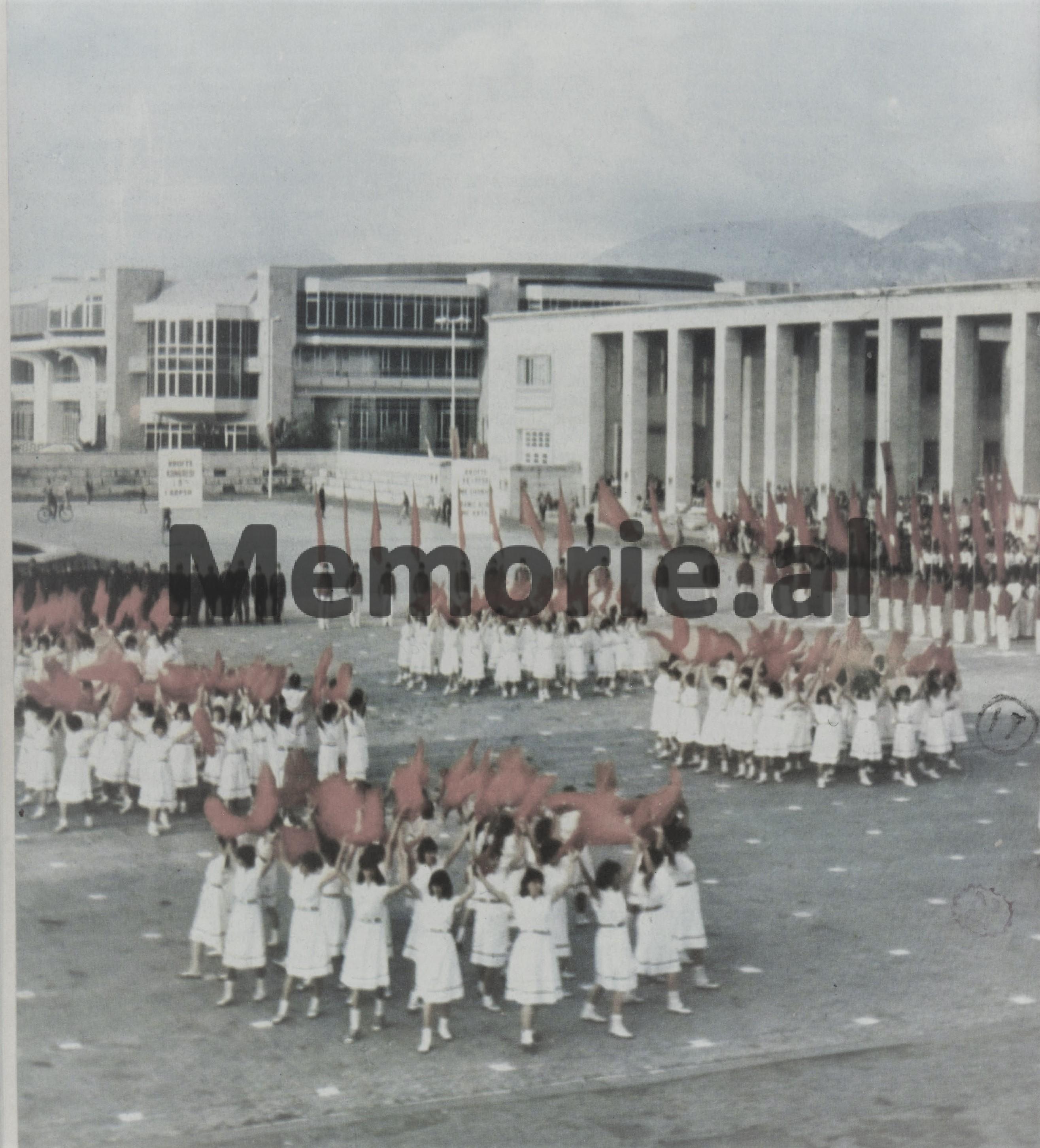
What he instructs is above all work. From this forbidden Tirana flows a river of orders, directives and reminders to the regional authorities. Production must be increased at the “Stalin” Textile Combine; the “Karl Marx” Hydroelectric Plant must be enlarged. Why is work on the new drilling tower in the oilfield south of Vlorë going so slowly? Why are there not more honour flags in the Knitwear Factory in Korça (a workshop that is more effective gets a small triangular flag above the machine)? Why does the Elbasan factory give such low figures? Since the Ohrid cooperative has worked well, it should be given more holiday places than last year at the state beach of Durrës…!
Here he mixes praise and reprimands, thus keeping the workers constantly under pressure, but no one can deny that work gets done. Within the diplomatic corps the anonymous impression on this point is unanimous. Considering the country’s poverty and lack of resources, the results are very great. As one Western European observer puts it: one is torn between admiration for the result and revulsion at the methods.
Discontent is directed not only against persecution at work. Big Brother also uses another, much more effective tool of a kind that can freeze the blood of a Western European. The main aim – that the people are overworked to the point of impossibility – is achieved through a very strong organisation of the denunciation system, which instils terror in every Albanian. He does his best because he dares not do otherwise.
The regime has ordered a large notice board to be placed in a conspicuous spot in every community, titled “FLETË RRUFE” (Lightning Sheet). The “lightnings” are accusations against this or that person. Radio and press constantly repeat that it is the duty of every patriot to use the board to denounce anyone who behaves badly. Such a man or woman is an enemy of the people. In a town in the north of the country, I managed to persuade a museum official who spoke French to translate for me some of those beautifully written denunciatory texts.
One person was accused of coming late to work; a woman was branded for going out in short skirts; for two residents there was evidence of reactionary tendencies because they had organised a religious ceremony in their home. The names of all were written clearly, even underlined. But there were others, even more serious. The chairman of an agricultural cooperative was accused of giving false production figures; about an official it was said that he associated with foreign citizens.
It is a fact that the “lightnings” must be signed, and anyone who is attacked is obliged to reply in writing within three days and post the reply on the same board. The reply is checked by a court, which decides; if it is a criminal offence, the court also determines the punishment. The accused may be present in the courtroom and may speak. But he has no right to a lawyer, because the legal profession was abolished a year ago.
The regime has declared that judges are fully capable of distinguishing white from black, and that consequently lawyers perform no useful social function. The mere prospect of being held accountable before an all‑powerful judge with no possibility of legal aid is enough to instil terror and keep every Albanian in constant tension and anxiety.
It does not take much imagination to picture what a climate of suspicion, caution and anxiety – inevitably and necessarily – these boards of shame create, especially in small communities where everyone knows everyone else. And how this shameful system must tempt people to abuse others out of spite or to destroy a competitor. Is it the fear of being struck by a “lightning” from a clear sky that makes people so silent?
That is something every visitor to Albania encounters. You never hear a murmur when you enter a café full of people, and it is astonishing how little Albanians seem to have to say to each other when they walk side by side along the street. A strange silence reigns in the streets even when people return home after work. They are full of people, but the silence is the same.
Big Brother systematically maintains a state of war‑like atmosphere. Albania is depicted as a people who, after centuries of tyranny, were liberated for the first time in 1945 by the Communist Party and Enver Hoxha, but who are constantly threatened by great dangers both from within and without (according to this view, the country was not free even in the 1930s: King Zog was an Italian vassal).
Inside the borders, the danger is the Albanians who, because of laziness or low character, do not work efficiently and who must be fought through the “Lightning Sheets”. From outside, the country is threatened by malicious reactionary forces that want to deprive it of its independence, just as it has always been threatened by foreign peoples. Here we are faced with a true historical destiny that every Albanian must hold in his heart, says the country’s leader.
To illuminate this thesis, they emphasise everything to do with resistance against foreign invaders. The Albanian prince Skanderbeg, who fought so bravely against the Turks 450 years ago, has been named the Saint of the Nation – such a prince he was. Copies of his helmet and sword (the originals are in Vienna) are on display in every town. The Order of Skanderbeg is Albania’s equivalent of the Legion of Honour.
Otherwise, the country is filled with war museums, all exactly identical, reminding the local population of the communist resistance movement’s fight against the Italian and German occupation forces during the Second World War. The halls are filled with photographs, weapons, uniforms and torture implements used by the oppressors. Sometimes the museums almost seem comical. In Elbasan, with great seriousness, they showed a completely ordinary egg and said that the Germans used to boil it and put it under the armpit of resistance members to force them to give information.
Against this ultra‑nationalist background, the present situation is presented. The war continues. That the capitalist world tries to overthrow communist Albania is quite natural. But Russia and the Eastern states are being devastated by terrible decay – they are betraying communism and turning into masked capitalist states, which constitutes a serious danger. Through daily newspapers, hundreds of books and brochures, and countless radio speeches, the Albanians are indoctrinated with hate‑filled descriptions of the destructive actions of revisionism, as well as the Chinese themselves could not have done better. Along the country’s roads, warning signs have been planted. I remember one such sign near Pogradec: “Albanian! Do not forget that we are surrounded by capitalists and revisionists!” There is no doubt that the effect of this intensive propaganda achieves its goal: nationalism and xenophobia.
There is no doubt at all that Albania’s Big Brother sends a shock through anyone who had the fortune to know the country before it was transformed into a People’s Democracy of the Stalinist and Chinese model. It is not about material progress – that would not be right to deny – the shock is one of spiritual form. That Albanian people with whom I made friends in the 1930s was open, hospitable and liked foreigners: eager to shake hands, tireless efforts to speak foreign languages, invitations and gifts. One felt as if one were in the Land of Smiles.
Now the foreigner is an enemy and a spy. Suspicious glances, or feigned indifference. People do not answer questions, do not accept cigarettes, and do not allow them to be photographed. Never a reply when you wave a greeting, never a smile. And what hateful things do the children learn at school? We were stoned on many occasions by angry children.
In Korça, stones whistled when I was on the hotel balcony; in Gjirokastra, an elderly French gentleman in our travelling group had his trousers torn and was injured in the leg. Of course it wasn’t that serious. Finally the police came and chased away those aggressive Red Pioneers, who were merely trying to put their lessons into practice. But of course one must not conclude that those charming Albanians have been completely dissolved. Their true nature is drowned by hatred and suspicion; a different political climate would certainly revive it. But for now, it is as it is. Albania is no longer the joyful country, but the land of the evil eye. /Memorie.al