• Rreth Nesh
  • Kontakt
  • Albanian
  • English
Monday, March 9, 2026
Memorie.al
No Result
View All Result
  • Home
  • Dossier
  • Interview
  • Personage
  • Documentary
  • Photo Gallery
  • Art & Culture
  • Sport
  • Historical calendar
  • Others
  • Home
  • Dossier
  • Interview
  • Personage
  • Documentary
  • Photo Gallery
  • Art & Culture
  • Sport
  • Historical calendar
  • Others
No Result
View All Result
Memorie.al
No Result
View All Result
Home Dossier

“Despite the insults and verbal abuse, ‘Enver’s volunteers’ continued moving forward with his portraits; the small group lost their patience, and…” / February 1991, when the boys of “Skela” clashed with the Enverists of Vlora.

“Me gjithë të sharat dhe ofendimet, ‘vullnetarët e Enverit’ me portretet e tij vazhdonin përpara, grupi i vogël e humbi durimin dhe…”/ Shkurt 1991, kur djemtë e “Skelës” u përleshën me enveristët e Vlorës
“Agjencia austriake e lajmeve ‘APA’, shkruante: Fakti se kur monumenti i udhëheqësit shqiptar, Enver Hoxha, do të rrëzohej…”/ Si e pasqyruan mediat e huaja rrëzimin e përmendores së diktatorit?!
“Na ndoqën, moj bijë, na ndoqën, pasi ishim të padëshirueshëm në atë dasëm, ku na ftuan vetë, na tha babai, që ishte bërë vrer, nga Abazi, miku i…”/ Kujtimet e ish-të burgosurit politik, nga Vlora
“Me gjithë të sharat dhe ofendimet, ‘vullnetarët e Enverit’ me portretet e tij vazhdonin përpara, grupi i vogël e humbi durimin dhe…”/ Shkurt 1991, kur djemtë e “Skelës” u përleshën me enveristët e Vlorës

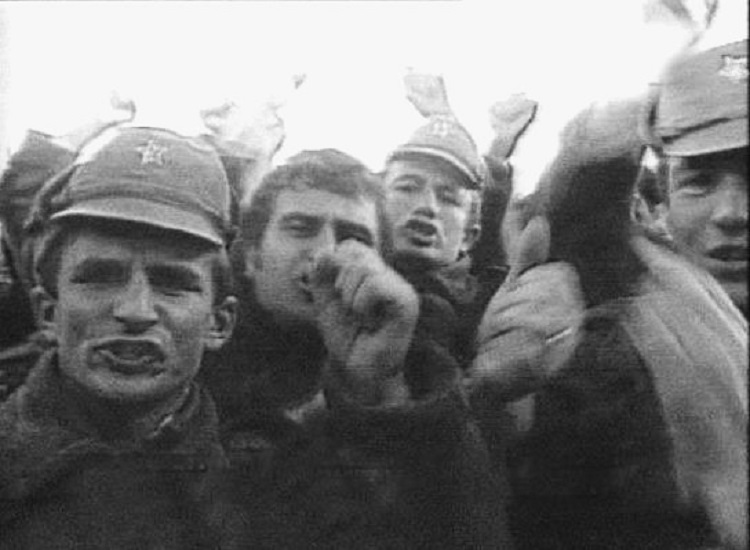
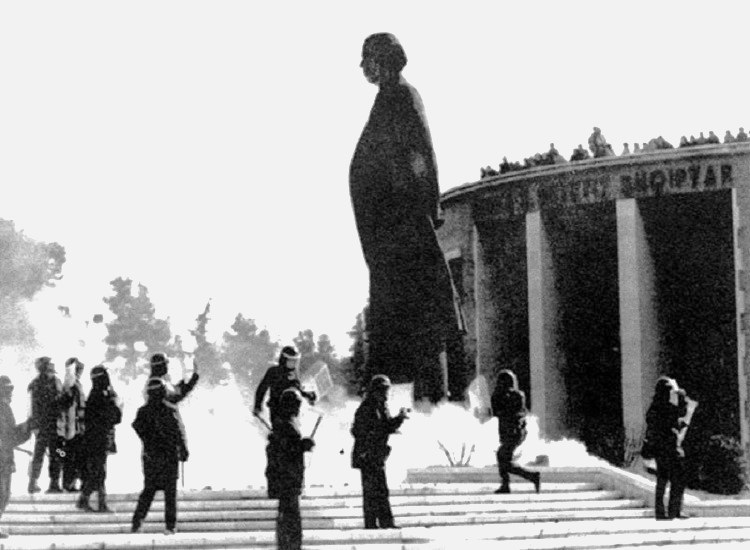
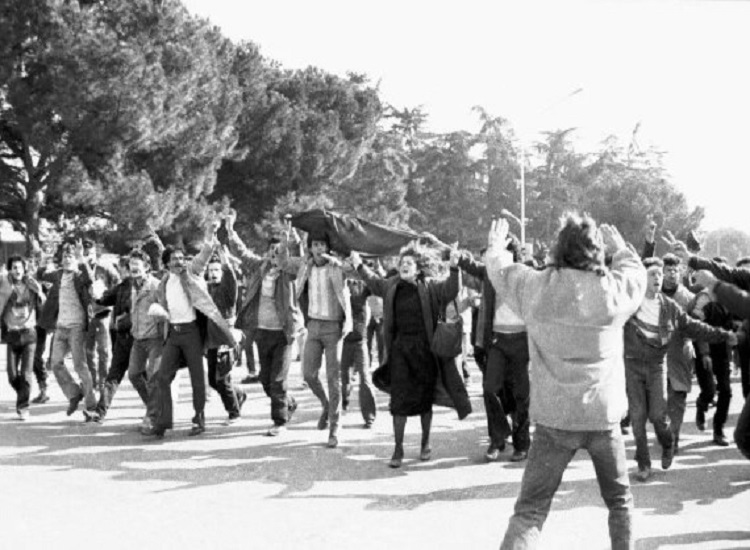
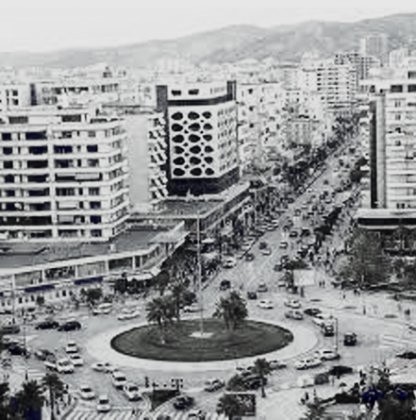
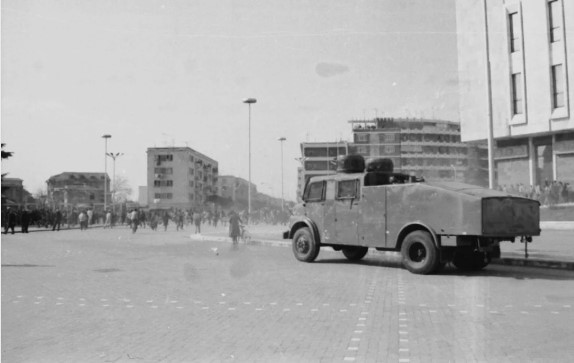
Memorie.al / Five days after the statue of the dictator Enver Hoxha was toppled and dragged through the streets of Tirana, on February 25, 1991, the Party Committee of the Vlora district organized a demonstrative march. Workers from Pashaliman were mobilized to march toward “Flag Square” (Sheshi i Flamurit) for a rally in support of the dictator’s name. The workers had been told they would be paid for the workday.

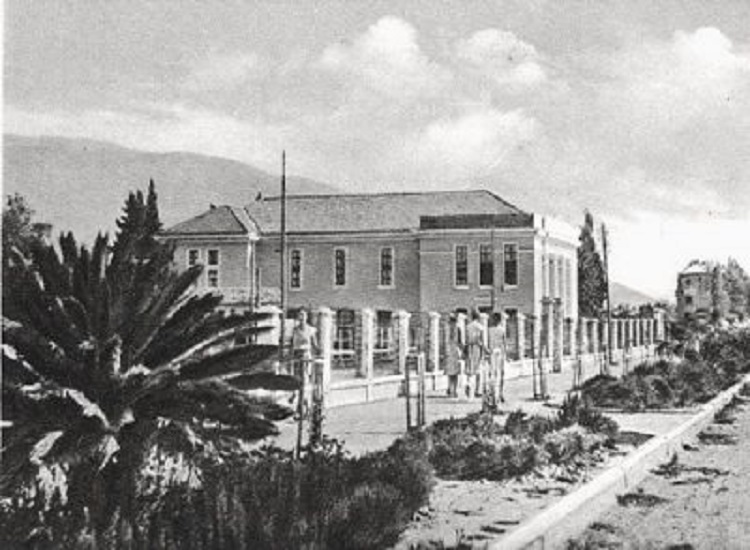
It was around 10:00 AM when buses, packed with employees from the Pashaliman Base, stopped in “Skela.” People began to disembark and, under the command of party secretaries, started to line up. Some held bread wrapped in newspapers; others carried portraits of Enver Hoxha and various slogans. At the front of the line, a red banner with white lettering stood out: “Enver – Albania” and “Enver’s Volunteers.”

Before the march even began, the crowd, led by the Director of Pashaliman, Luto Hasko, and other officials from the district party committee, began to chant: “Albania-Enver, we are ready whenever!” Meanwhile, some workers slipped away secretly, unwilling to go to the square. As the crowd passed “Kulaçi” and advanced about 50 meters, as if by magic, about twenty men appeared – aged 25 to 40 – all from Skela or the surrounding areas. Most were simple people with no specific political affiliation.

Among them, I recognized Xhoxhi Prifti, the Skela barber; Hamdi Memeti, a shoemaker; Vilson Haskaj, a port pilot; Namik Mustafaj, a technologist; Koto Zilja, a coach; Nasip Imeri, a welder; Kastriot Axhami, a fisherman; Gjergji Kallçia, Sulo Nebiu, Lefter Islami, and others – all born and raised in Skela.

Gjithashtu mund të lexoni

“Most honored General, the highlander would sooner accept death than the unsparing rod being laid across his back; and I, as the deputy of the region…” / The letter of Prof. Kol Prela to Mehmet Shehu, December ’45.

“Regarding the Arab-Israeli conflict in the Middle East, I spoke to the Minister of Defense about the defense of Vlora against a potential air-sea attack, as it and Durrës are…” / Enver Hoxha’s political diary, July 1967.

“Stop, you bastards! Where do you think you’re going?!” the “Skela boys” screamed.

“You want to revive the dictator, but we won’t let you! Turn back or you’ll regret it!” Without orders or leaders, the Skela boys began to pursue the crowd, which was marching down the middle of the boulevard, flanked by party instructors and secretaries trying to keep the formation compact. Despite the insults and verbal abuse, “Enver’s volunteers” continued forward with their portraits. That was when the small group, moving parallel to the crowd, lost their patience. Someone shouted the call to action:

“Stone the communists! Pelt Enver Hoxha’s lackeys with stones! Don’t let Enver’s dogs reach Flag Square! Down with communism!”

That was all it took. Dozens of stones began to fly over the crowd, which continued to chant: “Albania, Enver.” Not a single stone went to waste. Meanwhile, the Skela boys walked on the sidewalk, shouting: “Freedom-Democracy  –  Dulla’s head on a tray!” (Dulla being a derogatory nickname for Enver).

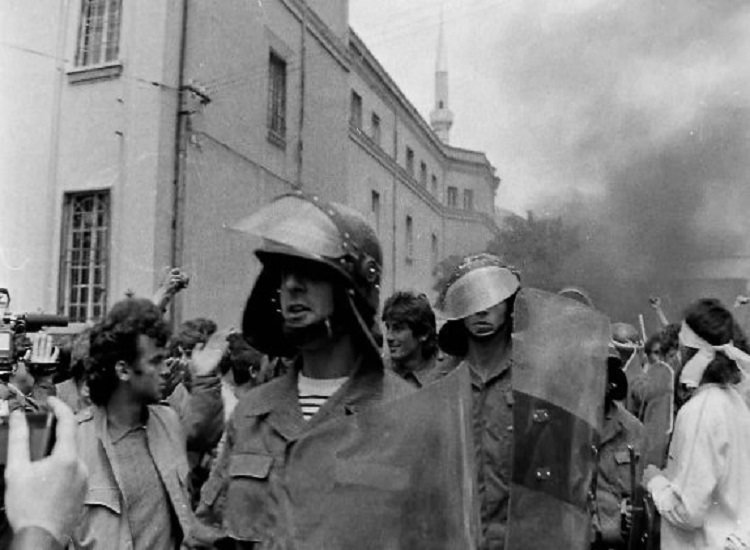
Before reaching the former “Ernest Telman” Fish Plant, right next to the Skela buffet, the massive crowd from Pashaliman found they face-to-face with the few men trying to stop them. The clash was swift and brutal.

Anything that could be used as a weapon was thrown. After ten minutes, the crowd retreated, leaving behind on the asphalt dozens of slogans, portraits, a large torn red banner, stones, pieces of pavement ripped from the sidewalk, broken bottles, fence stakes, and all sorts of items used in this unexpected hand-to-hand combat. The orderly ranks of the Pashaliman workers dissolved, with most fleeing toward the large party committee building nearby, pursued by the shouts and stones of the attackers.

The bloodied crowd dispersed in all directions. A portion, consisting of “Enver’s Volunteers,” gathered inside the party committee building. For two hours, people took shelter there: the “volunteers” feared the Skela boys who waited nearby like hawks ready for a fight, while the leaders and party instructors hoped for a new march toward the square.

The opponents exchanged insults from a short distance. One party instructor threatened: “We will let you rot in prison! We won’t give up without blood, for it was with blood that we took power!” An old Cham lady from the neighborhood, passing by by chance, heard him, turned her head, and cursed: “May you never have a grave, O Great God!” She didn’t insult them or threaten them; she only asked that the seed of humanity called communism be eternally condemned to oblivion – that they should have neither a name nor a grave.

The old woman was dressed in the characteristic tumanet (traditional baggy trousers) of the Chameria region, with a white lahuri (headscarf) shining on her head. She never looked back.

In my diary that day, I wrote: “I watched closely the people sheltered in the Party Committee building and these others, ready for new attacks if the crowd started toward the center again. They were dressed the same, fed the same – perhaps both groups had skipped breakfast that day – equally poor. And just like me and my brother, they had relatives in that crowd, perhaps even brothers and fathers. Looking at the Party instructors who never stopped running among the workers, I thought: Why do they set people against each other? In whose name?!”

I was convinced that if the Pashaliman workers had remained determined to reach the square, there would certainly be a plaque at “Kulaçi” today for those killed that day. The streets of this old neighborhood – home to poor, hardworking, and brave people – would have been washed in innocent blood.

Thank God that did not happen! The workers began leaving the building one by one, or in pairs, and hurried home. The rally in support of Enver Hoxha failed, thanks to the democratic and courageous spirit of the Skela boys, who were thirsty for freedom.

P.S. Kiço Mustaqi and Xhelil Gjoni were the founders of the infamous extremist association: “Union of Enver’s Volunteers,” on February 12, 1991, in Berat. The marches, threats, and counter-rallies organized by this ominous association to restore the dictator’s busts will be remembered for a long time by those who lived through those events. On February 20, 1991, the people of Tirana toppled the giant statue of the dictator. It was impossible to deploy the armed forces against that crowd of hundreds of thousands, even though Nexhmije Hoxha (the dictator’s widow) stated: “…At least at that moment, someone should have been killed…”/Memorie.al
ShareTweetPinSendShareSend
Previous Post

"In October 1956, the US delegation of the 'National Front' sent Jani Dillon to the Congress of the Agrarian International in Paris, where he..."/ The tragic story of the famous family from Sheperi Zagoria

Next Post

"The Lura meeting on August 27, '43, attended by Mit'hat Frashëri, Abaz Kupi, Muharrem Bajraktari, Fiqiri Dine, Hysni Dema, Miftar Kaloshi and..."/ The unknown history of the "parliaments" of Dibra

Artikuj të ngjashëm

“Mark Çuni was tied with his hands behind his back and the head of the branch brutally punched and kicked him in the stomach, so much so…”/ The sad testimony of the ex-prisoner from Shkodra
Dossier

“Most honored General, the highlander would sooner accept death than the unsparing rod being laid across his back; and I, as the deputy of the region…” / The letter of Prof. Kol Prela to Mehmet Shehu, December ’45.

March 8, 2026
“Regarding the Arab-Israeli conflict in the Middle East, I spoke to the Minister of Defense about the defense of Vlora against a potential air-sea attack, as it and Durrës are…” / Enver Hoxha’s political diary, July 1967.
Dossier

“Regarding the Arab-Israeli conflict in the Middle East, I spoke to the Minister of Defense about the defense of Vlora against a potential air-sea attack, as it and Durrës are…” / Enver Hoxha’s political diary, July 1967.

March 8, 2026
“Following their escape from Albania in 1949, Azis Biçaku and his son, Isuf, fled to Greece, where they took part in the civil war against communist forces and…” / The unknown story of the nationalist family from Librazhd
Dossier

“Following their escape from Albania in 1949, Azis Biçaku and his son, Isuf, fled to Greece, where they took part in the civil war against communist forces and…” / The unknown story of the nationalist family from Librazhd

March 8, 2026
Memorie.al
Dossier

“Oh my son, I myself brought you to the prison door, because it is better for me to bring food here than flowers to your grave…!”/ The memories of the former prosecutor about the most terrible case of his career in the Shkodra investigation office.

March 8, 2026
“From the Cham Issue, the ‘August 1949 Provocations,’ and the Absurd Law of War, to the Colonels’ Junta and…” / Reflections of the well-known scholar and diplomat on the Greece we want.
Dossier

“From the Cham Issue, the ‘August 1949 Provocations,’ and the Absurd Law of War, to the Colonels’ Junta and…” / Reflections of the well-known scholar and diplomat on the Greece we want.

March 5, 2026
“The last year of Islam in Albania: When the communists closed 1,225 places of worship and arrested 1,235 clerics…”! / How Albania was transformed into the first atheist state, turning churches and mosques into wheat warehouses?!
Dossier

“Men and women with axes and shovels attacked the young people from Tirana who were demolishing the minaret, A. Basha tried to hit the party secretary in the head…”/The Sigurimi report on the Shupal incident, May ’67, is revealed

March 7, 2026
Next Post
“The Lura meeting on August 27, ’43, attended by Mit’hat Frashëri, Abaz Kupi, Muharrem Bajraktari, Fiqiri Dine, Hysni Dema, Miftar Kaloshi and…”/ The unknown history of the “parliaments” of Dibra

"The Lura meeting on August 27, '43, attended by Mit'hat Frashëri, Abaz Kupi, Muharrem Bajraktari, Fiqiri Dine, Hysni Dema, Miftar Kaloshi and..."/ The unknown history of the "parliaments" of Dibra

“Historia është versioni i ngjarjeve të kaluara për të cilat njerëzit kanë vendosur të bien dakord”
Napoleon Bonaparti

Publikimi ose shpërndarja e përmbajtjes së artikujve nga burime të tjera është e ndaluar reptësisht pa pëlqimin paraprak me shkrim nga Portali MEMORIE. Për të marrë dhe publikuar materialet e Portalit MEMORIE, dërgoni kërkesën tuaj tek [email protected]
NIPT: L92013011M

Na ndiqni

  • Rreth Nesh
  • Privacy

© Memorie.al 2024 • Ndalohet riprodhimi i paautorizuar i përmbajtjes së kësaj faqeje.

No Result
View All Result
  • Albanian
  • English
  • Home
  • Dossier
  • Interview
  • Personage
  • Documentary
  • Photo Gallery
  • Art & Culture
  • Sport
  • Historical calendar
  • Others