
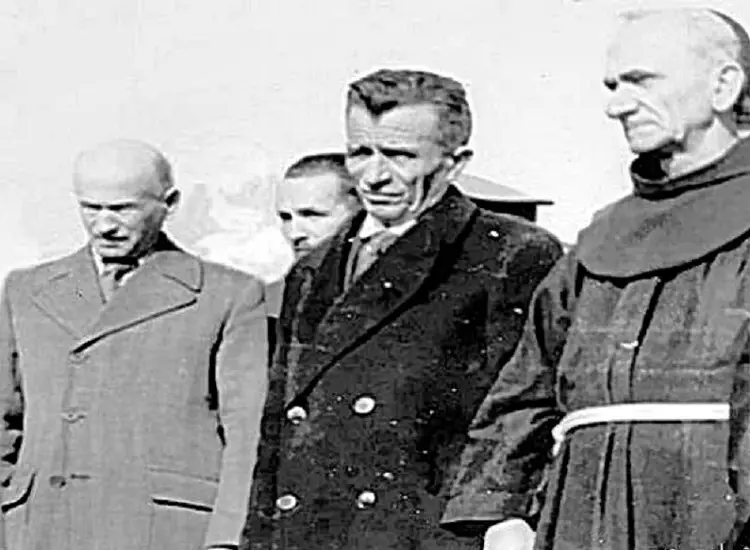

Memorie.al / In his memoir “Before the Trial of History, Paris 1966,” Xhelal Staravecka recounts his version of the Fier Uprising, which attempted to overthrow Ahmet Zog but failed, having been betrayed. Staravecka, a controversial figure in Albania’s history, had been assigned to lead the uprising precisely at its heart, in Fier. It is an interesting account for those who want to see history from many perspectives. In Berat and Vlora, the uprising was betrayed by the Vrioni family, according to Staravecka. The head of the uprising, Riza Cerova, was left alone with 7–8 men and was killed in Pogradec. “That traitorous Pogradec that killed Gani Butka and Colonel Thomson, it killed Riza Cerova too” – writes the author.
After Riza Cerova in Skrapar and Xhelal Staravecka in Fier were left alone, the uprising was extinguished. In Fier, Zog sent Colonel Ali Riza Topalli for punishment, which Staravecka portrays with contemptuous notes. “Zog liked men stripped of every manly virtue” – he writes. Here is what Staravecka writes about the launch of the Uprising. He arrived in Durrës from Italy in July 1935:
Xhelal Staravecka
“Musa (Kranja) told us that the day of the outbreak of the movement was set for Wednesday, 14 August, in the early afternoon hours according to the circumstances that might prevail in every center of Albania, leaving full freedom to the revolutionaries to choose the time of the outbreak of the movement from 14:00 to 16:00 of that day. Although we would discuss once more the setting of the hour for the outbreak of the revolution, there we decided to set it off at 16:00, and they charged me, since I had more armed men than anyone else, to march on the town of Fier and to attack and seize the depots, especially that of recruitment, above all that of the paramilitaries where there were, in our opinion, more than a thousand rifles.
On the night of 13–14 August, with 65 armed men I entered the “Shkoza” hotel, and when the offices opened I went to meet Musa and his comrades. At 14:00 I came out with my men armed to the teeth from the “Shkoza” hotel and set off the uprising, marching toward the paramilitary depots and then the others. In the paramilitary depots we found 800 Italian long guns, not only without a single cartridge, but also without bolts and firing pins. From 17:00 we began to wait for the arrival of the revolutionaries of Vlora, but they were not coming. The betrayal of Qemal Vrioni had done its work. On that occasion nothing remained for us but to March toward Tirana.
In the middle of the night we reached Lushnja, where two hours earlier the two gendarmerie captains, the two Marashi brothers, Lleshi and Gjeka, had arrived, who received us with rifles. We surrounded and attacked them and took the post-telegraph office, and while the rifle was boiling, we were asking almost all the towns of Albania, even Tirana, what they had done, since the movement was supposed to be general throughout all Albania, and everywhere Zog’s officials answered us…!
Riza Cerova with the Skrapar men came close to Berat, being certain that in Berat the uprising would have broken out. On the contrary, in Berat as elsewhere, not a single fly moved against the regime, because the revolutionary beys, such as Sehit Vrioni, Sybhi Vrioni, Mahmut Shehu and others, already on the night of 13–14 August, had loaded onto donkeys quilts and mattresses and other toilet banalities and had fled from the villages of the Nahije, so as not to be in Berat when Riza Cerova came and set off the uprising with his Skrapar men.
Poor Riza Cerova! When he saw that a whole world in the service of Zog was marching against him, he took only 7–8 men, with whom he crossed Skrapar and entered the district of Pogradec. But that traitorous and rebel Pogradec, where Gani Butka lost his life from the bullets of the betrayal of the Starova men, just as Colonel Thomson had been left, killed Riza Cerova too.
We of Fier, when we saw that the circle was tightening around us in Lushnja, we left that town and returned. Musa came as far as the road leading to Karavasta with the adventurer Cekrezi, who came to Fier from Tirana after the killing of General Gilardi. With these two went: Zenel Hekali, Arshi Shehu from Tepelena, the tetar Kadri Kosova and the gendarme Xhevahir Spathara. Together they went to that village and from there by fishing boat went to Italy. Whereas I, who was forced to follow the fate of the people I had put into war against the regime, preferred to stay and give account as the sole responsible one in order to save them from the consequences of legal persecutions, since I instructed them to say that I had taken them by force. And so it was done.
On 14 August, Wednesday, we set off the uprising that everyone should have made, as we did in Fier and Riza Cerova in Skrapar. On 15 August after noon, into that Fier that we made our republic for 24 hours, entered the military column commanded by Colonel Ali Riza Topalli, to carry out operations, torture, trials, punishments and other executions by firing squad.
Ali Riza Topalli was full to the top of his hair with feelings of servility. Being one of the ignoramuses of the crowd of Zog’s officers, dominated by an egoism that knows no limit, sterilized of every patriotic feeling, for Zog he was the most suitable man to load, giving him a blank check to plunge into blood – as commander of the operation and chairman of the court for political offenses – that Fier that set off the movement against the tyrant, the prefect of the Duce, Ahmed bey Burgajeti from Mati. Yes, Zog liked men stripped of every manly virtue.
The municipality, the houses of Qemal Vrioni in those days was courtrooms and at night torture rooms, the Post-Telegraph office, the shops of Idris Bylo, the office of the Gendarmerie of the district and that of the Post-command, the “Plotore” school of Fier in Bishanak, the hotel of Ramis Omar and other premises, were prisons and torture rooms. More than five thousand prisoners languished in those buildings, hands and feet bound with dog chains and with wounds on the body that multiplied from one moment to the next. During the days of torture they asked me only one question: why I had taken part in that movement, since His Highness had sent me to school and kept me with his money. Naturally, because the state for Zog’s regime did not exist, but everything in the state was Zog’s property.
And for nine days in a row my answer has been this: I took part in this movement, to save myself from the Italian occupation. The operation of Fier has been the peak of the animal behaviors of those who were charged with a blank check, to leave the most terrible memory of a personal reaction, specialized in crime, banditry and others. At the conclusion of the trial, 42 of us were sentenced to death and a thousand to punishments, from life imprisonment to one year in prison.
My trial began on 14 September 1935, Saturday, and the verdict was read to me on Monday, 16 September of the same month. On 17 September the trials ended. Since on Tuesday there is a market in Fier, they had left our execution for Tuesday, 24 September…”!
But the executions, except for one, were not carried out. Zog sent in the last minutes a decree of pardon. Why? According to Staravecka, this happened after a “trick” of Mehdi Frashëri, at that time the representative of Albania in the League of Nations in Geneva, the head of which, always according to Staravecka, being Orthodox, showed a special interest in the events of Fier, a town which at that time was inhabited massively by Orthodox.
Some of those sentenced to death were anti-Zogist intellectuals who belonged to this faith. Staravecka considers this affiliation important, although there is no supporting evidence that links the League of Nations’ interest in the events in Fier with the religious affiliation of some of the participants. Here is what Staravecka writes about the strange pardon, a few hours before the execution:
“Whoever does not know the reason why Zog pardoned us, thinks as the Albanians of those times who did not know the ‘backstage’ thought: that Zog supposedly pardoned us for his magnanimity and not because he was forced, as we shall see below. The population in the overwhelming majority of the town of Fier was Christian. I do not know for sure, but certainly from 85% to 90% were Orthodox, and among those sentenced to death and to life imprisonment, such as Spiro Papa, Doctor Kostantin Kallojeri and others, there were a large number. At that time in the society of the League of Nations in Geneva, the turn came as chairman of that Assembly to the Foreign Minister of Romania, the famous Titulescu. He opened a discussion in the League of Nations on the matter of Fier.
The representative of Albania in Geneva was Mehdi Frashëri. When the session of discussion opened in the afternoon of Monday, 23 September, Titulescu addressed the representative of Albania, asking him what was happening in the town of Fier in Albania. And Mehdi Frashëri, who had the instruction from Zog to minimize the Albanian events, so as not to point out the dissatisfaction of the Albanian people against his regime before the outside world, answered that a local movement provoked by some irresponsible elements had forced the government to intervene to restore order.
But when Titulescu asked him how many inhabitants Fier had, Mehdi Frashëri understood the trap and, as a pure patriot that he was, did not hesitate to enter that trap with the aim of saving us, and answered that Fier had five thousand inhabitants. Then Titulescu stood up and addressed the Assembly saying: – Mr. Representatives of the nations…! The population of Fier is five thousand inhabitants; the prisoners for the local movement of Fier reach five thousand…!
They told Mehdi Frashëri to address Zog and tell him that that League, which overthrew the predecessor Fan Noli, would find no difficulty in overthrowing Zog as well. Mehdi Frashëri, as soon as he came out of the session at 18:00, sent an urgent telegram to the Palace, telling Zog to stop the tortures, punishments and executions, if he did not want Albania to be plunged into adventure. Zog’s telegram arrived at 22:00 on 23 September. That Monday afternoon the command of the operation prepared 42 triangles for our hanging, at four or five in the morning, on Tuesday 24 September; they even cut our hair to make the head alike, with that shaved part with which they tortured us.
When I asked Mehdi Frashëri on this matter, since I had sat with him many times in conversation both in Albania and in Italy, after my release from prison, whether he fell into that trap on purpose, he answered me with a chuckle that showed his satisfaction: “I had no other means, he told me, except that cunning to save myself from the slaughterhouse of Fier…”!
Zog was afraid of the League of Nations. He sent to the commander of the operation, Colonel Ali Riza Topalli, a telegram in which he said that for those sentenced to death of that movement, the punishment was being converted to life imprisonment. After that telegram, to Ali Riza arrived the telegram of Musa Juka with the hypocritical formula: “His Highness, Zog I, King of the Albanians and savior of the fatherland, deigned to pardon from death those sentenced by the court for political offenses of the operation of Fier, converting their capital punishment to life imprisonment.”
Zog’s telegram arrived in Fier at 23:00 and that of Musa Juka at 24:00, but the latter not with 42 pardoned but with 41. Hekuran Maneku had been left out of the pardon…”! Memorie.al