
Part Twenty-Five
Memorie.al /After a series of attempts by the Americans to overthrow the communist regime in Albania through the recruitment of Albanians, during the years 1955, the State Security [Sigurimi] was also set in motion. In a document declassified by the CIA, an event at the Albanian embassy in Rome is shown, where the CIA attempted to recruit one of its employees, but in fact the latter had made a series of attempts to recruit an Albanian agent who was part of the CIA. The document also reveals the names, which greatly worried the Americans, who confess that they had no information at all about how Sigurimi agents were distributed. Their suspicions were that Sigurimi was attempting to recruit CIA agents and use them to steal information on various operations. The CIA used one of its agents to gather information from an employee of the Albanian embassy in Rome, where it also began to suspect that he was part of Sigurimi.
31 January 1955
Project personnel: Kraja, Shyti, Gjon Markagjoni
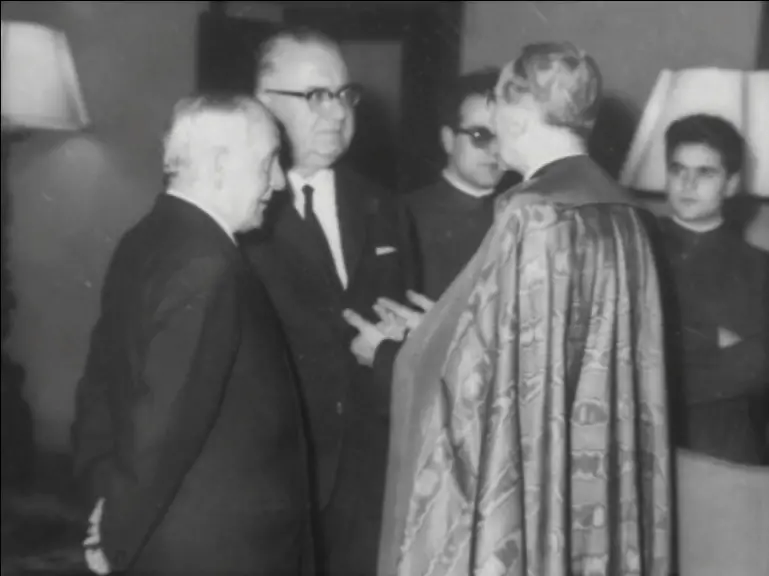
Ernest Koliqi from Shkodra, intellectual, member of the cabinet that collaborated with the Italian occupiers and has possible connections in the Vatican. May be a sub-agent of German intelligence. The subject’s son in 1949 was reported to be in contact with Italian intelligence for operations against Albania. The project’s targets are Albanians residing in Albania, Yugoslavia and Italy. Contacts with individuals in the targeted areas have been maintained through open mail. In 1953 there were doubts about the efficiency of the operation, since the efforts of the BKI (Independent National Front) were judged as non-operational and non-productive.
During this period of hesitation it was accepted that the project would not create agent infiltrations, but it was thought it would strengthen the measure of liaison between the CIA and Italian intelligence. One of the interesting aspects of the project was the use of nine agents in Yugoslavia, which is believed would shed light on Yugoslavia’s true intentions regarding Albania and also reveals the modes of action of the UDB.
Control over the agents
During the first years of CIA-BKI cooperation (1950-1953) the agents were more interested in Albanian emigration policies, including intrigues or schemes for increasing personal prestige. From experience we know that this is normal for political groups in emigration and even then the CIA viewed them with suspicion. The project included considerable financial support. Most of the information obtained was on Yugoslav activities against Albanian individuals. Our control over the Albanian agents comes from their strong ideological conviction that the USA is the champion of self-determination and the only hope for the country’s liberation, while some particular agents are controlled by us from the fact that they can be deliberately exposed as collaborators of the USA.
But the problem of control cannot be fully solved when we are dealing with figures or political parties, or with their sub-agents, therefore we and in our communications with the BKI use the vague phrase “sources numerous in number to be mentioned,” somewhat similar to the negative operations of the Polish emigration with lack of control, excessive expenses and fertile ground for double agents. Besides some reports on transports, the information from the Albanians of Yugoslavia contains only the quarrelsome activities within the Committee for “Free Albania,” NCFA, as well as the movements, rumors or sufferings of Albanians in Yugoslavia.
The clash of agents
Iliaz Kraja (sponsored by the CIA) presented us with an opportunity for penetration into the Albanian Embassy in Rome, through the functionary Aleko Shyti, but it was thought that Shyti’s true aim was the recruitment of Kraja into a double agent. This psychological game between Kraja and Shyti brings to mind the three main objectives of the operation: information on personalities and their functions, learning the adversary’s policies, and his modes of operation. Thus it would be of interest to know the true reasons for Shyti’s open request to Kraja for information on possible missions against Albania or the time and place of the envoys.
The questions that arise are: Was that meeting intercepted? Can we organize an interception of the next meeting between them? In what form does the CIA receive information on the meetings? When and how was Kraja instructed by the CIA to play with Shyti? An interesting detail is their meeting on 10 May where Kraja accepted 20,000 lira in the form of a loan from Shyti. In case the opposite is not proven, this is strong evidence that Kraja is controlled by his Albanian officer. Can it be true that the NCFA is infiltrated by the Albanian secret services? What do we know about members like Kodra, Mufiti, Bineri, who were denied the possibility of being Shyti’s agents?
Suspicions about Aleko Shyti
Through his contacts Shyti has continued to dig for information on the Albanian Guard in Germany, and believes that agents are recruited by it as was done some years ago. Kraja seems too open in his discussions with Shyti and the latter has opened the topic in all recent meetings. Kraja instead of withdrawing as ignorant has accepted many things, even for those about which he has no information. Shyti’s list of requests for us functions as the list of priorities of the Albanian intelligence services. The breaking of the Kraja – Shyti relationship around 28 June drew the attention of the six Albanians who were aware of Kraja and his operation.
For this case our officers must accept a lack of vigilance in maintaining security. The attempt to set the meeting with Shyti on 4 September failed. Two days later Kraja met with the new case officer, showing that he was being surveilled by Albanian intelligence and that they could contact him at any time. It is interesting to mention Mersin’s (the new Sigurimi officer’s) frequent references to the territorial integrity of Albania, as the communists also do, which is one of the main factors of the people’s support for the communist power.
Fear of Sigurimi
Now that three meetings with Mersin have been carried out and we have given him controlled information, it is becoming clear that the Albanian services do not know more about their targets than we know about ours. We do not know much about the modes of action of the Albanian Sigurimi, their persons and policies. Now we must not be satisfied with observations of Mersin’s reaction in conversations, but Kraja must be placed under the control of an American officer and trained in specific tactics and objectives.
Control over Kraja
In conclusion, to take Kraja under control and to avoid other security breaches, we must appeal more to the subject’s patriotic motivation, if he truly has any. We can use blackmail against Kraja or take drastic measures to make his stay in Italy entirely in the service of the USA. We must learn whether he has signed any document for the 20,000 lira received from Shyti, since entering into debt with a real signature is a technique used by the Soviets.
It seems that Albanian intelligence has considerable information on the NCFA, policies and personnel, but they have misconceptions about the German Guard Company, and this seems to worry them. Although we are still not sure of Kraja’s total loyalty, every measure must be taken to avoid falling victim to him. As far as we are aware, we learn only about what Kraja reports to us, therefore I return to the suggestion of audio interception. The case must be given deep analysis so that we do not lose the opportunities this relationship may bring.
April 1952
Operational report
In the field of political action we are working toward weakening the internal position of Hoxha’s regime, while on the other side we are strengthening the position of the NCFA through propaganda. As for operations with agents, we are trying to create a solid base within Albania, which will ultimately have the ability to overthrow the Hoxha regime when the moment for action comes.
Steps to be taken currently: Infiltration into Central Albania of the group of four pro-Zogist agents, to assess the political and economic situation. They will contact all pro-Zogist elements and will extract from Albania 10-12 new elements that will be used as guides in future missions. There are possibilities that a group sent by us within the country will join them.
20 April
Pine Tree contact mission
A group of three agents will infiltrate northern Albania, to attempt to contact the group of four agents who spent the winter in Prizren, Yugoslavia.
20 May
A group of four agents will infiltrate the Korça area, to gauge public reaction to our propaganda programs, as well as to create intelligence sources for the clandestine radio station. The three-man group of Hamit Matjani will infiltrate Korça, to attempt strike missions on the Korça electric station, an ammunition depot southeast of Korça, and an ammunition depot north of Korça.
June
Release of propaganda leaflets. Contacts will be made with the Red One group in Prizren, Yugoslavia. One man may be released to establish contacts with the group, on account of the Committee for Free Albania.
June – July
Three infiltrations in groups of two people each, into the armed forces, according to refugee information. The mission of killing Bogdan, with two people who will stay in camp for a week.
July
The four-man group from the Greek camp of Lavrion, which will infiltrate the Gjirokastra area, with the mission of establishing contacts with old connections in the army and police. A communication network to be created with letters and with couriers.
28 October 1952
Rivalry between the Americans and the British
In our forthcoming discussions with the British regarding Albania, several points must be raised that affect the acceptance or not of the British proposals. One of them is the fact that our operation “BGF-iend” is much larger and more complex than the British operation “Valuable” and during recent years our operations have been much more successful than the British ones, providing most of the intelligence and adding American prestige in Albanian anti-communist circles. There are some signals that the British seem somewhat dissatisfied with our achievements in Albania, as they are worried that we may gain a more favored position of influence both within the country and in emigration circles.
Although from the beginning the British have attempted to turn “BGF-iend” and “Valuable” into a joint operation, we have managed to preserve and maintain operational distancing, enough to ensure that the termination of one does not necessarily bring the termination of the other operation. The British have benefited greatly from the Albanian operations financed only with American funds. Whatever happens to the British project “Valuable,” the American project is in a very good position to continue as an exclusively American operation?
The State Department has signaled that it is satisfied with our activities and will continue them at the current level. In case the British decide to cut or stop their operations in Albania, there is no reason why the American project should also have such measures. The program is implemented in accordance with the directives of the highest US authorities regarding the Soviet Union’s satellites. But we believe that the British project may also have escalations due to the loss of British prestige and the growth of American influence in the Balkan region.
May 1961
Relations with the USSR
The Soviet state’s relations have improved with Yugoslavia, bringing considerable disappointment in Tirana. The Albanian Communist Party is very disappointed, which must show less hatred toward its old enemy. The USSR has begun negotiations for a long-term trade agreement with Yugoslavia, five days after the closing of the Albanian party congress. The negotiations were closed in favor of the Yugoslavs, with the agreement for doubling the volume of trade of 1960, while with Albania; the Soviets have signed a one-year accord that brings only a seven percent increase compared to last year.
Direct Albanian-Soviet relations have not changed much since the Albanian party congress in February. The non-participation of Hoxha and Shehu in the Warsaw Pact showed tension in relations, but Moscow’s propaganda has tried hard to advertise the Soviets’ previous services to Albania. Moscow also exploited the anniversary of the occupation of Albania by Italy (21 April 1939), to remind it of the debt of liberation from the fascist armies, as well as the current line of foreign policy. The Albanians were also reminded of the advantages of membership in the Warsaw Pact.
Also, during the time when the signing of the economic agreement between China and Albania was being concluded in Beijing, Radio Moscow was praising the fourth anniversary (18 April) of the 1957 declaration between Albania and the USSR in Moscow. It nostalgically reminded the Albanian audience of the “sunny days,” when Albanian leaders were received with enthusiasm wherever they went, further detailing the gifts the Albanian people had received as a result of friendship. According to their calculations, the gifts amounted to 435 million rubles in economic goods. While the economic loans being offered by China amounted to 500 million rubles.
Operational Plan for Albania 1954
Albania is the smallest satellite country of the Soviet Union and an isolated point of communism, with very little military importance, except for an incalculable threat on the Yugoslav border, or in the form of a base for reigniting the Greek civil war. Under certain international conditions, it could serve as a pretext for the consolidation of communist hegemony in the form of a possible union of the border with Bulgaria along southeastern Yugoslavia.
Long-term objectives
Obtaining positive information on political, economic and military issues about Albania, preserving and reinforcing the hope of liberation of the Albanian people and fostering the desire for resistance to communism. Damaging the political, economic and military structures in Albania; creating the means and the terrain for a possible separation of Albania from the Soviet bloc. Summary of intelligence on Albania: Albania is a typical police state, with strong security structures.
Until 1953 the population was so frightened that it did not support individuals or clandestine groups, but later a change was noticed, since after 1953 the infiltrated groups began to receive considerable help from the population, especially in the northern mountainous regions. The change is believed to have come from the fact of the improvement of intelligence and the increase in the caliber of the preparation of operations. The country’s army cannot be considered a loyal element of the regime, but the secret police (Sigurimi) with about 10,000 members, is a strong and loyal weapon of the dictatorship.
Achievements
Through the infiltrated groups and other sources, a general coverage of intelligence objectives in Albania has been achieved. Through the concentrated campaigns of clandestine radio broadcasts and brochures released from the air we have created a better atmosphere for our agents to operate. During 1953 we carried out about 20 infiltrations and 75 radio contacts with agents. We have released propaganda texts every month, as well as supplies for the agents in the field. / Memorie.al
Continued next issue