
By Albert Hitoaliaj
Part One
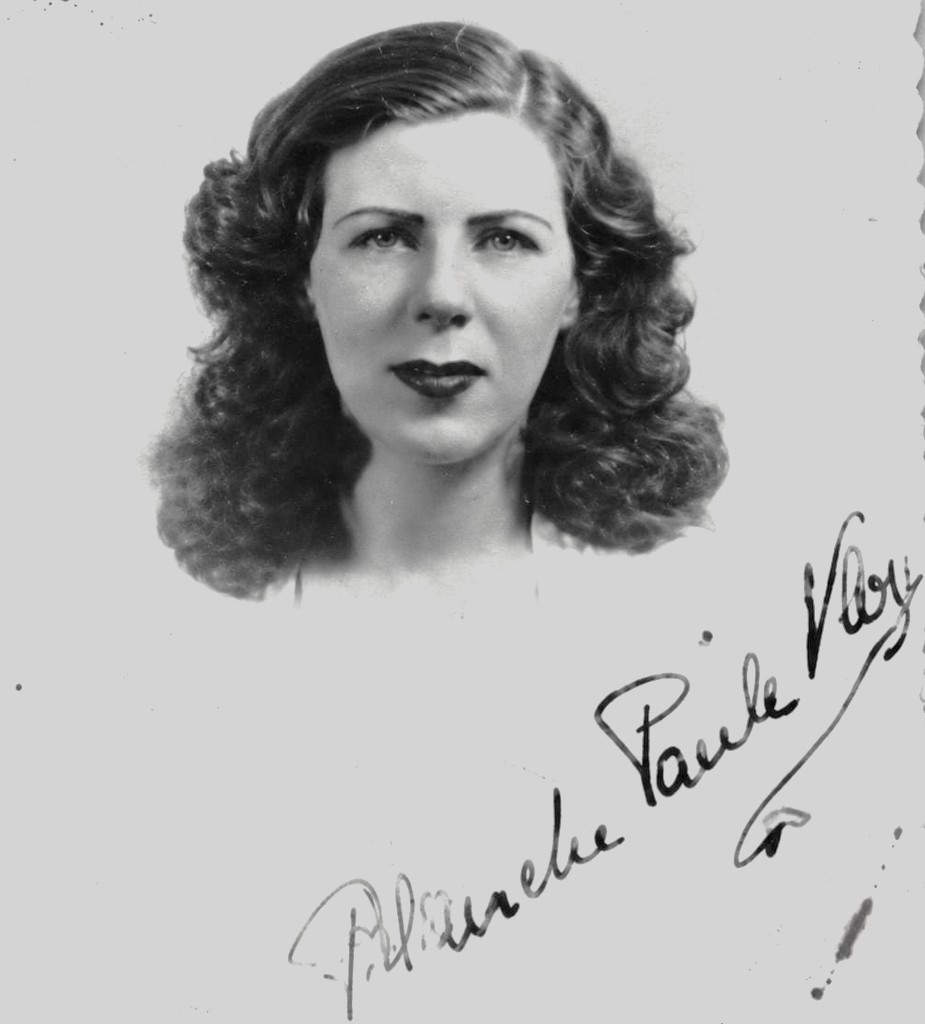
Memorie.al / The descendants of the architect of Albania’s Independence, Ismail Qemal bey Vlora, have had an all-round dispersion and a not-so-easy history. Historical studies on this important historical figure and on his descendants, or the genealogy of the Vloras, are not lacking. In this writing, based on archival documents, we bring unpublished data on the life of Blanche Paulette Vlora (1917-2002), who was the first granddaughter of Ismail Qemal, the daughter of Mahmud Kemal Vlora and the beautiful Frenchwoman, Alice Escoffier. Her parents married in Nice in 1913 and had three children: Ismail Kemal Galib Aleksandër, Blanche Paulette and Suzanne. After Mahmud’s death in Vlora, in 1921, Alice settled with the children in Bari, Italy, where the family experienced economic difficulties.
Ismail Kemal Galib Aleksandër, Ismail Qemal’s first grandson, in the years when Zog governed, was forbidden to come to Albania; Zog gave him a monthly salary, with the aim that he would be educated outside Albania. During the Second World War, the family members moved to Turin and later to Sanremo. After the war, ironically, they remained without citizenship.
According to Ismail Qemal’s great-grandson, Nedim Vlora, Blanche emigrated during the 1950s to the USA as a refugee, where she worked in a factory in New York. Later she settled in Canada, where she also passed away. The obituary notice for Blanche Vlora, who passed away in Canada, giving details about her family connections, wrote:
“Vlora, Blanche (1917-2002). Passed away at the age of 85, resting peacefully in the hands of God, in the late hours of the evening of September 22, 2002, at Verdun Hospital, in Montreal. A true lady, intelligent, clear-minded and cultured, who always had something to teach us, until the last hours of her life.
Her absence will be deeply felt by family members in Montreal and in Italy. Her loss is mourned by her beloved brother, Diano Escoffier, together with his sister-in-law Tonia. She loved them very much and was equally dear to her nephew, Edmond Escoffier (wife Kelly Guerin and baby Anthony), as well as to her niece Alice Escoffier and her children, Olivier and Jordan.
She adored the small children of the Escoffier family, Olivier, Jordan and the newborn Anthony, toward whom she nourished a special love and dedication. Even a single day without seeing them saddened her!
She was the dear aunt Popi (“Zia Popy”) to Sara and Rosela, members of the Vlora family, in Sanremo, Italy; also to Nedim Vlora (wife Mina and son Alessandro) and to Vittoria Vlora (husband Peppino and son Paolo), as well as to the sweet aunt Tina (“Zia Tina”), the wife of her late brother, Alessandro Vlora (Galib), from Bari, Italy.
We express our deep gratitude for the care and attention given by Doctor Proulx and the wonderful medical staff of Verdun Hospital. The funeral Mass will be held on Thursday, September 26, 2002, at 11:00, at the Church of St. John Bosco (St-John Bosco). Aunt, we will always keep you close to our hearts. Thank you for everything you have done for us! We love you.” (The Gazette, “Obituaries”, Montreal, September 22, 2002).
But what was the history of emigration to America of this member of the Vlora family? The data given below refer to her interviews, letters, forms and requests for emigration, addressed to the Emigration Organization, Geneva, which are found in her archival file. Their summary will shed light on the history of Blanche Vlora and her departure from Albania to Italy and then toward America.
Blanche Vlora, a documented history, according to the archival file of emigration
Blanche Paulette Vlora, registered in documents also with the names Blanche Paule Vlora and Blanche Paulette Vlora, was born on February 11, 1917 in Nice, France. She was the daughter of Mahmud Kemal Vlora and Alice Escoffier.
The documentation of the organization for refugees, who emigrated in the years 1949-1951, contains data on her family origin, education, residences, professional activity, departure from Albania, stay in Italy and efforts to secure international protection and to emigrate.
In a letter of March 30, 1950, addressed to Mr. Tonglet, representative of the emigration organization in Geneva, Blanche presented her personal data beginning the letter: “I, the undersigned Blanche Paulette Vlora, daughter of Mahmud and of Alice Escoffier, born in Nice on February 11, 1917, of Albanian nationality, currently without citizenship […]”. This brief statement, at the head of the letter, contained the fundamental data of her identity and the determination of the legal status that she declared in March 1950.
In another form, of November 1949, she was registered as Albanian, while in the later letter, she explicitly used the term “apatride”, that is, a person without citizenship. Her father, Mahmud Kemal Vlora, the eldest son of Ismail Qemal bey Vlora, is mentioned in the 1949 form as “deceased”.
The mother, the Frenchwoman Alice Escoffier, appears in the documentation of this file also with the surname Vlora and the maiden surname, Escoffier. In another questionnaire, the form of February 9, 1951, she (Alice) was registered as 56 years old. In the other documents of the file, Suzanne Vlora and Diani Vlora are mentioned, respectively the sister and brother of Blanche.
In the card of the International Tracing Service, with number V-1941, of the emigrant registration centers, are registered the names Blanche Paule or Paulette Vlora, Mahmud Kemal Vlora, Alice Vlora, born Escoffier, Suzanne Vlora and Diani Vlora; so, referring to all the documents in the file, this was the family composition.
But, in the same card also appear the names of Josef Kupferschmidt and Sima Rosenzumen. The names of these two persons are also found in the notes of the file’s cover, without specifying what relationship they have with the Vlora family.
A graduate, knowing four languages, but unemployed…
Other data emerge from the form of the request for economic aid, filled out on November 9, 1949, where Blanche was registered as single and with Protestant religious affiliation. In the education section she noted that she had attended four years of the Commercial School and one year of university in Bari. As professional qualification a diploma in accounting was mentioned.
The form also contains data on her knowledge of four languages: Albanian, French, Italian and English, distinguishing her abilities to speak, read and write fluently. For the period of life before departure from Albania, the documentation registers as the family’s residence the city of Vlora, with address on Zog Street (Viale Zog).
In the questionnaire of November 9, 1949, when speaking of the year 1936, it is explicitly noted: “The applicant lived at home, in Albania, in Vlora, on Zog Street, and was unemployed […]”. In the employment section, for the period 1936-1940, she appears likewise, without employment.
In February 1940, Blanche and her family left Albania and settled in Italy. The questionnaire of November 1949 notes that the departure was carried out with regular passports, which Blanche declared she had later lost, because of the war with Greece.
The family had taken with them money and valuables, which were later sold to cope with the difficult life. In the answer for the circumstances of departure from the residence, this document of November 1949 notes: “February 1940. Departed out of fear of the war between Italy and Greece (geographical proximity)”.
In her letter of March 30, 1950, Blanche described with her own hand the departure from Albania as a consequence of the war and explained that the family had hoped to return to the homeland after the end of hostilities. She declared that she had arrived in Italy in 1940, together with the family, and that initially she had stayed in Bari, then in Turin and, finally, they had settled in Sanremo.
According to this letter, the family had awaited the possibility of return to Albania, but after the end of the Second World War, had decided to stay in Italy. Blanche linked this decision of the family with the political regime established in Albania and with the fate of some of her relatives, who, according to the declaration, had been killed or imprisoned.
A granddaughter of Ismail Qemal, but her family was considered traitorous after the War
In the letter of March 30, 1950, she wrote explicitly: “Since some of our relatives had been killed or imprisoned there, we were forced to stay in Italy […]”. More detailed data on the reasons for not returning to Albania are also found in the questionnaire of November 9, 1949. In this document, Blanche declared that she belonged to a well-known Albanian family and that she was connected to Ismail Qemal, mentioned in the form as president of the former Albanian Republic.
In the text of this questionnaire this family connection is noted with the term “granddaughter”, while the name of Ismail Qemal is accompanied with the year 1911. The document contains exactly this formulation: “The person belongs to a well-known Albanian family and she is the granddaughter of the President of the former Albanian Republic (1911).
Her family is considered by the current communist government as traitorous and an enemy of the regime. The family’s property has been nationalized. Some of her uncles are in prison and one has been killed”.
These data are registered in the file as declarations of the applicant for the family’s situation and as reasons for opposing repatriation. In the questionnaire of November 1949, Blanche expressed herself against returning to Albania.
As an answer to the question; “Do you wish to return there?”, it was noted; “No”. While in the section; “Determined against repatriation”, the answer appears; “Yes”. She declared as countries where she would like to settle permanently, Canada or the United States of America.
After arrival in Italy, the family had stayed initially in Bari. According to the questionnaire of November 1949, during the winter of 1942, the Italian police authorities had evacuated foreigners from Bari, since the city was considered a war zone.
Blanche had been sent initially to Turin, while later she had requested permission to go to Sanremo, because her sister was ill. The document states that, after settling in Sanremo, she had secured her living by giving lessons.
The French teacher who supported the family
In the letter of March 30, 1950, Blanche gave more detailed data on the economic situation of the family. She declared that she had given private lessons and that she had carried out various works to secure the living of her mother, a brother and a sister. In the same letter she stressed that she had not received from anyone, any material or moral aid.
In the form of November 1949, her professional activity, from the winter of 1942, was described with the note; “I have given French language lessons”, and in the income section it was noted that she earned a sum of about 15,000 Italian liras per month. The section of financial sources was registered as; “Nothing”, while the section of persons who could help her for employment or for securing a living, was noted with “No one”.
The document also registered that she had not received aid from UNRRA, or from any other voluntary organization. From just these few data it is clearly understood that their economic situation was difficult. In the section of relatives in these forms appeared Alice Vlora, Suzanne Vlora and Diani Vlora and as the family’s residence was registered the city of Sanremo: address Via Matteotti, no. 25. / Memorie.al
Continues next issue