
By EUGEN SHEHU
Memorie.al / The capitulation of the Italian fascist forces in Albania, in September 1943, was conveyed with a feeling of deep maturity to all Albanians. Although a few days before this capitulation, it was precisely the Italians who with their war machine destroyed and burned thousands of houses, this time, surprisingly, the Albanians did not take revenge. The communist and nationalist forces managed to disarm two Italian divisions, with which case they secured weapons and ammunition for future combat actions. While the Albanian peasants, in most cases, took the prisoners into their homes, sharing with them the dry morsel of bread. Meanwhile the fall of Italy was outlining other political situations not only in the Balkans but in all of Europe.
Within this theater of political actions, Albania was undoubtedly also included. The truth is that against fascist Italy, the Albanian nationalists had fought first; indeed their resistance was directly linked to April 7, 1939. Further this resistance had continued in almost all Albanian ethnic lands, being transformed in the end into an all-popular revolt. Gjirokastra and Saranda, Tirana and Durrës, Kruja and Dibra and up to Ferizaj, turned into outposts of Albanian resistance against the foreign occupier.
While now, with the capitulation of the Italian forces, an extremely great movement of the Albanian national liberation fighters was noticed, although created in the autumn of 1941 (at the time when the Italian prisons kept isolated over 100 Albanian nationalists), although they were directed from the very first night of creation by teachers who had come specially from Belgrade, the communist clique of the mother state wanted to take power at any cost, into its own hands. This is one of the major reasons, with which case this dirty clique of Enver Hoxha began the fratricidal war, under the pretext of the “betrayal” of Mukja.
The historiographies of Tirana and Belgrade, although they wanted to hide the truth, did not manage to keep the “enigma” for long. The communists of Tirana, sensing in advance that the overwhelming majority of the Albanian people in 1943 had filled the ranks of the Albanian nationalists, in an extremely diabolical manner, alongside false propaganda, also used the red terror. According to Bolshevik models. Through this terror, combined with the Serbo-Slavic one in the Albanian ethnic lands, Mugosha, Popović, Hoxha and company, sought to definitively wipe out the moral conscience of our nation, in order to then install in it communism, this cancer that came from Asia. But why was precisely the village of Dukat (in the mother state) singled out, to carry out the great massacre?
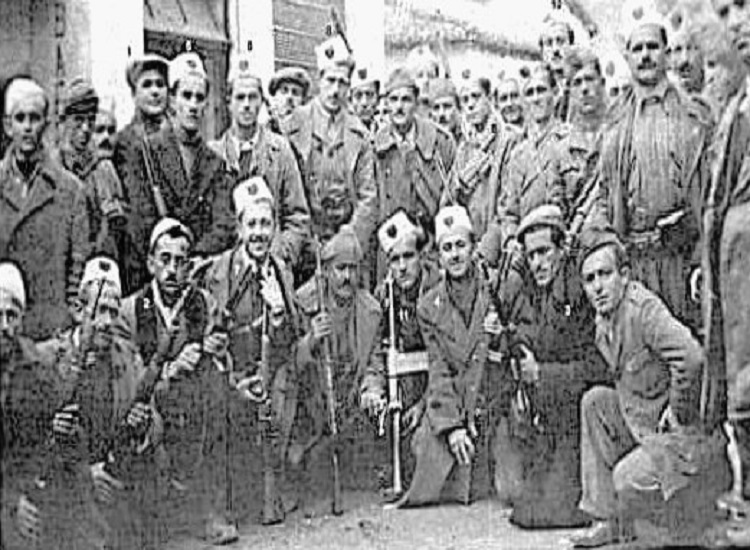
Without wishing to go too far, into the distant history of Vlora (I see it as necessary to remind the readers), almost all the houses of the village of Dukat had produced brave men. These men were at the side of Ismail Qemal, in 1912, at the side of Selam Musai in 1920 and likewise, the first who received with rifles the Italian fascists in 1939. During the years 1939-1943, in both villages Dukat-mal and Dukat-fushë, operated 4-5 nationalist bands of Vlora, which, were transformed into terror and fear towards the formations of the Italian army. There are several legendary battles that the ballists of Dukat have developed in these years, in the surroundings of Vlora, raising Albanian nationalism to the high political levels of that time. But Dukat also stung the eyes of the enemies of Albanian nationalism, for another reason as well.
In the years 1942-1943, there was the military staff of the ballist units of the south, where fought, lived and worked: Skender Muço, Hysni Lepenica, Ismail Golemi, Murat Budo, Bego Gjonzeneli and dozens of other leaders, distinguished, of nationalism in those lands. Moreover, when after two or three conversations of Enver Hoxha with Hysni Lepenica, the fratricidal war became clear; the clique of Tirana could not easily forgive captain Lepenica, the unmasking that he was doing to them before the national liberation people.
In this manner, according to the very data of Albanian communist historiography, in the documents of the General Staff of the National Liberation Army, in November 1943, in the valley of the river Shushic, as well as near the village of Dukat, there were in high combat readiness over 1500 forces, of which, 3 were the battalions of the First Assault Brigade, led by Mehmet Shehu and Dushan Mugosha and two other battalions were of the Fifth Assault Brigade. The staff of this national liberation force saw Dukat as an important fortress of nationalism and for this took a series of measures.
Although the German forces of the XXI corps were in that same zone, for the clique of Tirana this did not constitute any great concern. Firstly, they wanted to continue the fratricidal war through the red terror, and then if they were to remain with armament, they could fire some cartridge in the direction of the Germans. This is the reason why in the communiqué of those days, the command of the First Assault Brigade, among others, ordered; “Without drawing attention from the movements of the German forces in the zone between Shushica and Vlora, a fierce war is to be developed, with every means, against the ballists, all those who go after the forces of Balli are to be shot without trial”. (Central Archive of the Army. Fond First Assault Brigade, file. 17, sheet 4).
Nevertheless the partisan command did its utmost to preserve the secrecy of the strike on the village, knowing that there large ballist forces could be concentrated. In the character of their actions, the national liberation fighters had extremely developed cunning, which, in many cases, came as an obligation from the Yugoslav missionaries. Regarding the secret preparation for the massacre of Dukat, we are also informed by William Tilman, one of the representatives of the British mission in the Albanian national liberation staff.
Years later in his memoirs, this British missionary would write textually; “The commander of the Brigade, Mehmet Shehu, a strict military man and fiery communist, seemed to grow gloomier than usual when he saw us. He had a suspicion that we would not be able to pass through the ballist village of Dukat, where we had to go to get our guide, but he at the same time did not mention at all the intentions that they had towards that village…!
The next morning early, I and Mehmet, passed the chain of Lungara, through a narrow pass, from where we caught with a glance the Adriatic Sea and the Italian coast that was barely discernible. Then we descended downhill, through an oak and pine forest into Dukat. Before we entered the village, Mehmet took care, removing the red star from his cap”. (William Tilman “When people and mountains meet”, – Tirana 1997, page 43).
Naturally Mehmet Shehu could not tell the British officer about the massacre that he was going to carry out, but his going to Dukat was linked to an extremely anti-Albanian action. Throwing away Bolshevik pride (The removal of the star from the cap), in reality the “famous” commander was transformed into an anonymous one, wanting to divide the ballists, promising some that with the taking of power, they would be placed in the leadership of the country. But even this cunning game went to waste, before the honest nationalist thought, which could never make bargains with the fates of the nation.
On November 27, 1943, since the national liberation concentrations on the banks of Shushica (in the mother state) grew too much, the creation of the operative command was decided. At the head of this command was placed another Bolshevik, Hysni Kapo, who, nevertheless, had a certain name in the region of Vlora. The two together, Shehu and Kapo, coordinated the combat actions, having as the first object of the attacks the village of Dukat and further, whatever came before them. Hysni Kapo was followed at every minute by a bodyguard of 30-40 men from his village, which, were ready to carry out any crime, only and only to execute the paranoid orders of their commander.
On November 27-29, 1943, the partisan combat units approached with great secrecy the village of Dukat, in three directions, according to a special strategy and tactics, as if they were going to fight with entire German divisions. Since the overwhelming majority of the partisans were locals, they knew the terrain and could move freely at night, taking care not to inadvertently confront the forces of the German XXI Division.
Regarding these preparations, Albanian communist historiography, even today, writing about those years, shamefully declares; “The partisan command, decided to carry out the first joint strike, against the ballist base of Dukat, which had turned into a guard post of the Germans. There about 300 ballists were gathered…” (History of the Anti-Fascist National Liberation War of the Albanian people” –Tirana 1988, vol. 3, page 486).
All day of November 30, 1943, the Albanian partisans, armed to the teeth with the rifles of the Italians and the lessons of Mugosha, stayed in their positions around Dukat. The day was cold and rainy but they did not light any fire, so as not to be detected by the peasants. In silence, the operative command led by Hysni Kapo, waited for night to fall, to launch themselves at the nationalist houses, just as the beast at its prey. Around 24.00 of that same evening, amid the rain that was falling, the national liberation ranks were climbing to the village of Dukat-mal.
It was precisely the commander of the ballist patrol of the village, who felt steps and taking position asked who those travelers were and where they wanted to go! But to the call of the ballist Avdyl Hasko, the partisans answered immediately, with a burst of automatic fire. This burst, served at once for the powerful attack of the national liberation fighters, carefully prepared, for days on end. After this, in the direction of the Dukat houses, there poured for four hours straight, an entire arsenal of artillery and infantry weapons. At first the inhabitants of Dukat could not understand what was happening.
Indeed someone among them, thinking that the village was being fired upon in case there were Germans, shouted loudly for minutes on end, that there was no German at all, to stop the fratricidal war. But even after this shout the shots and bursts continued with the same fury, with which case, the Dukat people understood how sacred for them would be the price of nationalism. For the sake of truth, it must be said that within the first hours of that dense fire of weapons, taking advantage of the difficult terrain, as well as the rainy night, the bands of the National Front (4-5 such) organized themselves quite well taking the key positions from where the partisan attack was expected.
The commanders of these bands made it clear to the fighters that they had to fight to the death, since the national liberation fighters were determined in the fratricidal war and with every means they sought that by burning this village, to definitively kill the hope of Vlora and of all Albanians for democratic power, free, liberated from the Slavo-communist shackles. One of these commanders of these bands, Isuf Shehu, who had finished the high military academy in Rome, at the head of 60 men, took up an insurmountable barricade for the partisan forces.
Meanwhile also the other brave men like Maliq Koshena, Xhelo Koçiu, Murat Budo and Muharrem Xhezo, with their units, taking positions along the rocky ridges of Dukat, opened fire without cease in the direction of the national liberation fighters, although from time to time, someone rose from the position shouting; “It is a shame, O Albanians, we are doing a favor to the Serb!” Nevertheless, the partisans not only did not want to know about this so tragic shout, but on the contrary, from where the voice came, in the darkness of the night, they fired even more with fury, cursing the National Front.
They could not turn back, because Mehmeti and Dushani were observing them with binoculars and shooting them without trial, according to the Bolshevik style. Although the national liberation fighters had prepared for several days on end the attack against Dukat, although they had superiority at the beginning of this surprise attack, again they could not manage to enter the village. Indeed in the morning, when the light began to dawn and the numerous national liberation formations had begun to be revealed in their positions, the communist assault towards the village became almost impossible.
The only way, to carry the strategic aim of this attack to the end, was their withdrawal and reorganization. This is admitted by the very communist historiography of Tirana, which writes textually: “The attack began still before the dawn of December 1. After first clashing with the ballist guards, our forces entered inside the village. The fighting developed fiercely. Even the enemies organized a powerful resistance, defending themselves through the houses…! Faced with the created situation the operative staff decided the withdrawal”. (“History of the Anti-Fascist National Liberation War of the Albanian people”-Tirana, 1988, volume 3, page 486).
The day of December 1, 1943, would continue again with fighting although these would not be on a large scale. Enraged by the fact that they withdrew shamefully, Mugosha and Shehu seek the approach of the partisan forces in the direction of the village of Dukat-mal. Likewise, on the automobile road Vlora-Himara, the Albanian national liberation fighters set up several ambushes even with armored cars, with which case they wanted to hinder the nationalist forces of Vlora, Radhima and Kanina, from coming to the aid of the peasants of Dukat.
Indeed at midday of December 1, 1943, through that bad weather, several clashes developed between the partisans and the bands of the National Front, who at any cost wanted to head to Dukat. Only some nationalist fighters (about 25) who were in their homes, in Dukat-fushë, passing through the numerous national liberation forces. These in the “Thilpat” neighborhood of this village, when they saw that two or three children had been killed on the threshold of the house door, could not endure and threw themselves into fierce attacks. The partisans terrified took flight but within 3-4 hours, organized, they headed again to that neighborhood.
Brave men like Maliq Koshena (former commander of 300 Dukat men in the epic of Vlora, in 1912), Hamdi Gjoni and Mustafa Mislliu, also continued the resistance until the deep dusk of December 1. And precisely when night was falling, when the Dukat people were thinking how they should leave the village, through the darkness, the partisan forces, transmitted by word of mouth the cut order of the operative command: “For every partisan killed, ten peasants shot. Attack”. This would be the final hour of the tragedy. Saint Bartholomew was being repeated centuries later, on a cold December night, where a pack of wolves (partisans incited by Belgrade), would swoop down on brothers of one blood, to drink their blood.
While the men and the elders fought in the positions, it was the women who stayed close to them, brought them bread and cartridges. The national liberation fighters would not spare even their mothers. The women were seriously wounded: Zako Velja, Xhemile Shajakja, Xhixho Jazo, while Symbul Nelo, thus bloodied, between life and death, was hit with a mortar shell only and only because she was helping her sons. In the neighborhood called “Gjongjileka”, where the nationalist staff was and two Anglo-American missionaries, the attacks were even more severe. But, when the partisans saw that these missionaries had withdrawn, in the midst of the fighting they set fire to 7-8 houses nearby.
Even today, the old inhabitants of Dukat remember that in one of the houses that were burning, the screams of a child were heard. When the woman ran to the house, she was shot by the partisans falling dead on the threshold of the house. Still before the morning of December 2 came, also in the “Thilpat” neighborhood, fell like men with weapons in hand; Beqir Elamazi, Salo Mehilli and Shyqri Nezha. While Shyqyri’s son still un-grown, while he saw his father giving up his soul, is shot behind the back by the communist rifles. “In the ‘Sotiran’ neighborhood, in withdrawal, the national liberation fighters found sick at home Bino Dero, his brother Selim Dero, whom they slaughtered, carrying out a macabre act. Thus the communist hydra closed the attack in Dukat”. (Newspaper “Balli i Kombit” – Tirana May 28, 1992).
Over 30 innocent inhabitants of Dukat were burned, shot or massacred with knives, on December 1, 1943. A parallel drawn in the direction of Bihor, hundreds of kilometers away from Dukat, puts us in thought. Only a few days before, also in Bihor, Serbian criminal units had carried out the same massacre, for which was accused not only by Albanian opinion, but also by European opinion? A group from the nobility of Kosovo of that time, sent all the way to Tirana, the cut heads, the cut eyes or ears of Albanians, only and only so that the maskara and the collaboration with the Serbo-Slavs would be denounced, but the breaking of that collaboration was already in vain, the communists of the mother state had made “brotherhood” with the Slavic communists.
While 130 kilometers from Tirana, the Albanian national liberation fighters, under the leadership of Serbian criminals, carried out the same macabre act proving the madness of their extreme ideologism. The maskara of Dukat would not pass without echo and in December 1943, Skender Muço himself, this fiery nationalist and strict lawyer, in the tract that he wrote with his own hand and that spread throughout all Albania, would proclaim;
“Albanian people, wake up! Our brothers from one mother are blinded under the oppression of communist ideology. They are killing and slaughtering without asking, they are setting fire to those hearths from where they were born. Dukat was their first wailing, but it is not the last. Let us gather around Albanian nationalism, let us unmask forever these criminals with the stain of shame! Death to traitors!”
The Communist District Committee of Vlora, on that same day, brought out into the streets of the city a tract where cynically, the people were deceived, they sought to dedicate this massacre to the Germans, but the nationalist people of Vlora did not believe them, on the contrary, opened the doors and hearts for the brave peasants of Dukat, whose houses had been demolished. They were transformed into a powerful popular revolt, on the day of the burial of the killed, swearing that their memory would never be extinguished. Nevertheless the “Night of Saint Bartholomew” would be extremely long for the inhabitants of Dukat.
About 80 percent of the families of this village, after the magnificent “victory” of the communists on November 29, 1944, would experience the heavy calvary of killings, shootings, imprisonments and internments, under the accusation that; “you are the only entirely ballist village in Albania”. The sons and grandsons of those who fell in war or were massacred in December 1943 also lived the true hell of the communist dictatorship, which, saw them always as its real opponents. But they, just like their fathers, continue even today, to keep un-extinguished in their breast, the fire of Albanianism./ Memorie.al
*Bern-Switzerland