





By DASHNOR KALOÇI
Part Six
Memorie.al / Although he was the main leader of communist Albania for 40 consecutive years, governing his country with an iron hand from 1945 until his death on April 11, 1985, and even after his death and until the collapse of the communist regime in early 1991, a complete official biography of Enver Hoxha was never published, even though he himself left behind a series of works totaling around 80 volumes. In fact, even after the 1990s and to this day, no biography of the former communist dictator Enver Hoxha has yet been published that is based on archival documents shedding light on the early origins of his family, with its genealogical tree, as well as a life story of him, from the day he was born until the day he died…! This apparently is also due to the fact that throughout his life, there were many shadows, indeed many dark stains, which caused him never to give approval for the publication of a biography of him in a separate book, even though such biographies did in fact exist. In fact, three of them, by different authors, are still found today in Enver Hoxha’s personal fond at the Central State Archive in Tirana.
The first official biography of Enver Hoxha was made public in 1946, within the framework of “popularizing” his figure as “the main leader and first secretary of the Communist Party of Albania, commander-in-chief of the National Liberation Army with the rank of colonel-general, chairman of the presidency of the Democratic Front of Albania, prime minister of the Albanian government, minister of People’s Defense and minister of Foreign Affairs.” As can be seen in the respective facsimiles attached to this article, this biography, which is a small booklet of 58 pages, published by the “Rinia” Printing House (formerly the “Gutenberg” printing house), on the first page (after the dark maroon cover and the photo of Enver Hoxha in the military uniform of a general with medals on his chest), has written in capital letters: “ENVER HOXHA, A SHORT BIOGRAPHY.” That first official biography of Enver Hoxha was prepared for publication by the staff of the Agit-Prop (Agitation and Propaganda) sector within the apparatus of the Central Committee of the PLA, but in reality its compiler and author was First Captain Ndreçi Plasari, whose name does not appear in the book in question, but is found written in his own handwriting on the first page of the typed material sent to press.
The book, or more precisely the brochure “ENVER HOXHA, A SHORT BIOGRAPHY,” begins with a description of the city of Gjirokastra where Enver was born on October 16, 1908, and continues with several paragraphs on the history of the Hoxha family (which occupies only the first two pages), while the entire remaining part is devoted to his (Enver’s) role during the period of the “Anti-Fascist National Liberation War” with some of its main events (the founding of the CPA, the Peza Conference, the Labinot Meeting and the creation of the General Staff of the National Liberation Army on July 10, 1943, the Mukja Agreement, the Përmet Congress, etc.), concluding with January 11, 1946, with the event of the proclamation of the Republic. Even today it is not known with certainty why that brochure with the first official biography of Enver Hoxha (which almost entirely lacks a life story of him for the period of Zog’s Monarchy), which glorifies his figure and role (or that of the Hoxha family) from childhood up to the time it was published, was immediately withdrawn from circulation (it is said after two or three months) and was never again used even for reference in books, albums, or other works dedicated to his figure.
Because from that time onward, Enver Hoxha began eliminating his close collaborators (members of the Politburo, ministers, deputies, etc.), by imprisoning, interning or executing them, and the book in question with his biography could no longer circulate with the names of “enemies of the people.” The second biography of Enver Hoxha was written in 1950 (15.VI.1950) and its author is Misto Treska, a close and highly trusted man of Enver Hoxha since the period of the French Lyceum of Korça and the Communist Group of that city where he was a member, who during the War period was political commissar of the partisan Battalion “Reshit Çollaku” and after 1944 was promoted to major, being appointed as prosecutor and member of the judging body in the Special Trial of 1945, which sentenced to death former Prime Minister Maliq Bushati and the members of the Regency, Lef Nosi and Father Anton Harapi.
Just like the biography written by Ndreçi Plasari in 1946, that of Misto Treska, which has 238 pages of handwriting and the same title (“Enver Hoxha, a short biography”), glorifies excessively the figure and role of Enver Hoxha in all the time periods treated therein. Perhaps this was also the main reason why that biography written by Misto Treska about Enver Hoxha was not only never published, but was not even typed on a typewriter, like the 1946 biography by Ndreç Plasari, or the other one written later. Likewise, it is not known with certainty whether this “service” that Misto Treska did for the main leader of Albania, Enver Hoxha (with whom he was acquainted since the period of studies in France), influenced his later career, where he served as a jurist, translator, book author, diplomat, ambassador of Albania to France, Belgium, etc., as well as chairman of the Committee for Friendly and Cultural Relations with the Outside World, where he retired in 1981.
The same applies to Professor Ndreçi Plasari, a historian and researcher who during the communist regime held important academic and political posts, being for a long time also deputy director of the Institute of Marxist-Leninist Studies in Tirana, directed by Nexhmije Hoxha. In those duties, Professor Plasari served until 1982, when he was struck by the Party, accused as “a man of Mehmet Shehu, who had been sent by him to the British archives to inflate his (Mehmet’s) cult and had hidden the documents proving that Mehmet Shehu had been an agent of the Intelligence Service”! The third biography of Enver Hoxha was written in 1969 and its author is Aqif Selfo, a close friend of Enver’s childhood and youth and his neighbor in the city of Gjirokastra and, later, at the French Lyceum of Korça, where they studied together and Selfo served for some time also as a dormitory supervisor at that lyceum. On the first page of that biography, it is written: “Memories from the life of the Hoxha family, its origin and a life story of comrade Enver Hoxha, for the period 1908-1930 and 1931-1939, 6.1.1969, by Aqif Selfo.”
That biography, or more precisely a life story, as its author himself titled it (it has 124 pages of handwriting, while typed 82 pages), just like those of Ndreçi Plasari and Misto Treska, from beginning to end glorifies the figure and role of Enver Hoxha, indeed with distortions and falsifications of historical events and facts. (For example, on p. 46 of his memoirs, Aqif Selfo among other things writes that: “Enver set off for Belgium, settled in Brussels and began the duty of secretary of the Consulate. He stayed here partly in 1934, all of 1935 and partly in 1936. Alongside the duty of secretary of the Albanian Consulate in Brussels, Enver continued his studies at the faculty of law and took the exams of the second year.” While in another archival document found in Enver Hoxha’s personal fond, the Albanian diplomat Nos Qosja who served in our embassy in Paris, among other things writes: “During my visit to Belgium with comrade Harrilla Kola, we went to the University of Brussels (Faculty of Law) and asked and established: Comrade Enver is registered in the Faculty of Law for the academic year 1934-1935. In the archive of that faculty, there exists a card with these data;
HOXHA Enver
Academic year 1934-1935
Date of birth: 3 October 1908 (Gjirokastër)
Register number: 2821
His address: “Legation d’Albania 155 Rue de la Loi, Brussels”.
The card is white; it does not appear that he took any exam.”
Paris, 22 February 1969 — Nos Qosja
From what is stated even in the archival document in question (which is consistent with the period when Aqif Selfo’s biography of Enver was written), it results that Enver Hoxha did not take a single exam at the Faculty of Law of Brussels, which refutes what Aqif Selfo writes, that “Enver took the exams of the second year”! Perhaps this was also the main reason why those “Memories” were never published as a book, since in the period they were written, many of Enver’s and Selfo’s comrades and peers were still alive (in political prisons or at liberty), from the period of their childhood in the city of Gjirokastra, that of the Korça Lyceum, or even studies in France. But even though those “Memories” never saw the light of publication, in all likelihood they served their author Aqif Selfo as a shield for a quiet life (he worked as a teacher in Tirana at the “Qemal Stafa” gymnasium until he retired), unlike his two cousins, Riza and Syrja Selfo, whom Enver arrested and executed, even though they and the entire Selfo family had helped him with money during the War period, 1939-1944.
On the basis of these three biographies, in 1978, a book or more precisely a brochure-type publication was published with the title: “Enver Hoxha, beloved leader of the Albanian people” — (Material for conversations, on the occasion of the 70th anniversary of his birth), where on the first page after the cover, it is written: “Prepared by the sector of Marxist-Leninist education, at the C.C. of the PLA. — In aid of agitators and propagandists.” The book in question was published by the “8-Nëntori” Publishing House at the “Mihal Duri” Printing House in Tirana. The fact that these three biographies of Enver Hoxha are found in his personal fond, indeed with interventions and corrections by other persons, if they were not made by his order, in all likelihood were written with Enver’s approval. In any case, these remain within the framework of hypotheses where there is room for longer investigation, but in this article we are publishing first the biography of Enver Hoxha, which was written by Aqif Selfo, which is published for the first time and with the respective facsimiles in several issues, by Memorie.al.
Continued from the previous issue
THE ARCHIVAL DOCUMENT EXTRACTED FROM THE PERSONAL FOND OF ENVER HOXHA FOUND IN THE CENTRAL STATE ARCHIVE, WITH THE MEMORIES WRITTEN BY AQIF SELFO, ON THE ORIGIN OF THE HOXHA FAMILY AND A LIFE STORY OF ENVER HOXHA
Memories from the life of the Hoxha family, its origin, and the life story of comrade Enver Hoxha for the period 1908–1930 and 1931-1939
By Aqif Selfo
6.1.1969
These measures were also taken against the “Studenti” Society of Gjirokastra. The country’s authorities, who viewed with suspicion the activity and great influence of the society in the city of Gjirokastra, demanded that this cultural hearth be inside the lyceum and depend directly on the lyceum’s directorate, as in that way they could control it better. But the members of the society such as Enver Hoxha, Elmas Konjari and others, although they were lyceum students, courageously opposed this idea, saying that the society was not only of the lyceum students of Gjirokastra, but also of Gjirokastra students studying in other secondary schools of the country. Despite the objections made, the society was almost liquidated: the society’s premises were vacated; the furniture and books forming the library were locked in one of the lyceum’s rooms.
The closing of the society’s headquarters, for the school youth of Gjirokastra, was a very great damage: the school’s students now had no suitable place to spend their free hours. This became even greater during the summer holidays when students attending lessons in other schools of the country also returned. The gathering of students in the city, in “Çerçis Topulli” square or in some secluded café, attracted the attention of the country’s authorities and was not viewed favorably: the liveliness of youth enraged them. Therefore, to avoid their glances, the students gathered in certain places and in groups went for walks on the outskirts of the city. These walks took place almost every evening. They stayed on some bank near the automobile road, or went to a summer café located just outside the city.
On these walks, the school youth not only spent some moments in fresh air outside the city, but also distanced themselves from the observations of Zog’s “organizers” and “civilizers” (this is what the youth called Zog’s mercenaries who had come, as throughout the country, also to Gjirokastra). These walks had other positive sides as well: in them the contents of books read were told, as well as various jokes and anecdotes. On these afternoons Enver was one of the first to take the floor to tell the contents of books. He had acquired this quality from the great desire he had for reading: he made the best use of the books, in Albanian and French, found in the society’s library and later by withdrawing them from the library to read at home. So Enver, with the great desire he had for reading, not only benefited himself, but other comrades benefited as well.
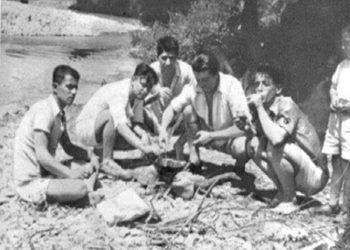
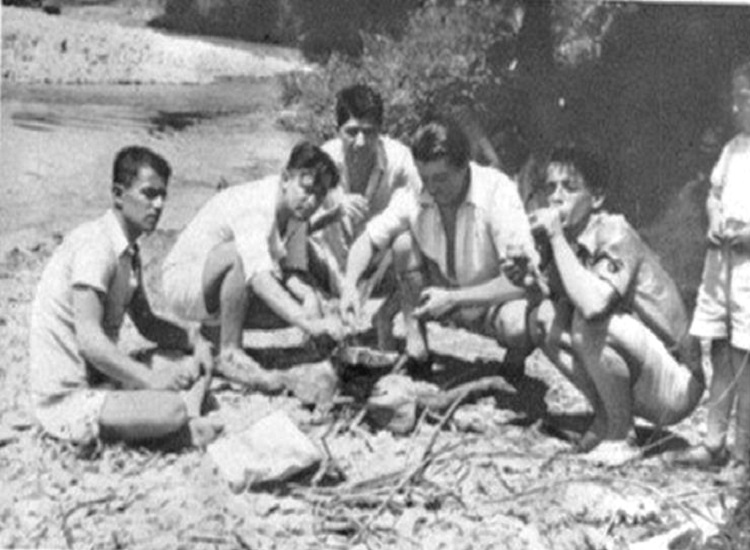
Besides walks in the city, excursions to nearby villages were often organized, especially to the villages of Lunxhëria. On these excursions each participant took with him the necessary food and, rising early, before dawn, took the road to the previously designated village. Upon reaching the village, after a short rest at the village spring or fountain, the village was visited. The villages of Lunxhëria attracted the young people of Gjirokastra because they had a nature different from their city: they had first of all water and great greenery, the gardens, built in the form of terraces, were full of vegetables and various trees. Thus on these excursions many villages of Lunxhëria were visited such as Lloksati, Qestorati, Krina, Tranoshista, Saraqinishta, Stegopuli, etc. But Qestorati, for the school youth, became the most beloved village as the birthplace of Koto Hoxhi.
Here they went to the church where Koto Hoxhi was buried or to the house of his granddaughter, Zoga (that seems to me to be what they called her). She, although small when Koto Hoxhi was alive, spoke about his life and efforts for the spread of education, as well as about the struggle waged against him by the country’s authorities and especially by the beys, the Greek-minded and the Orthodox clergy. These excursions were viewed favorably, not only by the parents of acquaintances of the participants in these excursions, but also by the villagers, who sometimes invited the young people to their gardens and homes, entertaining them with seasonal fruits, drinks and sometimes even sweets. Many young people took part in these excursions, but the most regular who missed almost no excursion were Enver Hoxha, Fejzi Hoxha, Elmas Konjari, Aqif Selfo. Besides these, in a more limited number, the young people also went to each other’s homes where they met and from there went for walks in various places such as by the river bridge, in the bazaar and at the castle, etc.
One of the aims of the youth of this period was also the shaking off of the old and the embrace of the new. One of these was also the replacement of the fez with a hat. This step was very courageous for that time; nevertheless the young people put it into practice. This made a great impression and was greatly criticized by fanatics and conservatives. These did not miss an opportunity to criticize them, dressing the young people with all sorts of derogatory nicknames. These conversations were held everywhere in cafés, in their homes where they gathered in front of their gates, but especially in the hajsomeres (hajsomere was the name of the place where the elders of a neighborhood gathered, especially in the afternoon). One of these hajsomeres was located in the “Hozmurat” neighborhood where Enver also lived at this time. When they left Enver’s house, to go to the Bazaar, on the days they had the meeting at his house – and approached the neighborhood hajsomere, Enver would stop and say to us: “Better we don’t go up to the Bazaar, because the hajsomere will be full of men and whatever you hear of their words, they will say about us, here go the sons of so-and-so, who have become like those of Dropulli (i.e. with hats on their heads), let’s go through ‘Meçitja’ (another neighborhood of Gjirokastra) and so we will be in the Bazaar.”
There were many such cases, but these were faced and put into practice courageously by the young people. Alongside these, of great and continuous importance, despite the heavy political situation of Zog’s regime, were also theatrical performances. These had their purpose: for the development of the cultural life of the city and to collect money for the erection of the statue of Çerçis Topulli. One of these performances, the most important and best prepared, was the drama “Faith and Nationality.” This theatrical piece had great success. In this drama the main character was Zylyftar Poda, one of the leaders of the 1831 uprising. Zylyftar Poda had betrothed his son, from childhood, to the daughter of one of the brave men – his fellow fighters. But Zylyftar’s son, when he grew up, fell in love with the daughter of the house servant, who was Christian. The resolution of this action develops with the serious illness caused by the despair of the betrothed of Zylyftar’s son, with her death, with the great anger of Zylyftar and his circle, and ends with the insistence of Zylyftar’s son in love, with his marriage to the Christian after also receiving the approval of his parents and relatives.
This drama was prepared by the lyceum students of Gjirokastra and Korça and was performed in the lyceum hall on July 27, 1928. In this drama Enver made a great contribution. Enver played the role of the main character Zylyftar Poda. Enver with his well-built and handsome body, with the Albanian clothes that suited him beautifully, with his manly tone and with the environment surrounding him (the room, the scene of Zylyftar’s house, was laid out with carpets and furniture of the time) gave the performance a great liveliness. From the opening of the curtain Zylyftar Poda (Enver), seated on the cushion, with the long chibuk, sits thoughtful, but suddenly rises to his feet and begins his prologue thus:
“O castles of Melesin, O famed fortresses,
You, O ravines, O marshes, O dreadfully terrible rocks,
You, O Poda, old Poda, O nest of bravery,
High and beautiful village that gave fame to Albania…!”
The spectators, who had filled the hall completely full, burst into applause from enthusiasm; these were repeated many times until the end of the piece. So this piece achieved great success. After several days this drama was performed also in Saranda and here too the success was complete. The income of both performances, in Gjirokastra and in Saranda, went, as did those of other performances of previous years, to increase the fund for erecting the statue of Çerçiz. This aim of the young people was praised by all honest patriots and by progressive well-wishers; evens the press of the time, connected body and soul with Zog’s regime, could not remain silent. The press greatly valued the aim of the young people and concludes its chronicle of a theatrical performance by writing: “Bravo to our students, who know better how to appreciate the importance of erecting the statue of Çerçiz than some other so-called intellectuals and patriots. Time proves many things.”
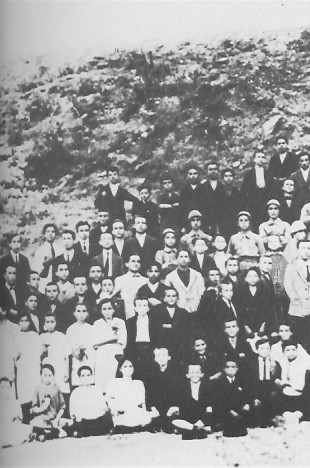
So in this way the lyceum students of Gjirokastra (the lyceum of Gjirokastra in this period, summer 1928, was closed entirely), of Korça and of other secondary schools of the country spent the summer holidays. On these walks, excursions, in the preparations of theatrical pieces and in every other activity Enver was one of the first. His comrades surrounded him with great love because in him they saw a well-educated, beloved, sincere and likable comrade. The year 1927, for Gjirokastra, was not favorable. The lyceum opened in 1923, after great efforts of the education-loving people of Gjirokastra, was maintained with difficulty: each year a class was added and in the school year 1926-1927 the third class (troisième) was added, i.e. the lyceum managed to be a half secondary school. In the summer of 1927, the Ministry of Education decided to leave this lyceum as an incomplete school, i.e. a half secondary school. This best shows the educational policy of Zog’s regime, a policy that sought to keep the people in a backward state. The development of education was the terror of this regime.
Deputies cried out everywhere loudly that in Albania there was an overproduction of intellectuals; their only aim was the greatest possible limitation of the openings of new schools and, where these had been erected with hardships, efforts and great sacrifices, to be greatly limited or even reach their closure. So as a consequence of this policy was also the decision of the Ministry of Education. This decision was the first step for the truncation of the lyceum, but the final and main aim was the complete closure of this educational institution. This is best confirmed by the polemic that developed between two newspapers that came out, in that year, 1927, in Gjirokastra: the newspaper “Demokratia” and the newspaper Viroj. The newspaper Demokrata, upon learning the news that the Ministry of Education had decided to leave the lyceum of Gjirokastra as a half secondary school, wrote an article that had more a demagogic spirit than for the completion of the lyceum.
In this article, mention was made of the little interest shown by the Gjirokastra authorities of the country and other Gjirokastra people who were outside, i.e. in other cities of Albania and especially in Tirana. The newspaper “Demokratia” wrote among other things: “The fault is ours, that we have not yet understood that here in our Albania, we must be advertisers, speak and shout, enough for our needs to be filled. The fault is our municipality’s (in this period the mayor was Bajo Topulli) which sleeps night and day, lives only for salaries. The fault is our deputies’, who believe they are elected only to receive the 27 napoleons. I do not understand the other Gjirokastra people who have had and have high positions and a certain influence in Tirana. Those gentlemen have betrayed their duty toward their own country. And renegades do not deserve to be mentioned.”
The newspaper “Viroj” was directed by the deputy of Gjirokastra Javer Hurshiti. The responsible director – a deputy more affected by the criticism made of him as a deputy and of the other deputies of Gjirokastra, than for the truncation of the lyceum – addresses the newspaper “Demokrata” with an open letter signed by him. In this letter, Javer Hurshiti tries to defend his interest as a deputy, to show himself as a man and as a deputy who views issues not in the local prism, but in the general prism, and appears as if he is of the opinion for the completion of the lyceum of Gjirokastra, while in reality he is for the closure of the lyceum. He, in the newspaper “Viroj,” writes among other things: “You say about us the deputies of Gjirokastra that we look only at the 27 napoleons. No one works nor is work accepted without salary. But deputies are not only of the prefecture that elects them, they represent all of Albania, they have the duty to look at the general interest not the local one; it is because Gjirokastra has been left with the lyceum incomplete, in the other prefectures primary schools are missing. Education must spread throughout all Albania.”
Further below the deputy in question continues: “The duty of a deputy is to study every issue from a general and not a local point of view. I prefer a boarding school in Dibra over such a one in Gjirokastra…! In short, a person we pride ourselves on has been overcome by sleep, the deputies look at the salary, the distinguished Gjirokastra people we have in Tirana are renegades, but then what is left for us in the sieve? Who assures us that those who will come out of that completed lyceum will not also become renegades, will not be overcome by sleep and will not have their minds on trifles”? He ends his article thus: “…and the deputies know their duty, but Albania’s needs are many. We must have patience until its turn comes for the need of the lyceum to be fulfilled as well.” This polemic, which erupted between the two newspapers of Gjirokastra, was nothing other than to throw dust in the eyes of the people: that the lyceum, according to the decision of the Ministry of Education, for the school year 1927-1928, remained truncated; while in the school year 1928-1929 it was closed entirely.
The opinion expressed, in the newspaper “Viroj” in the summer of 1927, by Javer Hurshiti: “We must have patience until its turn comes for the need of the lyceum to be fulfilled as well,” became a reality in 1928: The turn came for Gjirokastra, but not for the completion of the lyceum, but for the complete closure of this educational institution. So Gjirokastra remained without a secondary school. The students who finished the third class in June 1927 and all the students of the other classes in June 1928 were, for the most part, in a difficult economic situation. Therefore only a minority of them managed to continue at the lyceum of Korça, at the “Normale” of Elbasan or at some other secondary school of the country; the rest remained in the streets. The problem of further continuation of secondary school was also raised for Enver. Enver’s family was a middle-class townsman family. Its economic situation did not allow him to continue his studies in other secondary schools of the country, outside Gjirokastra. / Memorie.al
Continued in the next issue