
By Artan Rama
Part One
Memorie.al / In July 1978, when Albania was still a communist dictatorship, two grave events shook the state. The first was the letter from the Chinese government notifying the Albanian leaders that it was cutting off economic and military aid; the second was a letter that two political prisoners sent to the Party’s Central Committee. Although they were not connected to one another, the events were being conveyed through the same means: the sending of letters. But while the letter prepared by the Chinese leadership became public, the second, written in a prison cell, was kept secret. After 42 years it is not easy to return to the world of that time, to understand the inner workings of a state system which had been transformed, gradually, into an instrument of torture for anyone who opposed its functioning, even if only by calling it into question.
A Letter from Prison
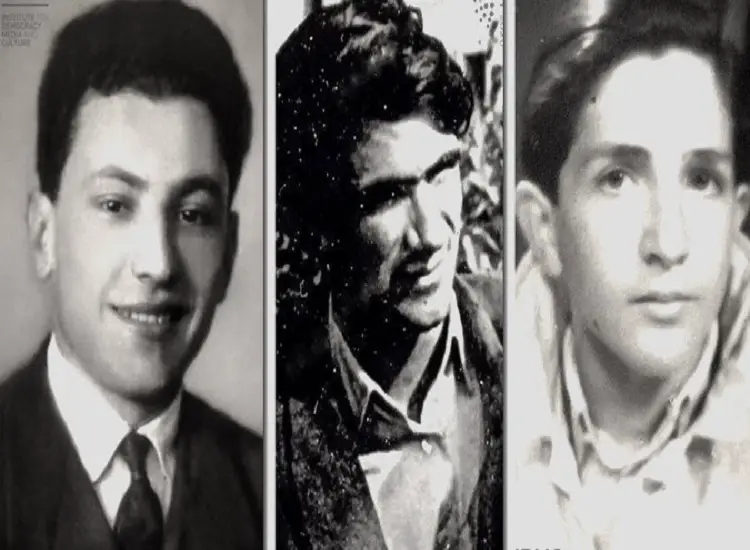
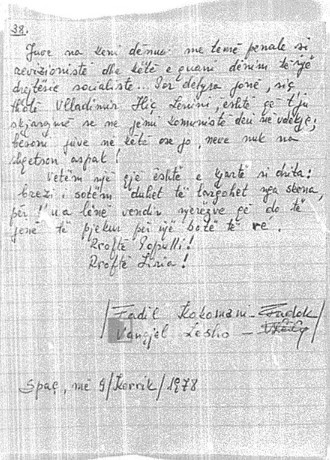
This is precisely what Fadil Kokomani and Vangjel Lezho were doing. Both men had been imprisoned together since 1963, first in Burrel prison and, later, in the infamous Spaç prison. The letter they sent on 9 July 1978 told an obscurantist and infamous regime, heartless and bloodthirsty, that; “in a state where general and particular life is subjected to the thought and political path of an eternal suite, without doubt this state has been seized by an abyss of amorality,” and that; “in Socialist Albania, the child, as soon as it comes out of the mother’s womb, is given the rifle and this is done solely with the humanitarian aim that he, the child, when he grows up, should kill himself!”
This was not only an accusation or a contradiction, but also an act of extraordinary courage and unparalleled bravery. Precisely this sincere and courageous assertion of the truth caused in the gloomy communist leadership a shock equivalent to that caused by the cutting off of Chinese aid. In that “abyss of amorality,” the power possessed considerable punitive force. The imprisoned letter-writers, Fadil Kokomani and Vangjel Lesho, were executed a year later. The event was kept secret and the family members were notified of the death only after several months, while nothing was said about the bodies. But no one asked about them anymore: it seemed that soon everything was forgotten.
The regime would live another decade and the violence, the harsh punishments, the shootings and the disappearances of the so-called enemies of socialism would continue without interruption, until the end. After the fall, the survivors came out of the prisons ruined. Some returned from internment, hoping they could start again where they had left off. The most sensitive began to search, in silence, for the disappeared.
A Farce and a Tragedy
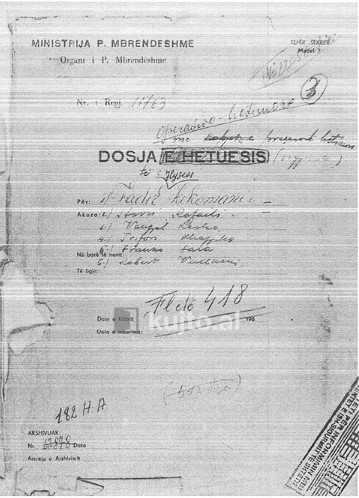
Before the execution of Fadil Kokomani and Vangjel Lezho, a judicial process had taken place, naturally staged. Other prisoners, some of them friends, had testified against the duo, under the threat and torture of the operatives behind the scenes. During the court sessions, the judges did not lose their composure even when the lies of the investigators came to light, or when the situation was visibly in favor of the defendants.
But unfortunately, the judging panel was determined to play the farce to the end, which would necessarily end in tragedy. This was also the purpose of the process. Everyone in the hall understood this. The publicist and researcher Fatos Lubonja, a former defendant together with Kokomani and Lezho, has recounted in detail the painful memories of these sad sessions in the work, perhaps the best of these thirty years: “Ridënimi” (The Retribution).
But beyond the weakness that envelops the soul when one becomes acquainted with the shocking atmosphere and facts of this trial, one cannot help but be deeply moved by the heroic stance of both of the prisoners, especially of Fadil Kokomani, who according to the descriptions of witnesses stood in a hall filled with gloomy portraits, above them all like a god.
At the end the judge had asked him; “Do you feel remorse for what you have done against the Party and the power?” “Of course not, since I have carried them out with full awareness,” Kokomani had answered. Those were his last words. He was 46 years old.
In the 38-page letter of 9 July 1978, Kokomani and Lezho said among other things that; ‘the generation of today must leave the scene, to make way for people who will be mature for a new world.’
On the 41st anniversary of the death, I became interested in learning something more about him. What had remained of this extraordinary character? I became interested in his family and whether there was any living descendant. I knew it would not be an easy search – about sixty years had passed since they had been imprisoned and I knew that a persecution of these dimensions left traces, not only on the prisoner but on the entire kinship.
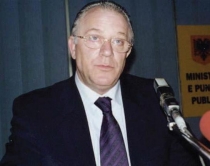
To save themselves, family members withdrew into silence, friends moved away. People pulled back and lived in fear, in shame. After searches through repeated information on the internet, I found the nephew of Fadil Kokomani. This man, Spartak Poçi, became Minister of the Interior in 1999. We met without delay and he invited me to talk in the relaxing corner of a design office where he worked with his sons, architects.
“A lot of time has flowed since then. The water may have carried them away,” he began to tell. “Nearby flowed a narrow stream and perhaps the erosion, together with the tuff terrain, must have moved them somewhere further. But the possibility of wrong coordinates is not excluded. We searched a lot. We dug for days on end, even when it rained.
Somewhere nearby we discovered some old bones, but it was soon seen that they did not match our data. The operation continued for more than three weeks. We saw no sign. They may have been buried somewhere else too: no one knows precisely. There is no document, no sign, map or manuscript.”
He was telling me about the searches for Fadil’s body. “Everything was based on a statement,” he said once. “Can you tell me what this statement was, how did it happen?”, I asked him. “I had just taken the post. With public security we did not have things going well. It was right after 1997 and the gangs were out in the open. Armed groups moved through the streets, freely, even during the day; at night as well.
On the national axes, there was not even talk of safe movement. I enjoyed broad support and with the American Embassy I had things going well. At that time, I remember we were making the lists to train some of our officers to go to America. Everyone wanted to go, but naturally, they would be filtered regarding the cleanliness of their image.”
The Story of Spartak Poçi
“On one of these feverish days, the secretary knocked and told me that an officer was seeking to meet with me. I received him. I knew him a little. He had finished the Faculty of Mechanical Engineering and then, newly graduated, had been accepted into the police forces, in the Directorate of Road Traffic. He had worked there the whole time, since 1978.
This officer tells me: ‘They have excluded me from the training group that will depart for America. Surely someone has slandered me, allegedly with a goods abuse, but the truth is that I have nothing to do with it. Believe me! It is simply jealousy and envy to support other people, or to favor them. They want to smear me,’ he continued, ‘unjustly.’
In the end he told me: ‘You as minister have the possibilities, either to remove this stain from me and I depart with my comrades to America, or remove me from work entirely.’ I called the director of personnel and asked him how the matter stood. ‘No, there is nothing,’ he tells me, ‘he is truly clean, as he has told you.’ Right away they brought me his papers. I glanced at them. It was visible that he had not committed any violation.
Nevertheless I waited until the next day for a final verification. I wanted this boy to come out as he truly was: if he was dirty, let him come out as such and naturally, he would have no place in this ministry. The next day at noon, the investigation confirmed the same positive result: he is clean! This was given in writing and the material was placed in his file.”
“So, you certified his cleanliness,” I interjected. “Yes, yes! On that occasion the files were also completed, since when I went to the ministry, almost all were empty. Immediately afterwards I called the American Embassy and spoke with the Ambassador.
I explained that the information regarding the officer who would be trained in America was extremely wrong and did not hold, since the check had produced the opposite: he was clean, indeed one of our best specialists. After a week the group departed for the United States for a training which lasted over a month and a half.
One day after they had returned, the secretary knocked again and told me that the officer in question was seeking to meet me. I received him warmly. After he thanked me for the training, he said: ‘I can help you find the bones of your uncle.’ I froze for a moment and could not say anything.
He continued with a convincing certainty. He told me that a colleague of his, who worked as a lecturer at the Police Academy, knew the place of the shooting. But he was embarrassed and could not present himself, so he had asked him to help with mediation.
I told him that for me it did not constitute any problem. If his friend would not pull the trigger, someone else would. He hastened to explain that his friend had not been the executioner, but only present during the execution.
Immediately the next day we went together with the officer to the indicated place. It was near a miserable military barracks, which, although without any visible function, was guarded by a soldier.
We passed through a small gorge between not very high hills and after 300 meters we found ourselves in the green territory of a thicket. The officer indicated the possible place with an unusual precision, as if it had happened only a few hours earlier. For a moment I hesitated. It seemed to me somewhat careless, this fine precision, almost impossible.
Nevertheless, right away I raised a digging team and we began that same day, but until dusk we found nothing. They continued the next day, the day after…! Thus a week passed. “We had established a regime of diggings, according to a well-defined plan. Every afternoon an engineer came and reported to me, but nevertheless nothing was found. With time, hopes faded.
We met again in my office. This time I called him. ‘Listen,’ I told him, ‘so many years have passed. It is impossible to remember with such precision. Call that friend of yours to come here, now!’ But he calmed me and asked that we go again there where the diggings were being carried out. We went. When we arrived he pointed with his finger, indicating the same position: ‘They are here.’ The excavator was started again. The bucket with steel teeth sank slowly into the soft earth and dug for more than an hour.
“Again nothing! I turned to the officer and asked to speak on the phone with his colleague. I was losing patience, since it seemed unacceptable to me to continue speaking still at a distance, without achieving anything. I told him to give him to me on the phone, or to bring him there, urgently. But he pulled me aside and asked that we return to the office. Something he sought to explain to me, but not there.
I became convinced that something else stood behind this story. When we returned to the office he began to speak in a calm and soft tone, but which weighed on me like lead: ‘It is I…! There is no other person. I was there that night, with the group that executed Fadil and the others!’ A brief moment followed, but he continued and told everything he knew.”
The Officer’s Story
“I had not yet completed a year in the police, when one day the chief called me into his office. He seemed softened and more approachable than other times. He told me that tonight some enemies would be shot and that I was assigned to take part in the execution. It seemed to me a terrible thing, extraordinarily different from the daily routine and although I was sensing a kind of implied testing, I felt too weak to react.
As he explained to me further, this was done so that some of the young officers, mainly those of us who came from civilian life, would have their courage strengthened and their hatred for the class enemy increased. I had not heard before of this process, I did not even know the condemned, but I did not dare to ask. At home I experienced a feverish state, as if on fire.
I remained thus until close to midnight and at the appointed hour I presented myself with precision at the required place. The prison van and a small car stood waiting near a neon post which emitted a light red light. Around, a bitter rain was falling that seemed not to reach the asphalt.
We arrived at Unit 313, where the condemned were held. As far as I remember, there the cars stopped before an iron gate which did not delay in opening. The large car slid in silence toward the inner courtyard of the prison. Nothing chirped. The condemned arrived accompanied by the guards, with their hands tied behind and climbed up, from the back part of the car. There were three. I watched their portraits stealthily. They seemed to me miserable and pale.
When the car started, it was Fadil who asked where we were going. He received no answer. Strangely, he seemed calm throughout the entire journey, while the other two seemed extremely weak and foggy. That feeling of the afternoon that had ignited me inside was being transformed into a general numbness.
I have often tried afterwards to bring back that journey-torture, but I have never been able to reproduce a complete and clear image, of what may have actually happened during that itinerary. / Memorie.al
Continues in the next issue