
By SHERADIN BERISHA
Part One
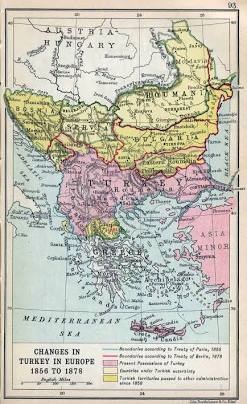
Memorie.al / The second decade of the 20th century was one of the hardest periods that the Albanian people were going through in their entire history. The First Balkan War, which began in October 1912, brought great changes to the geographic space of ethnic Albania. The neighboring states: Serbia, Montenegro, Bulgaria and Greece, which made up the “Balkan Alliance,” taking advantage of the successes of the general Albanian uprising of the summer of 1912 against the Ottoman army, in October-November 1912, occupied half of the Albanian ethnic territories. While the Great Powers at the London Conference on 29 July 1913 recognized Albania as a sovereign state, Kosovo (with its present territory), Kumanova, Skopje, Tetova, Gostivar, Dibra, Kërçova, Struga, Ohrid, Manastir, etc., remained under Serbian military occupation. These Orthodox states, basing themselves on the unjust decisions of the London Conference, to the detriment of Albania, benefited from these territories:
a) Serbia from this war occupied 19,000 km² (Kosovo and Macedonia), expanding to 82% of the territory, with a population of nearly one million Albanians who make up about 55% of it;
b) Montenegro occupied 62% of the territory, where 190 thousand Albanians lived, almost as many as the Montenegrin state itself had;
c) Bulgaria occupied 29% of the territory with about 3% Albanian population;
d) Greece occupied 68% of Çamëria where 67% Albanian population lived.
The creation of new state maps in the Balkans was unacceptable for the Albanian people, and being so, they were forced to continue the war for the liberation of Kosovo with the other Albanian regions and their union with London Albania. After the end of the First Balkan War, the leaders of the Albanian uprising: Elez Isufi, Bajram Curri, Isa Boletini, Sadik Ramë-Gjurgjeviku, Sali Hoxha and many other leaders were forced to withdraw to Albania and already in the months of February-March 1913, they began preparations for a new uprising against the Serbo-Montenegrin occupiers.
The Serbian government, although through its collaborators, of the kind of Esat Pashë Toptani, Arif Hiqmeti, etc., was following step by step every movement of the Albanian leaders, it reinforced the border zone in time. In truth, the Serbian military troops had not even withdrawn to the border line determined by the London Conference. On the contrary, within the Albanian territory, it had arbitrarily established the so-called “strategic line,” on which they set up customs posts, such as: in Kukës, where the Black Drin joins the White Drin, in Okushtan-Çermenik, on the Elbasan-Dibër road, in Qafë e Murit – west of the Black Drin facing Dibra, and in Pogradec, to supposedly ensure protection from Albanian attacks.
Already at the beginning of 1913, when the Serbian regime installed a military administration in Kosovo and in other occupied Albanian areas, the condition of the Albanian population worsened in all segments of life. Albanians lived in deep misery, suffered for bread and other foodstuffs. Also, against Albanians there were pursuits, persecutions and innocent killings. Against them, without any investigations or trials, the execution of the death penalty was carried out, while one cannot even speak of other more elementary human rights.
On 16 August 1913, Isa Boletini from the Highlands of Gjakova writes a letter to Ismail Qemal and with concern speaks to him about the misery and hunger that has befallen the highlanders of Gjakova and seeks the help of the Government of Vlora. In the letter, among other things, it is said: “…every corner of the Highlands, stone, rock everywhere is filled with miserable emigrants, who have come in a state not to beg, but to die. There is no heart that endures before the wailing of these sons of the fatherland…”!
With this condition reigning there, naturally in the spring of 1913 the number of Albanian chetas (armed bands) in Kosovo and elsewhere increased and preparations began for a liberation uprising. A realistic picture of the grave condition in the occupied Albanian lands is also given to us by the Serbian social democrat D. Tucoviq in the book “Serbia and Albania.” He wrote: “The Albanian uprising of September, because of which Serbia was forced to mobilize again nearly three divisions, is a classic example that shows how colonial wars are caused. The occupation of the Serbian army extended from the east up to the doors of the Albanian gorges and mountain passes.
This occupation separated the farmer from his field, the livestock from the pastures, the herds from the valleys, the village from the mill, the buyer and seller from the market, the surroundings from the city, and the entire mountain population from its economic centers and grain supplies. The Albanian from over there (from London Albania – pub.) did not dare to set foot anymore on his land that had remained on this side (in occupied Kosovo – Sh.B.). All sources of life were cut off from them. The desperate and immeasurably hungry people first begged to come freely to the markets. But when even this was forbidden, between death from hunger and death from the bullet, they chose the second (the bullet – Sh.B.). With the aim of coordinating the liberation activity, the leaders of the occupied provinces would also maintain contacts with Ismail Qemal.
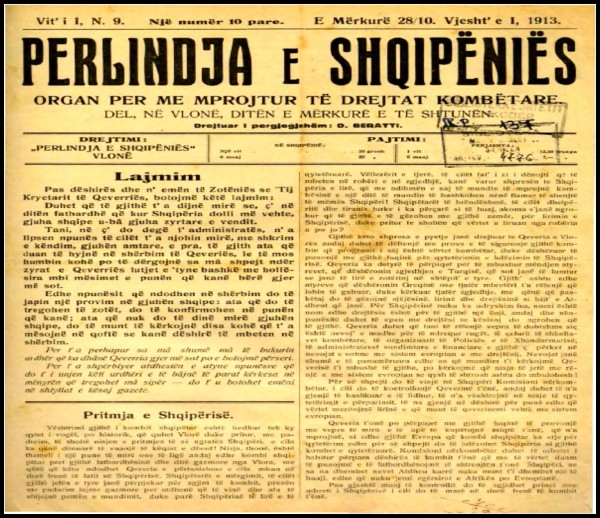
According to a notice published in the newspaper “Përlindja e Shqipnisë,” on 12 August 1913, Elez Isufi – distinguished leader of Dibra, Ramadan Zaskoci from Luma and Rexhep Bajraktari from Hasi with their retinues, went to Vlora and met and talked with the head of the Provisional Government Ismail Qemal, “…about the condition in the highlands they represented and about the measures that had to be taken to govern those areas… according to the interest of Albania.
Now, honored bajraktars, it was said in that notice, – the escapees from the Serbian army from those areas wait so that they may go to their place and thus expand the field of the government…” Ismail Qemal, on behalf of the Government, at this meeting, although he had no military power or financial means, promised the leaders of Luma, Dibra and Hasi help to be liberated from the Serbian occupation, but also instructed them that, upon returning to their provinces, they should organize the uprising against the Serbian occupiers. At the end of August 1913, Bajram Curri, Isa Boletini and Hasan Prishtina were also found in Vlora, while the latter (in September) accepted the post of minister in the government of Vlora.
THE UPRISING OF DIBRA
A special role in the organization of the Albanian uprising was played by Elez Isufi, Ramadan Zaskoci, Qazim Lika, etc., who during the summer of 1913 and up to the first half of September were intensively engaged in its preparation, while this activity quickly caught the eye of the Serbian authorities. Thus, the commander of the garrison of Orosh, Captain Vukotiq in mid-June 1913, sent a report to Major Leovac in Luma (in Vasije), with which he informed him that he had established contact with some Albanian mercenaries, who could eliminate these dangerous leaders.
The Serbian command in Luma, on 26 June 1913, for this information, notified the supreme command in Kosovo, emphasizing that: “The interruption of the activity and influence of these leaders was important for the Serbian authority, not only for these difficult times, but also for the future.” Although Major Leovac had requested that for the heads of these leaders and many others, 1000-1200 dinars be paid, in a reply signed on 8 July, by Nikolla Pashiq, among other things it is said: “Since the mentioned people are known as criminals… action must be taken against them according to the law. If money is needed, it should be taken from military credits.”
Also on 24 August 1913, the police inspector of Skopje notified the Serbian supreme command that Elez Isufi… was in Dardhë and was inviting Albanians to uprising. Therefore he proposed the destruction of the villages Reç, Dardhë, Kalis, from where all the armed groups in Dibra and elsewhere operated. Consequently, he requested that the security company in Zhirovnicë be reinforced with a cheta of 7 to eliminate the Albanian leaders.
In Albanian historiography until today it has been said that the Albanian uprising of 1913 began on 20 September in Dibra, while according to a report of the Head of the District (naçallnik) of Dibra N. Çirkoviq, sent on 8 October 1913 to the Serbian Government in Belgrade, it is specified that the uprising began at the beginning of September 1913.
Let us refer to this report.
The naçallnik of Dibra N. Çirkoviq in his long report says that: “On 1 September 1913, the Albanians had begun to provoke our outposts near Pogradec. On 3 September, between the positions and the village Rinakaj, the Albanians attacked the Serbian patrol and on that occasion killed one soldier and wounded another. For this the inspector in Skopje was notified.
On 4 September the order was given to abandon the distant positions and for the army to withdraw near the border envisaged by the London Conference. On 5 September the proclamation of the annexation of Dibra was made…! On 7 September, a strong Albanian unit had attacked the Serbian outpost at the bridge of Aras.
It dispersed it and had crossed to the right side of the River Drin (for this I have notified the inspector in Skopje). On 8 September, the Albanians with large forces attacked Peshkopia and took that attack at 6 in the morning. The naçallnik of the district confirms that in the fighting there were about 1200 Albanians… From Peshkopia the Albanian insurgents were oriented in two directions: one toward Dibra, while the other orientation toward Zherovnica.
The naçallnik of the district in those circumstances announces that that attack was such that he could not even put on his own clothes. Therefore, in Peshkopi there remained the entire archive with ciphers… The Albanian unit that was at the front toward Zherovnica here and there destroyed our (Serbian) chetas, while at 8 in the evening it was at the top of Zherovnica. In Zherovnica the Albanians enter at 9 in the morning (they liberated it – Sh.B.).
The leader of their unit was leading 300 men. With these forces Maliq Kroqishta was leading, while with 350 others Alil Kaloshi from Lower Dibra was leading. The other unit that was following our army in the direction of Dibra on 9 September 1913, in the morning was some 10 km away from Dibra (for this I have notified the inspector in Skopje).
According to the agreement reached with the commander of Regiment XIX in Dibra, Dibra was not allowed to be abandoned without a fight, therefore I immediately gave some instructions that order be ensured in the city and together with my subordinates the city be abandoned only when the army withdraws…! Around 10:30 (on 9 September – Sh.B.) the fighting develops in the city, such that bullets had begun to fall even in the office of the naçallnik.
At 11 in the morning the army had begun to withdraw… On the other side, the Albanian citizens were attacking us, both from the windows and from the doors, so that we could not even open our eyes from the rifle fire and with great difficulty we saved our heads. There were so many bullets that when mounting the horse, a bullet hit the protector and he died on the spot…! Exactly at 12 noon Dibra had fallen into the hands of the Albanians.”
Further in the report it is said: “According to the data, at the head of the Albanian insurgents were the leaders: Elez Isufi and Mersim Dema as general commanders. While as lower leaders there had been: Selman Alia, Halil Kaloshi, Haxhi Llan Kaloshi. There was also talk of the arrival of Isa Boletini in Dibra, but no one knows anything about him, a fact that speaks that he did not come at all. In connection with this, as soon as the Albanians had entered the city, one part had remained there, while the other part continued the war against our army.”
That day the Albanian insurgents led by Elez Isufi and other popular leaders: Sefedin Pustina, Selman Alia, Haxhi Llan Kaloshi, Isuf Xhelili, Mersim Dema, Iljaz Hoxha, Haziz Lila, Elez Koçi, sheh Sula, Dan Cami, etc., organized the further attack divided into several columns in the direction of Struga and Ohrid, of Mavrova and Gostivar.
And from the successive battles the Albanian fighters liberated: Gostivar, Tetova, Struga, Ohrid…, while the Serbian forces withdrew quickly leaving 1000 soldiers killed, 300 soldiers were taken prisoner and 12 cannons and many other war materials were captured. After the liberation of these Albanian provinces, the insurgents set up the administration in the cities and villages.
The naçallnik N. Çirkoviq in his report, sent to the government authorities in Belgrade, emphasizes that: “As soon as the insurgents entered the city (Dibra – Sh.B.) the local beys immediately formed the government: Sefejdin Pustina, Rizah Begu, and Sheh Latifi, where Sefejdin Pustina was elected as head of that government.” Mr. Çirkoviq also tells about the courtesy of the Albanian insurgents toward the Serbian soldiers, the wounded and the captured prisoners. He writes: “The Albanians immediately fixed the telephone between Peshkopia and Dibra, they put into use the apparatus that is not used in our army.
They immediately founded the hospital and began to heal our (Serbian) wounded. The Albanians toward the wounded and captured prisoners behaved with a humane correctness…”10, while completely differently the Serbian soldiers would behave with the unprotected Albanian population, with the women and children, whom they slaughtered with bayonets and burned alive in fire!!
THE SPREAD OF THE UPRISING IN THE PROVINCES: LUMA – OPOJA – VËRRI
After returning from Vlora, Ramadan Zaskoci together with Qazim Lika, Sali Spahiu, Hoxhë Mehmeti, Ramadan Çejku, Bajram Gjana, Osman Lita, Dervish Bajraktari, Sulë Elezi and other patriots, at the beginning of September 1913 in a meeting of the “Dheu” held in Shtiqën 11 of Luma, decided to mobilize the people of Luma for war against the Serbian occupiers. Mobilization assemblies were also held in the other occupied Albanian provinces.
Although the Albanian uprising began in Dibra…, in the second half of September 1913 it also spread in the direction of Kala e Dodës to continue quickly in Luma, in Gorë, Opoja – Vërri, up to Prizren and in the province of Hasi, of Krasniqa and of Gashi up to Gjakova.
At this time the Albanian insurgents were mainly concentrated and fought in the villages of Kala e Dodës, in the Plain of Luma and in the villages of Gorë…, because the largest Serbian forces were precisely in these places most deployed. Meanwhile according to data from Serbian documents, the bloodiest fighting took place in Vasije, then in Kalis where several Serbian units were annihilated.
From here, the remnants of the Serbian units withdrew toward Ujmisht, while many soldiers of regiments X, XI abandoned Luma and withdrew in the direction of Vranisht, the then capital of Gorë. 12 After a fierce clash, the Luma insurgents took the Serbian garrison in Ujmisht and here, their division into two wings-columns is made.
– The right wing, the first column composed of highlanders of the villages of Luma: Bushtricë, Kalis, Kala e Dodës, Radomirë, Çajë… under the leadership of Qazim Lika, Cen Daci, Idriz Zholja, molla Tofiku, etc., took the direction: Buzmadhe – Topojanë – Gorë (Vranisht) – Opoja – Vërri – Prizren.
– Meanwhile the left wing, the second column under the leadership of Ramadan Zaskoci, Osman Lita, Ramadan Çejku, Sali Spahia, Mustafë bej Deshati, Haxhi Noka, Riza Mati and others, attacked the other forces of the enemy in Bicaj, Nangë, Shtiqën, Gostil, captured the left bank of the river “Luma” and finally made for the Kulla e Lumës (where the two Drins meet), as an important center of the enemy’s military garrison.
According to a news item published in the newspaper of the time “Atdheu,” “on 16 September 1913, the insurgents capture the city Luma (Kulla e Lumës). A harsh war took place near that city. Quick measures were taken to reach and drive out the Albanians” 14. After the taking of Kulla e Lumës, the Luma insurgents set out in pursuit of the Serbian forces, which took the road in the direction of Zhur to end up in Prizren, passing through the transversal along the White Drin.
While the left wing (second column) of the insurgents, pursuing the Serbian remnants, took under control all the villages of the transversal Përbreg – Gjegjën – Bardhoc – Morinë – Vërmicë – Zhur and stopped in the village of Poslisht of Vërrini, the insurgents of the right wing of the front – (first column), with bloody fighting successfully advanced toward Buzmadhe, Topojan, Novosej, Shishtavec and capture Zapod, Vranisht, Restelica, Dragash and enter Opoja./ Memorie.al
Continues in the next issue