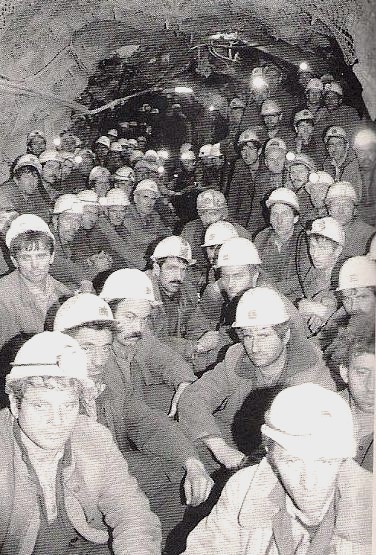
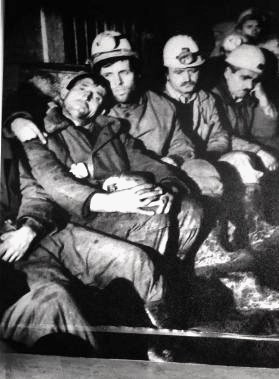
Memorie.al / The dust that clung to every breath, the darkness that instilled fear and the hunger that challenged the body, but not the will, remain alive in memory, even on the 37th anniversary of the historic strike when the miners of Trepça spent eight days and eight nights underground. Some of them now recall the courage and determination to defend the Constitution of 1974, while their solidarity and the support of the people became the most powerful weapons in this battle for dignity and justice. Rexhep Rrahmani, one of the miners who participated in the strike, told KosovaPress that their goal was clear: the defense of the Constitution of 1974 and of their rights.
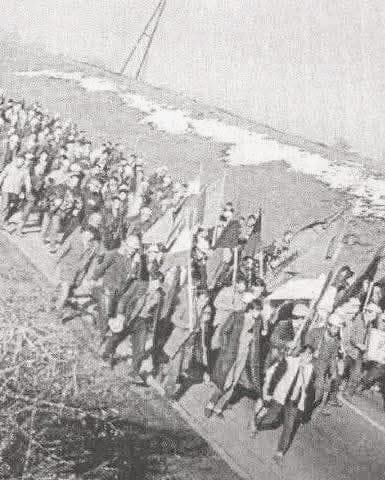
“Yes, we tried with dialogue, with words, plus we even walked 53 kilometers to Prishtina on foot, and nothing with them. They still tortured us, beat us, they didn’t leave us any place on the surface and we were forced to go into the ground alive. The Serbs put us in. We entered to defend the Constitution of ’74.
We entered there to die, because when I say to die, I mean I saw it with my own eyes. When Hashim Parduzi came, he was a pensioner, he had retired, and when he came he joined us. I told him: ‘Hashim, what?’ He said: ‘What do you think that I left you alone? I have come to die with my friends, here I will die. How could I leave you alone?’
Then Muja Cerraja, he was a supervisor in the ninth horizon. He was sick in the hospital, as soon as he left the hospital, he heard that we had remained here and he came. When he came, he joined us. The first one I saw, all the miners were saying: ‘There, Muja has come.’
It gave the miners a great strength. Next, Rrustem Voca, when he got sick, said: ‘I will not come out, I leave it as a testament to you that you bury me here in the workplace where I have worked, bury me here.’
Hasani Keqa, when he took the boots off his feet, all the skin fell off, the flesh was raw. Thanking the doctors, they came, bandaged the wounds and fixed them thread by thread. I am telling you this way because when we entered there, it was only to die.
But still they betrayed us, they deceived us, they threw us out of the strike, they beat us, they tortured us, they imprisoned us and they left us invalids. The miners have passed away, very few of us remain. They have gone, they have died,” said Rrahmani.
He recalled the solidarity among the miners and the support of the people.
“Eight days and eight nights, we who were given the will to stay and to die, it was the people who gave it to us. The entire people joined us and supported us. That was the greatest thing for us. The people, by supporting us, gave us even more will.
We just kept our demands, whether they were being fulfilled, but even they were not fulfilled for us. They lied to us, they betrayed us and we came out” — the former miner recounted.
Rexhep Rrahmani recalls that in the ninth horizon the state of Kosovo was started, which was finalized with the liberation war.
“I know that in the ninth horizon the foundation of the Republic of Kosovo was started, while the Liberation Army put the capstone on it. Why am I saying this? When Congressman Engel came, I sent him to someone in Tavnik, he took a small child and pointed him toward me:
‘Do you see this child?’ I said. ‘Yes.’ He said: ‘He will enjoy independence.’ When he put him down, I caught him and embraced him. That child worked in the ninth horizon,” declared Rexhep Rrahmani.
Meanwhile, another former miner, Ajet Tahiri, recounted that during those days the miners were very connected to one another and acted without any request or help from the leaders. When Serbia and Milošević removed Kosovo’s autonomy, they decided on their own path to defend the Constitution.
“At that time, as miners we were very connected to one another. With the arrival of Serbia and Slobodan Milošević, who intervened to take away our full autonomy of Kosovo, we miners talked among ourselves, without the initiative of any leader, without anyone forcing us with violence.
We found an understanding that the best way to defend our Constitution and our leaders was our path to go to Prishtina. Within the strike we stayed eight full days, from February 20 until the 28th, at 23:00, when we came out,” Tahiri told ‘Kosova-Press’.
Tahiri recounted that during the eight-day stay underground, the miners did not think of coming out without realizing their demands, not only for their own interests, but for all of Kosovo and the Albanian people.
“Yes, to tell the truth, while we were inside, we did not think of coming out alive without realizing those demands of ours, but with hope that something better is being done and we are trying to come out to the surface of the earth, not only for us as miners, but for all of Kosovo and the Albanian people.
Those who were ‘asising’ us were Sabedin Azemi, Rrahman Morina and some others who joined Serbia. We demanded their resignation. Until they signed the resignation, we did not come out to the surface. But they gave false resignations. When we came out to the surface of the earth, they said: ‘You neither took us out, nor can you throw us out.’
They returned again to duty. We had great emotions, great difficulties, then Serbia began heavily poisoning the students in the schools, and it began taking us to prisons. I was 60 days imprisoned in the prison of Smrekonicë,” he said.
Selim Selimi, who experienced the strike of 1989 up close, recounts that the difficulties had begun in the first days of work, when in addition to the harsh conditions; there had also been delays in wages.
“Our misfortunes happened, now we started the work, we all started the work, but those days our wages were delayed a bit, but they thought that we had holed up for wages, but that was not the case at all. And the strike began and eight days passed until it was over,” said Selim Selimi.
He adds that the miners’ determination was unwavering and that, as soon as they made a decision, there was no turning back. Prepared even for the greatest sacrifice, they stayed underground without minimal conditions.
“We went through it as miners, because when a miner decides something, he has no difficulty at all. We decided to die there and we thought of nothing else.
We thought, we joked, we stayed in company, even though it was different in the mine, without eating, without washing, all that dust, all that hell, and we endured it.
They knew that we were inside the ground, they knew when we left the house that we were going to work, then through the media they found out, but contacts no” — he added.
The strike of the Trepça miners remains one of the most significant acts of civic resistance in the history of Kosovo. Today, after nearly four decades, their accounts testify that freedom was achieved through sacrifice, resistance and collective determination.
The memories of that time remain a powerful call not to forget that Kosovo was built on the courage and determination of ordinary people, who refused to be silent. / Memorie.al