By ZEKIRJA IBRAHIMI
Memorie.al / Every time I pass through Bllaca and see that on the left side there is not a single plaque, not a memorial center, not a museum of the Kosovo exodus, but absolutely nothing to remind the new generations, who did not experience that suffering, of that Calvary, I cannot help but ask myself whether we Albanians are wiser than the Jews?! While the Jews have turned their Holocaust at Auschwitz into a pilgrimage and force all the world’s politicians to go and bow there, while all Jews are obliged to draw inspiration there, not from the heroes of the war for the establishment of the state of Israel, but precisely from the sacrifice of the Holocaust, I do not understand why the Albanians of Kosovo are so careless toward their own past?!
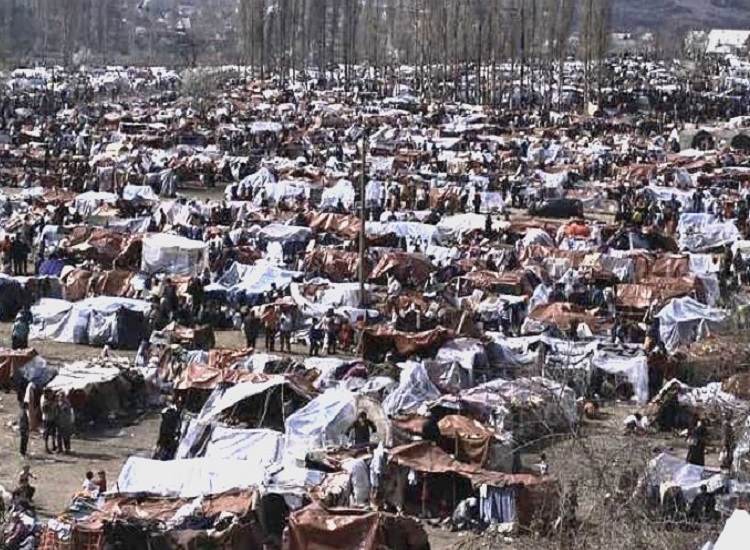
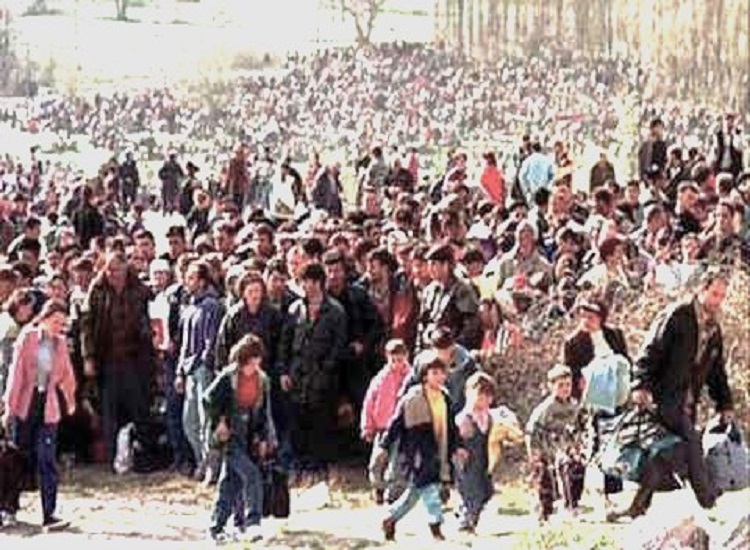
It was March 1999. NATO strikes had just begun. Kosovo had begun to empty. Being students, we had organized ourselves voluntarily at the Humanitarian Organization “El Hilal” in Skopje, to receive the refugees coming from Kosovo. As much as your soul burned when you saw people coming only with the clothes on their bodies, you were just as overjoyed when you saw how the Albanians of Macedonia competed so that no Albanian of Kosovo would remain on the street. A solidarity that I have never seen either before or since. Nevertheless, somewhere there at the end of March, Macedonia closed the border; more precisely it stopped the Kosovars in the Lepenac valley at Bllaca, because – as was officially stated – it could not cope with such a large wave of refugees.
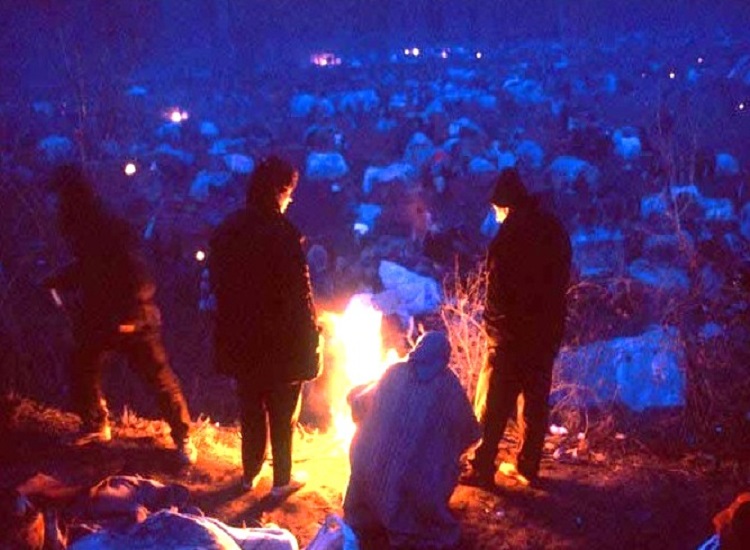
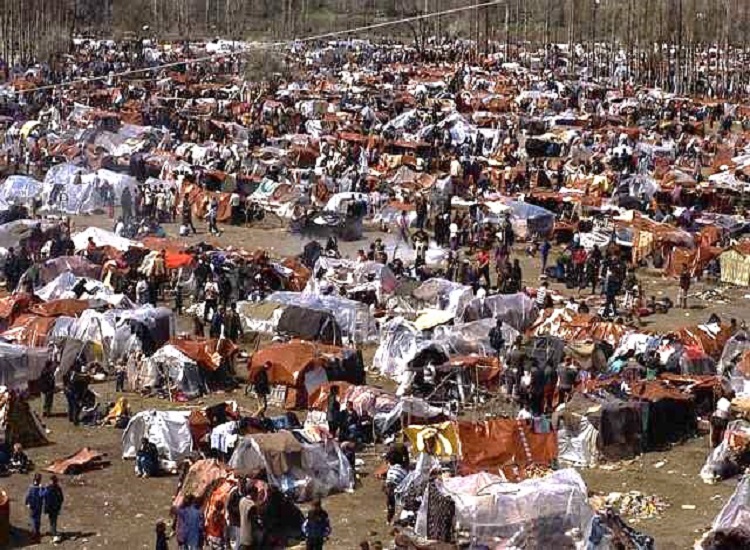
And then, for at least a week – as far as I remember it was from 31 March until 6 April 1999 – the Albanians of Kosovo remained under the open sky. This was the exodus of Kosovo. When we reached this point and when it was said that humanitarian activists of organizations other than those of the Red Cross had problems entering down among the Kosovars, we found a way, through a Macedonian friend of mine, and we became members as volunteers in the Youth Forum of the Red Cross. There we were divided into two teams: one would work from 19:00 in the evening until the next morning, while the other team from 07:00 in the morning until 19:00.
I stayed with the second team. The next day at 06:00 we were in front of the Red Cross headquarters in “Dare Xhambaz”. With a large “Jeep” we traveled to Bllaca. Before 07:00 we were there. During the night rain had fallen and, besides the mud that had formed, the weather had also grown quite cold. On the right side, now in front of the Macedonian border point, the tents of the humanitarian organizations were set up, as well as the tents where the sick and the dead were evacuated, while down on the left side were all the Kosovars waiting for life. As soon as we arrived, we met with the other friends. They seemed to be very tired. Not only without sleep, but they were completely exhausted. Just as they were getting ready to leave for Skopje, one of our friends fainted and crashed to the ground. We thought he had died.
Doctors came and said it was not serious and that it was from exhaustion. They gave him an injection and, after he rested a little, they sent him back to Skopje. This was also a message that a difficult day awaited us. And where to begin?! To take a sack of bread, carry it down, take a box of water bottles, take milk with you, or go with a stretcher in hand so that you could bring up the sick and the dead?! All of these were urgent. When you went down, everyone would cling to your back, take whatever you had, and often it turned out that you could not make even 50 meters in the crowd and had to return again to get something else, because they took everything – willingly or unwillingly. An unprecedented struggle for survival. We knew well that those who were deeper were worse off, but we had difficulty reaching down there.
Nowhere as on that day in Bllaca have I seen life and death so close. We took a man who had died, carried him on a stretcher, brought him up and, after covering him with a blanket, continued down to other tasks. You had no time to shed even a single tear, or to sing a dua for him. Down there were women who had just given birth, or whose babies were only a few days old. Their pain burned you. But what could be done?! People told us that several babies had died during those days. Therefore we tried to at least get those women out. But then the rest of the family became a problem. When we once insisted on saving such a woman, a humanitarian activist addressed me in Macedonian (thinking that they did not understand us), saying: “Don’t, because it’s not known where they send them and then they get lost among themselves.”
Terror! An activist, perhaps a doctor, because he was wearing the coat of the organization “Doctors without Borders,” invited me to go and bring down a very sick person. Dusk had just fallen. A fine rain was wetting us, but no one had their mind on the rain. We took the stretcher in hand and entered the crowd to look for him. Eventually we found him. I put my arm under his armpit and pulled him from the improvised tent. He was very heavy. I thought he had died. He did not move at all. We somehow grabbed him and placed him on the stretcher. We barely carried him up that slope to the top. Behind us came his family: the wife with a couple of children, who cried without stopping. But the police did not allow them to come out up either. We sent the sick man to the ambulance, also improvised, and, without having any time at all to grieve over the separation of the family, which who knows when it would be reunited again, we again had to go down.
So the whole day passed: send down food, carry up the sick and the dead… When we were returning to Skopje, we were notified that from the next day the Kosovar refugees would be allowed to enter Macedonia. At last I arrived home. Physically crushed and spiritually destroyed and broken. Before I lay down to sleep, the doorbell rang. In front of my door was that friend who had fainted in Bllaca in the morning. Please register me again to go tomorrow with the next group of volunteers, he told me. Tomorrow perhaps Bllaca will end, I told him. And, although tomorrow we would not be among them, we still felt good. But we could not look each other in the eye any longer, because we did not trust our tears. And indeed, the next day the carrying of everyone who was in Bllaca began, so that our work also shifted.
BLLACA – THE “AUSCHWITZ” OF THE ALBANIANS!
P.S. I remembered these days in this event, although I do not remember many details – because I have not kept any diary or any exact record – not to prove something else, but only to draw attention to what the Kosovar politicians have not done during these years. Every time I pass through Bllaca and see that on the left side there is not a single plaque, not a memorial center, not a museum of the Kosovo exodus, but absolutely nothing to remind the new generations, who did not experience that suffering, of that Calvary, I cannot help but ask myself whether we Albanians are wiser than the Jews?!
While the Jews have turned their Holocaust at Auschwitz into a pilgrimage and force all the world’s politicians to go and bow there, while all Jews are obliged to draw inspiration there, not from the heroes of the war for the establishment of the state of Israel, but precisely from the sacrifice of the Holocaust, I do not understand why the Albanians of Kosovo are so careless toward their own past. Instead of showing the world what Serbia forced us into in 1999, we continue to glorify the heroes of the war, who despite their incontestable merits, were not a more important cause for NATO’s intervention than the humanitarian catastrophe caused by the Serbian regime.
But, as it seems, politicians have more desire to benefit politically from those organizations than to do something really for the empowerment of the collective memory of the Albanians of Kosovo and of the world. Perhaps because of the lack of such a memorial center, today Putin declares that Crimea is like Kosovo. Meanwhile, wisdom says that he who forgets his past, let alone is himself forgotten, but he has no future either./ Memorie.al