Part Thirty-Three
Memorie.al / The CIA have revealed the major role that the Soviet Union played in communist Albania. In several “Top Secret” documents, which have been declassified for years, it is shown that the USSR built several important military bases, especially in the South of the country. Detailed information is provided regarding the submarines Moscow had on Sazan Island and the Gulf of Vlora, as well as air bases, such as those in Rinas, Kuçova, etc. Furthermore, an overview of political developments is given, mentioning the dismissal of Minister of Defense Beqir Balluku in the summer of 1974 from all functions in the army and the party. Likewise, a special place in the documents declassified by the CIA is occupied by those discussing Albanian political emigrants in Yugoslavia, who were integrated into the Prizren Committee, initially headed by Apostol Tanefi, and under pressure from the UDB, which recruited them through coercive measures, such as forced return to Albania, etc.
Continued from the previous issue
Wartime Resistance
Many Albanians are convinced that only another war between the West and the East can bring about their liberation, which would also lead to an increase in the potential for domestic resistance. In such an event, both peasants and workers would step up their attempts to sabotage the communist regime, provided the risk to them is reduced. Furthermore, support for anti-communist activity from Yugoslavia, Greece, and Italy, isolation from the rest of the Soviet Bloc, and the regime’s need to expend resources on securing its borders would make it easier for internal resistance to organize.
Although massive uprisings would be unlikely immediately following the outbreak of war, elements of internal resistance could organize to become a serious force. However, this would also depend on the success of the Western offensive or the ability of émigré groups to provide proper guidance and assistance. Only if the USSR were to swiftly reinforce Albania with military units could the organization of guerrillas in the north and south be prevented. Developments would also be influenced by the tendency of Albanian soldiers to desert.
February 1976
Atmosphere of a State of Siege in Albania
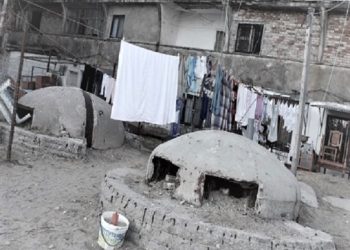
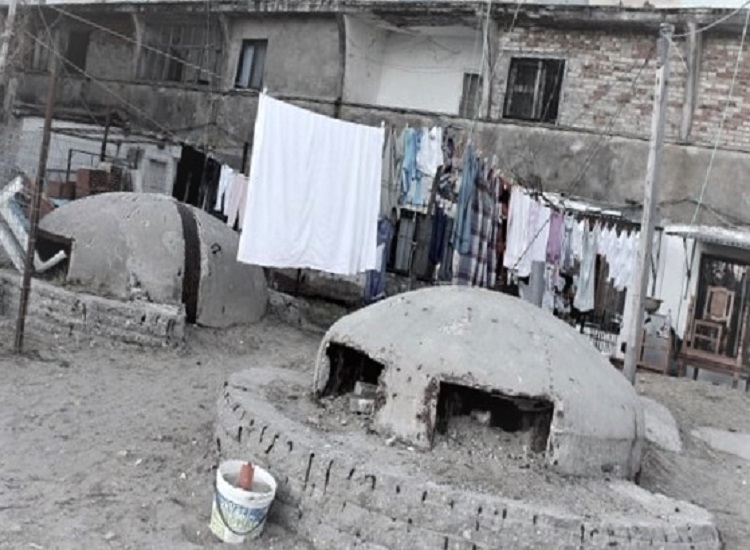
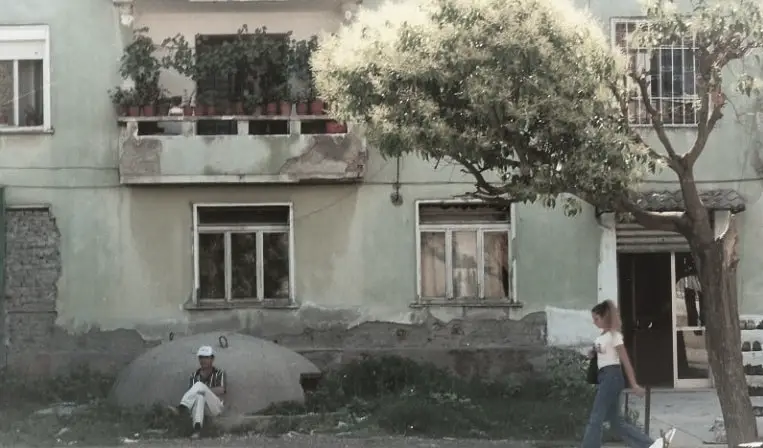
During recent weeks, the situation in Albania has deteriorated significantly, to the point that diplomats in Tirana state the country resemble a giant concentration camp. Mass purges in recent months and the harshening of state propaganda have pushed ideological control and xenophobia in the country to the maximum. Ordinary citizens are now afraid even to exchange greetings with foreigners. In addition, Albanians are constructing numerous shelters and bunkers around the capital, this time without trying to conceal their activities.
The authorities have also requested foreign embassies to build shelters on their premises. The French ambassador stated that Albania is in the midst of a frantic campaign to construct a chain of bunkers along the Adriatic coast. These frenzied preparations bear the stamp of party leader Enver Hoxha and are intended to ensure the survival of his policies after his death.
In recent months, there have been persistent rumors among diplomatic observers that Hoxha and his number two, Shehu, are in poor health. Some diplomats even suggest that the 67-year-old leader will not last much longer. The purge of party and administrative ranks may be the first step in the transfer of power. The process reportedly began about a year and a half ago, and between the summer of 1974 and the spring of 1975, the main cadres of the Ministry of Defense were removed – reasons for which there are neither information nor an official explanation from Tirana. Subsequently, the top three economic leaders were also dismissed, two of whom were long-standing members of the Politburo.
It now appears clear that all officials were caught in the first wave of purges directed against excessive “bureaucracy.” The main brunt of the impact was borne by ministry staff, local government, and other institutions such as state media. Another critical aspect of the purges is the implementation of “rotation” as a key tool to cure bureaucracy; however, their primary effect is undoubtedly creating a permanent sense of instability within the bureaucracy to make the potential emergence of any opposition as difficult as possible. The lack of trust in the administration, contempt for any detachment from the non-professional, one-class society undergoing rotation and the ruthless doctrine of self-reliance are all very costly to Hoxha.
Although the dismissals indicate that dissidence exists within the military, economy, and culture, strong evidence suggests that the newcomers must come from party ranks and be personally loyal to Hoxha. Further steps in tightening internal control and creating an atmosphere of impending foreign invasion appear to have Moscow as their primary target. Tirana clearly harbors a paranoid fear of the Soviet Union, which escalated greatly after 1974 when pro-Soviet communists were exposed in neighboring Yugoslavia. Tirana continues to reject Soviet offers for rapprochement, even though it is certain that Moscow possesses the willingness to offer assistance to Albania in order to improve relations.
The USSR has several reasons to desire the restoration of its influence in Albania, such as the strategic advantages of Adriatic ports denied to it since 1960, or inflicting a blow – however small – to the satisfaction of Beijing, which has exploited Tirana’s hostility with the USSR for its own advantage. Moscow would also gain another leverage point against Belgrade that it could use against post-Tito Yugoslavia. It remains unclear how much Albanian policies or doctrine will shift in the post-Hoxha era. China’s current indifference to Albanian problems has reinforced their isolationist stance, but the new Albanian leadership is not expected to make an immediate about-face by accepting the tutelage of Yugoslavia or the Soviet Union.
It is more likely that a rapprochement with other communist countries in Europe will occur, which would alter the political contours in the Balkans, concerning both Belgrade and Bucharest. This would mean that the Warsaw Pact would gain another outlet to the Adriatic. Meanwhile, amidst the turmoil he has created, Hoxha seems determined to project a new image of unity within the party. In mid-January, the entire communist hierarchy appeared at the Chinese embassy to offer condolences on the death of Zhou Enlai, and again in February, the full ranks of the party attended the parliamentary session on the budget and state plan.
CIA: Hoxha Brought in Foreign Doctors When Severely Ill; After His Death, Alia Began Purges – Here is How the Country’s Opening Began
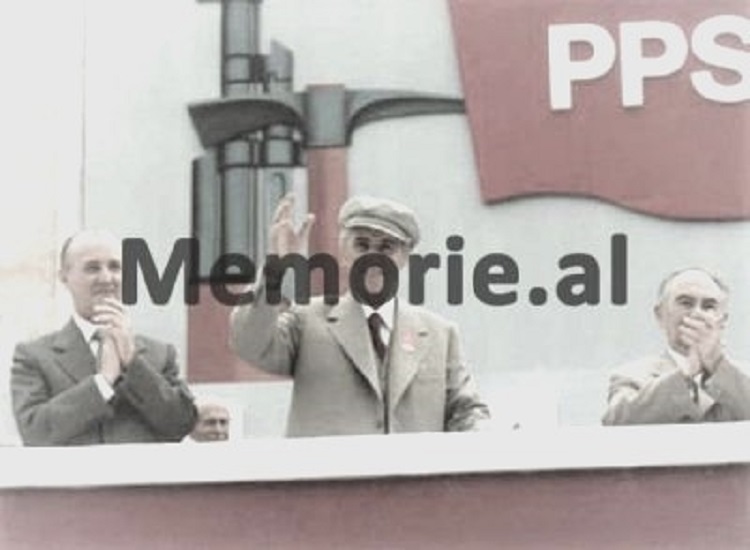
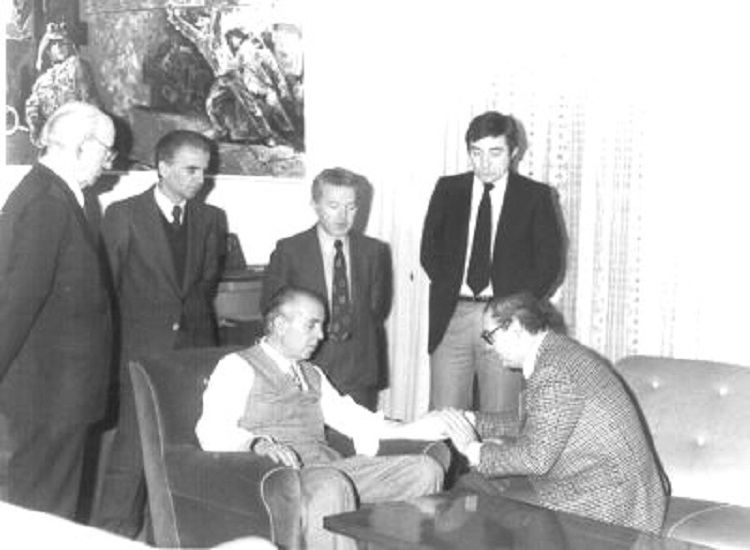
A doctor in Tirana reports that during the May 1st parade, leader Enver Hoxha appeared to have aged significantly within a single year. For the first time during that parade, comfortable armchairs were placed on the dignitaries’ platform. This was clearly done to prevent discomfort or fatigue for leader Hoxha. The parade lasted about two hours, and Hoxha remained seated almost the entire time. Other members of the Politburo did the same. It was observed that Hoxha had lost a great deal of weight and looked pale. Reports also indicated he moved his hands with difficulty. Another indicator of his health condition was the cancellation of his periodic trips to various towns across Albania.
March 1985
Summary of Enver Hoxha’s Health Condition
A report for headquarters on the health condition of Albania’s leader, Enver Hoxha. A friend of our agent, Prof. Zorzoli, traveled to Albania on the occasion of a medical seminar. He is a specialist in pulmonary diseases and examined Enver Hoxha during this visit. According to Zorzoli, Hoxha suffered from diabetes and circulatory issues. In 1976, Albert Zurani visited Albania with a group of businessmen from West Germany and met with Dr. Nikoll Shurbani, a friend from their high school days in Shkodra between 1934 and 1938.
Dr. Shurbani is a heart specialist and Enver Hoxha’s personal physician. Shurbani told Zurani that Hoxha experienced heart problems in 1976 and receives regular medical treatment and checkups. He mentioned that Shurbani instructed Hoxha to avoid stress and spend winters on the coast in Himara. Dr. Nikoll Shurbani graduated from the University of Bologna in 1943 and completed a three-year internship in Moscow in the late 1940s.
The Situation in 1983
During this year, a French doctor traveled to Albania, but no further details are available. The report was provided by Dr. Angelo Sferazza during a conversation with our agent in Rome in 1984. Year 1985: Our source had the opportunity to speak with Liljana Prendushi on March 11, the day she had just arrived from Albania. In the conversation, Hoxha’s health was brought up, and Prendushi stated that he was reported to be ill, with no one having seen him for four months.
Additional information regarding Hoxha’s health came from Ms. Silvia Zorzoli, a friend of the Albanian ambassador in Rome and also a friend of Seladin Bekteshi, the Albanian doctor who traveled to Italy, France, and Switzerland to handle the procurement of medications abroad.
March 1986
Albania One Year without Hoxha
Ramiz Alia continues to consolidate his power, one year after succeeding Hoxha at the helm of Europe’s most backward and isolated nation, but he faces severe economic problems that are likely to cause tensions within the leadership. Alia is energetically cultivating his image as the chosen successor of the dictator, and so far, he has taken no steps to alter the Stalinist foundations of his predecessor’s system. Nevertheless, Alia is gradually moving to place his own loyalists in key institutional positions.
He replaced the head of planning last summer and, at roughly the same time, installed an ally in the Party Secretariat…! In January, he reportedly dismissed Minister of Security Hekuran Isai, although the latter has recently appeared in public and retained his seat in the Politburo. Several other officials are expected to be reassigned, including Minister of Justice Prokop Murra, who remains at the head of the armed forces despite all of his predecessors having been purged. Alia’s position, as well as the influence of other leaders, will soon become clear at the upcoming party congress scheduled for June 3–8.
Economy
Alia is maintaining Hoxha’s stance on national self-reliance following successive rifts with Yugoslavia, the Soviet Union, and China. Economic growth ground to a halt following the break with Beijing in 1978, and last year’s drought wiped out any hopes of economic recovery. Furthermore, world market prices for Albanian commodities will remain low for at least several years to come.
Alia now appears to favor austerity over seeking another economic patron or abandoning Hoxha’s constitution, which prohibits foreign loans. However, according to the Western press, the Albanian working class is facing severe hardships, and a debate over economic strategy is expected to take place shortly.
Expansion of Contacts
Alia has escalated Hoxha’s efforts to expand the country’s economic contacts with the West, particularly those concerning modern technology. In 1970, Tirana maintained diplomatic relations with only 27 countries, whereas it now has ties with over 100 nations, including most of Western Europe. Socialist solidarity mandates maintaining connections with Third World communist regimes such as Cuba and Vietnam, but the desire to expand trade makes key Western ties essential.
Relations with Italy were on good terms until the incident involving six Albanians who sought political asylum at the Italian Embassy in Tirana, where they have remained since December. Albania is urgently seeking a resolution to the problem. In March, Tirana and West Germany’s Bonn conducted a fourth round of talks, despite several unresolved issues. The two countries may establish diplomatic relations starting next year. Relations with neighboring Greece have also improved, albeit slowly. According to a recent report, Athens is expected to announce the formal termination of the state of war between the two countries in May, which has persisted since World War II.
Alia is also following Hoxha’s line of strengthening trade relations with China and Asian nations, which are more receptive to inferior Albanian goods and products. In early December, Albania signed its first five-year treaty with China since the 1970s, as Alia attempts to secure increased contacts with both the East and the West – always ensuring that these do not compromise the country’s isolated political structure and institutions. Tirana’s long-standing fear of Yugoslav intentions continues to be a central concern for the communist authorities.
Albania’s grievances and attacks regarding the treatment of the Albanian minority in Yugoslavia, numbering around 2 million, keep relations perpetually strained. Nevertheless, the two sides are expected to open the first railway line between the two nations this year. Alia has continued hostile rhetoric against the United States and the Soviet Union as a fundamental principle of foreign policy. Moscow has intensified efforts to regain influence in Albania by offering signals of economic assistance and other enticements to the leadership.
However, Tirana has rejected its overtures, and the possibility of reviving ties appears slim. Western nations are sensitive to the Soviet threat and are therefore maintaining correct relations with Alia, taking into consideration his requests for cooperation while minimizing criticism. Nevertheless, they will continue to oppose Tirana’s self-isolation and the militant communist regime that suppresses human rights. / Memorie.al
Continued in the next issue