Part Twenty-Eight
Memorie.al / The CIA have shown the great role that the Soviet Union played in communist Albania. In several “Top Secret” documents, declassified for years, it is shown that the USSR built several important military bases, especially in the South of the country. There, details are given of the submarines that Moscow had on the island of Sazan and the Bay of Vlora, and likewise the air bases, such as that of Rinas, Kuçova, etc. Then a panorama of political developments is given, where the dismissal of the Minister of Defense, Beqir Balluku, in the summer of 1974, from all functions in the army and party, is mentioned. Likewise, a special place in the documents that the CIA has declassified are also those that speak of Albanian political emigrants in Yugoslavia, who are included in the Committee of Prizren, initially headed by Apostol Tanefi and under the pressures of the UDB, which recruits them with coercive measures, such as return to Albania, etc.
Continues from the previous issue
The Clash with the Yugoslavs
Although this is in fact anti-communism under a revisionist name, we think the operation can be effective if we have the right information available. We are also in favor of anti-communist content because they do not prefer to keep in Albania the same line of broadcasts as the Yugoslav ones. The Yugoslavs have their own interests in Albania and perhaps have better sources of information that they can exploit in their propaganda texts, therefore we should not be a supplement to their propaganda, because our revisionism is the same as their revisionism, even though we attack them from time to time.
Our opinions regarding the operations are merely evaluative for the future of the program. Currently, we think the operation is acting at its maximum according to the conditions of personnel, technical, and others in general. After the training of additional staff, we believe the new leaders will take responsibility for the project and we believe we will continue to work with the same intensity. Within a few weeks, we will send our request for the renewal of the project also for the fiscal year 1960, with the main arguments being the maintenance of the programs at the current level of transmission. If the headquarters has preliminary comments regarding the renewal plan, we will accept them with pleasure.
March 1952
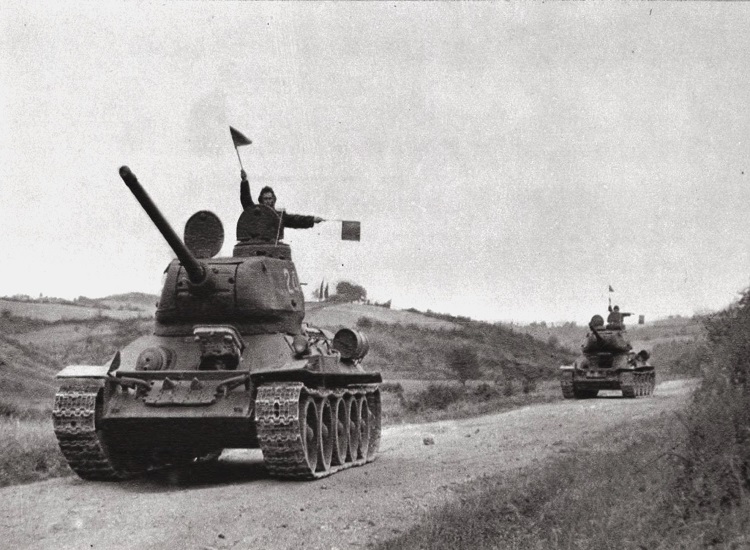
The ship “Dimitrov” of the Romanian cargo fleet Sovrontransport, stopped in Vlora, where it unloaded 84 crates with pharmaceutical goods and 10 persons of unknown nationality; the ship started sailing from Constanța in Romania and passed through the Bosphorus on December 30, 1951. The ship “Petrovski” registered with the USSR, during the voyage from Murmansk to Poti, stopped in Durrës between January 10 and 15, 1952, where it unloaded the following: Twelve tanks of a new type, which resembled the T-34 model. The tanks had no distinguishing marks while their cannons were packed in wooden crates.
Four large artillery cannons together with their bases, which are believed to be used in coastal defense installations. A torpedo boat that is believed to be used in patrolling Albanian waters. Among the persons who disembarked from Petrovski were at least four Soviets. The aforementioned tanks were left in the port’s dock for one night until the next evening, when they were equipped with Albanian personnel under the direction of Soviet specialists. Petrovski stayed in the port of Durrës for eight hours, until the completion of unloading, after which it is reported to have left.
Possible Exchange of Goods between Czechoslovakia and Albania
January 1950
The following report relates to possible exchanges of goods between Albania and Czechoslovakia and has been taken in the English language. Although the senders do not know the exact origin of the document, it is believed to have been prepared in the Czechoslovak office of the Ministry of Foreign Trade, and a signal for this is the name of the translator O. Cardeë, which is noted at the end of the report.
Report on the negotiations of our experts in Albania
Commercial-political observations
Among the main possible imports of Czechoslovakia from Albania is chromium ore, determined according to the agreement at 10,000 tons. Our trade delegation discovered that this quota could be increased to 15,000 tons. We need chromium for the ceramics industry with a minimum content of pure mineral, and the percentage of Albanian chromium of 40 percent purity is acceptable.
We will buy a total of 200 tons of walnut wood, according to the conditions of the preliminary agreement. Although Albanian wood is not cut properly, it is controlled, and our agreement can increase to 500 tons per year. Half of the mass can be used for industry, 30 percent for technical purposes, and the rest for boards.
Beech wood: Although the agreement quotas were for 50 tons, we doubt we can reach this quantity since Albania’s annual production of beech wood is around 200 tons. Other types of wood in Albania do not meet our industrial criteria, while Albanian oak also does not meet the criteria for building barrels. It can only be used in railway wagons.
According to the agreement, about 3,000 loads of animal offal will be sent from Albania, which our delegation calculated could be bought for about 5 million Czech crowns, to meet our needs. Albania’s annual production of animal offal is about 140,000 sheep offal and 250,000 offal from other cattle. Albania also produces special dried types of offal.
Medicinal herbs: The agreement does not specify the quantity of medicinal herbs, but Albania has many reserves of such herbs, some of which are dried according to criteria, but large quantities have been neglected and have gone out of function. Until now we have not organized the purchase of herbs and a group of experts should be sent to classify and select the herbs that Czechoslovakia seeks to buy. We are not interested in buying hemp from Albania since the samples brought by our experts turned out to be of inferior quality; therefore these imports are expected to be stopped by Czechoslovakia.
Horns and hooves: Albania has offered to bring 10,000 kg of mixed horns and hooves and 1,000 kg of horns, which have not yet been tested or verified.
Natural asphalt: Albanian asphalt is of high quality, almost like Trinidad asphalt, but the production mass in Albania is somewhat limited. Albania produces about 30,000 tons per year, of which it is calculated that about 6,000 tons can be bought for 8 million Czech crowns. They can be sent to Czechoslovakia this year. Daily production is somewhere around 80 tons. As long as there is no supply of metal sheets, Albania cannot increase its asphalt production and imports for us.
Fur skins: Albania has improved the quality of skins and their collection is organized. Their goat and sheep skins are suitable for the production of our export shoes. Even their soft skins can be used in industry. If Albania were to organize hunting with traps, it would gain large quantities of fur.
Czechoslovakia is interested in buying marten and otter fur, which are of high quality. But we are not interested in fox skin, due to lack of demand. Albania has few wild cats and bears. Vlora oak is abundant in Albania and is a good material for dyeing and processing skins. We would be interested in buying Vlora oak from Albania if it possesses 33 to 36 percent dye content for skins.
Seed oils: Albania’s annual production of sunflower is 6,500 to 7,000 tons, calculated at a value of about 35 million Czech crowns, while 100 tons of peanuts are valued at 3 million crowns. 1000 tons of castor oil is valued at 18 million Czech crowns and about 500 tons of sesame seeds are valued at 5 million crowns. We are also interested in Albania’s tobacco seeds, grape seeds, and about 100 tons of olive oil.
Cotton produced in Albania reaches 3,500 to 4,000 tons per year. We can use any amount of cotton from Albania and should buy at least 1,000 tons worth about 35 million crowns.
Wool: Albanian wool production reaches 1200 to 1500 tons. Czechoslovakia is interested in buying 300 to 500 tons worth respectively 15 million or 25 million crowns, and we are also interested in buying animal wool.
Laurel: We are not interested in buying laurel from Albania since we have already bought 50,000 kg from Italy, France, and Yugoslavia.
Juniper: This year Albania began to organize the collection of juniper and wants to know if we are interested in buying. Our average request is about 200,000 kg per year.
Resin: There are many possibilities for resin production in Albania, but the organized system of its collection is lacking.
Sulfurous minerals (pyrite): Czechoslovakia is interested in buying 10,000 tons. Albania’s annual production is about 20,000 tons. In Albania, pyrites are not sought by the mining industry since their use in copper production is very costly. Since we are interested in pyrites for our copper industry, we would need to supply Albania with the appropriate machinery for extraction.
Alabaster can be used in our industry while white gypsum for medical purposes. Our companies Keramiky and Metrans should have handled the transport in case of export, but to encourage Albania to export, political pressure must be exerted.
Copper: We are interested in Albania’s copper, the annual production of which reaches up to 2,000 tons.
Albania seeks in exchange for its exports materials for its industrial development such as spare parts for engines of machines produced in Czechoslovakia, parts for textile machinery, engine injectors, locomotive parts, machinery for cigarette production; it has a great demand for industrial measuring instruments, turbines, diesel engines, metal sheets, and materials for the sugar refinery in Korça.
We can give Albania a considerable amount of assistance in building industrial forest roads and in training Albanian forest workers in the correct use of wood. The population must learn modern methods of forest work, as Albania has not systematically used these reserves. Czech experts can prepare a long-term program for forest work in Albania. Albania can send a group of forest experts for training, who will qualify in the use of modern saws or in barrel production.
December 1961
Albania’s Relations with the Soviet Bloc
Albania’s relations with the Soviet Union and other countries of the satellite bloc have deteriorated significantly since April, perhaps as a result of discussions initiated by the Soviets regarding Albania’s so-called “deviation” from the Bloc’s line. The meeting of the political conference of the Warsaw Pact countries in Moscow on March 28-29, in which all Eastern European communist countries participated except Enver Hoxha’s regime, decided to initiate steps to isolate Albania from the rest of the Bloc.
On April 8, Moscow reminded the Albanians of their obligations to the socialist camp. In a radio broadcast, it was said that Albania is an equal-rights country of the Warsaw Treaty and has benefited from great economic aid from cooperation with other socialist countries. Albanian-Soviet political relations reached their lowest point in November in Moscow, when Hoxha and Khrushchev exchanged insults and criticisms before the delegations of 81 communist countries. The Albanians seem to be encouraged for this by the support of communist China. They have defended their positions even in the last party congress in Tirana, as well as in Hoxha’s speech on May 1st.
At a congress of labor unions, Albania announced the continuation of the trials of “spies and traitors” involved in the failed coup d’état last summer in Tirana, sponsored by Yugoslavia, Greece, and the United States. The proposed trials will most likely be held in the context of criticisms of the Soviets. The latter suspect that many of the arrested will be pro-Russian sympathizers. The Soviet media have not mentioned the congress at all and have reported only on the speech of the Soviet delegate.
Among other indicators of Tirana’s new isolation is Moscow’s praise for the April conference in Athens between representatives of Romania, Bulgaria, Yugoslavia, and Greece, calling it the “first post-war pan-Balkan conference,” even though the Albanian delegation failed to participate because Greece refused visas. Criticisms of Albania have also been mentioned in an article by the leader of the Italian Communist Party, Togliatti, in the newspaper “Rinascita.” / Memorie.al
Continues in the next issue