

Part Nineteen
Memorie.al / The CIA have shown the great role that the Soviet Union had in communist Albania. In several “Top Secret” documents but declassified for years, it is shown that the USSR built several important military bases especially in the South of the country. There are shown in detail the submarines that Moscow had on the island of Sazan and the Bay of Vlora, and likewise the air bases, such as that of Rinas, Kuçova, etc. Then a panorama of political developments is given, where the dismissal of Defense Minister Beqir Balluku in the summer of 1974 from all functions in the army and party is mentioned. Likewise, a special place in the documents that the CIA has declassified are also those that speak about Albanian political emigrants in Yugoslavia, who are included in the Committee of Prizren initially headed by Apostol Tanefi and under the pressures of the UDB [Yugoslav State Security], which recruits them with coercive measures, such as return to Albania, etc.
Continues from the previous issue
The current policy of the USA regarding Albania has as its objective the restoration of Albania’s independence through the overthrow of the current regime and its replacement with a government acceptable to the people of Albania. This government would enjoy the support of the United States as long as it remained friendly to the United States and its objectives, and hostile to the Soviet Union and its objectives. The US Government views positively the initiation of steps for the realization of its policy in Albania.
The economic support that the USA would give to a non-communist Albania would be small if we take into account the obligations of the USA in other countries. In pursuit of this policy the USA must act in cooperation with Great Britain and the two countries must take full responsibility and not delegate responsibility to other nations, however friendly they may be to the USA. But nevertheless the use of means and the taking of assistance from other countries such as France and Italy are possible.
The Taking of Measures
The United States and the allies must take preliminary measures for the prevention of Tito’s intervention in Albania; this risk can be reduced if measures are taken against the creation of a power vacuum in Albania, that is to say there should not be an interval between the disappearance of Hoxha and the arrival of the power of Albanians oriented toward the West. Before the presentation of the plan to the National Security Council, consultations must be made with the military establishment and General Van Fleet.
Operations
Secret contacts must be created with the different groups of the emigration with the aim of organizing a united front of all Albanian anti-communists, without political distinctions. The Balli Kombëtar group headed by Mit’hat Frashëri appears as the most qualified to take the leadership of the united front. Other groups must be invited for cooperation and must accept the leadership of Frashëri in the effort for the liberation of Albania from the domination of the communists. The seat of the national committee must be created in the right city, possibly Trieste, and other branches must be created in New York, Paris, Cairo and possibly Athens.
At the right time, the governments of Athens and Rome are to be informed about our benevolent aims in the direction of the united Albanian committee, with the aim of stopping their interventions in the activities of the committee. The British government must be informed, initially informally, to be assured about the mentality for Albania and the general program of policies. Trust must be gained for closer cooperation in the continuation of actions.
The French government must be informed, initially informally, to be assured about the mentality for Albania and to inform it about the creation of the Albanian National Committee. The measure of the involvement of the French government must be determined, mainly in secret operations, if the need arises.
February 1966
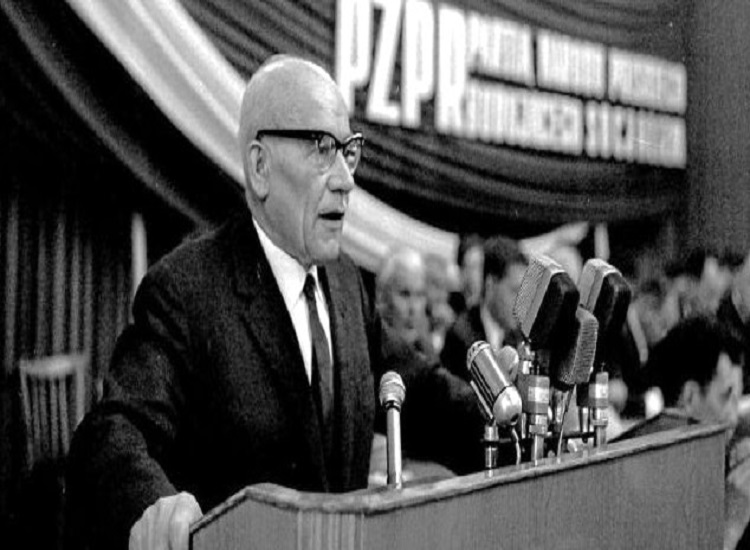
Relations between Warsaw and Tirana are worsening rapidly. The expulsion of the Albanian ambassador from Warsaw on February 23 appears to be partly a reaction to Albania’s antagonistic rhetoric and the public refusal a month earlier of the Polish initiative regarding Vietnam. They had privately proposed to the Communist Bloc a meeting for the coordination of aid for Hanoi. While the announced reasons for the departure were that Albania was involved in anti-state propaganda, as well as in the clandestine departure from Poland recently of the opposition activist, the first secretary of the party Gomulka.
But in fact the Albanian propaganda activities have been known for years by the Poles, although this time the new development was the Albanian connections with the Stalinists in the Polish party. Apparently the Poles had hoped that Tirana would follow their example and not pay attention to ideological problems within the party, and would work for the improvement of state relations.
Warsaw had announced on January 30 that its diplomatic mission in Tirana would again be headed by an ambassador, after an absence of five years. In recent months Tirana has shown interest in increasing ties with several chosen communist and non-communist countries. The manner and tone of Albania’s refusal of the Polish proposal clearly demonstrated that Tirana’s activity at the state level will not change its opposition to the “revisionist” policies of the Soviet Bloc.
August 1978
The Worsening of Albania-China Relations
The long declaration of the Albanian authorities last weekend is probably part of the increasingly intensive verbal war between the two former allied countries. The document gives a detailed response to last month’s announcement that China will end all economic and military aid to Albania.
China mentions as reasons the ever-greater demands of the Albanian authorities for aid, while the Albanian declaration attributes the problems to old disagreements with Beijing and accuses it of using economic and political pressure to bring the country to its knees, almost in the same manner as it reacted to the interruption of Soviet economic aid 17 years earlier.
The possible Chinese withdrawal in all likelihood will encourage the approach of the Soviets, who have sponsored the development of Albania since the 1950s. They are expected to intensify efforts for the smoothing of differences with Tirana, hoping not only to gain the lost influence in Albania, but also access to the naval bases there. The Albanian document emphasizes that Tirana hopes to minimize the economic effect of the separation from China, relying on its own resources.
The fact that the accusations focus on China’s approach with the USA, and its willingness to restore old ties with Moscow, suggests that at least for the moment, Albania will refuse any offer of approach both from the Soviet Union and from the United States.
CIA: After Hoxha’s death, Ramiz Alia began to establish his authority in the government; Adil Çarçani and Hekuran Isai were the most trusted people
The CIA has given details about Ramiz Alia’s power after the death of Enver Hoxha. According to declassified documents, Alia began to establish his authority in the government, while bringing closer his most trusted people. Even the CIA has shown that he brought into the government his brother-in-law, while it has listed all the trusted people, starting from Adil Çarçani to Hekuran Isai.
March 11, 1988
New York, Department of Justice
The consolidation of power by the First Secretary of the Party Ramiz Alia and consequently the establishment of diplomatic relations with Western countries. Our source that is a researcher and well acquainted with Albanian affairs has first-hand information on Albanian political leaders, including the current leader Ramiz Alia, with whom he was in a school. In several cases in the past he has given the FBI reliable information, while the following information was given by him on February 25, 1988:
Ramiz Alia, First Secretary of the Communist Party of Albania, president and commander of the armed forces, is successfully consolidating his power in Albania. Besides holding the first post in the country, he has filled the other three most important posts with his trusted people. These people have been close friends since the years 1944-1945, while they served together in the Seventh Partisan Brigade during the Second World War, where Alia was political commissar.
Ramiz Alia’s People
Adil Çarçani, Albanian prime minister (post number two in the country) has been commander of the Seventh Partisan Brigade. Hekuran Isai, Minister of Internal Affairs and deputy prime minister (post number three in the country), has been an officer in the Seventh Brigade. Among Isai’s responsibilities is the direction of the Police and Intelligence Services, known as Sigurimi.
Prokop Murra, Minister of Justice (post number four in the country) has also been an officer in the Seventh Partisan Brigade. All these people were raised to power by former leader Enver Hoxha before his death. Hoxha wanted to keep this clique to preserve his hegemony and that of his wife Nexhmije Hoxha.
Ramiz Alia’s Quota
After coming to power, Ramiz Alia also raised his brother-in-law Reiz Malile to the powerful post of Foreign Minister. Malile was described as an intelligent, serious man and loyal to Alia, and who took the post not only for his abilities, but also because of the relationship between them. Somewhere before 1973, Malile was ambassador in China, when his wife (Alia’s sister) together with two children was killed in an air accident while traveling from Beijing to Moscow.
Malile after this suffered a severe psychological shock and lost his mind for some time. But although he recovered and remarried, he still suffers occasional crises. Around 1981 or 1982, the bodies of his family came to Albania and Malile isolated himself for about two weeks, not speaking or meeting anyone. With the consolidation of Alia’s power, rumors have begun of a rupture between him and Hoxha’s wife. Nexhmija and her faction seek to preserve the isolationist policies of the former dictator, while Alia seeks a greater opening toward the West.
For the moment Alia is reported not to seek an opening toward the United States or the Soviet Union. In recent weeks Ramiz Alia has made several positive gestures toward Britain, including a citation in the local press, where he said: “If we and Great Britain sit down to discuss, we can solve our problems.” Alia has also announced that an Albanian football team will travel to Britain for several matches in the autumn of 1988 or in 1989.
Relations with Britain
Our source thinks that these developments are precursors to the establishment of diplomatic relations with Great Britain. During the last year Albania has established relations with Canada, West Germany and Greece. For reasons of urgent internal problems, our source thinks that the Albanian government accepts the need for developing the economy by means of trade with the West, especially with West Germany.
The latter have raised during the talks the issue of human rights, and for the first time the Albanian government is accepting certain sensitivity to world opinion regarding its human rights record. In a recent speech reported by the domestic press, Foto Çami, secretary of the central committee of the communist party (another man chosen by Ramiz Alia) mentioned the fact that Albania is being forced to improve its human rights record.
Çami denied having problems on this topic, mentioning that Albania had freedom of press and speech and that Albania had done a great service to its people by liberating it from the prejudices of religion. Although Çami’s speech denied the problems and abuses of the government, it was the first that discussed at a high level and publicly the affairs of human rights. Besides the changes of high-ranking personnel,
Ramiz Alia also brought younger, more educated people into all structures of the administration, who consequently would be loyal to him. There has been resistance to this from the old members of the party, and especially from Hoxha’s loyalists, but it is reported that these are being reduced in number. Our source predicts that in three or four years all the old loyalists of the regime will be passed aside, while Alia is being compared to a figure of the Gorbachev type, that is, moderate./ Memorie.al
Continues in the next issue