


Part Twenty-Seven
Memorie.al / The CIA have shown the great role that the Soviet Union played in communist Albania. In several “Top Secret” documents, declassified years ago, it is shown that the USSR built several important military bases, especially in the South of the country. There, the submarines that Moscow had on the island of Sazan and the Bay of Vlora are shown in detail, as well as the air bases, such as that of Rinas, Kuçova, etc. Then a panorama of political developments is given, where the dismissal of Defense Minister Beqir Balluku in the summer of 1974, from all functions in the army and party, is mentioned. Likewise, a special place in the documents that the CIA has declassified are also those that speak of Albanian political emigrants in Yugoslavia, who are incorporated into the Committee of Prizren, initially headed by Apostol Tanefi and under the pressures of the UDB, which recruits them with coercive measures, such as return to Albania, etc.
Continues from the previous issue
Conclusions
In conclusion, the branch accepted that according to field recommendations, the annual program for 1955 should be prepared. Among the recommendations received was the continuation of efforts for the development of intelligence inside Albania, the function of which is the supply of information for the support program from outside. The possibility of air-dropping falsified documents with the aim of provoking the regime will be studied, which will be supported by the campaign of fake threatening mail.
The campaign of encouraging desertions will continue, accompanied by new suggestions for ways of encouraging passive resistance in the population. Likewise, clandestine radio transmissions will continue, accompanied by the supporting campaign of propaganda brochures.
1 April 1952
Subject: Accusations of biological warfare
The document is the news bulletin regarding Moscow’s accusations of biological or poison warfare, as an attempt to discredit material aid for peoples suffering from famine in Soviet satellite countries, sent by emigration groups. The National Committee for “Free Albania” raised accusations today that Moscow has begun psychological warfare tactics, accusing the West of trying to poison the population of satellite countries with aid packages dropped from the air.
The USSR is trying at any cost to stop the feeling of sympathy that is spreading rapidly in the communist world after the giving of material aid by emigration groups in the Free World, for oppressed peoples. The NCFA spokesman mentioned Albania as an example where material aid has influenced the growth of support for the National Committee of “Free Albania,” and has led the red puppet government into chaos.
According to the NCFA, this news is being repeated in detail since the autumn. NCFA emissaries inside Albania have spread the news that despite one of the best harvest seasons in Albania’s history, the large quantity of crops has been sequestered by Enver Hoxha’s puppet government, to be sent to Russia, and the country’s population has been left with insufficient reserves to survive.
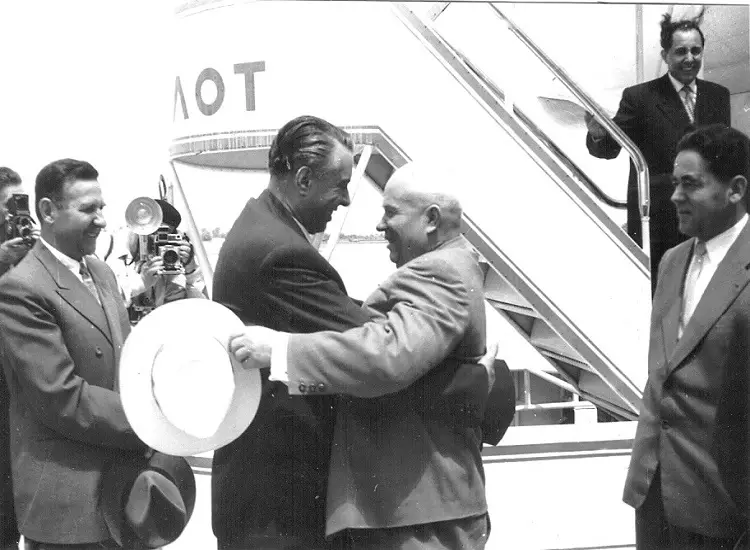
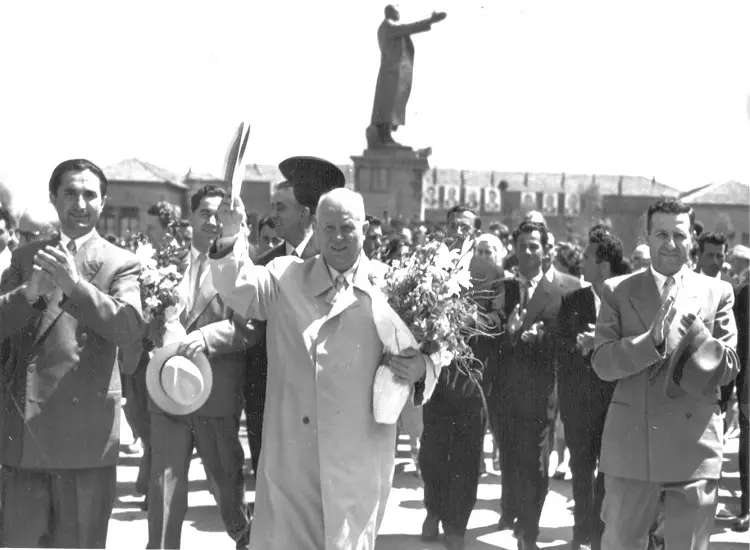
The CIA has given great importance to Nikita Khrushchev’s visit to Tirana in 1959. Through an article, his plans to visit our country and the internment that would follow are shown. In another document from the same year, the CIA shows how the Americans changed the plan for overthrowing the regime. The new plan was that through radio broadcasts, the figure of the party leaders would be denigrated.
May 1959
Khrushchev’s Visit
Radio Moscow announced on 20 May that Khrushchev will lead a party delegation that will stay in Albania from 25 May to 6 June. The visit, according to the announcement, was originally scheduled for the end of last year. No leader of rank close to Khrushchev had previously visited Albania. The time chosen for the visit suggests it is an attempt by Khrushchev not to give much importance to the earlier 27 May deadline and to assure the West that the USSR will not take unilateral steps during East-West negotiations.
Khrushchev may also use the visit to repeat his attacks against NATO. He may be joined by East German Prime Minister Otto Grotewohl, who arrived unexpectedly in Tirana on 15 May, for an indefinite stop. Greece and Turkey, two allies of NATO’s southeastern wing, have recently been criticized by Albania and Bulgaria for bilateral military agreements with the USA. Khrushchev may make other determinations of Soviet Bloc policies toward Yugoslavia, which is a favorite target for the Albanian regime as well.
On the return route, Khrushchev may visit Bulgaria, while Moscow announced in March that a party delegation will visit Bulgaria this year. Khrushchev has also said he would participate in the celebrations of the 40th anniversary of the founding of the Polish Workers’ Party in Warsaw, and in the second part of June has in his program a tour in Scandinavia, which will continue until the beginning of August.
April 1959
Summary of Operation OBTEST
This is an operation with a negative revisionist program in Albania, which has been operating for two years. Recent efforts to evaluate its technical effectiveness have been unsuccessful, but it is reported that “liberal” Albanian communists are aware of it. We have also learned that the Secretary of the Albanian Communist Party, Enver Hoxha, referred to the program in his speech of 3 March 1959 in the People’s Assembly. We think the program is operating effectively as far as circumstances allow.
In the long term, we have doubts about the recommendations of transmitting content the same as the Yugoslav one, and we believe the texts can be improved by expanding our line of attack with the inclusion of some anti-communist arguments. The clandestine radio program began in May 1957 and targets middle-level members of the Communist Party. Currently, a new text is being broadcast every five days, while transmissions last about 220 hours per month.
We think this level of production is optimal, as we have only one text writer. Besides the speaker and the text writer, the program staff includes a CIA officer and a regional officer who knows Albanian affairs well. Our group closely monitors the transmissions of Radio-Tirana, Radio-Belgrade, and Radio-Rome, for usable news and upcoming programs.
We usually get our information for programs from searches in the Albanian and Yugoslav press, from radio monitoring, and from suggestions from our main headquarters in monthly reports. Other valuable information comes from interrogations of Albanian emigrants and from Albanian refugees for whom we believe have valuable information for transmission.
Obstacles of the operation
One of the two major obstacles of the operation is the full exploitation of the revisionist line. Because most of the information reported is somewhat old, we cannot raise effective arguments on new events in Albania. Therefore we have relied more on repetition of negative developments in Albania, focusing on “Humanist Socialism” and “Scientific Socialism,” and not on ideological arguments. We have also created campaigns for promoting changes under the pretext of revisionism, with the argument that any improvement is for the good of socialism in Albania.
Two special campaigns through this principle are being used for the rehabilitation of the poet and Christian activist Gjergj Fishta, who has produced some of the most beautiful modern Albanian writings (who by coincidence was fiercely anti-Yugoslav), and the campaign for raising in the UN the problem of the persecution of Kosovars in Yugoslavia. When possible, the operation has attempted to embarrass high members of the regime, and during the last year has personally attacked Beqir Balluku, Gogo Nushi, and Adil Çarçani.
Exploiting the revisionist line, Operation OBTEST has passed into the dangerous line between a simple anti-regime approach and calling it an omen for Yugoslav revisionism. For the latter, one of the problems has been the risk that we are considered pro-Yugoslav by the communist regime, as an attempt to discredit us by exploiting the old Albanian fear of Yugoslav invasion.
Another major problem has been the evaluation of the technique and content of transmissions. We have conducted several operations inside and in the border areas of Albania to determine the program’s audibility. Monitoring from the Greek-Albanian border has been positive. We have also made periodic requests for monitoring in Tirana and two reports have been negative. From Belgrade, monitoring shows that the signal is strong and clear.
Jammers and the small number of radios
Despite the fact that monitoring operations have been incomplete and despite the fact that in Albania there are no more than 25,000 radio sets that catch shortwave transmissions, there is evidence that the programs are heard and they have their effect. In a report from our main headquarters, it was said that a “liberal” Albanian communist had heard the transmissions but thought the program was directed by a foreign power.
It should be emphasized that since Enver Hoxha mentioned our transmissions in the People’s Assembly, we have noticed a small increase in jammers during local transmissions. Although any hypothesis about the two references may be premature, we note two important aspects:
The two Albanian references to the transmission seem contradictory, because the country’s highest communist attacks the program’s propaganda, while a middle-level communist rejects it as propaganda of foreign countries.
Although Hoxha said the program propagandizes Yugoslav revisionism, he in fact attacked the transmission that called for more rights of Albanians vis-à-vis Yugoslavia.
The Operation
At this moment we have no plans for major changes in the operation, after the above comments. We have slightly re-adjusted its format in order to make our platform clearer to listeners, and we are investigating more aggressive ways to introduce the program into the interior of Albania. One of these ways is transmission on short waves and interference with Radio Shkodra, which we started on 3 February 1959.
In the long term, we have had some reservations regarding the purely revisionist line of the program and its effectiveness. The Albanian communist government is dependent on the Soviet Union for everything, even for the management of the government, therefore we cannot expect the government to change its way of governing.
Each of the communists has his doubts about the future, as do their capitalist colleagues, therefore we think our operation can exploit these doubts, for example; What happens if Hoxha loses power? Who is right in the debate between Shehu and Klosi? Would you allow someone like Balluku or Nushi to be your superior? In the same way, we can attack the Albanians’ inability regarding the Kosovo problem, or perhaps continue the campaign of rehabilitating Gjergj Fishta./Memorie.al
Continues in the next issue