Part Twenty-Six
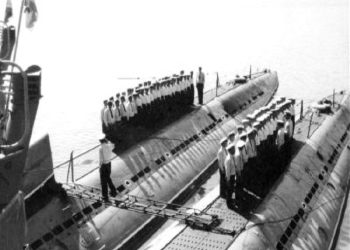
Memorie.al / The CIA have revealed the significant role played by the Soviet Union in communist Albania. Several “Top Secret” documents, declassified over the years, show that the USSR built major military bases, particularly in the south of the country. They details the Soviet submarines stationed on Sazan Island and in the Bay of Vlora, as well as airbases such as Rinas, Kuçova, and others. An overview of political developments follows, detailing the dismissal of Minister of Defense Beqir Balluku in the summer of 1974 from all his positions in the military and the party. Furthermore, a special section of the declassified CIA documents addresses Albanian political émigrés in Yugoslavia, who were integrated into the Prizren Committee – initially headed by Apostol Tanefi – and operated under pressure from the UDB, which recruited them through coercive measures, such as forced repatriation to Albania, among others.
To be continued in the next issue
3 March 1954: Establishment of the Anglo-Albanian Association in London
In December 1953, the Anglo-Albanian Association was created – a cultural and charitable organization under the leadership of Herbert, son of Lady Herbert-Carnarvon. Lady Herbert-Carnarvon was a longtime benefactor of Albania, founder of an important library in Tirana, and initiator of numerous charitable ventures across the country.
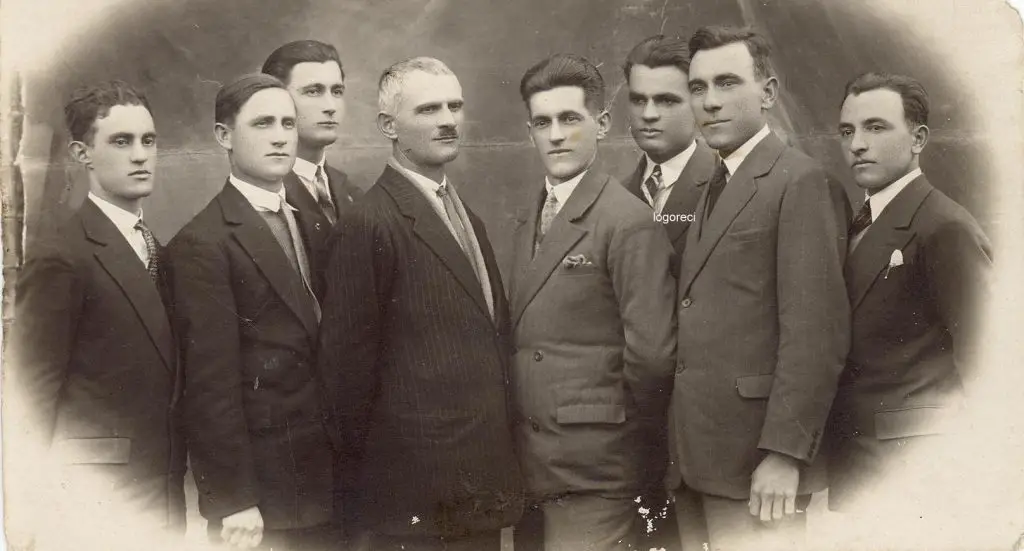
The Herbert – Carnarvon name is well-known and beloved in Albania. During January 1954, Anton Logoreci – an Albanian-language speaker for the BBC network and one of the most prominent figures in London’s Albanian community – visited Rome.
He reportedly traveled there to lay the groundwork for incorporating other groups, such as the “Balli Kombëtar Agrar”, into the London organization. Logoreci departed Rome after meeting with various groups, excluding the extremists of “Balli Kombëtar”. On his return trip, he is believed to have stopped in Portofino, where Lady Carnarvon owns a castle.
Abaz Ermeni is currently in Paris, where he is believed to be exploring options for publishing an Albanian-language newspaper. In Albanian circles in Rome, it is rumored that Lady Carnarvon will soon travel to the United States to attempt to raise funds for the association run by her son. These moves are believed to signal a well-defined campaign directed against the line of the NCFA.
The Role of “Balli Kombëtar”
This antagonistic activity is driven primarily by the leaders of the “Balli Kombëtar Agrar”, who undoubtedly receive funds from Britain disguised as charitable payments. Sait Kryeziu and Muharrem Bajraktari have predicted an early demise for the NCFA, or at least its complete paralysis. The financial reserves of “Balli Agrar” were recently transferred to France from an Italian bank where they had been originally deposited. “Balli Agrar” was formed during years when the party was receiving approximately $1,200 per month for charitable and propaganda purposes, as stated by Hasan Dosti in his “White Paper” document.
The repercussions of these British activities have been considerable within Albanian émigré circles. Some believe that the Americans’ lack of experience in this field will lead to the success of the British initiatives, which are viewed as detrimental to the Albanian cause.
Others secretly support these efforts, convinced that the British will ultimately control the situation in Albania and reward them accordingly. An unusual calm among the extremist leaders of Balli suggests they have gained support in their attempts to further divide the Albanian émigré factions.
28 September 1954: Conclusions on Albania’s Objectives and Projects
Among the objectives currently pursued is the preservation of the hope of liberation through the committee of Albanian émigré leaders, which remains loyal to the enslaved Albanian people and enjoys the support of the free world. Certain national directive objectives have been neglected, particularly those regarding the harassment of the regime and the encouragement of passive resistance that does not draw punishment or reprisals.
Regarding the goals of strengthening internal assets and preparing the ground for resistance against the Soviets, progress was admitted to be slow due to a shortage of qualified agents. The branch considers it desirable to build internal assets slowly and securely.
The Role of the National Committee for “Free Albania”
It is acknowledged that the operation has instilled the belief among Albanians that the National Committee for “Free Albania” is the sole émigré leadership group that is both loyal and supported by the major powers. Shortcomings include a lack of programs designed to foster passive resistance and harass the regime. A degree of success was achieved in draft-evasion and desertion encouragement programs, as a number of refugees who recently arrived in Greece were aware of them.
One explanation for the operation’s shortcomings is the lack of intelligence on conditions inside Albania. Significant attention is being paid to these deficiencies, particularly regarding the encouragement of selective desertions, which are now the subject of intensive propaganda from Athens. Encouraging passive resistance has encountered obstacles in producing tangible results without exposing anti-communist elements to severe consequences.
Leaflet Drops
To mitigate future deficiencies, the branch is expected to explore the possibility of dropping forged documents that would grant the finder special privileges, such as food rations or vacations at seaside camps. The branch will prioritize harassment opportunities made possible by the recent opening of postal channels into Albania from Eastern European countries.
Other aspects of the mail campaign will be examined to maximize its effectiveness as a tool of harassment. The branch and staff will review harassment campaign instructions to select those most suitable for Albania, while simultaneously encouraging a clearer understanding of passive resistance tactics that carry minimal risks.
Food Supplies
Efforts will continue to secure food supplies for distribution in the committee’s name, both inside Albania and for needy Albanian refugees abroad. After three years of broadcasting under Operation OBTEST, there is only scattered evidence of reception in Albania, but it was agreed that the project should continue indefinitely.
The rationale rests on the recent reduction in jammer signal strength and the fact that refugees from various parts of Albania were familiar with the programs. Furthermore, project operational costs remain low and equipment is already installed. The staff is simultaneously utilized for the leaflet-dropping program; discontinuing it would signal a waning West interest to both the authorities and the Albanian public.
The operation is also believed to have succeeded in building the Committee’s reputation inside Albania. Regarding the aerial text program, it was credited as the primary reason for successfully building the émigré Committee’s reputation in the country. Among the issues discussed were difficulties in establishing alternative delivery routes, printing equipment problems, and reports that leaflets were not dropped in heavily populated areas – though none of these challenges are insurmountable.
A shortage of field agents to supplement local personnel was also noted. Supply drops received a largely negative reception; interviews with several refugees revealed a degree of resentment toward the Committee for providing goods that fell into communist hands.
This ran counter to calculations that popular anger would be directed at the communists for confiscating the goods. However, since no further negative reactions have been noted since drops resumed last year, it was decided to evaluate the initiative once the supply packages in Athens are exhausted. Monthly field reports will be sought regarding this matter.
December 1969: Beijing Emphasizes Economic Support for Albania
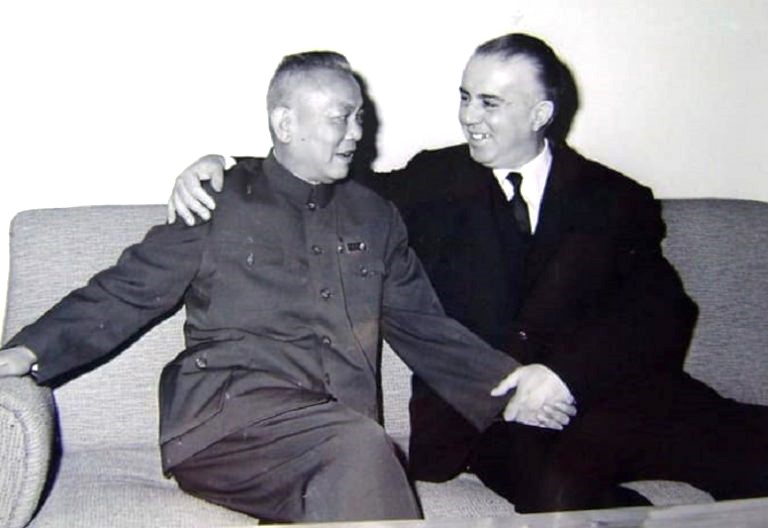
In a speech delivered on 30 November, Li Xiannian, head of the Chinese delegation currently in Albania for the 25th anniversary of liberation, emphasized Albania’s economic development. The tone of his speech, combined with the delegation’s composition, suggests that Beijing will firmly honor its promised economic support to Tirana.
Under an agreement signed a year ago covering the 1969–1975 period, China will supply the country with machinery and equipment—including complete manufacturing plants—for the steel, petroleum, electric power, and non-ferrous metal industries. Although the total aid amount was not disclosed, it is expected to represent a significant increase over previous deliveries, which have totaled roughly $280 million since 1955.
Following the termination of assistance from the Soviet Union and other Eastern Bloc satellite nations in 1960, Albania has relied increasingly on Beijing’s economic aid. Tirana has recently expressed interest in purchasing more industrial goods from the Western world, but progress is hampered by a shortage of foreign currency and Albania’s refusal to accept foreign credit.
December 1970: Improvement of Ties with Yugoslavia
The 25th anniversary of the Republic of Yugoslavia and the conclusion of the annual bilateral protocol provided a favorable opportunity for both sides to demonstrate their willingness to continue the rapprochement initiated in late 1968. Commenting on the Yugoslav holiday, Tirana avoided any mention of outstanding disputes between the two countries – a tone unseen in over 20 years – and instead praised their shared experiences and popular unity.
The commentary aligned with leader Hoxha’s speech in May and a statement issued by Tirana marking the 29th anniversary of the Nazi invasion of Yugoslavia. Responding to Yugoslav criticism following an increase in Albanian trade with Bulgaria at Belgrade’s expense, Tirana assured the Yugoslavs that they would always find a friend in Albania, and that Yugoslavia’s enemies were enemies of the Albanian people as well.
The trade protocol for 1971 was signed in Belgrade on 26 November. For the first time, both nations agreed to long-term economic consultations spanning 1971–1975. The Albanian delegation received red-carpet treatment in Belgrade, which included a guided tour of the joint Romanian-Yugoslav “Iron Gates” hydroelectric dam on the Danube. The Yugoslavs have sought further improvements in relations with Albania, but have signaled that the willingness to do so must first be demonstrated by Tirana, which now appears to be taking steps in that direction.
April 1970: Albania–China Relations
No concrete evidence has surfaced to support assumptions that Albania’s recent diplomatic moves reflect a rift in Tirana’s relations with China. Speculation arose among several NATO member powers following reports that Tirana had made overtures toward establishing diplomatic and economic ties with non-communist European nations. Beijing has made no public comment on the matter, and day-to-day relations between the two countries remain unaffected. Albanian propaganda continues to heap praise on Chinese policies while launching fierce attacks against what it characterizes as policy coordination between Moscow and Washington directed against Beijing.
Beijing has insisted it will continue providing intensive aid to Albania. On 3 January, the two sides signed a scientific and technical cooperation protocol providing for exchanges of documentation and personnel. Weeks after the signing, Chinese Minister of Foreign Trade Lin Hai-jun led a delegation to Tirana to sign the 1970 protocol. Although details of the accord were not made public, the tone of official speeches indicates that Beijing will maintain its assistance to Albania.
November 1975: Albania’s Stance Toward China
The line taken by Albanian party leader Hoxha regarding China at this week’s congress was more restrained and defensive than at the 1971 congress, yet far less negative than reported in the local press. Relations with China have cooled since 1971, and uncertainties surrounding the new Chinese leadership have fostered reservations among the Albanians.
Hoxha prioritized China in the foreign policy section of his address. He defended China’s economic and material assistance while telling his audience that the key principle for Albania remains self-reliance. Hoxha praised Mao Zedong and referenced the “counter-revolutionary plots” of Lin Biao and Deng Xiaoping.
He made no reference to China’s new leaders nor did he mention the purges of left-wing elements. One of the recently purged Chinese communist radicals – propagandist and Politburo member Yao Wenyuan – had received an enthusiastic welcome during a visit to Tirana in 1974. Diplomats close to developments in Tirana report a cooling of relations between China and Albania, even though China remains the country’s largest trading partner, accounting for 50 percent of its trade volume.
The French believe the Albanians are dissatisfied with Eastern European trade and are cautiously trying to expand economic contacts with the West. This course has long been encouraged by the Chinese, though Hoxha in his speeches insists on maintaining ideological safeguards while seeking new markets. / Memorie.al
To be continued in the next issue