

Part Twenty-Four
Memorie.al / The CIA has shown the great role that the Soviet Union played in communist Albania. In several “Top Secret” documents, declassified years ago, it is shown that the USSR built several important military bases, especially in the South of the country. There, the submarines that Moscow had on the island of Sazan and the Bay of Vlora are shown in detail, as well as the air bases, such as that of Rinas, Kuçova, etc. Afterwards, a panorama of political developments is given, where the dismissal of Defense Minister Beqir Balluku in the summer of 1974 from all functions in the army and party is mentioned. Likewise, a special place in the documents that the CIA has declassified are also those that speak about Albanian political emigrants in Yugoslavia, who are incorporated into the Committee of Prizren, initially headed by Apostol Tanefi and under the pressures of the UDB, which recruits them with coercive measures, such as return to Albania, etc.
February 1951
Military Fortifications, Turkish newspaper “Cumhuriyet”
In 1948, a group of Soviet officers and engineers came to the city of Vlora, accompanied by civilian assistants and specialists of the German army. The Soviet group ordered the immediate emptying of the best houses in Vlora so that they could be installed in them. The specialists had as their aim the taking of control by the Soviets of the Strait of Vlora and later with the fortification of the island of Sazan, at the entrance of the Bay of Vlora. The island of Sazan has a rocky surface of 2.5 square km. It is mainly granite like Gibraltar and is filled with tunnels and caves opened by man.
The island is only 55 miles from the Italian port of Otranto and a perfect location for a submarine base. With its position the island can block the entrance to the Adriatic, just as Gibraltar can block the entrance to the Mediterranean from the Atlantic Ocean. Rockets launched from Sazan can easily hit Otranto, which was Italy’s largest military base during the Second World War. The island’s galleries are maintained to accommodate thousands of soldiers. If Soviet claims can be believed, then they may have fortified Sazan even with protection against atomic bomb attacks, while their specialists say that atomic radiation does not affect the island.
According to information from Western intelligence organizations, the Soviets have installed anti-aircraft artillery on the island. The Bay of Vlora is also protected by the heights of about 1000 meters of Karaburun, while in the north Vlora has swamps about 6-7 miles wide. According to refugees who fled from Albania to Italy and Yugoslavia, German and Soviet experts are turning the island of Sazan into an important rocket point and Vlora itself into a gigantic naval military base.
The people of Vlora are not communist and when the important Soviet delegation arrived at the port, the mayor protested and in the name of the residents opposed the presence of Germans among the Soviets, because of the wartime grudge. But Enver Hoxha stopped these accusations, saying that any further protest against the Soviets would be considered treason.
After this came the squads of the Ministry of Internal Affairs and put the entire city under surveillance. All residents of Vlora who did not take Soviet coupons were excluded from the city, while those who remained in the city were not allowed to leave without special permission. After the removal of undesirable persons, Soviet ships began bringing people, materials and equipment. Among the workers who came there were also convicts from distant Soviet camps. The population of Vlora and its surroundings in a radius of 25 km was ordered to register for work in the construction projects, in which boys and girls of 12 or 13 years old were also included.
Before the Second World War, German military experts had visited the Sazan base and had determined that the military installations there were unsuitable, except for the galleries and interior spaces built by the Italians that were in perfect condition. Today all installations have been improved and old armaments have been replaced with the latest Soviet models. Rocket systems and hidden connecting channels of tunnels with the sea have been built. In the mountains of Karaburun, rocket units have also been installed, while other mysterious works are being carried out by means of prisoners at the top of the mountain of Kanina. These latter are believed to be radars.
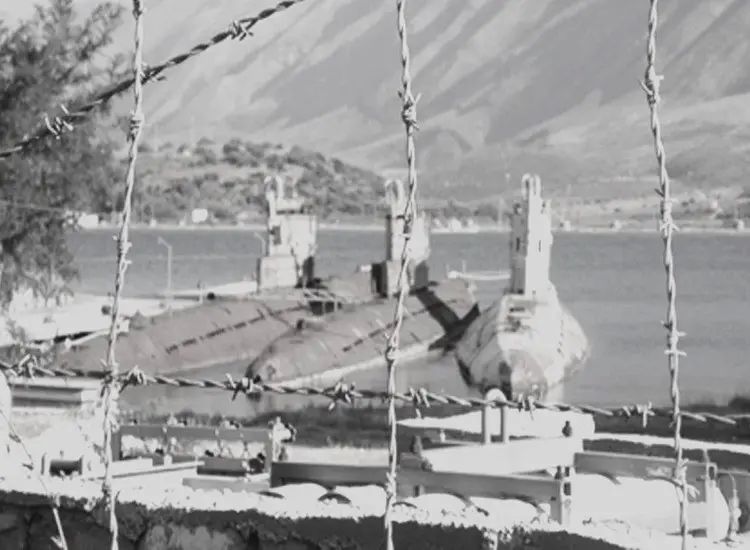
The most important installation of the area is the Soviet submarine base. The steep shores of the Bay of Vlora have many natural cavities, which have been turned into submarine docking places. Several Soviet submarines are already stationed at the points of Pasha Liman, which are believed to be of the German “Ualther” type, which were produced from the end of the war. These submarines are superior to the “Shnorkels” and have a speed of 26 miles per hour.
It is not known how many German “Uelther” submarines the Soviets possess, but their number is calculated at around 200 and others are under construction. According to specialists, up to 60 “Ualther” submarines can be kept in Vlora. Although the break with Tito’s Yugoslavia has interrupted direct communication with Albania, the Soviets now maintain communications by air routes. Soviet transport aircraft TU-2 with four engines make daily flights from Budapest, Sofia and Tirana.
August 1953
Hydroelectric Energy, Oil, Ports
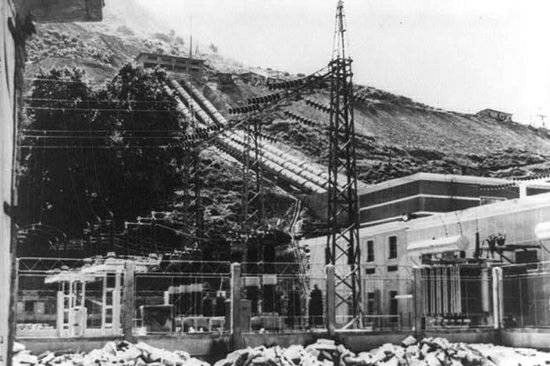
Work has continued for the benefit of hydroelectric energy from the Mat River. This is a fast mountain river which at the peak of the season comes out of its bed and floods the lands and produce of the peasants of the area. Within the framework of the five-year plan in the summer of 1952, the planning work began for the construction of the dam of the Mat hydroelectric plant in the village of Ulza, which will be called “Enver Hoxha”. The dam will be 60 meters high and 200 meters long and will form an artificial reservoir with a surface of about 20 square kilometers.
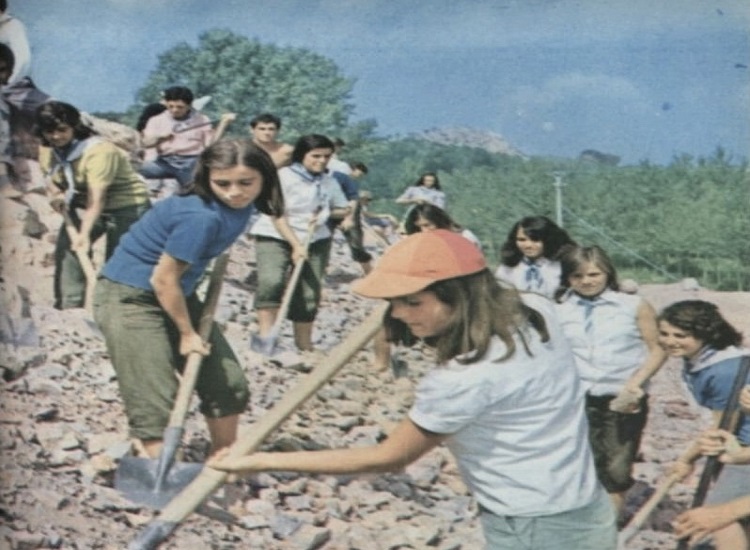
Thousands of young volunteers have started the construction work, initially of the 40 km road in the difficult mountainous terrain. The Mat River springs between two steep rocks about 130 meters high, while the road passes through terrain about 70 meters above sea level. The road is being opened by means of explosions and the hard work of volunteers.
The Cërrik Refinery
The oil refinery in Cërrik is one of the major projects of the five-year plan. Work has begun for the construction of residential premises for workers and specialists. The new village will have 1000 residential apartments, schools, a medical center and a sports stadium. With the entire refinery the territory will include 120 hectares. The industrial center will be connected to Durrës and Tirana with a railway of 7 kilometers. The Soviet methods Kulikov and Levchenko-Mukanov have been planned successfully and many of the employees have already become specialists.
Durrës Turns into a Major Adriatic Port
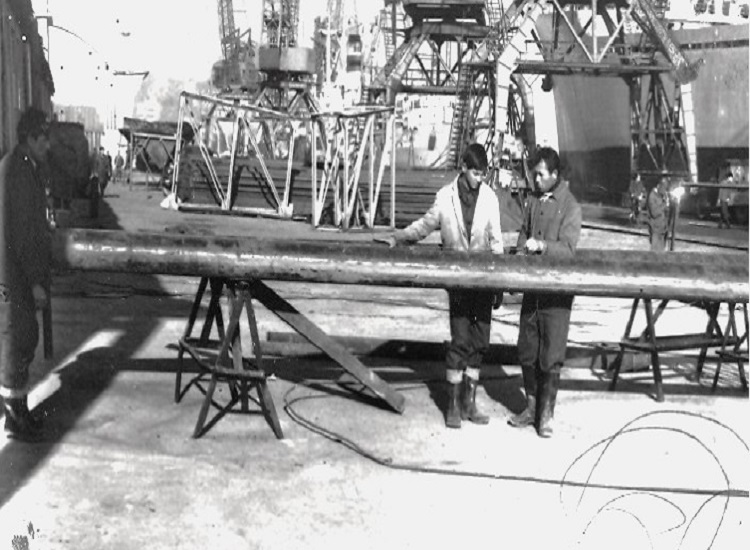
The Albanian port of Durrës has recently turned into an important transit point while Polish and Soviet ships bring locomotives, engines, trucks and passenger cars from Czechoslovakia and the German Democratic Republic. While Bulgarian and Romanian ships bring cement, paper, cranes, oil products and electrical equipment. Soviet ships Chiaturi, Kuban, Kotovski and Voroshilov bring tractors, industrial equipment, textiles and food products.
Even today Tito’s Yugoslavia continues to plunder Albania. It has stolen from the port of Durrës a floating sea crane with a lifting power of 70 tons, as well as the Albanian ship Borova. The Yugoslavs have always tried to destroy Durrës. With the help of the USSR, the Albanian government has renovated the port with new cranes and anchoring facilities. The new hydroelectric plant “Lenin” supplies Durrës with electricity, adding to the amount of work.
March 1953
Economy, Data on the Textile Industry
According to the East German daily “Aussenhandels Nachrichten”, on October 25, 1952, the Albanian textile industry fulfilled the production plan for the first nine months of the year. Compared to the same period of 1951, the industry produced seven times more pieces of different types. State shops and cooperatives have offered buyers in 1952 28 types of woolen fabrics and with printed motifs, most of which produced by the Stalin textile combine, the newspaper says. While industry employees have given customers 5 percent more knitted goods and socks, which previously came from imports.
The newspaper says that the textile industry has had great development since the years of liberation, with the construction of new factories and the increase in capacity of existing ones. Textile production in 1951 was 15 times greater than that in 1938. In a previous edition “Aussenhandels Nachrichten” reported that during the five-year plan 1951-1955 Albanian textile production would increase by 19 times compared to that of pre-war. The modern textile combine in Tirana is equipped with the latest Soviet machinery and has laid the foundations of textile production on a large scale.
The newspaper reports that its production capacity is 20 million meters of cotton fabric per year, thus fulfilling all internal needs of Albania. On May 27 “Zëri i Popullit” reported that the technical improvements of the combine had significantly increased production and machines that were previously operated by three or four people can now function with only one. The newspaper said that the three main tasks of the communist leaders of the combine were the realization of the five-year plan, keeping the machines in function and the acquisition of new techniques.
The newspaper added that in a meeting of the party organization some functionaries of the combine were criticized who had allowed the damage of machines and consequently the reduction of production. In one of the cited examples, one of the engineers Nazir Shkurti, who had neglected the inspections of machines, had allowed the consumption of a wire of the machine.
The party organization criticized the union and decided on the increase of the work spirit and socialist rivalry among the sectors of the combine. Even in the textile combine of Shkodra with 92 workers, the application of the latest Soviet methods has given satisfactory results.
Production methods such as “Levchenko-Mukanov” and “Afganova-Zhandarova” have made the plan be realized and even saving about 237,000 lekë in an 11-month period. “Zëri i Popullit” cited the example of Lirie Kallogjeri, who had started work in the Shkodra combine when she was 15 years old, and now was one of the first users of the “Levchenko-Mukanov” method and four other Soviet methods of knitting for tying threads and preventing waste.
Silkworms
“Zëri i Popullit” reported on May 30 that the raising of silkworms is a traditional activity for the women of the Kruja area, who in 1951 produced 800 grams of silkworm eggs, and in 1952, 1245 grams. The newspaper wrote that the employees of the veterinary office of the party and women’s organizations had paid special attention to this field.
The women’s collectives began silk production in May 1952 with positive results in localities such as Gashë Qese, Xunia Pistole and Hani Dema. According to “Zëri i Popullit”, in 1951 one gram of silkworm eggs produced 2 kg of silk. Tana Veseli, who had obtained 2 kg of silk from each gram of eggs, has sold to the cooperative 17 kg of silk and has benefited as a reward 31 meters of fabric, 6 kg of sugar, 6 kg of soap and 6 liters of kerosene.
August 1953
Economic Situation in the First Quarter of 1953
The recent campaign but the forced loans have made the population enter into debt of about 470 million lekë. The loans have caused many difficulties and have increased the obligations on the ridiculous salaries that the government has set. This comes at a time when the costs of living are increasing, therefore the economic situation remains very serious, not to say tragic.
The shortages of food items are visible and the food situation is so difficult that even leeks have been put into the rationing regime. Bread is of the poorest quality and difficult to eat. Meat has disappeared from the market, while the price of apples has reached 150 lekë per kg.
To cope with the difficult food situation, the Council of Ministers has approved the new system for land classification. This means that every farmer must deliver to the state a measure of his produce according to what is determined by the commission. Among other measures are included several land drainage projects, such as the Tërbuf swamp in Korça and drainage for irrigation of lands such as the Vjosë-Fier canal.
Many projects have already started in the industrial field. The bitumen processing factory has been built in Selenica, as well as the oil refinery in Patos. Among the government’s projects are included modernization of mines, installation of new equipment, construction of electric lines, and installation of turbines in hydroelectric plants. Initially industrial materials were brought to Albania free of charge, but the current industrial situation has changed and the industrial commitments of communist countries have made it necessary to request at least partial payment. / Memorie.al
Continues in the next issue