By Jakov Milaj
The “Shkje” of Shkodra
Memorie.al / The two foreign consulates in Shkodra were breeding grounds for division and espionage. But the Yugoslav one also had an entire community, the Orthodox one, which it tried to direct toward its own aims. The majority of the “shkje” of Shkodra had come from Berat, Kavaja, Durrës, Struga, and Manastir. So, almost all of them were Albanians. Very few had come from Montenegro and, among them; there were quite a few from Kuçi and Pipri, or from other regions of Albanian origin.
Nevertheless, propaganda presented them as early Slavs who were staying there in the hope that one day they would hand over the keys of Rozafa to the king of the Serbs, Croats, and Slovenes. To strengthen the Slavic feelings of this “minority,” the government of Belgrade had opened an elementary school here, and the majority of the children, who completed this school, in order to continue their secondary education, were sent mostly to Bitol, where they studied theology or pedagogy.
For these secondary school students and the rare university student, the consulate had organized the Cultural and Sports Society “Obiliq,” whose members always stayed together, listened to the propagandistic words of the consulate’s people, and spent their summer vacations somewhat detached from their peers of the other two communities.
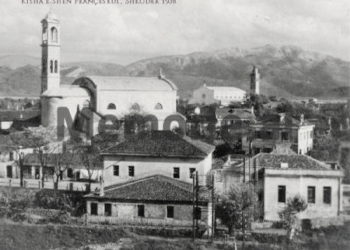
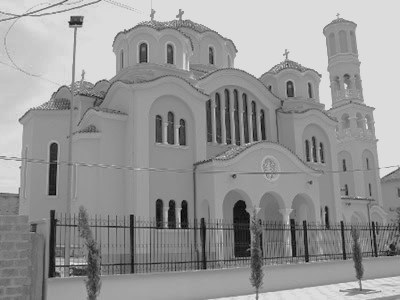
In a small street that led out to Fushë të Çelës there was also a new church, with a priest who had come from Montenegro and with a bishop who did not know a single word of Albanian. Thus, for the two hundred Orthodox families of Shkodra and for the village of Vraka, that is, for only two parishes, there was a separate bishop.
Besides these, another priest with the rank of protopresbyter, but dressed in civilian clothes, stayed in Shkodra as an inspector of the graves of Yugoslavs killed in wars. It is likely that he had even greater importance than the bishop. He spent the day at the café “Adriatik” and in a loud baritone voice conversed, not only with his table companions, but also with those who passed by on the Great Street.
It seems he wanted the presence of Yugoslavia to be felt even in the midst of Shkodra. He celebrated the liturgy only rarely, on some great feast day or on the national holidays of his own country, and whenever he wore the vestments of the mass, he delivered long speeches of a more political than religious character, in the Slavic language, to strengthen the Slavic feeling in the believers whom “bad fate” had temporarily severed from the “motherland.”
The Serbian church of Shkodra was an abscess on the body of free Albania. And strangely, our government had accepted, in silence, this dangerous abscess. On Flag Day, when “tedeume” were held in the mosque of Çela and in the Great Church, our authorities did not go, according to the custom applied throughout Albania, also to the church of the shkje, because it was considered foreign.
But the Orthodox of Shkodra did not pay heed to the propaganda of the protopresbyter and the bishop. These, the majority, were simple people who looked after their own troubles. They worked mostly as bakers, masons, and plasterers. Among them there were also patriots who had proven their Albanian feelings with rifle and pen.
In general, the Orthodox was a factor of rapprochement between Muslims and Catholics. In time, these proved that neither the sermons of the church, nor the words of the consuls, nor the advice of the pedagogues of Bitol and Belgrade tore out from them the feeling of Albanianism.
In the spring of 1929, Gabriel Meksi gathered us, the Orthodox students of the Gymnasium, and advised us to organize a small choir to chant in Albanian the mournful laments of Good Friday and some simple troparion on Easter day.
He convinced us by presenting it as a patriotic act that would be carried out in an environment that officially considered itself Slavic and said the mass only in Slavic. We accepted and tried to find some leader who understood Byzantine religious music.
Finally we found one. He was a baker somewhat older than us, Risto Plevneshi, who accepted the burden with pleasure and for several days in a row left his work at the bakery and occupied him with us. Besides him, another young baker, Pjetër Kostandini, also approached us from the Orthodox of Shkodra. Thus we became seven in total; besides the first two and Dhimitër Pinguli, Thoma Qereshniku, Vasil Konomi, Vasil Foti, and I.
On Friday night we went to the church to sing what we had learned. We thought we would encounter some opposition. So thought also many Catholic and Muslim intellectuals and many students, who that evening had gathered in the Orthodox church, self-understood not to pray, but to rejoice with us and to take a stand in case objections arose.
Strangely, neither the Yugoslav consul-general, who was supposedly very religious nor every Sunday tossed into the collection plate a coin with crowns, nor the famous protopresbyter came to the church that night.
The singing of the laments and of some other troparion went very well. Not only all those who had entered the church, but also many “shkje” smiled because they saw for the first time that people could converse with God not only in Old Slavic, but also in the Albanian language.
This choir was re-formed again before Easter of the year 1930. Now it was three times the size of that of 1929. I have kept a photograph of this choir. I have tried to recall the names of its members, but it has not been possible. More than half are young Orthodox Shkodrans.
Without my leaving the Gymnasium, the Slavic church of Shkodra was Albanized. The bishop left; the protopresbyter prayed only at the graves of the Yugoslav soldiers fallen in wars to conquer the lands of Albania. In their place, a bishop of the Autocephalous Church of Tirana was sent here.
Later, in 1933, the elementary school was closed. The Obiliq society also ceased its activity and its members joined with their Catholic and Muslim brothers and took part in the societies of our country.
For anyone, the fact was unexpected: how the Orthodox youth of Shkodra immediately detached themselves from the influence of the Yugoslav consulate and gave indisputable proofs for their Albanianism.
The call of the blood of the ancestors. During the National Liberation War, many of them became leaders of çetas and later of units, fell as martyrs for Albania, and were honored even with the title “Hero of the People.” / Memorie.al