




By DASHNOR KALOÇI
Part Two
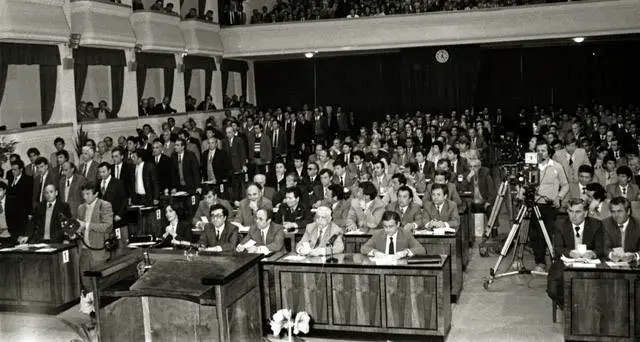
Memorie.al – Just ten days had passed since the first pluralist elections of March 31, and the two main political forces, the Party of Labour and the Democratic Party, along with their allies, who had emerged from those elections, were on the verge of opening the first pluralist People’s Assembly, when the Political Bureau of the Central Committee of the Party of Labour of Albania, headed by its General Secretary Ramiz Alia (who also held the post of Chairman of the Presidium of the People’s Assembly of the Socialist People’s Republic of Albania), held a lengthy meeting on April 11, 1991. Besides the tragic events of April 2 in the city of Shkodra, which was the first item on the agenda, they also discussed the problems arising with the opening of the first session of the first pluralist Parliament—an extremely significant event, as it was happening for the first time after 45 years of rule under the communist regime of Enver Hoxha and his successor, Ramiz Alia.
As we will see from the minutes of this meeting of the Political Bureau of the Central Committee of the PPSH, several of the most radical problems of the political drama that Albania was undergoing in the spring of 1991 were reviewed and discussed. These minutes clearly reveal the behind-the-scenes maneuvering of the communist power then in place, led by Ramiz Alia, which was in its final throes and facing its inevitable fall, marked by bloody events such as those of April 2 in Shkodra, as well as the unfamiliar challenges of political pluralism.
Accordingly, this archival document sheds light on three key issues that were agitating the country’s leadership dome in those critical days. The most interesting part concerns the political “architecture” that the PPSH was projecting for the new Assembly, which included 54 agronomists and 35 doctors. The discussions on the division of parliamentary commissions, the study of the Bulgarian experience, the proposal of new figures such as Kastriot Islami at the head of the parliament, and the preparations for confronting the new opposition (the Democratic Party) clearly reveal all the efforts and démarches that the still-ruling PPSH was making to try to maintain control of power through constitutional procedures and parliamentary diplomacy. The document in question is published here in its entirety and without any cuts, preserving the full dynamics of the speeches, the terminology of the time, and the interventions of the members of the Political Bureau – starting from its head, Ramiz Alia, followed by Xhelil Gjoni, Adil Çarçani, Hekuran Isai, Spiro Dede, Abdyl Backa, and others.
Equally interesting are the discussions of the highest leaders of the PPSH, not only regarding the names of their political force that they were selecting to lead the government, constitutional institutions, or the parliamentary group and commissions—such as Fatos Nano, Ylli Bufi, Leontjev Çuçi, Haxhi Lleshi, Llambi Gegprifti, Shane Korbeci, Ismail Lleshi, Petro Dode, Fehmi Avdiu, Çun Jonuzi, Engjëll Kolaneci, Ajli Alushani, Kleanthi Koçi, Pëllumb Kapo, Bujar Kolaneci, Fatmir Minguli, Lush Përpali, Tahir Elezi, Lefter Xhuveli, Bilbil Jaupi, Agron Dibra, Hajredin Tahiri, Isuf Dautllari, Muharrem Mezini, Pavllo Bojaxhiu, Kostandin Hoxha, Sotir Kokeri, Fatmir Zaloshnja, etc. – but also regarding the opposition led by the Democratic Party, whom they discuss by concrete names, such as Aleksandër Meksi, Genc Ruli, Emin Mysliu, Dhimitër Anagnosti, Petraq Kolevica, etc.
For more on all this, the document in question – recently extracted from the Central State Archive of Tirana (from the former Central Committee fund of the PPSH), published here for the first time along with corresponding facsimiles by Memorie.al – clearly reveals the behind-the-scenes of the Albanian transition during that period, which undoubtedly constitute some of the most important events in Albania since the creation of the state on November 28, 1912.
Continued from the previous issue
MINUTES OF THE MEETING OF THE POLITICAL BUREAU HELD AT THE MEETING OF THE POLITICAL BUREAU OF THE CENTRAL COMMITTEE OF THE PARTY
April 11, 1991
Agenda:
- On the events of Shkodra, April 2, 1991
- On the stance toward the demands of trade unions and newly created organizations and associations.
- Problems arising from the opening of the new pluralist Assembly.
(The agenda had not been distributed beforehand.)
Comrades absent: Pali Miska, Vangjel Çërava, Xhemal Dymylja.
PROCEEDINGS OF THE MEETING
RAMIZ ALIA: A great role, especially here in Tirana, is played by the work of the leading organs of Tirana. Llambi (Gegprifti) is here among the comrades from Tirana, but all forces, I think, should be treated differently. In particular, the organs of power in Tirana must be properly placed in their role. The same phenomenon seen in Shkodra – naturally in its more extreme aspect, in a certain way – is also noticeable in Tirana: in the trade centers, in the attitude toward the peasantry, in the distribution of milk, food, etc., where the workers of various sectors themselves are providing services according to party affiliation.
Comrade Llambi and the comrades of the District Executive Committee, if they want to work – the financial police and others – must be rigorous. If what is being written in the newspaper happens to us – that in Mjeda they park the trucks and don’t load them because they are told “you voted for the PPSH” – then the stick must crack, not figuratively; they must all be cleared from their jobs, the state organs must intervene, the prosecutor’s office must denounce, the control organs must do their work. Otherwise, if we allow state policy to be conducted according to the wishes of one party or the other, woe to us, it is not a good thing.
Problems arising from the opening of the People’s Assembly
COMRADE RAMIZ ALIA: We will go with the version that, as determined, the People’s Assembly must open on Monday (April 15, 1991). Taking into account that our Party has an absolute majority, or as it is said, a qualitative majority of votes in the People’s Assembly, it is entitled to the leading positions in the direction of the Assembly. On this matter, it is necessary for us, as the Political Bureau, to determine some basic criteria.
Here I am not referring to the work that will be done in the Assembly, because that task belongs to the Party organism we will have there; it is no longer a matter for the Political Bureau, and there is no need to get into those issues. The Political Bureau will determine the general lines of our policy, which the comrades who are in the Assembly will implement by concretizing them through laws, discussions, etc., that the Assembly will have.
I want to emphasize one thing: The People’s Assembly will not be easy; it will be an arena of quite difficult struggle. Our comrades are used to raising their hands – “we’ll go to the People’s Assembly and have two or three days of rest” – but now the Assembly may continue for 10 days or more. Therefore, the problem will arise of revising the duties of some individuals of our Party – for example, can someone continue to be a party secretary and a deputy at the same time?
In my opinion, it will be difficult, because they will be very engaged and must approach Assembly work with the utmost seriousness. They will not have time to go to their districts when the Assembly is in recess, because during that time they will need to study laws, discuss with specialists, etc.
I do not see this Assembly as being an easy matter.
I tasked the comrades from the Ministry of Foreign Affairs to inquire about how the People’s Assembly functions in Bulgaria.
The apparatus of the parliament there is directed by the bureau of the People’s Assembly, which includes: the chairman of the People’s Assembly and three vice-chairmen (we call this the presidency of the assembly).
The duties of the bureau of the Assembly. (Comrade Ramiz reads these.)
Administrative duties are followed by the general sector of the Parliament. Subordinate to it are two sectors: one responsible for the legal and informational problems of the parliament, the other for administrative affairs. Internal organization is carried out through several sectors: the legal and informational sector, administrative sector, chancellery, finance and accounting.
Alongside the sector operates the external relations sector and protocol. In the service of the parliament is a staff of 250 people, ranging from jurists to typists. These are in the service of the presidency of the Assembly, not of the Presidium.
The Chancellery has a head, who handles the duties of secretariat, stenography, photocopying services, and even the internal administration of the meeting hall. The administrative personnel are not all in one place; a part is attached to the commissions. There are permanent and temporary commissions. Each commission has its own administration and secretariat, which have dual subordination: to the commission and to the parliament administration.
Besides the members of the commission, each commission includes in its composition two outside specialist advisors, who are competent in the respective field that the commission covers. The commission has the right to take on other specialists and pay them honorariums for as long as they are needed. Each commission has its own working space.
The first session of the new parliament is very important. In the first session, no ceremonies or other discussions should be allowed except for the election of the parliament’s leadership. The oldest deputy in age should not allow anyone to discuss politics, only the election of the chairman and vice-chairmen. Very important is the installation of an electronic voting system. From the practice of the Bulgarian parliament, this lack has caused many problems and hours of debate.
Also important is the best possible approval of the parliament’s internal regulations. He suggested that the practice of direct radio-television broadcasting of parliament proceedings not be followed, because these are established once in the regulations and remain. I said these things just out of curiosity, for information, because we are used to the old practice, but there is a great, new practice, which is entirely different from ours. Naturally, it’s not about us having 250 people as well.
Concretely today we need: first, to determine who will open the Assembly. According to the norms, it can be opened by one of the 10 oldest deputies.
Second, the Mandates Commission will be elected, which, according to the Assembly regulations, is permanent, so its composition is important. It is not as it used to be, when one person prepared everything; all documents will be taken, the commission will review them one by one, there will be problems – because all these claims about voting manipulations, etc., will be discussed there and rejected – so that a joint report can be drafted to be presented before the People’s Assembly. This will not be an easy commission; it will be quite complicated.
It has been foreseen that the Assembly will approve a provisional regulation to enable the functioning of the Assembly, as a definitive regulation has also been foreseen, which will be issued after the constitution is approved, since both must align. Initially, a complete regulation cannot be approved, so it will be provisional until the Constitution is approved. After the regulation is approved, the presidency of the Assembly and the commissions of the People’s Assembly will be elected.
After that, the concrete procedure begins. In this session of the People’s Assembly, considering that there is a need to elect the leading organs of the state, it is not possible to proceed with the election of these organs without approving the Constitution. So, on the agenda will be the approval of the Constitution, which is a separate chapter for this Assembly and will have its own difficulties.
We must think about the commissions of the People’s Assembly that we will elect.
First, who will open the People’s Assembly? In my opinion, it would be good for Comrade Adil (Çarçani) to open it, because I believe he is among the 10 oldest, which include Haxhi Lleshi, Çun Jonuzi, etc.
Comrade Adil will naturally give a short opening speech. They have agreed with the Democratic Party that immediately after the opening of the Assembly, the national anthem will be sung (via recording, with each person having the text).
After this, the regulation must be approved, a process that Comrade Adil will lead, so you will need to study it beforehand. There may be attempts to make political declarations – that the elections were done this way or that way, or regarding the Shkodra events – so you must know how to maneuver: you will say, “Let’s establish the rules first, then we’ll have time for political declarations in other sessions.”
The Mandates Commission consists of seven members. According to Assembly norms, it is foreseen that four members be from our party, including the chairman, two from the Democratic Party, and one from Omonia. Concrete proposals can be made by Comrade Xhelil here. Approving these will take time, because problems will arise there, recesses will be taken, they will start making demands, etc.—but maybe they won’t make too many; it depends on them.
After the election of the Mandates Commission, the deputies take the oath, again led by the oldest deputy. After this, the election of the presidency of the People’s Assembly will take place. According to the constitution and the provisional regulation, the presidency will have three people: the chairman and two vice-chairmen. There is no need for secretaries as there were before.
Alongside the presidency of the Assembly there will be an apparatus; it will not be formal, as we had with Sali Shijaku (secretary of the presidency), but there will be a well-organized secretariat that will have all the minutes of everything. The Presidium will have its own apparatus, which deals with control over the government, relations with parliament, etc.
According to the rule, in the presidency of the Assembly we will have one chairman, who will be a representative of our Party, and two vice-chairmen – one from our Party, the other from the Democratic Party. Omonia cannot be represented in this presidency.
The Chairman of the Assembly, in my opinion, takes on special importance in this assembly where other parties are present, so we need a skilled chairman, one who can play the role of moderator, who is quick-witted, who can respond when spoken to, although his interventions should be as few as possible, as the meeting chairman usually intervenes little, but his actions must be very precise.
Here I am thinking of procedure – he must not hesitate as Petro (Dode) used to do, who would be asked a question and freeze. He must have procedures, ideas, thoughts, laws, regulations very clear; for every material, he must have consulted beforehand with legal consultants, so that regarding anything related to procedure, he must be extremely correct and extremely firm, not allow the parliament to become a mess, because the tendency will be for it to become a bazaar.
Taking this fact into account, I think that as Chairman of the People’s Assembly we should appoint Kastriot Islami, who is currently Minister of Education. I do not know him well, but from what I have heard from comrades who know him; Kastriot Islami is well-prepared, capable.
He is a Doctor of Sciences; from what I have read in his newspaper writings, they have had a militant spirit. He is not a party member, but he has his father, wife, and others who are communists. He comes from a family of fighters; he himself is a man of strong character, clear in thoughts and ideas, about 40 years old, originally from Çorrush in Mallakastra, and a deputy in Mallakastra.
I think he could be a man, who could withstand, especially, the sophisms of the Democratic Party. The chairman of the parliament, of course, has a duty to listen, but any attempt to turn the procedure, to exploit it in favor of this or that thesis – I have a feeling that he is capable of withstanding them.
As for the vice-chairman, let’s look at that later; do you have any more concrete proposal, or Xhelil who has been thinking about it. Then let Xhelil say what they have thought, and then we can give our opinions. / Memorie.al